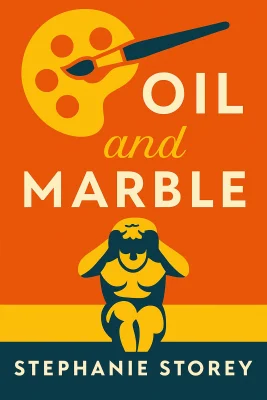
Oil and Marble
Categories
Fiction, Art, Audiobook, Historical Fiction, Book Club, Historical, Novels, Italy, Art History, Renaissance
Content Type
Book
Binding
Hardcover
Year
2016
Publisher
Arcade
Language
English
ISBN13
9781628726398
File Download
PDF | EPUB
Oil and Marble Plot Summary
Introduction
# Chisels and Brushes: The Immortal Rivalry That Forged Renaissance Genius The winter of 1499 brought devastation to two of Italy's greatest artists, though neither yet knew how their separate catastrophes would forge an immortal rivalry. In Milan's smoking ruins, Leonardo da Vinci watched French soldiers reduce his life's work to target practice, their burning arrows turning his magnificent clay horse into rubble. Twenty years of dreams crumbled in a single night as the master fled his adopted city, his patron overthrown, his legacy literally in flames. Meanwhile, in Rome's candlelit shadows, young Michelangelo Buonarroti knelt before his first masterpiece with hammer and chisel in hand. The Pietà gleamed in marble perfection, yet pilgrims whispered the wrong name, crediting his divine sculpture to a lesser artist. In that moment of triumph turned bitter, the young sculptor made a decision that would echo through eternity. Under cover of darkness, he would break into the Vatican itself and carve his name into the stone, claiming his rightful place among the immortals. Neither man could foresee that their paths would soon converge in Florence, where their mutual hatred would birth the two most iconic works of art in human history.
Chapter 1: Exiles Return: Two Masters Seek Redemption in Florence
Leonardo's hands trembled as cannon fire echoed through Milan's streets. Il Moro had returned with an army, and every Frenchman in the city faced death. Leonardo, who had served the French king after his patron fled, was now marked as a traitor. His assistant Salaì grabbed what they could carry as they prepared to abandon everything. In the piazza, Leonardo's clay horse lay shattered, its massive form reduced to fragments. A French soldier delivered the final blow with his sword, screaming curses as the monument crashed to earth. Leonardo stared at the ruins of his ambition. Four years of design work, countless nights dreaming of casting it in gleaming bronze, all destroyed in moments. They mounted their horses and galloped through Milan's gates into the wilderness. Behind them, the city burned. Ahead lay uncertainty. At fifty, Leonardo was running out of time to secure his legacy. The unfinished paintings, the abandoned sculptures, the theoretical inventions that existed only on paper. What would survive when he was gone? Meanwhile, Michelangelo pressed deeper into the shadows of St. Peter's Basilica, his heart pounding as he waited for the priest's footsteps to fade. He had broken into the Vatican with hammer and chisel, determined to correct history's mistake. For two years he had labored over the Pietà, forgetting to eat or sleep as he coaxed life from marble. When the unveiling came, the crowd fell to their knees in awe, but they credited his masterpiece to Gobbo, a mediocre sculptor from Milan. In the darkness, Michelangelo climbed onto his own creation. The Virgin Mary's serene face stared down at him as he positioned his chisel against her marble chest. Each blow echoed through the cavernous church as he carved the words that would ensure his immortality: "Michelangelo Buonarroti of Florence made this." When morning came and the cardinals discovered the signature etched forever in stone, the pope himself praised the work. It was time to return home to Florence, carrying both blessing and hard-won fame.
Chapter 2: The Contest for Stone: When Genius Meets Ambition
The meeting in Florence's cathedral workshop crackled with tension as thick as the marble dust coating every surface. Leonardo stood before the legendary Duccio Stone, his silk robes pristine despite the grime around him, while Michelangelo crouched beside the marble like a wolf guarding its kill. The massive block had defeated sculptors for forty years, its surface scarred with failed attempts and deep gouges. "You cannot seriously intend to work with this," Leonardo declared, his voice carrying the authority of decades at royal courts. He gestured dismissively at the stone's obvious flaws. "Look at these gouges, these amateur attempts. Any sculptor worth his salt would demand fresh marble from Carrara." Michelangelo's dark eyes flashed with something between rage and determination. "Perhaps that's the difference between us, old man. You see obstacles. I see opportunities." He pressed his palm against the deepest scar in the marble. "This wound will become David's hip, turned in contemplation before battle. What you call damage, I call destiny." The cathedral officials shifted uncomfortably as the two artists circled each other like gladiators. Leonardo's reputation preceded him, the brilliant inventor and court favorite who could paint angels so lifelike they seemed to breathe. But Michelangelo's recent Pietà had stunned even the most jaded critics, announcing the arrival of a new master. When the commission was awarded to the passionate youth willing to work without adding material, Leonardo swept from the workshop, his cape billowing like storm clouds. As his footsteps faded, Michelangelo was already reaching for his hammer and chisel. The real battle had only just begun.
Chapter 3: Divergent Paths: The Scientist and the Sculptor
While Michelangelo lost himself in the rhythmic pounding of hammer against chisel, Leonardo found himself drawn into Renaissance politics. Niccolò Machiavelli, Florence's cunning diplomat, approached him with an irresistible offer: design weapons for the republic, help divert the Arno River to strangle Pisa into submission, and reclaim his position as Florence's greatest mind. But Leonardo's true prize lay elsewhere. In the market square, he had encountered a silk merchant's wife whose mysterious smile haunted his dreams. Lisa Gherardini del Giocondo possessed something that eluded his scientific understanding, a quality of presence that seemed to shift like light on water. When her husband commissioned a portrait, Leonardo saw his chance to capture the uncapturable. In his new studio, Leonardo began the delicate dance of oil and canvas while across the city, Michelangelo waged war against stone. The sculptor had built a wooden shed around his marble, working in secret as David slowly emerged from his marble prison. Each strike of the chisel was a prayer, each carved muscle a testament to his unwavering faith. The contrast between their methods was stark as winter and summer. Leonardo approached his portrait with the patience of a scientist, mixing pigments with alchemical precision, building up layers of paint so thin they were barely visible. He studied Lisa's face like a map to be decoded, searching for mathematical principles that governed beauty itself. Michelangelo attacked his marble with the fury of a man possessed. He worked through nights by candlelight, his body becoming one with the rhythm of creation. Stone dust filled his lungs and coated his skin until he seemed carved from marble himself. Where Leonardo sought to understand, Michelangelo sought to become. As 1502 turned to 1503, both artists pushed deeper into their obsessions, unaware that their greatest trials still lay ahead.
Chapter 4: Crisis and Creation: Failure's Role in Masterpiece
The Arno struck back with the fury of a god denied. Leonardo's carefully calculated levees, designed to redirect the river's flow and starve Pisa into submission, crumbled under an unprecedented storm. The waters that were meant to flow gently into new channels instead exploded through Florence's streets like liquid vengeance, carrying away homes, livelihoods, and eighty human lives. Leonardo stood waist-deep in the churning flood, watching his engineering marvel transform into an instrument of destruction. Bodies floated past him in the muddy torrent, men who had trusted his calculations, families who had believed in his vision of controlling nature itself. Among them was Michelangelo's younger brother Buonarroto, pulled from the collapsed dam and barely breathing when his sculptor sibling dragged him to safety. The failure shattered something fundamental in Leonardo's understanding of himself. He was the man who claimed he could make rivers obey, who boasted of conquering the skies with mechanical wings. Now he was just another aging dreamer whose hubris had cost lives. In the aftermath, as Florence counted its dead and rebuilt its broken walls, Leonardo retreated to his studio and poured his anguish into the only thing that still made sense: Lisa's enigmatic face. Meanwhile, in his marble-dusted sanctuary, Michelangelo heard David's voice for the first time. It came not as words but as a whisper of stone against stone, a vibration that seemed to emanate from the sculpture's emerging heart. The psalm echoed through the shed as if spoken by the marble itself. David was no longer just a block of stone with human features. He had become something alive, something that breathed with Michelangelo's own breath and pulsed with his own blood. The sculptor could see him now in perfect clarity: not the triumphant boy-hero of tradition, but a man on the edge of battle, coiled with tension and terrible purpose. As Leonardo struggled with his demons, Michelangelo raced toward his destiny.
Chapter 5: The Lady and the Giant: Two Visions Take Form
In the spring of 1504, as Florence still bore scars from the great flood, two works of art neared completion that would outlive their creators by centuries. In his studio overlooking the city, Leonardo applied final gossamer layers of paint to Lisa's mysterious smile, while across town, Michelangelo polished David's marble skin to a luminous perfection that seemed to glow from within. Leonardo had discovered something profound in painting Lisa. She was more than just a merchant's wife posing for a portrait. She was every woman who had ever lived, every secret smile, every unspoken thought. He had painted her against an impossible landscape that existed only in dreams, a world of winding rivers and misty mountains that seemed to shift and breathe with her presence. Her hands, folded in perfect repose, held the weight of eternity. The real breakthrough came in her eyes. Leonardo had spent months perfecting their gaze, making them follow the viewer with supernatural intensity. They were the eyes of the Mona Lisa, and they would haunt humanity forever. Michelangelo faced a different challenge entirely. His David stood seventeen feet tall, a colossus of marble that had to be moved from the cathedral workshop to its destined place before the Palazzo della Signoria. The logistics were nightmarish: how do you transport a statue that weighs as much as a small building through narrow medieval streets without destroying it? The solution came in a moment of inspiration born from Leonardo's failure at the Arno. Instead of trying to make David immovable, Michelangelo would make him flexible. He designed a revolutionary transport system that suspended the statue in a rope cradle, allowing it to sway with the motion of the wooden platform beneath. Where rigid engineering had failed, adaptive design would succeed. As summer approached, both artists prepared for the moment when their creations would face the judgment of the world.
Chapter 6: Triumph Unveiled: Art That Transcends Time
The unveiling of David on September 8, 1504, transformed Florence into a city possessed. Every street leading to the Palazzo della Signoria overflowed with citizens who had come to witness the birth of a legend. When Michelangelo pulled the rope that dropped the black curtain from his creation, the roar that erupted from the crowd could be heard across the Tuscan hills. David stood naked and unashamed before his people, every muscle carved with anatomical perfection, every vein visible beneath his marble skin. But it was his face that stopped hearts: the expression of a man who knows he must fight but cannot know if he will survive. In that moment, every Florentine saw themselves reflected in David's anxious courage. He was not just a statue; he was the soul of the republic made manifest. As the crowd chanted and the great bell tolled for the first time in years, Michelangelo stood at David's feet and wept. He had given everything to this marble giant, his health, his family relationships, his very sanity, and in return, David had given him immortality. Meanwhile, Leonardo made a different kind of choice. When Francesco del Giocondo came to collect his wife's portrait, the artist looked at the small panel painting and realized he could not abandon Lisa to such a fate. "It is not finished," he declared, and walked away with the painting under his arm, leaving behind his most precious possession, a jeweled ring given to him by the King of France, as payment for his freedom. The Mona Lisa would never hang in that merchant's office. Instead, she would travel with Leonardo to France, where she would spend her final years in the chambers of kings. She was too mysterious, too alive, too perfect to belong to any one man. Like David, she belonged to the ages.
Chapter 7: Legacy Eternal: How Rivalry Became Immortality
In the end, both artists achieved a kind of immortality that neither had dared imagine. Their rivalry had pushed both men beyond their natural limits, forcing them to create works that transcended mere craftsmanship to become something approaching the divine. Leonardo, the aging master desperate to prove his relevance, had painted a portrait so psychologically complex it seemed to possess a soul. Michelangelo, the young sculptor burning with ambition, had carved a statue so lifelike it appeared ready to step down from its pedestal and walk among mortals. The two men never reconciled, never acknowledged the debt they owed each other. Leonardo would carry the Mona Lisa with him to France, where her enigmatic smile would launch a thousand theories and inspire countless pilgrimages. Michelangelo's David would become the ultimate symbol of human courage and artistic achievement, drawing millions to Florence to stand in awe before his marble perfection. But in the end, their mutual antagonism had given birth to masterpieces that would outlive empires and inspire generations yet unborn. In trying to destroy each other, they had instead created something eternal, proof that from the friction between great minds comes the spark that ignites human greatness. The rivalry between Leonardo and Michelangelo had ended not in victory for either, but in triumph for all humanity. Their hatred had become love, their competition had become creation, and their mortality had become immortal art.
Summary
The contest between Leonardo da Vinci and Michelangelo Buonarroti began in bitterness and exile, two masters returning to Florence with everything to prove and nothing left to lose. What emerged from their mutual hatred was something neither could have achieved alone: the Mona Lisa and David, twin monuments to human creativity that continue to inspire wonder five centuries later. Their rivalry demonstrated that greatness often emerges not from comfort and collaboration, but from the fierce friction of competing visions. The true victory belonged neither to the aging genius with his mysterious lady nor to the young sculptor with his marble giant. It belonged to art itself, elevated by their struggle into realms of perfection that seemed almost divine. In their desperate attempts to surpass each other, Leonardo and Michelangelo had instead transcended the boundaries of their own mortality, creating works that would speak to the human soul long after their creators had returned to dust. Their legacy reminds us that sometimes the greatest gifts to humanity emerge not from friendship, but from the sacred fire of rivalry that burns in the hearts of those who refuse to accept anything less than immortality.
Best Quote
“I think … the greater danger for most of us is not in aiming too high and falling short, but in aiming too low and hitting the mark.” ― Stephanie Storey, Oil and Marble: A Novel of Leonardo and Michelangelo
Review Summary
Strengths: The book is highly educational, providing fascinating historical facts about Leonardo Da Vinci and Michelangelo. The storyline, particularly Michelangelo's, is engaging and keeps the reader interested. The book offers substantial knowledge about the Renaissance period and the art pieces discussed. Weaknesses: The author is perceived as biased, favoring Michelangelo over Leonardo, and the writing style is not considered prize-worthy. The depiction of the artists in a good vs. evil narrative is seen as heavy-handed. Overall: The reader finds the book worthwhile and informative, especially for those unfamiliar with the artists. Despite some stylistic criticisms, it is recommended for its educational value and engaging content.
About Author

Stephanie Storey
Storey explores the intricate relationships between art, history, and human ambition, using her novels to illuminate the fascinating world of the Italian Renaissance. Her works dive into the lives of iconic artists like Leonardo da Vinci, Michelangelo, and Raphael, blending thorough historical research with vivid, engaging storytelling. Through novels such as "Oil and Marble" and "Raphael, Painter in Rome", she captures themes of creativity, rivalry, and the quest for an enduring legacy. Her books are celebrated for their rich sensory details and dramatic pacing, offering readers an immersive experience in historical settings.\n\nWhile Storey’s background as a television producer, with credits on shows like "The Arsenio Hall Show" and "The Writers’ Room with Jim Rash", complements her storytelling with a keen sense of narrative structure and audience engagement. Her shift from television to full-time writing was sparked by a pivotal trip to Italy, where her passion for art history inspired her literary career. Readers of her novels benefit from her ability to transport them to another era, providing both entertainment and education about the lives and artistic struggles of Renaissance figures.\n\nThe author’s work has received significant recognition, with "Oil and Marble" praised by "The New York Times" as “tremendously entertaining” and compared to the work of acclaimed historical fiction author Irving Stone. This book's development into a feature film further highlights its impact and appeal. Storey continues to engage audiences with her art historical novels, making her a compelling figure for those interested in the intersection of art, history, and fiction. Her literary contributions not only entertain but also offer insightful perspectives on the timeless pursuit of artistic excellence.
Read moreDownload PDF & EPUB
To save this Black List summary for later, download the free PDF and EPUB. You can print it out, or read offline at your convenience.

Oil and Marble
by Stephanie Storey
