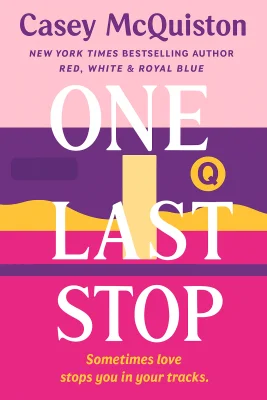
One Last Stop
Categories
Fiction, Science Fiction, Audiobook, Romance, Adult, Contemporary, LGBT, New Adult, Queer, Lesbian
Content Type
Book
Binding
Paperback
Year
2021
Publisher
Griffin
Language
English
ISBN13
9781250244499
File Download
PDF | EPUB
One Last Stop Plot Summary
Introduction
# Between Stations: A Love Story Across Time The Q train lurched through Brooklyn's underground arteries as August Landry clutched her coffee, steam rising from the cup like incense in the fluorescent-lit car. She was just another broke college student navigating New York's maze when disaster struck—hot liquid exploding across her shirt, passengers scattering, her dignity pooling on the subway floor. Then a voice cut through the chaos, offering salvation in the form of a paisley scarf. The stranger had dark hair, a leather jacket that looked decades old, and eyes that seemed to hold impossible secrets. August didn't know it yet, but she had just encountered Jane Su, a woman who shouldn't exist. Jane had been riding the Q line since 1977, trapped between moments after a fatal encounter with the electrified third rail during New York's great blackout. She appeared to passengers across decades—a ghost in leather who remembered fragments of a life lived forty years ago. But Jane had never stayed anchored to one person, one timeline, until August. Now, as their impossible love story unfolds in the spaces between stations, both women must confront a truth that defies physics: some connections transcend time itself, and some mysteries are worth risking everything to solve.
Chapter 1: The Girl on the Q Train: When Time Stands Still
The coffee explosion happened on a Tuesday morning, transforming August's commute into a disaster zone of scalding liquid and embarrassment. She pressed herself against the train doors, fighting tears as passengers stepped around her like she was debris. That's when the stranger appeared—moving with the fluid confidence of someone who belonged everywhere and nowhere. "Here." The woman unwound a scarf from her neck, offering it without hesitation. "It's clean." August accepted the lifeline, noting the stranger's vintage appearance. Everything about her seemed slightly out of focus, as if photographed through gauze. Her leather jacket bore the patina of decades, and when their fingers brushed during the exchange, static electricity jumped between them—not unusual on a dry winter morning, except the spark felt deliberate. "I'm Jane," she said, and her smile revealed a slightly crooked tooth that somehow made her more beautiful. "You smell like pancakes." The observation carried weight, as if Jane recognized something specific in that scent. Before August could respond, the train pulled into her station. She turned back as doors closed, catching Jane's enigmatic smile through the window. The scarf remained in her hands, soft and real and smelling faintly of cigarettes and mystery. Days passed before August saw Jane again. She found herself taking the Q line at different hours, scanning faces and searching for that particular shade of black hair. When Jane finally reappeared, she occupied the same seat as before, reading a paperback novel with yellowed pages. "You kept it," Jane observed, nodding at the scarf around August's neck. August slid into the adjacent seat, noting how other passengers seemed to look through Jane rather than at her. They talked about the city, about August's work at Billy's House of Pancakes, about the way New York could swallow newcomers whole. Jane spoke with the passion of someone who had lived through history rather than read about it, referencing events and places with startling specificity. But something was wrong. Jane's book was a romance novel from the 1970s. She didn't carry a phone, paid for nothing, and seemed confused by modern technology. When the train began to slow, Jane stood with fluid grace. "See you around, August from Louisiana," she said, disappearing into the crowd before August could ask how she knew her name.
Chapter 2: Fragments of Memory: Discovering the Impossible
August became a regular on the Q line, timing her commute to coincide with Jane's mysterious appearances. Their conversations developed rhythm—Jane's cryptic observations about the city, August's gradual revelation of her life in Brooklyn. Jane listened with the intensity of someone starved for human connection, asking detailed questions about August's roommates and coworkers as if memorizing details of a world she could only observe from a distance. The breakthrough came during a power outage that stranded their train in darkness. Emergency lighting cast everything in amber, and the usual subway sounds faded to silence. Other passengers grew restless, but Jane seemed almost relieved. "Finally," she murmured. "A moment of peace." When Jane reached for August's hand, the contact sent electricity through both their systems—not painful, but startling. Jane jerked back, eyes wide with something approaching fear. "I'm not entirely sure I'm supposed to be here," Jane whispered, staring at their hands. The confession hung between them like a challenge. August had grown up around mysteries, helping her mother chase cold cases and missing persons reports. She recognized the weight of secrets that demanded investigation. "Where are you supposed to be?" August asked quietly. Jane's smile carried infinite sadness. "That's the million-dollar question." August's detective instincts kicked into overdrive. She began documenting Jane's appearances, noting the anachronisms and impossibilities. Jane only appeared on the Q line, always wearing clothes that seemed decades out of date. She referenced events from the 1970s with vivid detail but seemed confused by smartphones and modern technology. The revelation came during a late-night research session. August found a photograph from a 1976 New York Magazine article about Brooklyn diners—and there in the background stood Jane, unmistakably Jane, serving coffee at Billy's House of Pancakes. The caption identified her as Biyu Su, age twenty-four. Cross-referencing the name with missing persons reports from 1977 yielded the impossible truth. Biyu Su had vanished during the great blackout, last seen in Coney Island. No body was ever found. The case went cold within months. But Jane wasn't gone. She was trapped, existing in some impossible space between past and present, riding the same subway line where she had disappeared forty years ago.
Chapter 3: Echoes of the Past: Augie's Ghost and Family Secrets
When August confronted Jane with the photograph, the other woman's composure finally cracked. Her story emerged in fragments—the night of July 13, 1977, a farewell drink at Coney Island, too much beer, and a stumble onto the subway tracks. She remembered falling toward the electrified third rail just as the city plunged into darkness. "I should have died," Jane said simply. "Instead, I got stuck between seconds, riding the same route over and over. Until you." But the mystery deepened when August discovered Jane's connection to her own family history. In her mother's obsessive files about her missing brother Augie, August found a postcard sent from California in 1977—after he supposedly disappeared. The message mentioned someone named Jane who had helped him through dark times in New Orleans. The pieces clicked into place with devastating clarity. Jane described her life before New York—the months she'd spent in New Orleans, sharing an apartment with a sweet guy named Augie who worked at a gay bar called the UpStairs Lounge. August's uncle, the family ghost who vanished in 1973, had been Jane's roommate and friend. "He talked about his little sister all the time," Jane remembered, tears streaming down her face. "Showed me pictures of this brilliant little girl with wild hair and green eyes. He was saving money to buy her an encyclopedia set." August realized she was holding her breath. The uncle she'd never known had been planning to return to their family, had been thinking of her even as he built a new life far from Louisiana's suffocating expectations. He hadn't died in the UpStairs Lounge fire—he'd escaped, traumatized and guilt-ridden, eventually making his way to California. Jane described the phone call that brought her to New York—Augie reaching out from California, sober and in love, encouraging her to go home to her own family. He'd found peace, she said, but died in a car accident just weeks after they spoke. The revelation reframed everything. August wasn't just investigating a missing person case—she was uncovering the lost connections between two families torn apart by time and circumstance. Jane represented the final link to understanding what happened to Augie, while August offered Jane her first real human connection in decades.
Chapter 4: Racing Against Time: The Q Line Closure
The notice appeared without warning—the Q line would close for renovations from September through October. Two months without access to Jane, two months during which the girl who had no anchor to the present might drift away entirely. August had seen what happened when Jane went too long without human connection—she became translucent, her memories fading like old photographs left in sunlight. August's roommate Myla, an electrical engineer turned sculptor, theorized that Jane was caught between dimensions, a temporal refugee displaced by some catastrophic event. She existed in the spaces between moments, visible to those tuned to the right frequency but unable to step off the train that had become both her prison and sanctuary. "Every time you touch her, every feeling you generate together, it creates electrical impulses that make her more real," Myla explained, sketching diagrams on their kitchen whiteboard. "But it also keeps her trapped here." The theory offered hope and heartbreak in equal measure. If they could recreate the electrical event that had displaced Jane, they might be able to reverse it. But success would likely mean losing her—either to the 1970s where she belonged, or to oblivion if the process went wrong. August threw herself into research, mapping Jane's final months in New York, searching for clues about what had happened on the Q line in 1977. She broke into Billy's archives, interviewed former employees, traced Jane's movements through the city. The work became obsessive, driven by love and desperation in equal measure. But the approaching September deadline loomed over everything. When the Q line closed for renovations, Jane would lose her anchor to this timeline. Without August's regular presence, she would fade back into the temporal drift that had claimed her for forty years. The plan they devised was audacious and probably illegal. They would access the subway's electrical control systems, recreate the conditions of the 1977 blackout on a smaller scale, and hope that a second surge would either send Jane back to her proper time or anchor her permanently in the present.
Chapter 5: Electric Hearts: Love in the Space Between Moments
Their relationship deepened despite the temporal constraints. They made love in empty subway cars, stealing moments between stations, creating intimacy in the most public of spaces. Jane's touch made August feel more alive than she'd ever been, while August's presence gave Jane substance and reality she'd lost decades ago. Standing on the narrow platform between subway cars, wind whipping through the tunnel around them, August finally understood what Jane had been trying to show her. This was what it felt like to exist in the spaces between—dangerous, exhilarating, completely alive. The rails rushed past beneath their feet, close enough to kill them both, but Jane stood steady as a lighthouse. "This is how I feel all the time," Jane shouted over the roar of the train. "Like I'm balanced on the edge of something, never quite falling but never quite safe either." August looked into her eyes and saw not just the confident girl who'd rescued her that first morning, but someone who'd been holding herself together through sheer force of will, someone who'd been alone for longer than anyone should have to be. They made it back inside as the train pulled into the next station, breathless and laughing, August's heart pounding with more than just adrenaline. She was falling in love with a girl who existed outside of time, who might disappear at any moment, who represented everything August had spent her life avoiding—mystery, uncertainty, the kind of connection that could destroy you when it ended. But as Jane pulled her close, as the city rushed past the windows and the future stretched out uncertain before them, August realized she didn't care about the impossibility of it all. For the first time in her life, she was exactly where she belonged—in the space between one moment and the next, suspended in time with the girl who had taught her that some mysteries were worth getting lost in. "I love you," August whispered against Jane's neck, tasting salt and electricity. Jane's response was a kiss that burned like lightning. "I love you too. But loving someone means wanting what's best for them, even if it breaks your heart." They both knew what she meant. Jane deserved the chance to return to her family, to live the life she was meant to have. August deserved someone who could exist fully in her world, not a ghost sustained by subway voltage and impossible circumstances.
Chapter 6: The Experiment: Risking Everything for Freedom
The cover story came together organically—a benefit concert for Billy's House of Pancakes, which was facing closure due to rising rents. They would hold the event at the electrical substation, disguised as an avant-garde venue choice. August's coworkers threw themselves into planning with the enthusiasm of people who'd found a cause worth fighting for. But as the date approached, August found herself paralyzed by conflicting desires. She wanted Jane to be free, to have the life that was stolen from her. But she also wanted Jane to stay, to build something real together in the present. The selfishness of that desire made her sick with guilt. The night of the benefit arrived with the weight of finality. Drag queens performed on a makeshift stage while August's chosen family celebrated around them, but she and Jane prepared for what might be their last moments together. The plan was simple in theory—Jane would position herself on the third rail while Myla overloaded the system, recreating the electrical conditions that had displaced her originally. "Whatever happens," Jane said, gripping August's hands as they stood on the subway platform, "thank you for seeing me. For making me real again." August wanted to beg her to stay, to choose love over the unknown. Instead, she kissed Jane with everything she had, pouring forty years of longing and hope into the contact. The taste of tears and electricity filled her mouth as Jane's lips moved against hers with desperate hunger. Myla's voice echoed through the tunnel, counting down the seconds until the surge. Jane stepped toward the third rail, her leather jacket catching the emergency lighting like armor. She looked back once, her eyes finding August's across the platform. "I'll find you," Jane called out, her voice barely audible over the growing electrical hum. "Somehow, I'll find you." When Myla threw the switch, electricity arced through the tunnel like captured lightning. August felt Jane slip away like smoke, leaving only the echo of her touch and the memory of impossible love. The silence that followed was deafening, broken only by the sound of August's heart shattering against her ribs.
Chapter 7: After the Silence: Loss and the Weight of Impossible Love
August spent three months in a grief that felt like drowning. She continued working at Billy's, went through the motions of finishing her degree, but part of her remained frozen on that subway platform, waiting for someone who would never return. Her roommates tried to help, but how do you comfort someone mourning a love that technically never existed? The only solace came from the knowledge that she'd solved two mysteries. Her research into Jane's past had led her to Augie's story, giving her mother the closure she'd sought for decades. The missing persons case that had defined Suzette Landry's life was finally closed, freeing both women from the weight of unanswered questions. But August couldn't shake the feeling that something was unfinished. Jane's disappearance felt too abrupt, too final. She found herself taking the Q line at odd hours, searching faces and listening for familiar laughter. The rational part of her mind knew it was futile, but hope was a stubborn thing. Billy's had been saved by an anonymous donation—enough money to buy out their lease and secure the diner's future. The staff celebrated their good fortune, but August felt hollow inside, unable to share their joy. Everything reminded her of Jane—the coffee machine that sparked when it overheated, the vintage music on the radio, the empty seat on the Q train where impossible love had bloomed. She threw herself into work, helping other families find their missing pieces. Each case was a distraction from her own loss, a way to channel her investigative skills into something productive. But late at night, alone in her apartment, August would stare at the paisley scarf Jane had given her and wonder if love could truly transcend time, or if she'd simply been fooling herself with fairy tales. The city moved on around her, indifferent to her grief. New students arrived at Brooklyn College, new passengers filled the Q train, new stories began in the spaces where hers had ended. August learned to smile again, to laugh at her roommates' jokes, to pretend that her heart wasn't permanently broken. But she never stopped listening for the sound of leather against subway seats, never stopped hoping for miracles.
Chapter 8: Homeward Bound: Building Tomorrow from Yesterday's Dreams
The miracle happened on a Saturday afternoon in November. August was at Billy's, helping celebrate the diner's salvation, when the door chimes announced a new arrival. She looked up from wiping tables and felt her heart stop. Jane stood in the doorway, looking exactly as she had the day they met. Same leather jacket, same crooked smile, same impossible presence that made the air shimmer with possibility. But there was something different in her eyes—a solidity, a permanence that hadn't been there before. "Hi," Jane said, as if three months hadn't passed, as if she hadn't been torn from August's life and flung across decades. "I was hoping I'd find you here." August crossed the diner in seconds, not caring who saw her desperation. When she touched Jane's face, her skin was warm and real and absolutely present. No electrical shock, no sense of temporal displacement. Just Jane, solid and breathing and somehow, impossibly, here. Jane's explanation came in fragments. The electrical surge hadn't sent her back to 1977—it had knocked her sideways through time, depositing her in an alley three months later with no memory of the intervening period. She'd been searching for August ever since, following half-remembered directions to the diner where their story began. "I think I was never supposed to go back," Jane said, her forehead pressed against August's. "I was supposed to be here, with you. The electricity didn't trap me—it was keeping me safe until you could find me." August didn't question the logic. Some things were too precious to examine too closely. Jane was here, solid and real and choosing to stay. That was miracle enough for any lifetime. They rebuilt their life together in the spaces between what was and what could be. Jane found work at a vintage record store, her knowledge of decades past making her invaluable to collectors and music lovers. August's investigation service thrived, helping other families find their missing pieces while she treasured the one she'd found. Six months later, they boarded a Greyhound bus bound for San Francisco. August had convinced Jane to reconnect with the family she'd left behind in 1977. Through careful research and delicate inquiries, August had confirmed that Jane's parents were still alive, that her sisters had built lives and families of their own. "They think I'm dead," Jane said as the bus pulled away from New York's skyline. "How do I explain where I've been?" August squeezed her hand, noting the new tattoo on Jane's wrist—a small bridge to match the one August had gotten on her ankle. Symbols of the connection that brought them together and the journey that lay ahead. "We'll figure it out," August said. "Maybe you tell them the truth. Maybe you create a new story. The important thing is that you get the chance to choose."
Summary
The bus rolled west through America's heartland, carrying two women whose love story defied every law of physics and probability. August watched Jane sleep against her shoulder and thought about the impossibility of their meeting—how many variables had to align perfectly for a girl from Louisiana to find a woman displaced from the 1970s on a Brooklyn subway train. But perhaps that's what love is—the universe's way of correcting its mistakes, bringing together souls that belong with each other regardless of time or circumstance. Their story became legend among their chosen family at Billy's, a reminder that love is archaeology—the patient work of uncovering what was always meant to be found. Jane chose both worlds in the end, reconnecting with her birth family through carefully constructed half-truths while building her future with August in Brooklyn. They proved that some connections endure beyond reason, that the most beautiful stories are often the ones that shouldn't be possible at all. In a world that often feels broken beyond repair, August and Jane discovered that love finds a way, that time is just another obstacle to overcome, and that sometimes the greatest mysteries aren't meant to be solved but lived fully in all their impossible glory.
Best Quote
“But, you know, that feeling? When you wake up in the morning and you have somebody to think about? Somewhere for hope to go? It's good. Even when it's bad, it's good.” ― Casey McQuiston, One Last Stop
About Author

Casey McQuiston
McQuiston interrogates modern romance through a queer lens, crafting narratives that blend humor with explorations of identity and politics. Their books are celebrated for weaving together romantic comedy and themes of self-discovery and inclusivity, all while highlighting nonbinary and bisexual experiences. For instance, McQuiston's early book, "Red, White & Royal Blue", delves into the romantic escapades of a bi son of the first female American president and the Prince of Wales, reflecting their knack for combining engaging storylines with political undertones.\n\nCentral to McQuiston's writing method is the incorporation of diverse characters and the complexities of contemporary relationships. Their novels often serve as an escape into joyful and offbeat worlds that challenge societal expectations, such as in "One Last Stop", where a time-traveling bi detective navigates love and identity. This emphasis on emotional connection ensures that McQuiston’s work resonates deeply with readers seeking both entertainment and meaningful representation. Moreover, with contributions to esteemed publications like "The New York Times", their impact extends beyond fiction, enriching discussions around queer identities.\n\nReaders of McQuiston’s novels gain not only enjoyment but also insight into the multifaceted nature of modern love and identity. By winning awards like the Goodreads Choice Award and appearing on the "Time100 Next List", their work has been acknowledged for its significance in contemporary literature. As an author whose bio reflects a blend of personal and professional influences, McQuiston's storytelling remains a vital part of queer literature today.
Read moreDownload PDF & EPUB
To save this Black List summary for later, download the free PDF and EPUB. You can print it out, or read offline at your convenience.

One Last Stop
by Casey McQuiston
