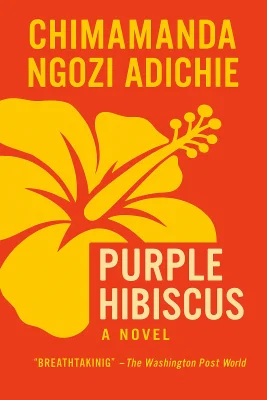
Purple Hibiscus
Categories
Fiction, Historical Fiction, Africa, School, Book Club, Contemporary, Novels, Nigeria, African Literature, Literary Fiction
Content Type
Book
Binding
Paperback
Year
2012
Publisher
Algonquin Books
Language
English
ISBN13
9781616202415
File Download
PDF | EPUB
Purple Hibiscus Plot Summary
Introduction
In the suffocating luxury of a Nigerian mansion, fifteen-year-old Kambili Achike speaks only in whispers. Her father Eugene—Papa to his children—is a newspaper publisher who fights corruption in public while ruling his family with the precision of a tyrant. Behind marble floors and crystal chandeliers, a different kind of violence unfolds. Papa's love comes wrapped in scalding tea and blistering sermons, his protection delivered through locked doors and rigid schedules. Kambili and her seventeen-year-old brother Jaja navigate this world of fearful silence, where speaking out of turn might shatter more than just the porcelain figurines on Mama's polished shelves. When their aunt Ifeoma arrives from the university town of Nsukka with her raucous children, she brings something dangerous into their controlled world: laughter. Her small, chaotic home overflows with purple hibiscus flowers and heated political debates. For the first time, Kambili tastes freedom—and discovers that love doesn't have to hurt. But as Nigeria's military dictatorship tightens its grip and Papa's enemies close in, the Achike family faces a choice between survival and truth. In a country where speaking out can mean death, sometimes the most radical act is learning to use your voice.
Chapter 1: The Shattered Sanctuary: Life Under Papa's Rule
The first crack appeared on Palm Sunday, when Jaja refused communion. The heavy missal flew across the dining room like a leather-bound judgment, exploding the porcelain dancers into a thousand glittering fragments. Kambili watched from the doorway as Papa's face swelled with fury, his cheeks mottled like overripe fruit. The silence that followed was different—brittle and sharp-edged, cutting through the familiar rhythm of their controlled lives. Eugene Achike owned newspapers, factories, and the souls of everyone under his roof. His children spoke in whispers, moved like ghosts through their marble palace, and measured their days in scheduled prayers and study sessions. Papa's love was a burning thing—literally. Kambili still remembered the scalding water on her feet, punishment for eating before Mass. "This is what you do to yourself when you walk into sin," he had said, tears streaming down his face as he poured. Mama cleaned up the broken figurines with her bare hands, blood seeping from tiny cuts. Her face bore fresh bruises, purple-black shadows that she claimed came from allergies. She polished those dancers obsessively after each "accident," each night Papa's fists reminded her of her place. The servants whispered about the sounds from upstairs, but no one dared speak above a murmur in Papa's house. The schedules ruled everything. Prayer at dawn, breakfast at seven-fifteen, study until lunch, more prayer, more study. Every minute accounted for, every breath measured. Jaja had always been the perfect son, the one who made Papa's eyes crinkle with pride. But something had shifted in him during their recent visit to their grandfather, something that made him look at Papa with new eyes—eyes that no longer reflected worship. When the figurines shattered, Kambili knew their old life was ending. The pieces on the floor were sharp enough to draw blood, but not sharp enough to cut through the ties that bound them to this house of beautiful terrors.
Chapter 2: Whispers Behind Walls: The Facade of Perfection
The school girls called Kambili a "backyard snob," but she couldn't explain that speaking felt like swallowing glass. At Daughters of the Immaculate Heart, she sat in the front row and watched her classmates chatter freely, their voices light as birdsong. When Mother Lucy called on her to lead the pledge, the words stuck in her throat like wet cement. The other girls giggled behind their hands, thinking she was proud. They didn't know that pride was a luxury she couldn't afford. Eugene Achike was Nigeria's golden son in public—the publisher who dared to print the truth, the businessman who funded orphanages and hospitals. White priests praised him from the pulpit, calling him a true Christian soldier. When his editor Ade Coker was arrested for investigating government corruption, Papa moved heaven and earth to free him. The Standard newspaper's bold headlines made him a hero to democracy advocates across the country. But heroes cast long shadows. At home, Papa's righteousness demanded perfection from his family. Second place in school meant failure. Speaking Igbo meant losing civilization. Any crack in their Christian facade brought swift correction. Kambili learned to hold her breath during Papa's prayers, learned to taste his love in the scalding tea he shared with his children, learned to see devotion in the bruises that bloomed on Mama's arms like dark flowers. The house itself seemed to hold its breath. Marble floors so polished they reflected prayer, windows so clean they were invisible, air that moved in whispers through rooms where laughter was suspect. The compound walls topped with electric wire kept the world out—and them in. Even the hibiscus flowers in the front yard were regimented, planted in precise rows, their red blooms obedient and uniform. When government agents came to intimidate Papa, Kambili watched from her bedroom window as they crushed the perfect flowers under their boots. The petals scattered like drops of blood across the manicured lawn. Papa stood firm, refusing their bribes, sending them away with righteous fury. That night, as he prayed longer and louder than usual, Kambili wondered if courage always had to feel so much like fear.
Chapter 3: Seeds of Awakening: The Journey to Nsukka
Aunty Ifeoma arrived like a whirlwind in the sterile calm of their home, her laughter too loud, her children too wild, her questions too direct. She was Papa's sister but seemed carved from different clay—tall where he was broad, laughing where he was stern, questioning where he demanded obedience. Her university professor's salary barely fed her three children, yet she radiated a wealth that had nothing to do with money. When she invited Kambili and Jaja to visit her in Nsukka, Papa's resistance crumbled under careful negotiation. A pilgrimage to Aokpe, where the Virgin Mary was said to appear, provided the holy cover needed. Kevin, their driver, packed yams and rice and cooking gas—supplies that revealed the poverty Aunty Ifeoma would never admit to. The drive to the university town felt like crossing into a different country, one where the rules hadn't been written yet. Their cousins greeted them with suspicious eyes and sarcastic comments. Amaka, fifteen like Kambili, painted watercolors and listened to Fela Kuti, her short hair natural and her opinions sharper than any knife. She called Kambili a snob without malice, simply stating facts as she saw them. Obiora, fourteen but wise as an ancient, pushed his glasses up his nose and quoted books that would have been banned in Papa's house. Seven-year-old Chima bounced between them all like a rubber ball, collecting laughter and scattering joy. The flat itself was a revelation—three cramped rooms where seven people lived with more happiness than Kambili had ever seen. Water ran only in the mornings, so they fetched it in buckets. The electricity failed constantly, so they gathered around kerosene lamps. The food was simple, stretched to feed everyone, but seasoned with conversation that sparkled like wine. Here, children argued with adults and adults listened. Here, mistakes were corrected with laughter instead of blows. On their first night, as Kambili lay on a thin mattress listening to Amaka breathe beside her, she felt something strange blooming in her chest. It was dangerous and beautiful, this feeling—the first taste of a world where her voice might matter, where speaking didn't require permission, where love didn't have to hurt.
Chapter 4: Blooming Defiance: New Voices, New Visions
The purple hibiscus grew wild in Aunty Ifeoma's garden, its unusual color a defiant splash against the ordered world Kambili had always known. These flowers bloomed without permission, their petals the color of royalty and rebellion. Jaja knelt in the red dirt, his school uniform abandoned for the first time in his life, his hands gentle with the experimental plants that Aunty Ifeoma's botanist friend had created. Father Amadi appeared like an answer to prayers Kambili hadn't known she was praying. Young and beautiful, with skin like fired clay and a smile that made her forget she was supposed to be afraid of wanting things, he coached football and asked dangerous questions. When he took her running at the university stadium, her legs found their strength for the first time. "You have good legs for running," he told her, and the compliment burned sweeter than her father's scalding tea. In this house, Papa-Nnukwu was not a heathen to be avoided but a grandfather to be cherished. The old man, bent with age and nearly blind, told stories that made the children laugh until their sides ached. His morning prayers to traditional gods scandalized Kambili's Catholic training, yet when she watched him greet the dawn with grateful words, she saw something achingly familiar—the same desperate love that drove her father's midnight devotions. Amaka painted her grandfather while he told stories of tortoise and trickery, her brush capturing the gentle dignity that Papa's religion had taught Kambili to despise. The watercolor portrait revealed not a devil-worshipper but a man who had raised his children with empty pockets and a full heart. His thin frame held the accumulated wisdom of eight decades, his clouded eyes reflected a different kind of faith. When Papa-Nnukwu died peacefully in his sleep, Kambili felt something tear inside her chest. The old man's death became a battlefield where love and doctrine collided. Papa arrived to collect his children, his face ravaged by strange rashes, his certainty cracking at the edges. He would pay for a Catholic funeral but not for pagan mourning rituals. Love, Kambili was learning, could be the cruelest cage of all.
Chapter 5: The Storm Breaks: Truth and Consequences
The regime struck back with letter bombs and midnight arrests. Ade Coker, Papa's brave editor, was obliterated at his breakfast table while his children watched their cornflakes turn red with their father's blood. The explosion shattered more than glass—it broke Papa's faith in his own righteousness, left him sobbing like a child in Mama's arms, wondering if speaking truth was worth the innocent blood on his hands. Kambili returned from Nsukka changed, her voice still quiet but her silence no longer submission. She carried Amaka's painting of Papa-Nnukwu hidden in her school bag like a secret rebellion. When Papa found it, his rage was biblical in its intensity. The belt fell like rain, each blow accompanied by tears and prayers for her salvation. She curled around the torn fragments of the painting, protecting the scattered pieces of her grandfather's memory with her own bleeding body. The physical wounds healed in the hospital, but something deeper had broken. Jaja no longer cowered during Papa's sermons. He ate meals in defiant silence, locked his bedroom door with furniture barricades, refused to participate in the performances of perfect Christian family life. His shoulders, once broad with pride, now carried a burden that aged him beyond his seventeen years. Father Amadi's letters from Germany became Kambili's secret scripture, each one a reminder that love didn't have to hurt, that faith could exist without fear. His words taught her that she was worthy of tenderness, that the bruises on her mother's face were not the price of devotion but the currency of terror. When he wrote that she could do anything she wanted, the words rewrote something fundamental in her understanding of herself. Nigeria itself seemed to be breaking apart. Student riots burned through university campuses, government soldiers raided newspaper offices, and men in dark suits made people disappear for asking inconvenient questions. In their marble house, the Achike family's private war mirrored the country's larger struggle between truth and power, between love and control.
Chapter 6: Poisoned Roots: The Fall of the Patriarch
The poison was subtle as whispered prayers, hidden in the morning tea that had always been Papa's communion with his children. Mama moved through her daily routines like a sleepwalker, but her hands were steady as she measured death into delicate china cups. Sisi, their house girl, had procured the substance from her uncle's traditional remedies—old Africa poisoning new Christianity, one careful sip at a time. Papa never suspected. The rashes spread across his face like a map of his crumbling empire, but he attributed them to stress, to the burden of fighting for Nigeria's soul. His hands shook as he drank his beloved tea, never tasting the bitter justice dissolving in the familiar sweetness. He grew thinner, weaker, his powerful frame collapsing inward like a building whose foundation had been quietly removed. When they found him at his desk, slumped over the newspaper that had been his life's work, the autopsy revealed what Mama had known for months. But she felt no triumph, only the hollow exhaustion of a woman who had finally found a way to protect what remained of her family. The police came with their questions and their certainty, but Jaja stepped forward with his confession, claiming responsibility for the crime his mother had committed. The boy who had never lied took this final lie upon himself like a burden he had always been meant to carry. His shoulders, which had bloomed so beautifully in Aunty Ifeoma's garden, bent under the weight of sacrifice. He would go to prison, he would carry Papa's death as his own doing, he would spare his mother the price of her desperate courage. Kambili watched her brother disappear into the police car and knew that freedom always comes at a cost. The purple hibiscus cuttings he had planted were taking root in their front yard, their unusual blooms a promise that beauty could grow from the strangest soil. But Jaja would not see them flower. He had chosen to become the shield that protected them all from the consequences of their father's love.
Chapter 7: Freedom's Price: Sacrifice and Redemption
Three years pass like a slow-healing wound. Jaja sits in overcrowded prison cells where men sleep standing up and toilets are plastic bags shared among strangers. His shoulders have sagged under the weight of his false confession, but his eyes hold no regret. He has become what Papa always wanted him to be—a protector, a sacrifice, a son willing to die for love. Kambili visits him every week, carrying fruits and letters from America where Aunty Ifeoma struggles to build a new life. In her cramped apartment, she works two jobs and dreams of Nigerian mangoes while her children grow fat on abundance but thin on laughter. Amaka writes bitter letters about a country where nobody has time for joy, where prosperity tastes like exile. Mama has learned to speak above whispers, though her words often trail off into silence. She ties her wrapper loose around her shrinking frame and tells anyone who will listen that she killed her husband, that she put poison in his tea. But Nigeria has moved on from Eugene Achike's martyrdom. The newspapers that once celebrated him now focus on new heroes and fresher scandals. Even saints are quickly forgotten in a country drunk on its own tragedy. When the military government finally falls, democracy promises to free political prisoners like Jaja. The lawyers write his name on lists of conscience, filing papers that might return him to a world he no longer recognizes. Kambili carries Father Amadi's letters like prayers, each one reminding her that love persists across continents, that some bonds survive even the cruelest separations. The purple hibiscus finally blooms in their front yard, its impossible color proof that beautiful things can grow from poisoned soil. Kambili tends them carefully, these flowers that would never have existed without her aunt's rebellion, her grandfather's stories, her brother's sacrifice. They are the color of royalty and bruises, of faith and defiance, of all the things that Papa's love could never understand.
Summary
In the end, freedom is not the absence of cages but the courage to name them. Kambili's voice grows stronger with each prison visit, each letter from abroad, each day spent learning to exist without fear. She knows now that love can be gentle, that faith can question, that strength sometimes wears the face of quiet rebellion. Her mother's poison was not murder but mercy—the final act of a woman who chose her children's future over her husband's righteousness. The purple hibiscus continues to bloom, its unusual beauty a reminder that the most extraordinary flowers grow from the most unlikely soil. Nigeria itself struggles toward its own uncertain flowering, learning to live with the scars of its violent love affair with power. And somewhere in the space between silence and speech, between submission and rebellion, a young woman discovers that her voice—when she finally chooses to use it—can shatter cages that once seemed unbreakable. The price of freedom is always blood, but sometimes the payment buys exactly what it promises: a chance to breathe freely under purple skies.
Best Quote
“There are people, she once wrote, who think that we cannot rule ourselves because the few times we tried, we failed, as if all the others who rule themselves today got it right the first time. It is like telling a crawling baby who tries to walk, and then falls back on his buttocks, to stay there. As if the adults walking past him did not all crawl, once.” ― Chimamanda Ngozi Adichie, Purple Hibiscus
Review Summary
Strengths: The review highlights Adichie's ability to convey oppression without explicitly stating it, creating a powerful atmosphere through detailed storytelling. The narrative is described as tight, concise, and populated with complex characters. The balance between oppressive themes and moments of joy is praised, as is the simplicity and craftsmanship of the writing. The protagonist, Kambili, is compared to Celie from 'The Color Purple,' emphasizing her purity and fragility. Weaknesses: The review suggests a need for more doubt in Adichie's writing, implying that the certainty in her narrative might limit its depth. Overall: The reviewer expresses admiration for Adichie's debut, appreciating the nuanced portrayal of patriarchy and the compelling character development. The book is recommended for its strong voice and emotional impact, despite the reader's unfamiliarity with Nigerian culture.
About Author

Chimamanda Ngozi Adichie
Adichie reframes the narratives of postcolonial identity and gender through her compelling works, intertwining personal and historical perspectives to challenge societal norms. Her novels, such as "Purple Hibiscus" and "Half of a Yellow Sun," not only explore complex themes of religion and culture but also vividly depict the struggles of Nigerian history, including the Biafran War. Meanwhile, "Americanah" delves into the intricacies of race and belonging, illustrating the immigrant experience with nuanced clarity. Through her writing, Adichie employs a style that merges Igbo cultural elements with Western literary techniques, influenced by authors like Chinua Achebe, thus offering readers a richly textured tapestry of ideas.\n\nMoreover, Adichie's impact extends beyond her books; her eloquent essays, including "We Should All Be Feminists," have become pivotal in contemporary feminist discourse. Her TED Talks, notably "The Danger of a Single Story," underscore the perils of cultural stereotyping, resonating with audiences globally. As a celebrated author, she continues to engage readers and thinkers, fostering introspection and dialogue on identity and empowerment. This bio captures Adichie’s essence, revealing how her incisive social commentary and storytelling make her an influential voice in literature and beyond.\n\nRecognition of Adichie’s work is reflected in numerous awards, including the MacArthur Fellowship and the National Book Critics Circle Award. Her influence is further validated by her participation in prestigious academic fellowships and her involvement in cultural discussions worldwide. Adichie's literary contributions provide an invaluable perspective, making her works essential reading for those interested in themes of identity, feminism, and the immigrant experience. Her ability to synthesize personal narratives with broader societal issues ensures her place as a key figure in the cultural and literary landscape.
Read moreDownload PDF & EPUB
To save this Black List summary for later, download the free PDF and EPUB. You can print it out, or read offline at your convenience.
Purple Hibiscus
by Chimamanda Ngozi Adichie
