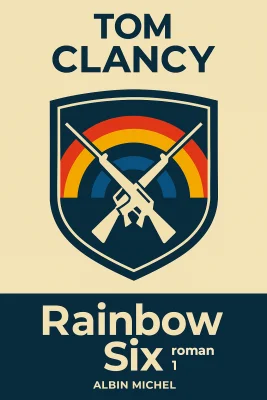
Rainbow Six, Book 1
Categories
Fiction, Audiobook, Military Fiction, Thriller, Novels, War, Espionage, Mystery Thriller, Spy Thriller
Content Type
Book
Binding
Paperback
Year
1999
Publisher
ALBIN MICHEL
Language
English
ISBN13
9782226110602
File Download
PDF | EPUB
Rainbow Six, Book 1 Plot Summary
Introduction
# Rainbow Six: Shadows of Global Extinction In the sterile corridors of a Kansas laboratory, Dr. John Killgore watched his latest test subject die from the Shiva virus—a genetically engineered plague designed to reduce humanity to a manageable few thousand survivors. The homeless man's body convulsed as hemorrhagic fever consumed him from within, another casualty in what the doctor believed was humanity's necessary salvation. Miles away, in the English countryside of Hereford, John Clark commanded Rainbow, an elite multinational counterterrorism unit that had just eliminated ten terrorists at a Spanish theme park with surgical precision. Neither man knew their fates were intertwined by a conspiracy that would use terror as camouflage for the greatest act of genocide in human history. The shadow war had already begun. Across Europe, dormant terrorist cells awakened with fresh funding and precise intelligence, striking targets that seemed random but followed a careful pattern. Each attack brought Rainbow's black-clad operators swooping down like avenging angels, their suppressed weapons coughing death in sterile efficiency. But someone was pulling strings from the darkness, orchestrating both the terror and the response, building toward a crescendo that would make their greatest victory humanity's final defeat.
Chapter 1: Birth of the Rainbow: Elite Response to Rising Terror
The Boeing 777 cut through Atlantic darkness as John Clark pressed his weathered face against the window, watching endless black water roll beneath them. Thirty years of CIA fieldwork had taught the former Navy SEAL to trust his instincts, and something felt wrong about this flight to London. The cold sensation crawling up his neck had nothing to do with cabin temperature. Beside him, his wife Sandy remained absorbed in her mystery novel while their daughter Patsy dozed against her husband Domingo Chavez, the young operator who'd become like a son to Clark through years of dangerous missions. They were traveling to establish Rainbow, a multinational counterterrorism unit that would operate in the shadows beyond normal military channels. The irony wasn't lost on Clark that danger might find them before they even reached their destination. His hand moved instinctively toward where his sidearm should be, then stopped. He'd made the rookie mistake of stowing his weapon in the overhead compartment, beyond reach in a crisis. The first test came sooner than expected. At Bern Commercial Bank, three former Baader-Meinhof terrorists burst through glass doors with Czech assault rifles, taking hostages and demanding the release of imprisoned comrades. Ernst Model, their leader, had emerged from years of hiding with revolutionary fire still burning in his chest. What he didn't know was that his operation had been orchestrated by Dmitriy Popov, a former KGB operative now working for mysterious American employers who watched from across the street as police cordoned off the area. When Model executed a hostage on the sidewalk in a moment of rage, everything changed. Black-clad figures materialized from the shadows like death itself. Flash-bang grenades shattered the bank's windows in blinding explosions. Rainbow's counterterrorism team moved with mechanical precision, their suppressed weapons coughing quietly as they eliminated all three terrorists. The marble floors ran red, but the hostages lived, and the world had witnessed the birth of something new and terrible in the war against terror.
Chapter 2: Puppet Strings: The Orchestrated Campaign of Violence
Dmitriy Popov counted his payment in a Manhattan office tower, each bill representing another step in a dance whose choreography remained hidden from him. The former KGB colonel had spent his career reading people, understanding their motivations, exploiting their weaknesses. But his new employer, billionaire John Brightling, remained an enigma wrapped in expensive suits and corporate power. The man showed no disappointment at the terrorists' failures, no concern for the money spent, no interest in operational details. His indifference was more unsettling than anger would have been. The pattern was becoming clear even if the purpose wasn't. Someone was using Popov to activate dormant terrorist cells, sending them on missions designed to fail spectacularly. The counterterrorism responses had been too swift, too professional, too coordinated to be coincidental. At Schloss Ostermann in Austria, German terrorists Hans Furchtner and Petra Dortmund had struck at a currency trader's fairy-tale castle, believing they were targeting secret international trading networks that existed only in their revolutionary fantasies. Domingo Chavez crouched in Austrian darkness, studying the castle through night-vision goggles as his Rainbow Team-2 prepared for assault. The massive stone building offered dozens of hiding places while the open grounds provided no cover for approach. The terrorists had scattered hostages throughout the structure, making clean rescue nearly impossible. When the deadline approached midnight and the first hostage died, Chavez made the hardest decision of his career: let them come to him. As the terrorists moved their captives toward the helicopter landing pad, Rainbow's snipers tracked them through their scopes. The night exploded in precisely coordinated violence. Homer Johnston's rifle spoke once, sending a 7mm bullet through Petra Dortmund's skull. Eddie Price emerged from the helicopter like an avenging angel, his pistol barking twice to drop Hans Furchtner. In seconds, all six terrorists lay dead on manicured lawn, their blood fertilizing grass in a world they'd tried to destroy. But somewhere in the shadows, puppet masters pulled strings toward an endgame that would dwarf these small tragedies.
Chapter 3: Blood at Hereford: When Hunters Become the Hunted
The morning mist clung to Hereford's training grounds like a shroud, but John Clark felt something darker approaching than English weather. His elite Rainbow unit had proven itself across Europe, their black-clad operators descending like death itself to eliminate terrorist threats with surgical precision. But success had made them visible to enemies who preferred shadows, and visibility in the intelligence world was often a death sentence. The encrypted message arrived like a digital dagger thrust into their security. Someone knew too much about Rainbow's most classified secrets. John Clark's real name, his wife's workplace, his daughter's identity. In Dublin warehouses, former KGB operative Popov sat across from Sean Grady, watching the IRA commander's eyes light up with predatory hunger as six million dollars transferred to Swiss accounts and ten pounds of pharmaceutical cocaine arrived by private jet. The attack came at dawn with the precision of a military operation. Fifteen Irish terrorists in three trucks surrounded Hereford Base Hospital where Clark's wife Sandy worked as head nurse and his daughter Patricia recovered from childbirth with her newborn son. Timothy O'Neil straightened his delivery uniform and hefted the cardboard box containing his folding-stock AK-47, transforming from deliveryman to terrorist in three seconds as he pressed his weapon against Sandy Clark's head. The battle raged across hospital grounds as Rainbow's superior training overcame the terrorists' initial advantage. Master Chief Mike Chin felt bullets shatter his legs while Sergeant Houston's sniper rifle sent heavy bullets through truck walls into terrorist bodies. Tim Noonan abandoned his car and sprinted toward the nearest truck, climbing onto its platform and slashing through canvas with his knife. Inside, three men crouched with weapons, too focused on targets to notice death approaching from behind. His pistol barked three times, each shot finding its mark with FBI precision. When smoke cleared, Rainbow had won, but the cost was mounting and families hung in the balance between life and death.
Chapter 4: Project Shiva: Engineering Humanity's Final Disease
Deep within Horizon Corporation's Kansas facility, Dr. John Killgore watched Subject F4 succumb to the virus they called Shiva. Mary Bannister, a young woman kidnapped from a New York singles bar, had been told she was participating in a medical study. Instead, she became another casualty in what her captors believed was humanity's necessary salvation. Her father's frantic emails went unanswered as she died in agony, hemorrhagic fever consuming her from within while Killgore took clinical notes. The Shiva virus was a masterpiece of genetic engineering, combining Ebola's lethality with an extended incubation period that would allow global spread before symptoms appeared. Dr. Barbara Archer and her team had spent years perfecting it, creating nanocapsules that could deliver death through aerosol dispersal. The mortality rate approached ninety-nine point nine percent. Only those with the most robust immune systems would survive to inherit a cleansed earth. But Shiva was only half the equation. The Project had developed two vaccines: Vaccine-A would be distributed to the general population, containing the virus itself and ensuring death for those it was meant to save. Vaccine-B, the real antidote, was reserved for the chosen few who understood that humanity needed pruning like an overgrown garden. The selection process had already begun, though most of the world remained blissfully unaware of the criteria being used. Carol Brightling, the President's Science Advisor and secret member of the conspiracy, used her position to gather intelligence and influence policy. She met with environmentalists like Kevin Mayflower, slowly recruiting those who shared her vision of a world without the human plague. The irony wasn't lost on her that she would use her government position to help destroy the very civilization she served. Test subjects died in waves while she attended White House briefings, their suffering justified by the billions of lives that would be saved when the planet's ecosystem finally achieved balance.
Chapter 5: Olympic Countdown: Racing Against Global Apocalypse
The Olympic Stadium rose from Sydney's landscape like a temple to human achievement, its gleaming surfaces reflecting harsh Australian sun. Thousands of athletes from every nation had gathered to compete in humanity's greatest celebration of physical excellence. None suspected they were about to become unwitting vectors in the most devastating biological attack in history. Colonel Wilson Gearing examined the stadium's cooling system with the eye of a professional killer. The fog-misting nozzles designed to provide relief from Sydney's brutal summer heat would serve a different purpose. The chlorine canister he would substitute contained billions of Shiva virus particles encased in nanocapsules designed to dissolve in human lungs. Athletes would breathe the contaminated mist, then return to their home countries carrying death in their bloodstreams. The beauty of the plan lay in its simplicity. No missiles, no armies, no dramatic declarations of war. Just a brief mechanical task performed in a utility room while the world watched its finest athletes compete for gold medals they would never live to enjoy. Fourteen seconds to swap the canisters. Fourteen seconds to doom the human race to extinction. Domingo Chavez raced through the Olympic complex, his Rainbow team following as every minute became precious. Clark had received Popov's desperate warning after the Russian discovered the truth and fled Brightling's Kansas facility. Somewhere in the maze of tunnels and equipment rooms, a madman was preparing to end the world. The confrontation came in a concrete chamber filled with pipes and pumps. Gearing stood over the cooling system's chlorine injection point, a backpack at his feet containing the modified canister. His face showed no remorse, only the calm determination of a true believer who saw billions of deaths as acceptable casualties in the war to save the planet.
Chapter 6: Amazon Reckoning: Nature's Justice for False Guardians
The Gulfstream jets carrying Brightling and his co-conspirators landed at a remote facility deep in the Brazilian Amazon, a backup complex designed to house survivors of their planned apocalypse. Here, surrounded by pristine rainforest they claimed to love, the architects of genocide prepared to wait out the storm they had hoped to unleash upon the world. Clark's assault team arrived like avenging angels, their black helicopter skimming treetops in pre-dawn darkness. The facility's defenders scattered into jungle where they were systematically hunted by Rainbow's elite operators. These weren't soldiers they faced, but scientists and executives who had never experienced real combat, their environmental fanaticism no match for professional killers who fought to protect the innocent. Using advanced heartbeat detection equipment, Clark's team tracked their enemies through dense foliage, striking from shadows with suppressed weapons. One by one, the defenders fell. Dr. Killgore, the epidemiologist who had perfected the virus. Kirk Maclean, the engineer who had designed the delivery system. Dozens of others who had willingly participated in planning humanity's extinction. The battle was swift and merciless, their dreams of environmental salvation reduced to smoking rubble and screams of the dying. When shooting stopped, only twenty-six conspirators remained alive, cowering in their concrete fortress as explosions rocked the compound around them. Brightling and his ex-wife Carol emerged with hands raised, their revolution ending not with glory but with the clinical efficiency of men who left no trace except bodies on jungle floor. Clark stood on the runway as the last buildings collapsed in flames, the conspirators huddled naked on hot concrete before him. They had wanted to live in harmony with nature, to strip away artificial constructs of civilization. Now they would have their chance. The helicopter's rotors spun as Rainbow prepared to leave, abandoning the architects of genocide to face the wilderness they claimed to love. No weapons, no tools, no shelter. Just twenty-six naked humans against the most unforgiving environment on Earth.
Summary
The shadow war between Rainbow and the Project reached its crescendo as two visions of humanity's future collided in the Amazon's green hell. John Clark and his elite warriors had dedicated their lives to protecting innocent people from those who would destroy them, never suspecting they were being manipulated by forces that viewed humanity itself as the enemy. The conspiracy that threatened to end human civilization died not in courtrooms or congressional hearings, but in the jungle its perpetrators had worshipped from afar. The architects of genocide had believed themselves nature's chosen guardians, superior beings destined to inherit a cleaner world through the systematic murder of billions. Instead, they discovered what every honest naturalist knows: the jungle doesn't distinguish between friends and enemies. It simply consumes whatever enters its domain, returning all things to the eternal cycle that governs the natural world they had claimed to serve. As Clark's helicopter disappeared into the morning sky, twenty-six figures stood motionless on the runway, watching civilization abandon them to face nature's own justice. The Amazon would show no mercy to the unprepared, and in that green darkness, the greatest threat to human survival would find its final, fitting end.
Best Quote
Review Summary
Strengths: The book is praised for its action, suspense, and danger, providing a comprehensive look into counter-terrorism missions. It is considered foundational in the genre of modern tactical and war drama writing, with well-detailed depictions of government agency operations and counter-terrorism tactics. Weaknesses: The narrative is criticized for its pacing, with a slow buildup and repetitive character insights. The climax is perceived as anticlimactic, and the resolution of the storyline is seen as inconsistent with the established character integrity, leading to dissatisfaction with the protagonists' actions. Overall: The reader's sentiment is mixed. While the book is recommended for its detailed action and suspense, the pacing and resolution may not satisfy all readers. It is suggested for those interested in intelligent action and tactical narratives.
About Author

Tom Clancy
Clancy interrogates the intersection of military precision and storytelling, producing a gripping narrative landscape filled with themes of patriotism, military expertise, and political intrigue. While initially aiming to serve in the military, his path shifted due to severe myopia, leading him to channel his fascination with military history into writing. His breakthrough novel, "The Hunt for Red October," catapulted him into the limelight, largely due to President Ronald Reagan's endorsement. This work not only sold millions but also established Clancy's reputation for technical accuracy and rich storytelling, which garnered him access to high-ranking U.S. military officials and further informed his novels.\n\nThe author's works, featuring heroic characters like Jack Ryan and John Clark, explore complex geopolitical tensions and the intricate workings of intelligence agencies. His method involves meticulous research and an ability to weave real-world military tactics into compelling narratives. Beyond his novels, Clancy's influence extended into video games such as Rainbow Six and Ghost Recon, showcasing his versatility in storytelling mediums. Readers benefit from Clancy's ability to provide a detailed, authentic experience of military and political dynamics, appealing particularly to those interested in thrillers grounded in reality.\n\nIn addition to his literary achievements, Clancy's financial success allowed him to engage in various business ventures, including part-ownership of the Baltimore Orioles. His staunch conservative views often permeated his writing, adding a layer of political discourse that resonated with like-minded readers. This brief bio highlights Clancy's impact on the literary and entertainment world, showing how his works continue to inspire adaptations and expand through the contributions of other writers, ensuring the legacy of his fictional universes endures.
Read moreDownload PDF & EPUB
To save this Black List summary for later, download the free PDF and EPUB. You can print it out, or read offline at your convenience.
Rainbow Six, Book 1
by Tom Clancy
