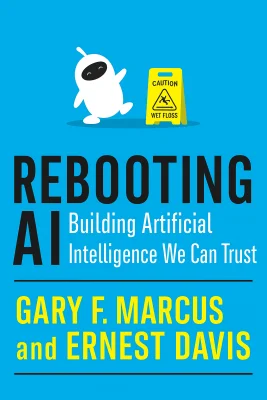
Rebooting AI
Building Artificial Intelligence We Can Trust
Categories
Business, Nonfiction, Philosophy, Science, Technology, Artificial Intelligence, Audiobook, Computer Science, Futurism, Computers
Content Type
Book
Binding
Hardcover
Year
2019
Publisher
Pantheon
Language
English
ISBN13
9781524748258
File Download
PDF | EPUB
Rebooting AI Plot Summary
Introduction
The world of artificial intelligence is no longer confined to academic laboratories or tech giants. Today's developers stand at the threshold of a transformative era where machine learning capabilities can be woven into everyday applications with remarkable ease. The challenge isn't whether AI will reshape our digital landscape, but rather how quickly we can master the tools to become active participants in this revolution. TensorFlow has emerged as the bridge between complex mathematical concepts and practical implementation, offering developers a pathway to build intelligent systems without requiring advanced degrees in data science. This journey from traditional programming to machine learning represents more than just acquiring new technical skills—it's about fundamentally reimagining how we solve problems and create value through code.
Chapter 1: Build Your First Neural Network with TensorFlow
At its core, a neural network is simply a pattern recognition system that learns from examples rather than explicit instructions. Think of it as teaching a computer to recognize relationships in data the same way a child learns to identify animals by looking at picture books. Instead of programming rigid if-then rules, we provide the network with examples and let it discover the underlying patterns. The beauty of TensorFlow lies in its ability to transform this conceptual framework into working code with remarkable simplicity. Consider the story of Sarah, a web developer who had never touched machine learning before. She started with the most basic possible neural network—one designed to learn the relationship Y equals 2X minus 1 from a handful of number pairs. What seemed like mathematical wizardry initially became clear when she realized the network was simply adjusting internal weights and biases through trial and error, much like a student learning through practice problems. Sarah's breakthrough came when she watched her simple model make its first accurate prediction. The network had successfully learned that when given the number 10, it should output something close to 19. This moment of recognition—seeing a machine discover patterns independently—sparked her transition from skeptical observer to enthusiastic practitioner. The practical steps to build your first neural network are surprisingly straightforward. Begin by setting up your development environment with TensorFlow installed through pip. Create your training data as simple arrays of input and output pairs. Define your model architecture using Sequential layers, starting with just a single Dense layer. Compile your model with an optimizer like Adam and a loss function such as mean squared error. Remember that your first neural network doesn't need to solve complex problems. Focus on understanding the training process—how the model iteratively improves its predictions through epochs of learning. Monitor the loss function as it decreases, signaling that your network is successfully finding patterns in the data. The confidence gained from building that first working model becomes the foundation for tackling more sophisticated challenges. Every complex AI system started with these same fundamental building blocks, proving that the journey from beginner to practitioner begins with that crucial first step of hands-on experimentation.
Chapter 2: Master Computer Vision for Image Recognition
Computer vision transforms the abstract concept of machine learning into something tangible and visually compelling. Unlike processing numerical data, image recognition allows us to literally see intelligence emerge as networks learn to identify patterns in pixels. The fundamental principle revolves around teaching computers to extract meaningful features from visual data, much like how our brains process the flood of visual information we encounter daily. The Fashion MNIST dataset provided the perfect entry point for Marcus, a mobile app developer eager to add intelligent features to his photo-sharing application. Rather than attempting to tackle real-world images immediately, he started with this carefully curated collection of clothing items—each a simple 28x28 grayscale image. Watching his neural network gradually learn to distinguish between shirts, shoes, and dresses gave him profound insights into how visual recognition actually works. Marcus's initial model achieved respectable accuracy, but the real magic happened when he discovered convolutional layers. These specialized layers don't just look at raw pixels—they learn to detect edges, shapes, and textures that define different objects. His excitement grew as he watched the network's accuracy jump from 89% to 99% simply by adding these feature-detection capabilities. The model was no longer memorizing pixel patterns but truly understanding visual characteristics. Building effective computer vision models requires a systematic approach to data preparation and architecture design. Start with properly formatted image data, ensuring consistent dimensions and normalized pixel values between 0 and 1. Design your convolutional layers to extract hierarchical features, beginning with simple edges and progressing to complex shapes. Add pooling layers to reduce computational complexity while preserving important features. Pay careful attention to preventing overfitting through techniques like data augmentation, where you artificially expand your training set by rotating, flipping, or slightly modifying existing images. Consider transfer learning opportunities, where you can leverage pre-trained models like MobileNet to jumpstart your own specialized applications. The transition from basic neural networks to computer vision represents a quantum leap in capability and practical application. When your model successfully identifies objects in previously unseen images, you've crossed into territory where artificial intelligence begins to mirror human-level perception, opening doors to countless innovative applications.
Chapter 3: Create Sentiment Analysis Systems with NLP
Natural Language Processing transforms the messy, unstructured world of human text into numerical patterns that machines can understand and analyze. The challenge isn't just converting words to numbers, but capturing the subtle nuances of meaning, context, and emotion that make human communication so rich and complex. This field represents one of AI's most ambitious goals—teaching computers to truly comprehend language. Jennifer, a product manager at a customer service company, faced an overwhelming volume of user feedback that was impossible to analyze manually. Traditional keyword-based approaches failed to capture the subtle distinctions between genuine praise and sarcastic criticism. Her breakthrough came when she discovered how embeddings could map words into vector space, where similar meanings cluster together naturally. Words like "excellent" and "outstanding" positioned themselves near each other, while "terrible" and "awful" formed their own distinct neighborhood. The transformation in Jennifer's workflow was dramatic. Her sentiment analysis model began catching nuances that human reviewers often missed, identifying subtle patterns in customer dissatisfaction that previously went undetected. The system's ability to process thousands of reviews in seconds, while maintaining accuracy comparable to human analysis, revolutionized how her team approached customer feedback management. Building robust NLP systems starts with proper text preprocessing and tokenization. Clean your data by removing HTML tags, normalizing punctuation, and filtering out stop words that add noise without meaning. Convert your text into sequences of tokens, ensuring consistent length through padding or truncation. Create word embeddings that capture semantic relationships, either by training your own or leveraging pre-trained vectors. Design your model architecture with sequence processing in mind. Recurrent layers like LSTM or GRU excel at maintaining context across word sequences, while attention mechanisms can focus on the most relevant parts of longer texts. Experiment with bidirectional processing to capture context flowing in both directions through your text. The power of NLP lies not just in classification accuracy, but in its ability to unlock insights hidden within vast amounts of unstructured text data. When your model successfully distinguishes between genuine enthusiasm and subtle sarcasm, you've achieved something truly remarkable—teaching a machine to read between the lines of human communication.
Chapter 4: Generate Creative Text with Sequence Models
Text generation represents the creative frontier of natural language processing, where models learn not just to understand language but to produce original content that follows learned patterns. This capability transforms AI from a passive analyzer into an active creator, generating everything from poetry to prose by understanding the statistical relationships between words and phrases in human language. David, a content marketing specialist, initially approached text generation with skepticism after encountering obviously artificial chatbot responses. His perspective shifted dramatically when he began training a model on traditional Irish folk songs, watching as the network learned to capture not just vocabulary but rhythm, rhyme, and thematic elements. The model's early attempts produced nonsensical word combinations, but gradually evolved into verses that, while not perfect, captured the essence and mood of the source material. The magic moment arrived when David's model generated a haunting verse about "the wild colleen dying" that seemed to emerge organically from the patterns it had learned. This wasn't mere word prediction—the model had internalized structural elements of folk poetry and was creating new combinations that felt authentic to the genre. His initial skepticism transformed into genuine appreciation for the creative potential of well-trained language models. Successful text generation requires careful preparation of training sequences where each word becomes both feature and label. Create windowed datasets that show the model how sequences flow naturally, with each group of words predicting the next logical continuation. Structure your neural network with embedding layers to capture word meanings and recurrent layers to maintain context across sequences. Pay special attention to your training data quality and quantity. Larger, more diverse datasets generally produce more coherent and creative outputs. Experiment with different sequence lengths to balance context preservation with computational efficiency. Consider character-level encoding for shorter vocabularies and more granular control over output generation. The journey from basic text classification to creative generation represents a fundamental shift in how we think about machine intelligence. When your model produces original text that captures the style and substance of its training material, you've witnessed artificial creativity emerging from mathematical optimization—a truly remarkable achievement in the field of AI.
Chapter 5: Deploy Models Across Mobile and Web Platforms
The true power of machine learning emerges when intelligent capabilities reach end users through practical applications they can access anywhere. Deployment transforms experimental models into production systems that must handle real-world constraints like limited processing power, battery life, and network connectivity. This transition from development to deployment represents the bridge between AI research and user impact. Alex, a startup founder, created an impressive image classification model that achieved 99% accuracy on his laptop but faced crushing disappointment when attempting to deploy it to mobile devices. The model's 200MB size and intensive computational requirements made it completely impractical for smartphone applications. His salvation came through TensorFlow Lite, which compressed his model to just 2.3MB while maintaining 94% accuracy—a trade-off that transformed an impossible deployment into a smooth user experience. The breakthrough extended beyond mere size reduction. Alex's optimized model ran inference in milliseconds rather than seconds, enabling real-time image classification that felt responsive and natural to users. Battery consumption dropped dramatically, and the app functioned perfectly even without internet connectivity. This transformation from resource-hungry prototype to efficient production system demonstrated the critical importance of deployment-focused optimization. Effective model deployment begins with understanding your target platform's constraints and capabilities. Mobile devices require model quantization techniques that reduce precision from 32-bit floats to 8-bit integers, dramatically reducing size and computation while preserving accuracy. Web deployment leverages TensorFlow.js for in-browser inference, eliminating server round-trips and protecting user privacy. Master the conversion workflows specific to each platform. TensorFlow Lite handles mobile deployment across Android and iOS, while TensorFlow.js enables browser-based applications. Each platform requires specific data formatting and result parsing, but the core inference logic remains consistent across environments. The satisfaction of seeing your model running smoothly on a user's device represents the culmination of the entire machine learning pipeline. When real people can access your AI capabilities instantly, regardless of their location or device, you've successfully bridged the gap between algorithmic innovation and practical human benefit.
Chapter 6: Optimize Performance through Model Tuning
Performance optimization transforms good models into great ones through systematic fine-tuning of hyperparameters, architecture choices, and training strategies. This process requires both technical understanding and experimental patience, as small adjustments can yield dramatic improvements in accuracy, speed, and resource efficiency. The art lies in finding the optimal balance between model complexity and practical performance. Lisa, a data scientist working on time series prediction, watched her initial model struggle with an accuracy plateau that seemed insurmountable through traditional approaches. Her breakthrough came when she discovered hyperparameter tuning with Keras Tuner, systematically exploring combinations of learning rates, network architectures, and optimization strategies. What began as manual trial-and-error evolved into a sophisticated automated search process that uncovered optimal configurations she never would have found intuitively. The transformation was remarkable. Lisa's optimized model not only achieved significantly higher accuracy but trained faster and showed improved stability across different datasets. The systematic approach revealed that her initial assumptions about optimal network size were completely wrong—the best performing architecture used fewer neurons but arranged in a more efficient configuration. Begin optimization with systematic learning rate exploration using learning rate schedules that adjust dynamically during training. Monitor both training and validation metrics to identify overfitting early, implementing techniques like dropout, regularization, and early stopping to maintain model generalization. Use tools like Keras Tuner to automate the search across multiple hyperparameter dimensions simultaneously. Focus on architecture optimization by experimenting with different layer types, sizes, and arrangements. Consider ensemble methods that combine multiple models for improved robustness. Implement proper cross-validation strategies to ensure your optimization gains translate to real-world performance rather than just fitting your specific validation set. The discipline of systematic optimization separates amateur experiments from professional machine learning systems. When your model achieves peak performance through careful tuning rather than lucky guessing, you've developed the methodical approach essential for tackling increasingly complex AI challenges.
Chapter 7: Implement Ethical AI in Production Systems
Ethical AI implementation extends far beyond technical correctness to encompass fairness, transparency, and social responsibility in deployed systems. This dimension of machine learning addresses how our models impact real people and communities, requiring developers to consider bias, privacy, and equity as integral design considerations rather than afterthoughts. The goal is creating AI that enhances human potential while protecting individual rights and promoting societal benefit. The story of a healthcare AI system illustrates these principles in action. Initially designed to assist with diagnostic recommendations, the model demonstrated excellent technical performance in laboratory testing. However, careful analysis revealed concerning patterns—the system showed systematic bias against certain demographic groups, potentially exacerbating existing healthcare inequalities. The development team's commitment to ethical principles led them to completely redesign their training approach, implementing fairness constraints and diverse validation procedures that ultimately produced a more effective and equitable system. This ethical redesign process didn't just address bias—it improved overall model performance by forcing the team to consider edge cases and underrepresented scenarios they had previously overlooked. The final system demonstrated both superior accuracy and equitable treatment across different population groups, proving that ethical AI often leads to technically superior outcomes. Implement ethical AI through comprehensive bias auditing using tools like Fairness Indicators and What-If Tool to analyze model behavior across different demographic groups. Design privacy-preserving training approaches using federated learning techniques that keep sensitive data on user devices while still enabling model improvement. Establish clear governance frameworks for model deployment and monitoring. Prioritize transparency through explainable AI techniques that help users understand how models make decisions. Implement continuous monitoring systems that track model performance and fairness metrics in production environments. Create diverse testing procedures that evaluate model behavior across different scenarios and user populations. The integration of ethical considerations into AI development represents a maturation of the field from purely technical optimization to socially responsible engineering. When your models demonstrably serve all users fairly while protecting their privacy and dignity, you've achieved the gold standard of professional AI development.
Summary
The journey from traditional programming to machine learning mastery represents more than just acquiring new technical skills—it's about fundamentally reimagining how we solve problems and create value in our digital world. Throughout this exploration, we've seen how TensorFlow democratizes artificial intelligence, transforming complex mathematical concepts into accessible tools that any dedicated developer can master. The path forward requires embracing both the technical rigor and creative potential of machine learning. As one practitioner discovered during their AI journey, "The goal is not to replace human intelligence, but to amplify it—creating systems that enhance our capabilities while remaining true to our values." This perspective captures the essence of responsible AI development, where technical excellence serves human flourishing. Take action today by building your first neural network, no matter how simple. Download TensorFlow, work through the basic examples, and experience the moment when your model makes its first successful prediction. That single step will transform abstract concepts into concrete understanding, launching your journey toward becoming an AI practitioner who can shape the future through intelligent code.
Best Quote
“More broadly, formal logic of the sort we have been talking about does only one thing well: it allows us to take knowledge of which we are certain and apply rules that are always valid to deduce new knowledge of which we are also certain.” ― Gary F. Marcus, Rebooting AI: Building Artificial Intelligence We Can Trust
Review Summary
Strengths: The book effectively critiques the current state of AI, emphasizing the lack of common sense and reasoning in mainstream AI. It serves as a cautionary tale against the hype surrounding AI advancements and underscores the importance of multidisciplinary research. Weaknesses: The writing is repetitive, with examples that do not add significant value. Proposed solutions are deemed unhelpful, and the tone is perceived as somewhat snide. The book lacks examples of successful AI applications and does not provide practical guidance for future research directions. Overall: The book is critical yet informative, making a strong case for the limitations of current AI. It is recommended for readers interested in a deeper understanding of AI beyond the hype, despite its repetitive nature and lack of practical solutions.
About Author

Gary F. Marcus
Gary Marcus is a scientist, entrepreneur, and best-selling author known for his critical perspective on artificial intelligence. He is the Founder and CEO of Geometric Intelligence, a machine learning company acquired by Uber. Marcus is an Emeritus Professor of Psychology and Neural Science at NYU and a vocal critic of the current "hype" surrounding deep learning and Large Language Models.\n\nHe is the author of Taming Silicon Valley and co-author of Rebooting AI. Marcus argues that current AI systems are untrustworthy and lack true understanding. He advocates for a new approach to AI that combines neural networks with symbolic reasoning. His work serves as a reality check for the tech industry, calling for robust regulation and a focus on safety over speed.
Read moreDownload PDF & EPUB
To save this Black List summary for later, download the free PDF and EPUB. You can print it out, or read offline at your convenience.
Rebooting AI
by Gary F. Marcus
