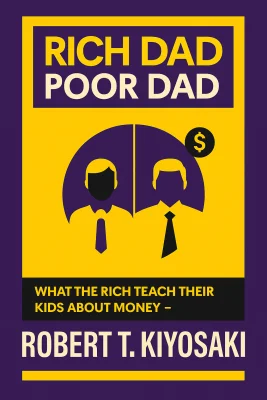
Rich Dad, Poor Dad
Categories
Business, Nonfiction, Self Help, Finance, Economics, Audiobook, Entrepreneurship, Money, Personal Development, Personal Finance
Content Type
Book
Binding
Paperback
Year
2001
Publisher
Time Warner Books UK
Language
English
ASIN
0751532711
ISBN
0751532711
ISBN13
9780751532715
File Download
PDF | EPUB
Rich Dad, Poor Dad Plot Summary
Introduction
Picture this: A nine-year-old boy sits in confusion as his two fathers give him completely opposite advice about money. His highly educated biological father, who holds multiple degrees and works for the government, tells him to study hard, get good grades, and find a secure job. Meanwhile, his best friend's father, who barely finished eighth grade but owns multiple businesses, whispers a different truth: "The poor and middle class work for money. The rich have money work for them." This profound contradiction would shape a young mind and eventually transform the way millions think about wealth. The boy would grow up to discover that financial intelligence isn't taught in schools, that our educational system prepares us to be employees rather than business owners, and that the path to financial freedom requires a completely different mindset than what society teaches us. Through the lens of these contrasting father figures, we explore timeless principles of money management, asset building, and entrepreneurial thinking. This journey reveals why so many educated people struggle financially, why playing it safe can be the riskiest strategy of all, and how anyone can develop the financial intelligence needed to break free from the cycle of working for money. The lessons ahead offer not just financial strategies, but a blueprint for transforming your relationship with money itself.
Chapter 1: The Tale of Two Fathers: Contrasting Financial Philosophies
The story begins with a stark reality that would puzzle any child. Here was a boy blessed and cursed with two father figures who couldn't have been more different in their approach to money and life. His biological father possessed impressive academic credentials, held advanced degrees from prestigious universities, and commanded respect as the head of Hawaii's Department of Education. Yet despite his intelligence and steady government salary, he struggled with money throughout his life, constantly worrying about bills and living paycheck to paycheck. The other father figure never finished eighth grade but had built a financial empire that would eventually make him one of the richest men in Hawaii. This man owned restaurants, construction companies, warehouses, and various other businesses. While the educated father spoke about job security and the importance of good grades, this entrepreneurial mentor taught a completely different philosophy: that financial education was more valuable than academic achievement, and that the wealthy don't work for money but make money work for them. The contrast became even more apparent in their daily language and mindset. The poor father would often say phrases like "I can't afford it" or "Money is the root of all evil," while the rich father forbade such limiting language in his presence. Instead, he would challenge young minds by asking "How can I afford it?" He understood that our words shape our thoughts, and our thoughts ultimately determine our financial destiny. What made this situation particularly fascinating was observing how each father's beliefs created their reality. The educated father's focus on job security and benefits led him to a life of financial dependence on his employer and, eventually, the government. The entrepreneurial father's focus on building assets and creating passive income streams led to financial freedom and the ability to help others achieve the same success. This tale of two fathers reveals a fundamental truth about money that most people never learn: your financial philosophy determines your financial future far more than your formal education or your starting circumstances. The choice between security and freedom, between working for money and having money work for you, shapes everything that follows in your financial life.
Chapter 2: Assets vs Liabilities: The Critical Distinction
The foundation of all financial education rests on understanding one simple yet profound distinction that eludes most people their entire lives. During one of their regular meetings, the rich father drew two simple diagrams on paper to illustrate the difference between assets and liabilities. An asset, he explained, puts money in your pocket. A liability takes money out of your pocket. This definition was revolutionary because it contradicted everything the boy had learned from conventional wisdom. The rich father used the example of a house to demonstrate this principle. Most people, including the boy's educated father, believed their home was their greatest asset. But when the rich father showed the cash flow pattern of home ownership, the truth became clear. A house you live in takes money out of your pocket every month through mortgage payments, property taxes, insurance, maintenance, and utilities. By definition, this makes it a liability, not an asset. This revelation was shocking because it challenged one of the most deeply held beliefs in society. To further illustrate the concept, the rich father explained how the wealthy approach major purchases differently. When he wanted a luxury item like a Porsche, he didn't take out a loan or dip into savings. Instead, he would first acquire an asset that generated enough cash flow to pay for the luxury item. The asset bought the liability, ensuring that his wealth continued to grow even as he enjoyed the finer things in life. This approach created a virtuous cycle where assets multiplied while liabilities remained minimal. The poor father's approach was exactly opposite. He would work harder to earn more money, then use that money to buy what he thought were assets but were actually liabilities. His house, his car, his furniture, and his gadgets all took money out of his pocket. The harder he worked and the more he earned, the deeper he fell into the liability trap, creating a vicious cycle that kept him financially struggling despite his intelligence and hard work. This simple distinction between assets and liabilities becomes the lens through which all financial decisions can be evaluated. It explains why many high-income earners remain financially insecure while others with modest incomes achieve true wealth. The secret lies not in how much money you make, but in how much money you keep and how hard that money works for you.
Chapter 3: Financial Education: Breaking Free from the Rat Race
The concept of the "Rat Race" emerged from observing how most people live their financial lives in an endless cycle of earning and spending. The rich father described this phenomenon by observing that people get up each morning, go to work, pay their bills, get up the next morning, go to work again, and pay more bills. Their entire existence revolves around this pattern, and despite working harder or earning more money, they never seem to get ahead. Like hamsters running on a wheel, they expend tremendous energy but never actually progress. The rich father explained that the Rat Race is driven by two primary emotions: fear and greed. Fear of not having enough money drives people to seek employment and work hard. Then, when they receive their paycheck, greed takes over as they dream about all the wonderful things money can buy. This emotional pattern traps them into believing that more money will solve their problems, but it rarely does. Instead, they simply upgrade their lifestyle to match their income, creating new expenses that keep them trapped in the cycle. What makes escape from the Rat Race so difficult is that the education system actually prepares people to enter it. Schools teach students to be good employees who work for money, but they never teach how to make money work for them. Students learn to avoid mistakes rather than learn from them, to seek security rather than opportunity, and to work for others rather than build their own wealth-generating systems. This educational programming makes people feel secure in their employment while keeping them financially vulnerable. The path out of the Rat Race requires a fundamental shift in financial education. Instead of working harder for money, people must learn to acquire assets that generate income whether they work or not. This means developing skills in areas that schools don't teach: how to analyze investments, how to understand tax strategies, how to build business systems, and how to make money multiply through compound growth. It requires learning to think like an investor and entrepreneur rather than an employee. Breaking free demands both courage and patience, as the transition period can be uncomfortable and uncertain. But those who persist in acquiring financial education and building asset columns eventually reach a tipping point where their passive income exceeds their expenses. At that magical moment, work becomes optional, and true financial freedom begins. This transformation represents one of life's most profound shifts from being controlled by money to controlling money.
Chapter 4: Mind Your Own Business: Building Your Asset Column
The story of Ray Kroc and McDonald's perfectly illustrates the difference between having a job and building a business. When Kroc spoke to a group of MBA students, he asked them what business McDonald's was in. The students confidently replied that McDonald's was in the hamburger business, but Kroc corrected them with a smile. He explained that while McDonald's might appear to be in the hamburger business, they were actually in the real estate business. Every franchise location was carefully chosen for its real estate value, making McDonald's one of the largest landowners in the world. This revelation demonstrates a crucial principle: your profession and your business are two different things. A person might be a doctor, teacher, or accountant by profession, but their business should be building their asset column. Too many people spend their entire lives making their employers rich while neglecting to build wealth for themselves. They focus all their energy on climbing the corporate ladder or increasing their professional fees, never realizing that they're still just trading time for money. The rich father taught that true financial security comes from owning income-generating assets rather than relying on earned income from employment. These assets might include rental real estate, stocks that pay dividends, business ownership, intellectual property royalties, or any investment that puts money in your pocket regularly without requiring your daily labor. The key is to start acquiring these assets while maintaining your day job, gradually building your asset column until it can support your lifestyle. One of the biggest mistakes people make is confusing net worth with true wealth. They list their personal possessions, homes, and cars as assets on their financial statements, but these items often lose value and require ongoing maintenance costs. Real assets are those that appreciate in value while generating income. Building a strong asset column requires discipline to distinguish between true assets and mere possessions, focusing investments on items that will work to create more wealth. The transformation from employee thinking to business owner thinking represents a fundamental shift in approach to money and time. Instead of trading hours for dollars, successful business builders create systems that generate income whether they're present or not. This requires developing skills in areas like marketing, finance, and systems management, but it ultimately leads to the freedom that comes from having money work for you rather than working for money.
Chapter 5: The Power of Financial Intelligence: Creating Opportunities
The concept of financial intelligence encompasses much more than simply knowing how to balance a checkbook or save money. It represents a comprehensive understanding of how money flows, how opportunities are created, and how wealth is built and preserved. The rich father described financial intelligence as the ability to solve financial problems quickly and efficiently, turning challenges into opportunities for growth and profit. A perfect example of financial intelligence in action occurred during a depressed real estate market when most people saw only problems and stayed away from property investments. While others complained about falling prices and difficult financing, those with financial intelligence recognized this as an opportunity to acquire quality assets at significant discounts. They understood that the best investment opportunities often come disguised as problems that scare away less educated investors. The story of buying a house for twenty thousand dollars that was worth seventy-five thousand dollars illustrates how financial intelligence creates wealth. By understanding foreclosure processes, financing alternatives, and market timing, it became possible to acquire the property with borrowed money, quickly sell it for sixty thousand dollars with owner financing, and create a forty-thousand-dollar asset that would generate monthly income for decades. This transaction took only a few hours but required years of financial education to recognize and execute. Financial intelligence also involves understanding the different ways money can work. While most people know only one method of making money - working for it - financially intelligent individuals understand multiple wealth-building strategies. They know how to make money through business ownership, real estate appreciation, stock market investments, commodity trading, and currency fluctuations. This diversified knowledge allows them to spot opportunities that others miss entirely. Perhaps most importantly, financial intelligence includes the wisdom to take calculated risks while managing potential losses. This means learning to analyze investments thoroughly, understanding when to get in and when to get out, and never risking money that you cannot afford to lose. It requires developing the emotional discipline to act when others are paralyzed by fear and to remain cautious when others are driven by greed.
Chapter 6: Work to Learn: Developing Skills That Generate Wealth
The tale of a young reporter in Singapore perfectly demonstrates the difference between working for money and working to learn valuable skills. She was an excellent writer with a master's degree in English Literature, but she struggled to achieve her dream of becoming a bestselling author. When advised to take sales training courses, she was offended, believing that learning to sell was beneath her professional status. She couldn't understand that the title "bestselling author" emphasized sales ability over writing ability. This story illustrates how many talented people remain financially unsuccessful not because they lack skill in their chosen field, but because they lack the complementary skills necessary for financial success. The reporter could write beautifully, but without marketing and sales skills, her talent remained hidden from potential readers. She possessed one piece of the success puzzle but refused to develop the other pieces that would complete the picture. The rich father emphasized that financial success requires a combination of technical skills and communication skills. Technical skills get you in the game, but communication skills determine how successful you become. The most financially successful people are rarely the most technically competent; they're the ones who can communicate value to others, build relationships, negotiate effectively, and inspire people to take action. These skills are rarely taught in schools but are essential for success in business and investing. The concept of working to learn rather than working to earn requires a fundamental shift in how people choose jobs and career paths. Instead of automatically seeking the highest-paying position, financially intelligent individuals seek opportunities that will teach them valuable skills for building wealth. They might take lower-paying jobs that offer experience in sales, marketing, negotiation, or business management, understanding that these skills will ultimately generate more income than any salary increase. This approach to career development requires both patience and vision. It means sometimes taking positions that may not look impressive to family and friends but provide invaluable learning opportunities. It means viewing every job as a school where you're paid to learn skills that will serve you for a lifetime. Those who master this approach often find that their earning potential increases dramatically as they develop the skills that create wealth rather than simply earn wages.
Chapter 7: Overcoming Obstacles: Fear, Cynicism, and Financial Inertia
The journey toward financial freedom is rarely smooth, and understanding the psychological barriers that prevent success is crucial for anyone seeking to change their financial circumstances. Fear represents the most significant obstacle, but not the fear of losing money that most people assume. The real fear is the fear of being different, of standing out from the crowd, of being criticized for making unconventional choices. This fear keeps people trapped in jobs they dislike and prevents them from pursuing opportunities that could change their lives. The story of a Texas attitude toward failure provides powerful insight into overcoming fear. Texans have a saying: "If you're going to go broke, go big." They understand that failure is part of the learning process, and they prefer to fail spectacularly rather than live a life of quiet mediocrity. This philosophy transforms failure from something to be avoided into something that provides valuable education and builds character. Those who embrace this mindset often discover that their failures become the foundation for their greatest successes. Cynicism presents another major obstacle, often disguised as wisdom or sophistication. Cynical people can always tell you why something won't work, why an opportunity is too risky, or why someone else's success was just luck. They use their intelligence to justify inaction, finding sophisticated reasons to avoid taking the steps necessary for financial growth. This intellectual arrogance becomes a prison that keeps them from learning and growing. Laziness takes many forms, but the most dangerous is the laziness of busy people. Many individuals stay constantly busy with activities that feel productive but don't actually move them toward their financial goals. They attend meetings, answer emails, watch television, or engage in other activities that provide the illusion of progress while avoiding the difficult decisions and actions required for real change. This busyness becomes a comfortable excuse for not pursuing their dreams. The solution to these obstacles involves developing what the rich father called "financial intelligence," which includes not just knowledge about money but the emotional intelligence to act despite fear, the wisdom to distinguish between valid concerns and mere excuses, and the discipline to focus on activities that truly matter. Success requires learning to be comfortable with discomfort, to act before you feel ready, and to persist when others would quit. These psychological skills often matter more than technical knowledge in determining financial outcomes.
Summary
Through the wisdom of two contrasting father figures, we discover that financial success depends far more on financial intelligence than on formal education or high income. The journey from financial struggle to financial freedom requires understanding fundamental principles that schools never teach: the difference between assets and liabilities, the importance of building passive income streams, and the power of making money work for you rather than working for money. The path forward demands both courage and education. It means developing new skills, challenging conventional wisdom, and sometimes making choices that others don't understand. Success requires learning to overcome the psychological obstacles of fear, cynicism, and inertia that keep most people trapped in financial mediocrity. But for those willing to invest in their financial education and take calculated risks, the reward is the ultimate freedom that comes from having money work for you. Remember that every financial journey begins with a single step, and the best time to start building your financial intelligence is now. Whether you're just beginning your career or seeking to change directions later in life, the principles revealed through these contrasting philosophies can guide you toward the financial security and freedom you deserve. Your financial destiny is in your hands, shaped by the choices you make today about how to think about and handle money.
Best Quote
“In school we learn that mistakes are bad, and we are punished for making them. Yet, if you look at the way humans are designed to learn, we learn by making mistakes. We learn to walk by falling down. If we never fell down, we would never walk.” ― Robert T. Kiyosaki, Rich Dad, Poor Dad
About Author

Robert T. Kiyosaki
Kiyosaki reframes the conversation around personal finance, emphasizing the power of financial literacy over traditional employment. His work, deeply influenced by his dual upbringing under a financially struggling educator and a wealthy entrepreneur, encourages readers to question the conventional wisdom surrounding money. Through books like "Rich Dad, Poor Dad" and "Rich Dad's Guide to Investing," Kiyosaki challenges readers to adopt a mindset of financial independence, advocating for investments in real estate and entrepreneurship as pathways to wealth. This approach, while occasionally contentious, has made Kiyosaki's works accessible and thought-provoking, urging a re-evaluation of the financial systems we adhere to.\n\nCentral to Kiyosaki's method is his use of anecdotal storytelling to convey complex financial principles, making his ideas relatable and actionable. By contrasting the philosophies of his "rich dad" mentor and "poor dad" father, he presents a clear dichotomy between financial literacy and traditional career paths. This narrative technique not only simplifies intricate economic concepts but also encourages a broader audience to engage with his teachings. While some critics argue his methods can be risky, Kiyosaki's focus on self-reliance and entrepreneurial thinking provides a compelling alternative to standard financial advice.\n\nReaders benefit from Kiyosaki's work as it equips them with the tools to pursue financial freedom actively. His books resonate particularly with those seeking to break free from the limitations of traditional employment and aspire towards wealth building. For individuals eager to explore non-traditional routes to financial success, Kiyosaki offers both inspiration and practical guidance. Despite the controversies surrounding his bold assertions, his influence remains significant in personal finance education, challenging readers to rethink their relationship with money and take control of their financial futures.
Read moreDownload PDF & EPUB
To save this Black List summary for later, download the free PDF and EPUB. You can print it out, or read offline at your convenience.
Rich Dad, Poor Dad
by Robert T. Kiyosaki
