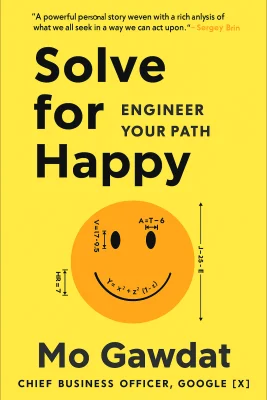
Solve for Happy
Engineer Your Path to Joy
Categories
Business, Nonfiction, Self Help, Psychology, Philosophy, Health, Science, Spirituality, Audiobook, Personal Development
Content Type
Book
Binding
Hardcover
Year
2017
Publisher
Gallery Books
Language
English
ISBN13
9781501157554
File Download
PDF | EPUB
Solve for Happy Plot Summary
Introduction
Seventeen days after losing his son Ali to a tragic medical error, a successful tech executive found himself in the most unlikely place imaginable—writing about happiness. Mo Gawdat, Chief Business Officer at Google X, had spent years climbing the corporate ladder, accumulating wealth and recognition, yet feeling increasingly miserable despite his external success. He had developed a mathematical approach to happiness that worked brilliantly in his life, bringing him genuine joy and peace. But when tragedy struck and Ali passed away during what should have been a routine appendectomy, his entire understanding of happiness faced its ultimate test. This profound loss could have destroyed everything Gawdat believed about finding joy in life. Instead, it revealed the deepest truths about human resilience, the nature of suffering, and what it truly means to live a meaningful existence. Through his journey from success to devastating loss and back to genuine happiness, we discover that our greatest challenges often become our most powerful teachers. The book explores how we can maintain inner peace and joy even when life delivers its harshest blows, transforming our understanding of what happiness really means and how to sustain it regardless of external circumstances.
Chapter 1: The Pursuit of Happiness in a World of Success
In the gleaming towers of Dubai, surrounded by luxury cars and million-dollar apartments, Gawdat found himself trapped in a paradox that defines modern life. Despite achieving everything society promised would make him happy—a prestigious job at Microsoft, financial independence, and all the material comforts money could buy—he felt increasingly miserable. The more fortune blessed him, the less joy he experienced. One evening, in a moment that perfectly captured his emptiness, he went online and with two clicks bought two vintage Rolls-Royces. Not because he needed them, not because he particularly wanted them, but simply because he could, desperately trying to fill the growing hole in his soul. The expected euphoria never came. When those beautiful classics arrived, they didn't lift his mood one bit. He had become what psychologists call a hamster on the "hedonic treadmill"—the more you get, the more you want, and the more reasons you discover for striving. This relentless pursuit had transformed him from a naturally happy young man into someone pushy, unpleasant, and demanding. He was manically trying to make the world conform to his expectations, spending more time in airplanes than at home, too little time appreciating his remarkable family. This modern epidemic reveals a fundamental truth: success doesn't lead to happiness, but happiness often contributes to success. When we chase external validation and material accumulation as our primary path to joy, we're essentially solving the wrong equation. True happiness isn't something we achieve or earn—it's our natural default state that gets obscured by false beliefs and misguided expectations about what should make us feel fulfilled.
Chapter 2: Understanding Our Inner Voice and Thought Patterns
Every morning, millions of people wake up to an internal narrator that never seems to take a break. This little voice in our heads worries about the future, criticizes our past decisions, compares us to others, and rarely offers a moment of peace. Gawdat discovered that this constant mental chatter—which feels so intimately part of who we are—is actually separate from our true selves. The voice isn't you; it's your brain doing what it was designed to do millions of years ago when survival depended on constantly scanning for threats and staying hypervigilant. Consider the story of Gawdat's daughter Aya and her encounter with a cockroach. As a one-year-old with no conditioned fear, she grabbed the flying insect like any other toy and waved it happily at her mother. But her mother's terrified reaction—screaming in horror and crying for help—instantly conditioned Aya to fear cockroaches for years to come. This demonstrates how our brains learn to associate experiences with emotions, creating thought patterns that persist long after their original purpose has disappeared. What started as a survival mechanism becomes a source of unnecessary suffering. The breakthrough comes in recognizing that we can observe our thoughts, which proves we are not our thoughts. You can watch your mind spinning stories, making judgments, and creating drama, but the observer—the real you—remains calm and aware. Like Neo in The Matrix learning to see the code behind reality, when we master the art of observing our internal dialogue without being controlled by it, we gain the power to choose which thoughts deserve our attention and which ones we can simply let pass by like clouds in the sky.
Chapter 3: The Truth Beyond Our Physical Form
Throughout our lives, we identify so completely with our physical bodies and the roles we play that we forget who we truly are beneath all the masks. Gawdat challenges us to examine this fundamental assumption through a simple exercise: stand naked in front of a mirror and remove everything that serves only your ego—the designer clothes, expensive jewelry, status symbols, even your carefully cultivated image. Strip away the roles of successful professional, devoted parent, or whatever identity you've constructed, and ask yourself: who remains when all these external layers are removed? The answer might surprise you. You are not your achievements, your possessions, your relationships, or even your body. You are not the story your mind tells about who you should be or how others should perceive you. These are all temporary masks worn by the eternal observer within—what Gawdat calls "Pooki," the innocent, happy child who existed before society taught you to chase external validation and build elaborate personas to gain acceptance. This realization is simultaneously humbling and liberating. When you understand that the real you cannot be threatened by external circumstances—job loss, relationship changes, even physical illness—you discover an unshakeable foundation of peace. Your worth isn't dependent on maintaining any particular image or achieving specific outcomes. The authentic self beneath all the masks is already complete, already lovable, already enough. This truth allows you to navigate life's challenges with grace, knowing that while the external circumstances may change, your essential nature remains untouchable.
Chapter 4: Facing Loss and Embracing the Present Moment
When Ali was admitted to the hospital for what should have been routine surgery, Gawdat experienced every parent's nightmare as a simple medical procedure became a cascade of fatal errors. A needle pushed just millimeters too far punctured a major artery, and within hours, his beloved twenty-one-year-old son was gone. In that moment, all of Gawdat's theories about happiness faced their ultimate test. Would his understanding of joy and peace survive the most devastating loss imaginable, or would grief overwhelm everything he had learned about finding meaning in life's darkest moments? The initial response was profound peace—a feeling so unexpected that it seemed almost inappropriate given the circumstances. But this peace wasn't denial or emotional numbness; it came from recognizing that Ali had lived fully, loved completely, and faced death with the same calm acceptance he had brought to life. His final weeks were spent asking everyone he met what they thought happened after death, as if preparing for a journey he somehow knew was coming. His last words to his family were expressions of love and specific guidance for how each should live after he was gone. This tragedy revealed the deepest truth about presence and acceptance: that our greatest suffering comes not from what happens to us, but from our resistance to what has already occurred. Grief was natural and necessary, but the additional layers of anger, blame, and "what if" thinking only multiplied the pain without serving any useful purpose. By staying present with the reality of loss rather than getting lost in mental stories about how things should have been different, Gawdat discovered that even in the midst of profound sorrow, peace and even gratitude remain possible.
Chapter 5: Navigating Life's Pendulum Swing
Life operates like thousands of pendulums, each seeking its natural point of balance. When we try to force outcomes or maintain extreme positions—working obsessively, accumulating possessions desperately, or avoiding all discomfort—we exhaust ourselves fighting against natural rhythms. Gawdat learned this lesson through years of attempting to control every detail of his family's life and career trajectory, only to discover that the more tightly he gripped, the more stressed and unhappy he became. True peace comes from finding the equilibrium point where minimum effort produces maximum harmony. The ancient concept of yin and yang illustrates this perfectly: opposing forces that actually complement and balance each other. Shadow cannot exist without light, rest has no meaning without activity, and joy is deepened by our experience of sorrow. When we accept that life naturally contains both peaks and valleys, we stop exhausting ourselves trying to eliminate all challenges and instead learn to ride the waves with grace and wisdom. This understanding transforms how we approach both success and setbacks. Instead of desperately clinging to good times or fighting against difficulties, we recognize both as temporary states in an ever-changing dance. The key is maintaining perspective and staying centered regardless of external circumstances. When we stop trying to control the pendulum's swing and instead find our stable point within the movement, life becomes far less effortful and much more enjoyable. We learn to work with natural rhythms rather than against them.
Chapter 6: The Power of Unconditional Love
True love—unconditional love—exists independent of reasons, expectations, or circumstances. Unlike the conditional love that dominates popular culture, which depends on someone making us feel good or meeting our needs, authentic love simply is. Gawdat discovered this through his relationship with Ali, whose love remained constant regardless of external circumstances, and through his own growing capacity to love butterflies, strangers, and even difficult people without needing anything in return. This kind of love transforms both the giver and receiver because it operates outside the realm of transaction and expectation. When you love someone unconditionally, you're not investing in order to get something back—you're expressing the natural overflow of a full heart. This eliminates the disappointment that comes when conditional love isn't reciprocated according to our expectations. More remarkably, unconditional love seems to multiply when given away, creating ripple effects that return to us in unexpected forms. The practical application begins with loving yourself without conditions—not because you've achieved certain goals or maintained particular standards, but simply because the essential you is inherently worthy of love. From this foundation, you can extend genuine care to others without the hidden agenda of getting something in return. This doesn't mean becoming a doormat or ignoring harmful behavior, but rather approaching each interaction from a place of abundance rather than neediness. When love flows freely without conditions attached, it becomes one of the most powerful forces for creating joy and peace in both your own life and the world around you.
Chapter 7: Finding Peace in a World of Uncertainty
The ultimate truth that emerges from Gawdat's journey is that peace doesn't come from eliminating uncertainty, but from accepting it as the fundamental nature of existence. Death, the most certain and most feared aspect of human experience, becomes a teacher rather than an enemy when we understand its role in giving life meaning and urgency. Ali's unexpected departure, devastating as it was, illuminated the preciousness of every moment and the importance of living authentically rather than postponing joy until some imagined future when conditions might be perfect. This acceptance doesn't mean passive resignation, but rather active engagement with life as it actually is rather than as we think it should be. We can still work toward positive change, pursue meaningful goals, and care deeply about outcomes while holding these efforts lightly, knowing that the universe operates according to principles far more complex than our individual desires. This perspective transforms challenges from personal affronts into neutral events that simply require our best response. The mathematics of existence—from the intricate folding of proteins to the vast choreography of galaxies—suggests an underlying design so sophisticated that our role becomes less about controlling outcomes and more about participating consciously in something magnificent. When we align ourselves with this larger pattern rather than fighting against it, we discover that happiness isn't something we achieve but something we allow. Peace emerges naturally when we stop demanding that reality conform to our preferences and instead find our place within the grand design.
Summary
The journey from success to profound loss and back to genuine happiness reveals that our deepest joy comes not from external circumstances but from our relationship to whatever life brings us. Through the ultimate test of losing his beloved son, Gawdat discovered that true happiness is our natural state—not something to be earned or achieved, but our birthright that gets obscured by false beliefs about what should make us feel fulfilled. His mathematical approach to joy, tested in the crucible of grief, proves that peace is possible even in the midst of life's greatest challenges. The path forward requires releasing our grip on illusions of control, dropping the masks we wear to gain approval, and embracing the truth that we are far more than our thoughts, achievements, or circumstances. When we love unconditionally, live presently, and accept the design of existence rather than fighting against it, we discover an unshakeable foundation of peace. This isn't about positive thinking or denial of difficulty, but about recognizing the deeper patterns that make even loss and pain part of a meaningful whole. In choosing happiness regardless of external conditions, we honor not only our own authentic nature but also those we love who have shown us the way.
Best Quote
“The gravity of the battle means nothing to those at peace” ― Mo Gawdat, Solve for Happy: Engineer Your Path to Joy
About Author

Mo Gawdat
Gawdat reframes the interplay between technology and human potential, revealing the profound impact of artificial intelligence on personal well-being. His books, such as "Scary Smart: The Future of Artificial Intelligence and How You Can Save Our World," delve into the ethical challenges of AI, urging readers to shape its future positively. Meanwhile, "That Little Voice In Your Head: Adjust the Code That Runs Your Brain" equips individuals with strategies to optimize mental health, thereby fostering resilience in an increasingly digital age. By focusing on the science of happiness and brain function, Gawdat provides practical frameworks that empower readers to achieve personal growth and stress-free living.\n\nFor audiences navigating rapid technological change, Gawdat's works offer insightful guidance on aligning innovation with ethical considerations. His focus on self-improvement and stress management resonates with those seeking to thrive amid digital transformations. Through his unique combination of analytical rigor and empathetic storytelling, he establishes himself as a pivotal thought leader, encouraging global contemplation of a harmonious future with technology. This bio encapsulates his dedication to fostering a deeper understanding of the synergies between AI and human experience, thereby inspiring meaningful conversations about how we can collectively engineer a better world.
Read moreDownload PDF & EPUB
To save this Black List summary for later, download the free PDF and EPUB. You can print it out, or read offline at your convenience.
Solve for Happy
by Mo Gawdat
