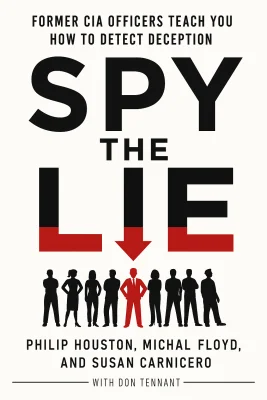
Spy the Lie
Former CIA Officers Teach You How to Detect Deception
Categories
Business, Nonfiction, Self Help, Psychology, Science, Education, Communication, Reference, Audiobook, Personal Development
Content Type
Book
Binding
Hardcover
Year
2012
Publisher
St. Martin's Press
Language
English
ASIN
125000585X
ISBN
125000585X
ISBN13
9781250005854
File Download
PDF | EPUB
Spy the Lie Plot Summary
Introduction
Every day, we navigate countless conversations where truth hangs in the balance. Whether it's a colleague explaining missed deadlines, a teenager denying late-night activities, or a job candidate discussing their qualifications, our ability to discern honesty from deception shapes our relationships, careers, and personal safety. Yet most of us rely on instinct alone, missing subtle but powerful indicators that trained professionals use to uncover the truth. The reality is that deception surrounds us far more than we'd like to admit. Research suggests we encounter lies multiple times daily, from harmless social courtesies to serious betrayals that can devastate our lives. But what if you could develop the same skills used by intelligence officers and seasoned investigators? What if you could spot the telltale signs that someone isn't being entirely truthful, giving you the power to make better decisions and protect yourself and those you care about?
Chapter 1: Understanding the Language of Lies
Deception isn't a single behavior but a complex pattern of verbal and physical responses that reveal themselves when someone attempts to conceal the truth. Just as a polygraph examiner studies physiological changes, we can learn to recognize the subtle shifts in behavior that occur when facts aren't someone's ally. The key lies in understanding that lies come in three distinct forms, each with its own signature. At the Central Intelligence Agency, Phil Houston encountered this reality during a routine security interview with a trusted foreign asset named Omar. For twenty years, Omar had provided valuable intelligence and passed every security screening. When Phil asked the standard question about whether Omar had ever worked for another intelligence service, something unexpected happened. Omar suddenly asked, "Can I pray?" He then retrieved a towel from the bathroom, positioned it toward Mecca, and spent ten minutes in prayer before returning to answer the question. This seemingly religious moment was actually Omar's unconscious attempt to buy time and prepare himself to lie. When pressed again, Omar's verbal responses became evasive, and his body language shifted dramatically. Within hours, Phil had uncovered the shocking truth: Omar had been working for enemy intelligence the entire time, feeding information to America's adversaries while pretending to serve U.S. interests. The power of this approach lies in recognizing that deceptive people rarely create outright fabrications. Instead, they employ three strategic approaches: lies of commission (direct falsehoods), lies of omission (withholding crucial information), and lies of influence (managing your perception rather than conveying facts). Understanding these categories allows you to listen not just for what's being said, but for what's being carefully avoided or artfully presented. Start practicing this awareness in low-stakes conversations. Notice when responses seem designed more to convince you of someone's character than to answer your actual question. Pay attention to elaborate explanations that dance around simple yes-or-no inquiries. The more you tune into these patterns, the sharper your detection abilities become. Remember that developing this skill isn't about becoming suspicious of everyone around you. It's about becoming more discerning, protecting yourself from those who would deceive you while deepening your appreciation for those who consistently tell you the truth.
Chapter 2: Recognizing Verbal Deception Patterns
When someone isn't being truthful, their words betray them in predictable ways. Unlike the polished lies we see in movies, real deception creates verbal stumbling blocks that reveal themselves to those who know what to listen for. The key is learning to hear not just what someone says, but how they structure their response when the truth isn't on their side. Michael Floyd experienced this firsthand when interviewing a bookkeeper accused of embezzling over seven thousand dollars from her employer. When asked about specific instances of theft, she repeatedly used the word "basically" in her responses: "Well, he basically told me that he would pay me extra, you know, points or whatever. Basically, we didn't go into an extensive conversation, basically." This excessive use of qualifying language revealed her attempt to leave herself wiggle room while appearing to answer directly. These qualifying words, known as exclusion qualifiers, allow deceptive people to feel they're being truthful while actually withholding critical information. When someone says "I basically didn't do it" or "for the most part, that's accurate," they're psychologically creating space for the parts of the story they don't want to share. Similarly, perception qualifiers like "to be perfectly honest" or "frankly speaking" often signal that the person feels a need to enhance their credibility because they're about to stretch the truth. Watch for failure to answer direct questions, especially when the response becomes a lengthy explanation that never actually addresses what you asked. Listen for convincing statements that focus on the person's character rather than the facts at hand. Someone who responds to "Did you take the money?" with "I'm an honest person who would never jeopardize my career" is managing your perception rather than denying the allegation. Practice active listening by mentally noting when responses don't match questions. Ask follow-up questions that require specific rather than general answers. When you hear qualifying language, gently press for clarity: "When you say 'basically,' what exactly do you mean?" The goal isn't to catch people in lies but to gather more complete information. Often, people use these verbal patterns unconsciously when they're uncomfortable with full disclosure. By recognizing these signals, you create opportunities for more honest dialogue and better decision-making.
Chapter 3: Reading Nonverbal Deception Indicators
The human body speaks volumes about deception, often revealing what words attempt to conceal. While popular culture focuses on obvious signs like avoiding eye contact, the most reliable nonverbal indicators are far more subtle and occur in direct response to specific questions. Understanding these physical manifestations of psychological discomfort gives you a powerful tool for detecting when someone isn't being entirely truthful. Phil Houston witnessed this dramatically when interviewing Norman, a senior Fortune 500 executive suspected of concealing a foreign girlfriend despite security requirements to disclose all foreign contacts. Norman was an imposing figure, a former college football player with a commanding presence. When Phil explained the reason for the interview, Norman calmly said "Okay" and removed his right shoe, pulled his foot into the chair, and wrapped his arms around his knee. When directly asked about the foreign girlfriend, Norman provided evasive answers while removing his left shoe and pulling both legs into his chair, ending up in a complete fetal position while peering between his knees at Phil. This transformation revealed how even sophisticated, intelligent people exhibit unconscious defensive behaviors when confronted with uncomfortable truths. Norman's anchor-point movements, where the parts of his body that normally kept him grounded shifted dramatically, demonstrated his psychological retreat from a threatening situation. The progression from confident executive to defensive posture happened without his awareness, making it all the more revealing. These nonverbal indicators work because deception creates internal anxiety that the body seeks to release through physical activity. You might notice someone touching their face, adjusting their clothing, or fidgeting with objects in response to specific questions. Hand-to-face activity often increases because stress redirects blood flow away from surface areas, creating sensations of itchiness or discomfort that the person unconsciously tries to relieve. Look for behavioral changes that occur within five seconds of asking a question. Notice when someone's verbal response doesn't match their nonverbal behavior, such as nodding yes while saying no. Watch for grooming gestures like adjusting ties, smoothing hair, or straightening papers that seem to serve no practical purpose. Focus on clusters of behaviors rather than single actions. One suspicious movement could have many explanations, but multiple indicators appearing together in response to your question create a more compelling pattern. Train yourself to observe without making your scrutiny obvious, as people become more guarded when they know they're being analyzed. Most importantly, use these observations to guide further inquiry rather than jumping to conclusions. Nonverbal indicators tell you where to look more carefully, not necessarily what you'll find when you do.
Chapter 4: Asking the Right Questions to Reveal Truth
The art of uncovering truth lies not in aggressive interrogation but in strategic questioning that creates psychological pressure for deceptive individuals while remaining comfortable for truthful ones. The questions you ask, and how you ask them, determine whether someone feels compelled to reveal information they'd prefer to keep hidden. Master interviewers understand that the right question at the right moment can accomplish more than hours of confrontational discussion. This principle proved crucial when Phil Houston found himself in the position of interviewing O.J. Simpson during the early stages of the Nicole Brown Simpson murder investigation. Instead of the direct approach that gave Simpson easy "no" answers to expected questions, a more strategic approach might have yielded different results. Rather than asking "Did you kill Nicole?" which allows a prepared response, presumptive questions like "What happened at Nicole's last night?" create processing challenges for deceptive individuals while truthful people can respond immediately and directly. The power lies in the psychological discomfort these questions create for someone with something to hide. A presumptive question assumes knowledge or involvement, forcing the person to consider what the questioner might already know. Bait questions like "Is there any reason witnesses would say they saw you there?" trigger what's known as a "mind virus," causing guilty individuals to mentally race through potential consequences and evidence while innocent people simply answer "no" without hesitation. Simpson's actual interview demonstrated the importance of question strategy. Given eighteen minutes to entrench himself in his prepared story before facing challenging questions, he maintained his advantage throughout the encounter. The detectives' approach, while well-intentioned, allowed Simpson to stick to his script rather than forcing him into uncomfortable territory where deception becomes more difficult to maintain. Begin important conversations with open-ended questions that establish baseline information, then use closed-ended questions to test specific facts. Save your most important presumptive or bait questions for key moments, and don't overuse them or people will recognize the pattern. Always deliver these strategic questions in a neutral, matter-of-fact tone that doesn't telegraph your suspicions. Follow up consistently with "What else?" to signal that selective disclosure won't be sufficient. When responses seem incomplete or evasive, ask for clarification rather than moving on to new topics. Sometimes the most revealing information comes from exploring inconsistencies in details rather than confronting major allegations directly. Remember that your goal is information gathering, not confrontation. The most effective questioners create an environment where truth feels safer and easier than continued deception, gradually building pressure through strategic inquiry rather than aggressive challenge.
Chapter 5: Managing Bias to See Clearly
Our personal biases represent perhaps the greatest obstacle to detecting deception accurately. We want to believe people we like, trust those who remind us of ourselves, and accept explanations that confirm our existing beliefs. These natural human tendencies, while often serving us well in daily life, can blind us to deception when we most need clarity. Learning to recognize and manage these biases is essential for anyone serious about distinguishing truth from lies. Susan Carnicero experienced this challenge firsthand during a screening interview when her client mentioned that the candidate had been diagnosed with cancer. Like anyone touched by this disease, Susan felt natural sympathy and could easily have allowed this bias to influence her assessment. However, by focusing on behavioral indicators rather than emotional responses, she discovered that "Mary" was fabricating her cancer diagnosis to manipulate her yacht club into extending her membership privileges after her parents' death. Mary had constructed an elaborate deception, telling the club she needed more time due to her cancer treatments, convincing her best friend's family of her illness, and even using fake chemotherapy appointments to avoid work responsibilities. "If I don't feel like working," Mary casually admitted, "I just tell them I have chemo that day." Without systematic bias management, this level of manipulation would have succeeded completely. The most dangerous biases often appear in the form of convincing truths that deceptive people use strategically. When someone responds to accusations by sharing verifiable positive information about themselves, our natural tendency is to let this influence our judgment. The CIA polygraph examiner who encountered the asset with a trunk full of Bibles learned to ignore truthful behavior that didn't address the actual question, ultimately discovering the man's theft of forty dollars despite his religious devotion. Develop awareness of your emotional responses during important conversations. Notice when you find yourself particularly wanting to believe someone and ask why that desire exists. Create mental separation between verifiable facts and character assessments, focusing on specific behaviors rather than overall impressions. Practice the discipline of ignoring truthful statements that don't address your core concerns. Someone can be genuinely religious, truly charitable, or honestly successful in their career while still lying about the specific matter you're investigating. Train yourself to compartmentalize this information rather than letting it cloud your judgment. Approach each significant conversation with conscious awareness of what biases might influence you. Are you hoping for a particular outcome? Do you like or dislike this person for reasons unrelated to their truthfulness? By acknowledging these tendencies upfront, you create space for more objective assessment of the information that actually matters.
Chapter 6: Responding Effectively to Suspected Deception
When you detect deceptive behavior, your response determines whether you'll uncover the truth or drive it deeper underground. The natural impulse to confront lies directly often backfires, causing people to become defensive and more committed to their deception. Instead, effective truth-seekers learn to manage deceptive behavior strategically, creating conditions where honesty becomes the path of least resistance. The key principle is preventing psychological entrenchment, the phenomenon where people feel compelled to repeat and defend their lies rather than admit deception. Every time you force someone to restate a lie, you make it harder for them to eventually tell the truth. Phil Houston learned this lesson during countless interviews where patience and strategic neutrality accomplished more than aggressive confrontation ever could. When encountering convincing statements, where people try to manage your perception by emphasizing their good character, the most effective response is neutralization rather than challenge. If someone says "I would never steal, I'm an honest person," respond with something like "I can see that integrity is important to you" before redirecting to your original question. This acknowledges their statement without accepting or rejecting it, preventing defensive reactions while maintaining your investigative focus. For exclusion qualifiers like "basically" or "for the most part," avoid immediate confrontation about the hedging language. Instead, follow up with questions that explore what might have been excluded: "If you had to identify one aspect of this situation that was different from what you described, what would it be?" This approach often reveals the information they were trying to protect without creating adversarial dynamics. When faced with inconsistent statements, resist the urge to point out contradictions directly. Instead, use legitimacy statements like "Help me understand how this fits with what you mentioned earlier" to create opportunities for clarification rather than defensiveness. Often, the updated information is closer to the truth than the original statement, and treating it as such encourages continued disclosure. Maintain emotional neutrality throughout these interactions. Your tone, facial expressions, and body language should convey professional interest rather than suspicion or judgment. People are more likely to open up when they don't feel attacked or criticized for their previous responses. Focus on broadening rather than narrowing the scope of inquiry when you suspect deception. If someone admits to minimal wrongdoing, ask about other possible instances before drilling down on specifics. This prevents them from anchoring to a limited story while increasing your chances of learning the full scope of the situation. Remember that your goal is truth-seeking, not punishment. The most successful practitioners of these techniques create environments where people feel safe to correct their previous statements rather than trapped by them.
Chapter 7: Building a Strategic Approach to Truth Finding
Developing mastery in deception detection requires moving beyond individual techniques to create a comprehensive, strategic approach that serves your long-term interests. This means building systems and habits that help you gather better information consistently, whether you're hiring employees, managing relationships, or making important personal decisions. The most effective practitioners think several steps ahead, considering not just immediate answers but the broader patterns of behavior that reveal character and reliability. The foundation of this strategic approach lies in preparation and systematic thinking. Before entering any important conversation where truth matters, consider what information you actually need and what biases might influence your judgment. Develop clear questions in advance, but remain flexible enough to follow unexpected leads that emerge during the discussion. Think about the person's motivations and what they might gain from deception in this particular situation. Create environments that encourage truthfulness while making deception more difficult. This might mean choosing neutral locations for important conversations, ensuring privacy so people don't feel they're performing for an audience, and managing your own emotional state so you can respond professionally to whatever you learn. When people feel safe and respected, they're far more likely to share difficult truths than when they feel threatened or judged. Develop the discipline to follow information wherever it leads, even when it contradicts your hopes or expectations. Phil Houston's career was built on this principle, following behavioral indicators even when they challenged his assumptions about trusted assets or seemed to point toward uncomfortable conclusions. The story of Omar demonstrates how even twenty years of apparently loyal service couldn't override the clear evidence of deception that emerged during systematic questioning. Build your skills gradually through practice in low-stakes situations before applying them to critical decisions. Watch interviews on television, practice reading behavior in casual conversations, and develop your ability to ask strategic questions without seeming invasive or suspicious. The more comfortable you become with these techniques, the more naturally you'll employ them when they truly matter. Most importantly, remember that these skills serve a higher purpose than simply catching people in lies. They help you identify trustworthy individuals who deserve your confidence, make better decisions about important relationships, and protect yourself and those you care about from those who would deceive or manipulate you. Used ethically and thoughtfully, these abilities enhance rather than damage your connections with others. The ultimate goal is not to become suspicious of everyone but to become more discerning about who deserves your trust and more skilled at gathering the information you need to make wise decisions throughout your life.
Summary
The ability to distinguish truth from deception stands as one of life's most valuable skills, affecting everything from personal safety to business success to the quality of our relationships. Throughout this exploration, we've seen how trained professionals use systematic approaches to uncover truth even when faced with sophisticated deception, and how these same principles can serve anyone committed to making better decisions based on accurate information. As the authors remind us, "The greatest deception in life is to believe that any significant accomplishment is solely one's own," yet the greatest gift we can give ourselves is the ability to recognize when others are being truthful with us. This skill doesn't require cynicism or suspicion but rather careful observation, strategic questioning, and the discipline to follow evidence rather than emotions. The techniques revealed in these pages have proven themselves in the highest-stakes environments imaginable, from intelligence operations to criminal investigations, demonstrating their reliability when properly applied. Your journey toward mastery begins with a single commitment: to pay closer attention to the gap between what people say and how they say it. Start tomorrow by practicing active listening in one important conversation, watching for the verbal and nonverbal indicators you've learned about. Notice your own biases, ask one strategic follow-up question, and trust yourself to recognize the patterns that separate truth from deception. With patience and practice, you'll develop an invaluable ability that serves you well throughout your life.
Best Quote
“Human behavior isn’t necessarily logical, nor does it necessarily conform to our expectations. What each of us thinks of as logical is a reflection of our own beliefs, and of our own moral compass.” ― Philip Houston, Spy the Lie: How to spot deception the CIA way
Review Summary
Strengths: The book is praised for its readability and the effort to compile signs of deceptive behavior and effective questioning techniques. The author, Don Tennant, is noted for transforming the experiences of CIA operators into an engaging narrative. Weaknesses: The review criticizes the book for its reliance on anecdotal cases rather than evidence-based models. It questions the effectiveness of the techniques presented and highlights the lack of rigorous studies supporting the model. Concerns about cultural differences affecting the model's accuracy are also raised. Overall: The general sentiment is mixed. While some readers find the book enjoyable and informative, others are disappointed by the lack of scientific backing and depth in the techniques discussed. The recommendation level is moderate, with potential usefulness acknowledged but with caution.
About Author

Philip Houston
Houston reflects on the complexities of human communication through the lens of deception detection, drawing upon his extensive background as a former CIA officer. His approach combines rigorous methodologies with accessible language, making his insights valuable for professionals and laypeople alike. In his acclaimed book "Spy the Lie", co-authored with Michael Floyd and Susan Carnicero, Houston provides practical strategies for identifying deceit, a skill crucial in fields ranging from law enforcement to corporate negotiations. By focusing on real-world applications, he aims to empower readers to improve their critical interviewing and elicitation skills.\n\nCentral to Houston's work is the translation of complex deception detection techniques into everyday tools for better understanding human behavior. His methods are rooted in years of intelligence work, conducting thousands of interviews and interrogations. This experience informs his accessible style, designed to demystify the process of identifying falsehoods. Meanwhile, his book "Get the Truth" delves deeper into techniques for persuading individuals to disclose information, enhancing the reader's ability to navigate sensitive conversations.\n\nAs an author, Houston contributes significantly to the fields of security and communication, offering insights that extend beyond traditional espionage contexts. His work benefits readers by providing them with the tools to recognize deception, ultimately fostering more transparent and effective interactions in both professional and personal settings. Though there are no specific awards documented in his bio, his books have achieved bestseller status, underscoring his authority and impact in the realm of deception detection.
Read moreDownload PDF & EPUB
To save this Black List summary for later, download the free PDF and EPUB. You can print it out, or read offline at your convenience.
Spy the Lie
by Philip Houston
