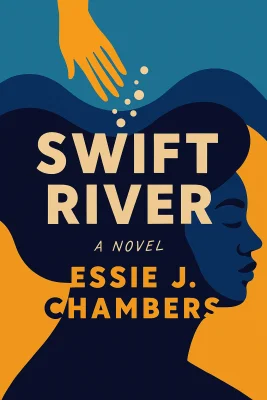
Swift River
Categories
Fiction, Audiobook, Historical Fiction, Adult, Family, Book Club, Historical, African American, Coming Of Age, Literary Fiction
Content Type
Book
Binding
Hardcover
Year
2024
Publisher
Simon & Schuster
Language
English
ISBN13
9781668027912
File Download
PDF | EPUB
Swift River Plot Summary
Introduction
The sneakers sit empty on the riverbank, worn-out and mud-caked from gardening, positioned where the grass meets the sand. This is where Diamond's father disappeared seven years ago, leaving behind only these shoes, his wallet, and house keys tucked inside. The Swift River churns restlessly from summer rains, and nine-year-old Diamond watches men in boats drag hooks and nets across the water, searching for her Pop. They find a tricycle, a mattress, a dead deer with antlers stuck in mud. But no Pop. Now sixteen and weighing nearly three hundred pounds, Diamond lives in a town that calls her and her white mother "riverbeasts." She's the only Black person left in Swift River Valley, a place that once expelled its entire Black population in a single violent night decades ago. Her great-aunt Clara was the only one allowed to stay, delivering babies for the white community. When mysterious letters from a cousin in Georgia arrive, Diamond discovers a hidden family history that will transform her understanding of herself, her father's disappearance, and the town she's desperate to escape.
Chapter 1: Shadows in Swift River: A Town's Hidden History
The summer Diamond turns sixteen, she deliberately lets her bike get stolen. Her body has outgrown the red frame that once carried her through the streets of Swift River Valley, and she can no longer bend enough to pedal without her stomach pressing into her legs. She cleans the bike one last time, scrubbing until the bright color emerges from years of grime, then leaves it against a light pole outside CVS like an offering. Ma finds this hilarious. "You got a new boyfriend?" she calls through their cigarette-hazed window, laughing at Diamond curled around the bike with cleaning supplies. Their house looks like it's having a cigarette too, yellow-stained and sagging. Ma has just lost another job, this time for telling off her boss at the fertilizer store. Now they'll have to live off Diamond's check from the Tee Pee Motel, where she cleans rooms decorated with racist imagery meant to memorialize a Native American massacre. Without the bike, Diamond becomes hyperaware of how she moves through this town. People in cars flip their heads around to stare at her walking down Main Street, blank-faced as if they don't know she's their classmate, their coworker's daughter. Kids at school have called her father "Nigger Jim" because he's Black, somewhere in a river, and has no shoes. They call Diamond "Fishbelly" now. The walk home takes her past the abandoned mill where Pop once worked, past the house where he grew up with his Aunt Clara after moving from Georgia at age seven. These places hold secrets Diamond is only beginning to understand. Pop used to tell her about the Black community that once thrived here, running the textile mill, living in an area they called "Little Delta." One night in 1915, they all left except Clara. Now Diamond realizes this wasn't migration—it was expulsion.
Chapter 2: Letters from the Past: Discovering Aunt Clara's Legacy
The package arrives on a day when the electricity has been shut off. Diamond finds her name written in unfamiliar handwriting: "To: Diamond, From: Auntie Lena." Inside are records, a quilt made from her father's baby clothes, and a letter that will crack her world open. Lena introduces herself as Diamond's second cousin, a nurse from Atlanta who's been caring for family business in Woodville, Georgia. She explains that their great-aunt Clara wasn't just the town midwife—she was a trained doctor who delivered babies for both Black and white families before the exodus. Clara had raised Pop for his first seven years after his mother died in childbirth, before his father took him north to Swift River for what he thought would be a better life. The package contains Clara's letters to her sister Sweetie, written from 1915 to 1954. These letters reveal the truth about "The Leaving"—the night when Swift River's entire Black population was forced out by white vigilantes who set fire to buildings and shot people trying to escape. Clara stayed behind to continue her medical work, living in secret with her French Canadian husband Jacques in the woods, delivering the babies of the same people who had terrorized her community. Diamond hides in her father's abandoned car to read these letters, feeling the presence of ancestors she never knew existed. Clara writes about moonlight and starlight, about learning French words for courage, about the moss that sings when you lie in it. She writes about fear and love, about delivering white babies whose parents don't see her as human, about the loneliness of being the only one left behind. Through Clara's words, Diamond begins to understand why her father carried such sadness, why he never felt safe even in the town where he was supposedly protected. The letters transform her understanding of Swift River from a place where she simply doesn't belong to a place built on the bones of her people.
Chapter 3: The Weight of Absence: Living with Father's Disappearance
Pop's disappearance began long before his shoes appeared by the river. Diamond remembers the summer she was eight, when he started leaving them in slow drips. Ma would make excuses, create curtains of protection around his growing silence and rage. He stopped making Diamond breakfast, stopped looking at her directly, stopped being the father who held her like a cannonball and launched her into the swimming hole. The trouble started after a barbecue at the Campbells' house, where Pop was desperate to prove himself worthy of Tom Campbell's friendship and potential employment. When Tommy Campbell Jr. pushed Diamond to the ground during a game, Pop lifted the boy by his arms and shook him until the child's lips flapped. It was a violation of everything Pop believed about protecting children, about being better than the violence that surrounded them. That night, Pop took Diamond and Ma to catch fireflies by the river. He was drunk on whatever brown liquor Tom had shared, and when Diamond brought him the glowing insects, he made her promise never to scream again. The screaming had started as Diamond's way of releasing the pressure that built up inside her when words got stuck, but Pop saw it as evidence of damage, proof that Swift River was destroying his daughter the way it had destroyed him. After the barbecue, bandana-wearing men began following Ma to work, circling their house in cars, leaving messages that only Pop could decode. The garden he'd built as proof he could feed his family was destroyed, vegetables smashed and scattered with garbage like a taunt. Pop knew his time was running out, that the same forces that had expelled his people were closing in on him. The morning he disappeared, Pop left early without making breakfast, without gas money for the car. Ma stood at the window with her worried look, already knowing something had shifted permanently. Two days later, his sneakers appeared by the water like evidence in a crime scene, his wallet and keys tucked inside as if he'd planned his own disappearance.
Chapter 4: Freedom on the Horizon: Learning to Drive and Planning Escape
Diamond secretly enrolls in driver's education, hiding her permit and forging Ma's signature on forms. She's been saving money from her job, asking her boss Tim to hold back a few dollars each payday until she has enough for lessons. At sixteen, she weighs nearly three hundred pounds and can no longer ride her bike, but she discovers she can drive. Her classmate Shelly Ostrowski becomes an unlikely friend and driving partner. Shelly is known as a "slutty slut" at school, living in a house so filled with junk you can see garbage piled to the windows. But her car is immaculate, organized like a mobile beauty salon with makeup tucked into every available space. She lives in this car more than her house, sometimes sleeping by the river under a red fuzzy blanket. Their driving instructor, Mr. Jimmy, is twenty-nine and trying to pass for younger, wearing Van Halen t-shirts and calling everyone "dude." He quickly develops an inappropriate relationship with Shelly, making out with her in the back seat while Diamond drives them through the countryside. Diamond watches through the rearview mirror, fascinated and disturbed by this adult transaction happening behind her. Shelly plans to move to Florida to live with her mother and work on a dinner cruise boat. She invites Diamond to come with her, painting pictures of beach life and freedom from Swift River's suffocating smallness. For the first time, Diamond can imagine a life beyond the mountains that surround their valley, beyond the stares and whispers that follow her through town. The driving lessons become Diamond's first taste of real independence. Behind the wheel, she controls the speed and direction, feels connected to the wheels and the ground. When she successfully navigates a covered bridge while Mr. Jimmy and Shelly fool around in the back seat, she experiences the intoxicating power of movement, of being able to leave.
Chapter 5: Family Ghosts: Searching for Reflections in Strange Mirrors
While out driving with Shelly and Mr. Jimmy, Diamond spots a Black man with a little girl at a convenience store forty-five minutes from Swift River. The man's arm dangles from his car window, the same shade as Pop's skin, and Diamond's heart flips with the familiar response to unexpected Blackness. Shelly insists they follow the car, convinced this might be Diamond's father living a parallel life. They trail the careful driver to a house with shutters and a well-maintained lawn, watching as he and the little girl are greeted by a Black woman at the door. The family seems impossibly normal—afternoon snacks, backyard pool time, gentle discipline when the girl throws trash from the car window. Diamond is mesmerized by their ordinariness, their ability to exist peacefully in a world that has never been peaceful for her. Mr. Jimmy brings along his friend Rick, a former student with teased hair and missing fingers from a high school chemistry accident. Rick tries to flirt with Diamond by asking about her college plans, and she surprises herself by declaring she wants to study botany. The attention feels good even as she recognizes the flash of disgust in his eyes when he looks at her body. At Rick's trailer in the mobile home park, they drink peppermint schnapps and make a fire. Rick plays guitar and Diamond sings harmony, revealing a voice that makes everyone stop and listen. For a moment, she feels like she's starring in a movie about friendship, about normal teenagers having normal fun. But when she discovers that Shelly's mother has rescinded her invitation to Florida, leaving no backup plan for escape, Diamond spits schnapps into the fire like dragon breath. Later, as Rick goes down on her on his waterbed, Diamond experiences her first orgasm while thinking about family and loss and the impossibility of belonging anywhere. Outside, she watches through a car window as Mr. Jimmy has sex with Shelly, their inappropriate relationship finally crossing into criminal territory. The dream of Florida crumbles as Diamond realizes she's witnessing the end of her first real friendship.
Chapter 6: Claiming Inheritance: Finding Strength in Ancestral Roots
Lena's letters reveal that Diamond has inherited one hundred acres of land in Canada from her great-great-uncle Jacques, Clara's husband. The property includes a lake and hunting grounds that Jacques's father originally received for his work as a translator between Native tribes and European colonizers. This inheritance represents everything Pop never knew he had—land, legacy, the possibility of true ownership. The revelation comes as Diamond and Ma finally obtain Pop's death certificate, making his disappearance legally official after seven years. The court process is surprisingly anticlimactic, just an tired judge with giant dentures saying "Looks good" and a clerk stamping papers. They celebrate by hitching a ride with two young men who turn hostile when Diamond mentions Clara's role as town midwife, recognizing their own family names in her delivery records. The men throw Diamond and Ma from their moving car, leaving Ma with a deep cut requiring stitches. As they sit in a field of goldenrod waiting for help, Diamond sees her mother clearly for perhaps the first time—not as an extension of herself but as a separate person caught in patterns that might never break. Ma looks small and wounded among the wild flowers, still trying to make the best of their situation. When Shelly arrives to drive them to the hospital, Diamond realizes this will be one of their last times together. Shelly admires Ma's beauty, calls her a babe, treats her like a person rather than an embarrassment. In the car, Diamond reveals her plan to visit the Canadian land with Lena, and Ma responds with surprising grace, saying Diamond should have that time with her new family. That night, Ma surprises Diamond with two new bicycles—one red, one blue—bought with borrowed money she plans to repay with the insurance settlement. It's a gesture of love and apology, recognition that Diamond needs freedom to move. But Diamond can't bring herself to thank her mother, not yet ready to forgive the years of small compromises and large disappointments that brought them to this moment.
Chapter 7: The Journey North: Following the Call of Water and Land
Diamond leaves Swift River with Lena and her partner Tilly, heading north to claim the land that represents her father's lost inheritance. The journey takes them through small towns and vast forests, following the route that earlier generations of her family traveled in search of safety and opportunity. Lena tells Diamond about her own struggles with belonging, about being gay in a world that demanded invisibility, about missing Pop's wedding because she was too afraid to bring her girlfriend Laila to meet the family. She explains how secrets can become more important than the people we're supposed to love, how the need for protection can override the need for connection. The Canadian property exceeds all expectations—one hundred acres surrounding a pristine lake, with a small cabin where Clara and Jacques spent their final years together. Diamond sees her reflection in the dark water and understands that she carries the features of all her ancestors: Clara's dimples, Pop's smile, the stubborn chin that helped her great-aunt survive alone in hostile territory for decades. For the first time in her life, Diamond swims without shame, her body weightless in the cold lake water. She performs handstands for the clouds, showing off her legs to the sky, feeling the presence of all the family members who fought and sacrificed so she could exist in this moment. The water holds her up the way love should, the way belonging feels when you finally find the right place. Standing chest-deep in the lake, Diamond calls out to Pop, to Clara, to all the ancestors who speak through instinct and intuition. She understands now that leaving Ma wasn't abandonment but inheritance—the continuation of a family tradition of movement, of searching for places where Black bodies can exist without apology or explanation.
Summary
Diamond's journey from the suffocating confines of Swift River to the liberating waters of her inherited Canadian lake represents more than personal escape—it's the reclaiming of a family legacy nearly erased by historical violence. Through Clara's letters and Lena's courage, she discovers that her father's sadness wasn't weakness but the weight of carrying stolen history, of being the descendant of people who had to choose between community and survival. The novel's final image—Diamond floating in pristine northern waters, her mixed-race body reflecting both her white mother's freckles and her Black father's strength—offers not resolution but possibility. She has learned that belonging isn't about finding the right place but about carrying your people with you wherever you go. The lake holds her up because it recognizes her claim to it, because the water remembers Jacques and Clara's love, Pop's unfulfilled dreams, and the resilience that runs deeper than any river that could carry a person away. In claiming her inheritance, Diamond doesn't just save herself—she honors every ancestor who survived so she could exist, so she could finally, gloriously, take up space in the world without apology.
Best Quote
“Then I grow up and know it’s the opposite—they don’t see me at all. I’m an empty bucket to pour themselves into. They can talk into the deep black well of me and their secrets will never come out.” ― Essie J. Chambers, Swift River
About Author

Essie J. Chambers
Chambers reframes the intricacies of race and family legacy through her novelistic endeavors, inviting readers to engage with themes of historical trauma and identity. Her debut novel, "Swift River", set in a New England mill town during the 1980s, delves into issues of generational trauma, friendship, and racial identity while confronting the harsh realities of sundown towns. Chambers draws on her biracial upbringing in New England to provide a narrative rich with emotional depth and irony, reflecting both her personal history and the larger socio-historical context.\n\nWhile her literary work is deeply informed by her MFA studies at Columbia University, Chambers’ career initially blossomed in the television industry as a senior creative executive at ViacomCBS (Paramount). This background in media, particularly her work on adaptations like Jacqueline Woodson’s "Miracle’s Boys", provided her with a unique perspective on storytelling, further honed through her documentary filmmaking experiences with "Descendant". Readers of her work benefit from her ability to weave complex family and racial histories with poetic language and narrative propulsion, allowing for a deeply empathetic engagement with the material.\n\nEssie J. Chambers' work, particularly "Swift River", has garnered critical acclaim and numerous awards, such as the 2024 Barnes & Noble Discover Prize. The book was also a finalist for the NAACP Image Awards and was selected for the Today Show’s “Read with Jenna” Book Club. This bio highlights her influence as a contemporary author who crafts narratives that resonate with a wide audience, making significant contributions to the exploration of race and identity in literature. Her achievements are marked by a commitment to exploring profound social themes while engaging readers with compelling and empathetic storytelling.
Read moreDownload PDF & EPUB
To save this Black List summary for later, download the free PDF and EPUB. You can print it out, or read offline at your convenience.

Swift River
by Essie J. Chambers
