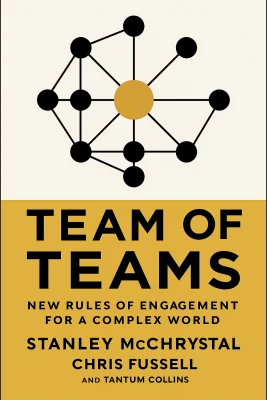
Team of Teams
New Rules of Engagement for a Complex World
Categories
Business, Nonfiction, Self Help, History, Leadership, Audiobook, Management, Military Fiction, Buisness, War
Content Type
Book
Binding
Hardcover
Year
2015
Publisher
Portfolio
Language
English
ISBN13
9781591847489
File Download
PDF | EPUB
Team of Teams Plot Summary
Introduction
# From Command to Network: Leadership Lessons from Modern Warfare The radio crackled to life at 0347 hours in a fortified compound outside Baghdad, carrying news that would challenge everything the world's most elite military force thought they knew about warfare. Intelligence had just intercepted communications revealing that a terrorist network, operating with seemingly primitive resources, had successfully anticipated and countered every strategic move made by the most technologically advanced military in history. The enemy wasn't just surviving—they were thriving, adapting faster than their pursuers could respond, and growing stronger with each engagement. This moment of reckoning would spark one of the most profound organizational transformations in modern history, revealing truths that extend far beyond military operations into every corner of contemporary leadership. In boardrooms and hospitals, classrooms and community organizations, leaders everywhere face the same fundamental challenge: how to maintain effectiveness when the old rules no longer apply. The journey from rigid hierarchy to adaptive network offers a blueprint for anyone seeking to build resilience and agility in our interconnected world. Through stories of failure and triumph, this transformation illuminates a path forward for leaders who recognize that in today's complex environment, the greatest strength lies not in commanding others, but in unleashing their collective potential to achieve what no individual could accomplish alone.
Chapter 1: The Shape-Shifting Enemy: When Hierarchy Meets Networks
The morning of October 15, 2004, began like any other in the Green Zone, with intelligence analysts poring over intercepts and surveillance footage, searching for patterns in the chaos of insurgent activity. But by noon, everything had changed. A coordinated series of attacks across Baghdad demonstrated a level of sophistication and timing that defied every assumption about how terrorist organizations operated. Car bombs detonated simultaneously at multiple checkpoints, drawing security forces away from their posts just as suicide bombers struck government buildings. The attacks weren't random acts of violence—they were the carefully orchestrated movements of a network that could think, adapt, and strike with devastating precision. What made these attacks so troubling wasn't their brutality, but their intelligence. Each operation demonstrated intimate knowledge of security protocols, perfect timing to exploit vulnerabilities, and seamless coordination between cells that had no apparent direct communication. The enemy had evolved beyond traditional organizational structures into something resembling a living organism, capable of learning from each encounter and adapting its tactics faster than conventional military forces could respond. Like a shape-shifting entity from ancient mythology, this adversary refused to hold a fixed form that could be targeted and destroyed. The Task Force found itself fighting an enemy that embodied the future of organizational structure while remaining trapped in the past. Every advantage that had made them the world's premier counterterrorism force—superior training, advanced technology, overwhelming firepower—proved inadequate against an opponent that could evolve in real time. The network's strength lay not in its individual components, but in the speed and flexibility of connections between them. This wasn't just a military problem; it was a preview of how interconnected, adaptive networks would challenge traditional hierarchies across every sector of society. The question was no longer whether to change, but whether they could transform quickly enough to survive.
Chapter 2: Beyond the Machine: From Efficiency to Adaptability
Frederick Winslow Taylor stood in the Midvale Steel Company foundry in 1881, stopwatch in hand, watching workers load pig iron onto railroad cars. What he observed troubled him deeply—men working at different paces, using various techniques, with no systematic approach to maximize output. Taylor began timing every movement, analyzing each gesture, and redesigning workflows to eliminate wasted motion. His revolutionary approach could increase productivity from twelve tons per day to forty-seven tons, not through harder work, but through perfect efficiency. Workers became interchangeable components in a magnificent machine, and the industrial age found its guiding philosophy. For over a century, Taylor's principles shaped everything from factory floors to military commands. Organizations became marvels of specialization and control, where every role was clearly defined, every procedure optimized, and every outcome predictable. The Task Force itself embodied this legacy—an awesome machine where elite operators executed flawless missions according to carefully rehearsed plans. Like Roman legions building identical camps across their empire, modern organizations found comfort in standardization, hierarchy, and the pursuit of maximum efficiency through minimum variation. But the world had evolved faster than the organizations trying to manage it. The same technological advances that gave the Task Force unprecedented capabilities also created an environment of bewildering complexity, where small events could trigger massive consequences and where the pace of change outstripped any individual's ability to control it. Taylor's clockwork universe, where inputs produced predictable outputs, had given way to something far more volatile and interconnected. The butterfly effect wasn't just a scientific curiosity; it had become the defining characteristic of the modern operational environment. Being the most efficient organization in the world meant nothing if you couldn't adapt to constant change, and the pursuit of perfect control had become a recipe for catastrophic failure when facing adaptive adversaries who thrived on unpredictability.
Chapter 3: Building Trust: The Foundation of Effective Teams
Captain Chesley Sullenberger felt the birds strike US Airways Flight 1549 just ninety seconds after takeoff from LaGuardia Airport on January 15, 2009. Both engines lost power simultaneously, leaving him with an Airbus A320 carrying 155 people and no thrust to maintain altitude. In the next three minutes and twenty-eight seconds, Sullenberger and his crew would face decisions that no training manual could have prepared them for, with no time for detailed analysis or consultation with ground control. Their survival would depend entirely on their ability to function as a seamless team under the most extreme pressure imaginable. The cockpit became a symphony of rapid communication as the crew shared observations, tested options, and adapted their plan in real time. First Officer Jeffrey Skiles immediately began running through emergency checklists while Sullenberger took control of the aircraft. Flight attendants Donna Dent, Doreen Welsh, and Sheila Dail prepared the cabin for impact while maintaining calm among increasingly anxious passengers. Air traffic controller Patrick Harten offered runway options at nearby airports, but Sullenberger quickly realized they wouldn't make it to any conventional landing site. "We're gonna be in the Hudson," he announced, making a decision that would either save everyone aboard or kill them all. What followed was a masterpiece of team coordination under pressure. The crew communicated constantly—thirty-one interactions per minute—with each member contributing expertise while supporting the collective effort. When they successfully ditched in the Hudson River, saving all 155 people aboard, investigators discovered that their technical training had been almost irrelevant to the outcome. What saved them was their ability to think and act as a unified team, sharing information instantly, adapting to unprecedented circumstances, and maintaining trust in each other when individual expertise reached its limits. This distinction between commands that wait for orders and teams that solve problems together would prove crucial for any organization facing complexity that exceeds what traditional hierarchy can manage.
Chapter 4: Shared Vision: Information as Organizational Oxygen
President Kennedy stood before a sweating crowd at Rice University on September 12, 1962, and made a promise that seemed impossible: America would land a man on the moon and return him safely to Earth before the decade ended. The challenge was staggering—the necessary metals hadn't been invented, heat shields couldn't withstand reentry temperatures, and nobody knew if the lunar surface could support a spacecraft's weight. Meanwhile, across the Atlantic, European space efforts were failing spectacularly as ELDO rockets exploded on launch pads, victims of interface failures between components built by different countries that refused to share critical information with each other. NASA succeeded where ELDO failed not because of superior technology, but because of superior information sharing. Under George Mueller's leadership, NASA dismantled traditional organizational boundaries and created what amounted to a nervous system for the entire Apollo program. Engineers who had worked in isolated departments suddenly found themselves in daily communication with counterparts across the country. Contractors weren't kept at arm's length but brought inside, given full access to the project's complexities and challenges. Information flowed instantly through networks of radio loops and teleconferences that connected every team to every other team, creating unprecedented transparency across the entire enterprise. This approach violated every principle of efficient organization—specialists spent time learning about systems outside their expertise, meetings multiplied exponentially, and information flowed to people who didn't strictly need it. But this apparent inefficiency made the impossible possible. When problems arose, solutions emerged from unexpected quarters because everyone understood the complete picture. When Apollo 13 faced catastrophic system failures, engineers across the program contributed to solutions because they possessed shared consciousness about how all the pieces fit together. The Task Force would learn the same lesson in Iraq: in complex environments, information isn't just power—it's oxygen. Without it flowing freely throughout the organization, even the most capable teams suffocate, and the most brilliant individual insights remain trapped and useless when they're needed most.
Chapter 5: Empowered Decision-Making: Leading Like a Gardener
Admiral Horatio Nelson paced the deck of HMS Victory on the morning of October 21, 1805, knowing that the coming battle would determine whether Britain maintained its naval supremacy or fell to the combined fleets of France and Spain. His tactical plan was audacious—instead of the traditional parallel battle lines that had governed naval warfare for centuries, he would punch through the enemy formation at right angles, creating chaos that would prevent their commanders from coordinating an effective response. But Nelson's real genius wasn't tactical; it was in how he had prepared his captains for the moment when smoke and confusion would make central command impossible. In the months before Trafalgar, Nelson had patiently cultivated what he called his "band of brothers," spending countless hours with his captains, sharing not just battle plans but his deeper philosophy of naval warfare. He wanted them to understand not merely what to do, but why they were doing it, so they could make good decisions when circumstances inevitably deviated from any predetermined script. His guidance was elegantly simple: "No captain can do very wrong if he places his ship alongside that of the enemy." When battle commenced and signal flags became invisible through the smoke, each captain made independent decisions based on the situation before him, yet all their actions served the common purpose. The result was one of history's most decisive naval victories—nineteen enemy ships captured or destroyed, zero British ships lost. Nelson had discovered something profound about leadership in complex, rapidly changing situations: the most effective commanders don't try to control everything from the center. Instead, they create conditions where others can make good decisions throughout the organization. This principle would revolutionize how the Task Force operated in Iraq, as leaders learned to function more like gardeners than chess masters, cultivating the right environment for growth rather than trying to direct every move. The shift required enormous trust and courage, accepting that empowerment sometimes leads to mistakes while recognizing that the alternative—maintaining tight control in a complex world—leads to bigger failures and missed opportunities that no single leader can prevent.
Chapter 6: The Zarqawi Hunt: Transformation in Action
The intelligence breakthrough came at 2:17 AM on June 7, 2006, when signals intercepted from a safe house in Baghdad revealed that Abu Musab al-Zarqawi, the most wanted terrorist in Iraq, was meeting with key lieutenants at a location north of the capital. Under the old system, this information would have traveled up through multiple layers of command, been analyzed by separate intelligence agencies, and eventually resulted in a mission brief for operators who had played no role in developing the intelligence. By the time authorization came down through the chain of command, the opportunity would have vanished. Instead, the transformed Task Force moved like a living organism. Intelligence analysts worked directly with operators, sharing raw data and insights in real time. Air support coordinated seamlessly with ground forces, while partner agencies that had once guarded their secrets jealously now contributed information freely to the collective effort. Within hours, surveillance assets confirmed Zarqawi's presence at an isolated house near Hibhib. F-16 fighters were airborne, armed with precision-guided munitions, while backup teams positioned themselves to exploit any intelligence recovered from the site. At 6:12 PM, two 500-pound bombs ended Zarqawi's reign of terror, but the real victory wasn't the death of one man—it was proof that a new kind of organization could thrive in the complex modern world. The operation succeeded because information flowed instantly across traditional boundaries, decisions were made by people closest to the action, and every participant understood how their role contributed to the larger mission. The Task Force had evolved from a collection of elite teams into something unprecedented: a network that could match its adversary's adaptability while maintaining superior capabilities and resources. This transformation revealed that the choice facing every modern organization isn't between hierarchy and chaos, but between rigid control that fails in complex environments and adaptive networks that can thrive amid constant change.
Summary
The transformation revealed in these pages offers more than a military success story; it provides a blueprint for leadership in our interconnected age. When traditional hierarchies encounter networked challenges, the result is often frustration, failure, and missed opportunities that no amount of individual brilliance can overcome. But organizations willing to embrace radical transparency, genuine empowerment, and shared purpose can achieve remarkable results even in the most challenging circumstances. The path forward requires courage to abandon comfortable certainties and embrace uncomfortable changes, building trust across traditional boundaries and sharing information that was once closely guarded. Most importantly, this journey reveals that effective leadership in complex environments means creating conditions where good decisions emerge naturally throughout the organization rather than trying to control every choice from the center. Like gardeners tending an ecosystem rather than chess masters directing pieces, modern leaders must cultivate environments where teams can adapt, learn, and respond to challenges that exceed any individual's capacity to understand or control. In a world where change is the only constant and complexity is the new normal, the choice is clear: transform into adaptive networks capable of thriving amid uncertainty, or remain trapped in structures designed for a simpler world that no longer exists. The tools and principles exist to build organizations equal to these challenges; the question is whether we possess the wisdom and courage to embrace them.
Best Quote
“The temptation to lead as a chess master, controlling each move of the organization, must give way to an approach as a gardener, enabling rather than directing. A gardening approach to leadership is anything but passive. The leader acts as an “Eyes-On, Hands-Off” enabler who creates and maintains an ecosystem in which the organization operates.” ― Stanley McChrystal, Team of Teams: New Rules of Engagement for a Complex World
Review Summary
Strengths: The book is praised for clearly explaining how outdated organizational structures can be adapted to modern needs, providing a clear path to creating agile organizations. It includes compelling examples, particularly the organizational change of The Task Force against Al Qaeda, which adds interest. Weaknesses: Criticisms include excessive repetition, lack of novel insights compared to existing business literature, and limited applicability of lessons. Some readers found it more of a nostalgic account rather than a practical guide, and questioned the relevance of its military focus. Overall: The book received mixed reviews, with some appreciating its insights on organizational change, while others found it repetitive and lacking in new ideas. It may appeal to those interested in military strategies applied to business but might not satisfy those seeking fresh leadership concepts.
About Author
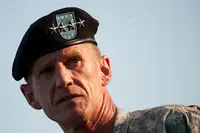
Stanley McChrystal
McChrystal delves into the transformative power of leadership in high-stakes environments, weaving military precision with adaptable strategies applicable to diverse fields. His leadership philosophy emerges from years of commanding the Joint Special Operations Command, where he was instrumental in the global counterterrorism efforts, including the capture of Saddam Hussein and the elimination of Abu Musab al-Zarqawi. This experience laid the foundation for his book "Team of Teams," which introduces a leadership model that promotes flexibility and rapid decision-making. For readers interested in leadership, his works offer insights into the balance between hierarchical structure and agile responsiveness.\n\nBeyond his military career, McChrystal extends his expertise into the civilian sector through the McChrystal Group, a consulting firm that adapts military lessons to business contexts. His post-military endeavors, including his role as a senior fellow at Yale University, demonstrate his commitment to fostering leadership skills across disciplines. Meanwhile, McChrystal's literary works, such as his memoir "My Share of the Task," provide a candid bio of his career and the challenges faced during pivotal military operations. Readers and organizations seeking to navigate complex environments can benefit from his unique perspective on leadership and strategy.\n\nAs an author, McChrystal synthesizes his military experiences into actionable insights for both individuals and organizations. His work has been recognized as redefining how military and government agencies interact, showing that his leadership principles have wide-ranging applicability. Therefore, his books serve not only as a narrative of his own experiences but as a guide for others looking to lead effectively in dynamic settings.
Read moreDownload PDF & EPUB
To save this Black List summary for later, download the free PDF and EPUB. You can print it out, or read offline at your convenience.
Team of Teams
by Stanley McChrystal
