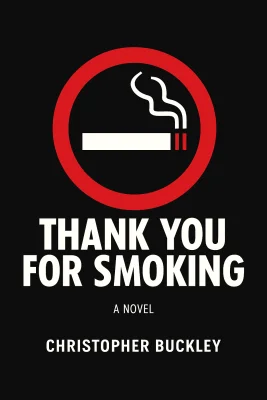
Thank You for Smoking
Categories
Fiction, Politics, Literature, American, Humor, Book Club, Contemporary, Novels, Comedy, Satire
Content Type
Book
Binding
Paperback
Year
2006
Publisher
Random House Trade Paperbacks
Language
English
ASIN
0812976525
ISBN
0812976525
ISBN13
9780812976526
File Download
PDF | EPUB
Thank You for Smoking Plot Summary
Introduction
Nick Naylor adjusted his silk tie as he stepped into the lions' den—a hotel ballroom packed with 2,500 health professionals who viewed him as Satan incarnate. The image projected on the wall behind the podium showed his face bathed in hellish red, with the caption: "Warning: Some people will say anything to sell cigarettes." As chief spokesman for the Academy of Tobacco Studies, Nick had perfected the art of defending the indefensible, spinning death into doubt with the smooth precision of a con artist in an Armani suit. The crowd purred like predators sensing blood. They had come to witness the public flaying of tobacco's most eloquent advocate, the man who could stand before grieving families and argue that cigarettes might actually be good for you. But Nick thrived on this hostility. In a world where his industry killed 1,200 people daily—two jumbo jets worth of casualties—he had learned to weaponize charm, deflect with statistics, and transform moral outrage into procedural debates. Tonight, facing a woman whose uncle had died of lung cancer, he would demonstrate why he was worth every penny of his six-figure salary.
Chapter 1: The Merchant of Death: Nick Naylor's World of Spin
The woman's voice cracked as she described her uncle's "courageous battle" with lung cancer. Nick nodded sympathetically, absorbing every gruesome detail with the practiced composure of a funeral director. When she finished with the inevitable question—"How can you sleep at night?"—he was ready. "I appreciate your sharing that with us," Nick began, his voice carrying the perfect blend of empathy and authority. "But I think the issue here is whether we as Americans want to abide by such documents as the Declaration of Independence, the Constitution, and the Bill of Rights." He paused, letting the patriotic rhetoric sink in. "Your uncle, who I'm sure was a very fine man, might just agree that if we tamper with bedrock principles for the sake of unscientific speculation, we risk our children's freedoms." The non sequitur was breathtaking, but Nick pressed on without missing a beat. He invoked Murad the Fourth, the Turkish sultan who executed people for smoking, painting modern anti-tobacco advocates as bloodthirsty tyrants. The audience sat stunned as he transformed their moral crusade into an assault on American liberty. Back at the Academy's K Street offices, Nick reviewed his performance with satisfaction. The building's ten-story atrium created an inside-out Hanging Gardens of Babylon, complete with a massive fountain providing soothing white noise. From his interior corner office, he could leave his door open and let cigarette smoke drift into the vast space—even smokers, he reasoned, cared about proper ventilation. His assistant Gazelle handed him a stack of pink message slips. The networks wanted his reaction to the Surgeon General's call for billboard advertising bans. USA Today needed a response to tomorrow's story about Buerger's disease, which required amputating victims' extremities. Just another day at the office for America's most notorious corporate apologist. Nick's expertise lay in the alchemy of doubt. Where others saw causation, he found correlation. Where science offered certainty, he demanded more research. His favorite office poster captured his philosophy perfectly: "Smoking is the nation's leading cause of statistics." In a world of data and studies, Nick had learned that confusion was more powerful than clarity, and doubt more valuable than truth.
Chapter 2: Nicotine Nightmare: The Kidnapping and Its Aftermath
The fake fireplace at Bert's Grill cast its ersatz glow over the weekly lunch meeting of the Mod Squad—an acronym for Merchants of Death. Nick sat with his fellow pariahs: Bobby Jay Bliss from the gun lobby and Polly Bailey from the liquor industry. They called themselves this because, as Nick often joked, that's what the press would inevitably name them if their unholy alliance ever became public. "My product puts away 475,000 people a year," Nick declared, competitive even in mortality statistics. "That's 1,300 a day. Your numbers don't even come close." It was their twisted version of locker room bragging—who killed more Americans annually through perfectly legal products. The camaraderie would prove prophetic. Days later, Nick found himself facing his greatest challenge yet when a homeless man approached him outside his office building. The man's eyes were clearer than most street dwellers, and when he asked for cigarettes, Nick obligingly handed over a pack and lighter. Following the man toward the escalators, Nick felt something poke his back. "That's the muzzle of a nine millimeter," the voice said, no longer the mumbled speech of a vagrant. "Do everything I tell you or you'll be on a slab with a tag on your toe." The kidnapping unfolded in broad daylight among hundreds of witnesses, yet no one intervened as Nick was forced into a dark limousine. His captors, led by a man with a creepy Peter Lorre accent, transported him to an undisclosed location where the real horror began. They stripped him naked and began covering every inch of his body with nicotine patches—dozens of them, delivering a potentially lethal dose of the drug he'd spent years claiming was harmless. "Look at de bright side, Neek," his captor taunted as Nick's heart began racing toward cardiac arrest. "After dis, I bet you're never going to want to smoke anodder cigarette again."
Chapter 3: Blowing Smoke: Media Darling and FBI Target
Nick's rescue came through sheer luck—park police found him stumbling near the Vietnam Memorial, covered head to toe in patches, vomiting violently as his heart fibrillated. The irony was exquisite: the man who claimed smoking was safe had nearly died from an overdose of pharmaceutical nicotine. His would-be executioners had left a sign around his neck reading "Executed for crimes against humanity." The media circus that followed transformed Nick from corporate villain into unlikely victim. Suddenly, the man who'd spent years dodging bullets was fielding sympathy calls from competitors and invitations from talk shows. His appearance on Larry King became must-see television when a caller threatened to "dispatch" him on live television, adding another layer to his newfound martyrdom. But success bred suspicion. FBI agents Monmaney and Allman began asking uncomfortable questions about Nick's convenient survival and the massive publicity windfall that followed. Their investigation took disturbing turns—why would kidnappers leave evidence so easily found? How did Nick's fingerprints end up on nicotine patch boxes discovered at a rented Virginia cabin? The agents' questions grew more pointed during uncomfortable interviews. They wanted to know about Nick's ambition, his psychological state after the infamous incident years earlier when, as a television reporter, he'd announced the President's death due to a communications mix-up involving code names. The stock market had plummeted 180 points before the White House produced the very much alive President, earning Nick the lasting nickname "The Three Billion Dollar Man." As the FBI's net tightened, Nick realized someone was methodically framing him for his own kidnapping. The evidence was too neat, too convenient. Someone with intimate knowledge of his life had orchestrated this elaborate setup, transforming his moment of triumph into a potential life sentence for conspiracy and fraud.
Chapter 4: Ashes to Ashes: Betrayal and Downfall
The web of deception began unraveling when Nick discovered the truth about his closest colleagues. Jeannette Dantine, the ice-blonde communications director who'd become his lover, had been collecting evidence against him through their intimate encounters. Those late-night rendezvous in his apartment weren't just passion—they were intelligence-gathering operations. BR Rohrabacher, Nick's boss and Jeannette's real partner, had orchestrated the entire scheme. Coming from the murky world of cigarette vending machines—where mob connections ran deep and problems disappeared permanently—BR saw Nick's popularity with the company's chairman as a threat to his own ambitions. The kidnapping was meant to eliminate Nick while generating sympathy for the tobacco industry, but when the hired killers botched the job, BR and Jeannette improvised. The "condoms" Jeannette had insisted on using during their encounters were actually empty nicotine patch boxes, carefully planted to collect Nick's fingerprints. Phone calls were made from his office to the Virginia cabin. A piece of paper with the cabin's number was planted in his apartment. Each piece of evidence was meticulously crafted to paint Nick as a narcissistic publicity hound who'd staged his own near-death experience. The Captain—Doak Boykin, the tobacco industry's legendary patriarch—lay dying in a Winston-Salem hospital when Nick arrived to plead his case. The old man's heart was failing, patched together with pig valves and regret. "Son," he wheezed, "tobacco takes care of its own." But his proposed solution was as morally bankrupt as the industry he'd built: take ten million dollars, plead guilty, and disappear to a minimum-security prison while BR consolidated power. Nick's refusal to accept the blood money sealed his fate. The Captain died that night, taking with him any hope of justice from within the industry's ranks.
Chapter 5: Fighting Fire with Fire: Revenge and Redemption
Stripped of his job, his reputation, and his freedom, Nick faced the prospect of federal prison. His expensive lawyer, Steve Carlinsky, had a sudden conflict of interest when the tobacco lobby offered his firm a massive retainer. The message was clear: take the deal or face the consequences alone. But Nick had one ally left. Gomez O'Neal, the Academy's mysterious head of intelligence and a man with his own shadowy past, provided the key to revenge. He revealed that BR's "Team B" assassination squad had been eliminating tobacco liability litigants by staging "accidental" deaths—cigarette fires that claimed smoking victims before they could testify in court. The knowledge came with a price. These weren't bumbling kidnappers but professional killers who'd perfected the art of poetic justice—burning their victims alive with the very product they'd blamed for their illnesses. Any attempt to expose them would result in Nick joining their casualty list. Instead of going to the authorities, Nick chose a different path. With his fellow Merchants of Death—Polly and Bobby Jay—he orchestrated an elaborate counteroperation. They tracked down the Peter Lorre impersonator who'd tortured Nick, following him through his pathetic attempts at legitimate theater in New York's off-off-Broadway scene. The kidnapping of Nick's kidnapper became a masterpiece of psychological warfare. Using recorded conversations that implicated "Team A"—their code name for BR—they convinced the actor that his employers were planning to eliminate him as a loose end. The terrified killer fled into the night, presumably to share his knowledge with anyone who'd listen.
Chapter 6: Clear Air: A New Life Beyond Tobacco
Justice came swiftly after that. BR Rohrabacher was found dead in Jeannette's apartment, apparently from smoke inhalation—another "accidental" cigarette fire that fooled no one in law enforcement. Jeannette vanished, rumored to be working in an upscale brothel somewhere in Southeast Asia, catering to clients with specialized tastes. Nick's legal troubles evaporated with BR's death and Jeannette's flight. The FBI quietly dropped their investigation, recognizing that their carefully constructed case had been built on fabricated evidence. The real conspirators were dead or gone, leaving only questions that would never be answered in court. Years later, Nick found himself on Larry King's show again, but this time as the author of "Thank You for Smoking," his tell-all memoir about his years as tobacco's chief liar. The irony wasn't lost on anyone: the man who'd once claimed cigarettes were safe now worked for an anti-smoking organization, warning children about the very products he'd spent his career promoting. He'd married Polly—his former fellow Merchant of Death—and they were expecting their first child. She'd abandoned the liquor lobby for the Fetal Alcohol Syndrome Foundation, while Bobby Jay had found religion in a federal prison cell, becoming a leader in the Christian Prison Fellowship.
Summary
"I wrote the book for money," Nick told Larry King with characteristic honesty, his hand resting on his pregnant wife's shoulder. The studio lights reflected off his wedding ring—a symbol of redemption that seemed impossible just years before. The man who'd once defended the indefensible now spent his days warning others about the very products he'd promoted, working for Clean Lungs 2000 with the fervor of the converted. The tobacco industry continued its work without him, finding new spokesmen to peddle doubt and delay regulation. But Nick's transformation represented something unprecedented in the world of corporate advocacy—a Merchant of Death who'd lived to tell the tale. His book's dedication honored two men: the Captain, who'd shown him that even monsters could feel remorse, and Lorne Lutch, the dying Tumbleweed Man who'd chosen dignity over dollars. In the end, Nick discovered that the most powerful spin of all was the simple, devastating truth about what he'd done and who he'd served. The art of deception, it turned out, was no match for the weight of a clear conscience and the love of a good woman who'd once been just as lost as he was.
Best Quote
“Necessity is the motherfucker of invention.” ― Christopher Buckley, Thank You for Smoking
Review Summary
Strengths: The review highlights Christopher Buckley's adept use of wit and satire, particularly through clever character naming and humorous language. The novel's timing is praised for capturing a pivotal moment in tobacco industry history, enhancing its relevance and impact. The humor is noted as a standout feature, with Buckley's timing and language being particularly effective. Overall: The review conveys a highly positive sentiment, recommending "Thank You For Smoking" for its sharp social and political satire. The humor and clever narrative are emphasized as key strengths, making it a worthwhile read for those interested in satirical takes on serious issues.
About Author

Christopher Buckley
Buckley delves into the absurdities of American politics and society through sharp political satire. By using humor and irony, his writing critiques government bureaucracy and media culture, therefore offering readers a lens to view contemporary issues with a satirical twist. Buckley's approach often merges political themes with farcical and absurdist elements, making his works resonate with those interested in both wit and incisive social commentary.\n\nIn his career as an author, Buckley has crafted several notable books that blend humor with critique. "Thank You for Smoking," perhaps his best-known work, humorously critiques the tobacco industry's tactics and has been adapted into a film. Meanwhile, his early book "Steaming to Bamboola" offers a more personal narrative, inspired by his time as a merchant seaman. Buckley’s work extends beyond novels; he has contributed over 60 comic essays to The New Yorker, further cementing his reputation for blending satire with incisive critique.\n\nReaders who appreciate a humorous yet critical take on political and social issues will find Buckley's works both entertaining and thought-provoking. His distinct style has earned him significant recognition, including the Thurber Prize for American Humor, highlighting his impact on American satire. This bio encapsulates Buckley as a significant voice in literary and political satire, whose work continues to engage and challenge audiences.
Read moreDownload PDF & EPUB
To save this Black List summary for later, download the free PDF and EPUB. You can print it out, or read offline at your convenience.
Thank You for Smoking
by Christopher Buckley
