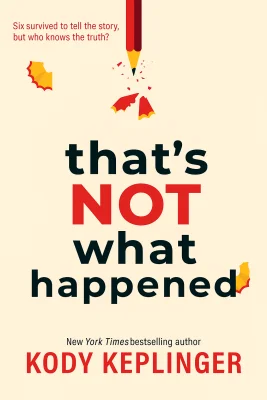
That's Not What Happened
Categories
Fiction, Mental Health, Audiobook, Mystery, Young Adult, Thriller, Contemporary, LGBT, Realistic Fiction, Teen
Content Type
Book
Binding
Hardcover
Year
2018
Publisher
Scholastic Press
Language
English
ISBN13
9781338186529
File Download
PDF | EPUB
That's Not What Happened Plot Summary
Introduction
The parking lot of Virgil County High School was nearly empty when Leanne Bauer spotted the note tucked beneath her windshield wiper. Three years had passed since the massacre that tore through her freshman biology class, three years since she watched her best friend Sarah McHale die in a blood-soaked bathroom stall. Now, as a senior on the verge of graduation, Leanne thought the ghosts of that March morning had finally begun to fade. But Brother Lloyd's handwritten message changed everything: "We need to talk." Sarah's story had become legend—the brave Christian girl who died defending her faith, clutching her cross necklace as bullets flew. Churches across Indiana held rallies in her honor. A Christian rock song bore her name. And now Sarah's parents were writing a book about their martyred daughter. The problem was, none of it was true. Leanne had been there, holding Sarah's trembling hand as terror consumed them both. She knew the real story. And she knew that another girl's voice had been stolen in the process—Kellie Gaynor, the goth outcast who had actually spoken those final words to the gunman, whose cross necklace was buried with the wrong girl.
Chapter 1: The False Martyrdom: Sarah's Story Unravels
The first time Leanne saw Sarah's face on a community bulletin board, staring down from a youth rally flyer with the caption "The Girl with the Cross Necklace," she felt her world shift beneath her feet. Four months had passed since the shooting, four months of therapy and medication and sleepless nights spent on her roof with Miles Mason, the troubled boy next door who had become her unlikely anchor in the darkness. Her mother found her that evening, sitting in front of the computer at three in the morning, tears streaming down her face as she scrolled through conspiracy theory forums claiming the shooting never happened. The internet had become Leanne's addiction and her torment—a place where she could read about herself and her dead best friend, where strangers debated the truth of their trauma as if it were entertainment. But this was different. This wasn't some basement blogger spinning theories about crisis actors. This was her community, her neighbors, transforming Sarah McHale into something she had never been. The Sarah they worshipped wore a cross necklace and quoted scripture in her final moments. The Sarah Leanne knew had been sneaking around with her secret boyfriend, applying contraband makeup in bathroom mirrors, and cracking jokes about self-righteous classmates. "It wasn't her necklace," Leanne whispered to Miles one night as they lay on the roof, staring up at stars that felt too much like oblivion. "She never said those things to him. It's all wrong." Miles turned his head toward her, his sleepy hazel eyes catching moonlight. He had saved Ashley Chambers in the hallway that day, throwing himself over her bleeding body as bullets flew overhead. The media called him an unlikely hero—the troubled kid with the suspended record who became something noble in his darkest hour. "So tell someone," he murmured. But they both knew it wasn't that simple. The story had grown too big, become too important to too many people. Sarah's face smiled down from church billboards now, her alleged final words printed on inspirational posters. The truth had become just another casualty of that March morning.
Chapter 2: Collecting Fragments: Letters from the Survivors
The idea came to Leanne like lightning striking twice—once when she read Denny Lucas's scholarship essay, and again when she learned about the book deal. Denny, the blind student who had lost his two best friends in Ms. Taylor's computer science class, had written something remarkable. Instead of playing the inspirational survivor, he had torn apart the narrative people expected from him. "I don't think I deserve this scholarship because I'm a black kid from a poor community who was born blind and then survived a shooting," he had written. "I deserve this scholarship because of my ambition and talent." His words crackled with defiance, rejecting the tragic hero role thrust upon him by media coverage that focused more on his disability than his dreams of becoming a tech innovator. If Denny could reclaim his story, maybe they all could. Leanne began reaching out to the other survivors, asking each to write their truth. Ashley Chambers-Osborne, the former student council president whose spine had been shattered by a bullet, responded first. She wrote about forgiveness and faith, about how the shooting had actually strengthened her belief in God's plan. But she also revealed something crucial—she was the one who had started the Sarah story, misinterpreting what she had overheard from the hallway. Eden Martinez came next, the quiet artist whose cousin Rosa had died beside her in the computer lab. Eden's letter arrived drunk and desperate, confessing years of alcoholism hidden behind her public activism. The girl who gave powerful speeches about gun control at colleges across the Midwest was drowning in vodka and survivor's guilt, using her dead cousin's memory to build a platform she felt too broken to deserve. Each letter peeled back another layer of the mythology that had grown around March 15th. These weren't the noble survivors the world expected to see. They were damaged teenagers who had grown into damaged adults, carrying secrets and shame that no news camera had ever captured. But there was still one voice missing—the most important one of all.
Chapter 3: Resistance and Revelations: Miles's Hidden Truth
Miles Mason had always been the most reluctant survivor, the one who changed the subject whenever heroism was mentioned. Leanne pushed him hardest, convinced that his story needed telling most of all. The media had painted him as the bad boy redeemed, the troubled kid with the suspended record who found his nobility in crisis. She couldn't understand his resistance until the night everything fell apart. They were at prom, an evening that had started perfectly. Miles in his absurd neon orange vest, Leanne in the simple black dress that carried a whisper of Sarah's favorite lipstick. They had danced slowly to country love songs, and for a moment the weight of trauma lifted from her shoulders. But then came the confrontation in the parking lot, Peter McHale screaming at her about his dead cousin, pinning her against a wall while panic consumed her vision. Miles found her there, cowering on the asphalt as flashbacks pulled her back to that blood-soaked bathroom. He helped her to her feet, drove her home, and handed her a crumpled wad of notebook pages. "Don't read it in front of me," he whispered. "I can't watch you hate me." His letter shattered everything she thought she knew about that day. Miles hadn't been a hero at all. He had been walking to the principal's office with Coach Nolan, fresh from another fight, when the shooting started. The teacher had run toward the gunman, shouting for him to stop, to put down the weapon. Miles had frozen, watching in horror as two bullets tore through Nolan's chest. Then he ran—not to save Ashley Chambers, but to save himself. He tripped over her bleeding body and played dead, too terrified to move as more shots echoed from the girls' bathroom. "I got him killed," Miles wrote. "Coach Nolan would still be alive if I hadn't been such a screwup, if I'd just listened to him instead of throwing another punch. He wanted to help me when no one else thought I was worth saving. And if I'd just let him, he would never have been in that hallway." The revelation should have changed everything between them. Instead, it drew them closer than ever before.
Chapter 4: The Town Turns: Facing Backlash for Speaking Out
Brother Lloyd had been waiting in the school parking lot, his baby-blue button-down and striped tie marking him as overdressed for a man supposedly making casual conversation. But nothing about his approach felt casual as he positioned himself between Leanne and her truck door, his forced smile failing to mask the steel in his voice. "The McHales are worried about you," he said. "Some of the things you've been saying lately have me concerned." He spoke like a man delivering a diagnosis, his tone suggesting that Leanne's truth-telling was a symptom of some deeper illness. When she refused to promise silence about Sarah's real story, his mask slipped entirely. "If word gets out that you're saying these things, people aren't going to take too kindly to it." The harassment started small—a keyed truck door, eggs thrown against her house in the dead of night. Then came the confrontations, angry church members cornering her in grocery stores and restaurants. Peter McHale's cousins threw tater tots at her during lunch, their red-faced fury turning the cafeteria into hostile territory. Tara Chambers, Ashley's younger sister, grabbed her wrist at prom and hissed, "It should've been you that died in the bathroom that day." Each attack felt like a replay of what had happened to Kellie Gaynor three years earlier, when the goth girl had tried to tell the truth about whose cross necklace the police had found. Leanne remembered seeing Kellie surrounded by angry adults in the grocery store, grown men spitting at a wounded teenager while her mother tried to pull her toward safety. The Gaynor family had been driven from town within months, their windows broken and their reputation destroyed. Now it was Leanne's turn to feel the weight of a community's rage. Virgil County needed its martyred saint, its inspirational story of faith conquering evil. The truth was just another inconvenience to be bullied into silence. But this time, Leanne refused to back down. She had spent three years carrying the weight of her cowardice, three years watching lies flourish while authentic voices were crushed. Even as the hostility escalated, even as former family friends turned their backs, she kept gathering letters from the other survivors. The truth, she believed, would eventually matter more than the comfortable fiction the town preferred to embrace.
Chapter 5: Confronting Kellie: The Real Owner of the Cross
The café was nearly empty when Kellie Gaynor walked in twenty minutes late, her appearance so transformed that Leanne almost didn't recognize her. Gone was the blue-black hair and heavy eyeliner of memory, replaced by a bleached blonde bob and square-framed glasses. She had gained weight, changed her name to Renee, and built an entirely new identity around the absence of her old one. "So what do you want?" Kellie asked, lighting a cigarette in the middle of the restaurant as if rules no longer applied to her. When a server asked her to put it out, she complied with the weary resignation of someone accustomed to disappointment. Leanne explained about the letters, about her plan to counter the McHales' book with the survivors' real stories. She expected gratitude, maybe even enthusiasm. Instead, Kellie laughed—a bitter sound that cut through the café's quiet atmosphere like broken glass. "You want to know how I'm doing?" Kellie said. "Fine. I'm good. I go by Renee now, and almost everyone knows me as Renee Marks. My friends think I moved away from Virgil County before the shooting happened. They don't ask me questions about it because why would they? The only person from that place they know is me, and I'm not Kellie Gaynor anymore." She had rebuilt herself from nothing, erasing every trace of the girl who had owned the cross necklace, who had spoken those final words to the gunman. But the cost had been everything—her name, her history, her voice. Even her own family seemed relieved when she stopped talking about the truth. "I used to want people to know what really happened," Kellie continued. "I told everyone I could when I was sixteen, when I thought it actually mattered. But that story was more powerful than either of us, Lee. The sweet, pretty dead girl dying a martyr for her beliefs is way better than the angry emo chick stuttering out answers because she doesn't know what the maniac with the gun wants to hear." As Kellie spoke, Leanne began to understand the true weight of what she had been asking. She wasn't just collecting stories—she was demanding that people relive their trauma for an audience that might not care, might not believe, might turn on them just as viciously as before. The truth, she realized, wasn't always liberating. Sometimes it was just another form of violence. Kellie stood to leave, gathering her purse and finishing her coffee in one bitter gulp. "Every time I spoke up, I got shouted down," she said. "My voice was stomped out. So Sarah's parents can write whatever book they want. Mine is to try like hell to put this behind me. And that's really hard when you keep emailing and calling constantly." She walked away without a goodbye, leaving Leanne alone with the wreckage of her good intentions and the uncomfortable knowledge that sometimes the most merciful thing you can do is let people keep their carefully constructed lies.
Chapter 6: Surrendering Control: The Letters Find Their Home
Summer arrived with the weight of unfinished business hanging over everything. Leanne had graduated, Miles had been accepted to community college, and the McHales' book had become a bestseller with movie rights already optioned. The letters sat on her computer like unexploded bombs—Ashley's confused faith, Eden's alcoholic confessions, Denny's angry defiance, Miles's crushing guilt, and her own sprawling attempt to make sense of it all. She couldn't publish them without Kellie's consent, but she couldn't destroy them either. They represented too much pain, too much truth, too much hope for redemption. The answer came to her finally in August, as she prepared for her cross-country drive to California and a new life as far from Virgil County as possible. The café meeting was brief and businesslike. Leanne handed Kellie a USB drive containing everything—all the letters woven together with her own narrative, the complete story of six teenagers whose voices had been stolen and reshaped by a world hungry for meaning in senseless tragedy. "You can destroy it if you want," Leanne said. "Or you can publish it. Or anything. It's yours now. All of the others gave permission for you to use it however you choose." Kellie turned the drive over in her fingers, its blue plastic surface catching the afternoon light. "Why do I get this? Why not someone else?" "Because of all of us, you're the one who has suffered the most. We saw you being silenced, we saw your voice get taken away, and we didn't do anything to help. So this is our way of trying to give you control of your story again." Miles waited by the truck, their entire lives packed into boxes under a blue tarp. They were heading west together, toward uncertainty and possibility, leaving behind the small town that had shaped them in blood and silence. As they drove away, Leanne watched Kellie through the passenger mirror until distance swallowed her completely. For the first time in three years, she felt something approaching peace. The truth was no longer her burden to carry alone.
Chapter 7: Moving Forward: Truth, Love, and Leaving Virgil County
The highway stretched endlessly ahead as Leanne and Miles drove toward California, their old truck loaded with hope and haunted by memory. They had found something fragile and precious in each other—a love built on understanding, on shared survival, on the recognition that healing doesn't always look like the world expects it to. Leanne's asexuality didn't frighten Miles away; instead, it became another truth they navigated together, like the nightmares and the anniversary anxiety and the way certain sounds could still send them both diving for cover. Behind them, Virgil County continued its quiet existence, sustained by the comfortable fiction of Saint Sarah and her martyrdom. The town needed its miracle, its proof that faith could triumph over evil. They would never willingly surrender the story that gave meaning to their grief, that transformed a senseless tragedy into something resembling divine purpose. But in a college dorm room hours away, Kellie Gaynor sat staring at a computer screen, reading the real stories of six survivors for the first time. The McHales' bestselling book lay nearby, its glossy cover promising inspiration and redemption. She had read it too, looking for her own reflection in its pages and finding only absence—not hatred or condemnation, but something worse: complete erasure. As she typed her own letter, adding her voice to the chorus of truth-tellers, Kellie felt something she hadn't experienced in years: the possibility of being heard. Not as Kellie Gaynor, the lying attention-seeker of small-town legend, but as Renee, the young woman who had survived both bullets and silence, who had rebuilt herself from nothing and now held the power to decide which stories would be told.
Summary
In the end, the truth found its way into the world not through grand gestures or media campaigns, but through the quiet courage of broken people choosing to trust each other with their real stories. Leanne and Miles built their love on a foundation of radical honesty, accepting each other's limitations and traumatic edges without demanding transformation. Eden sobered up and learned to separate her public activism from her private healing. Denny won his scholarships and headed off to study technology, carrying his friends' memories in code and innovation rather than grief. The letters became Kellie's gift to give or withhold, a restoration of the agency that had been stolen from her in those chaotic months after the shooting. She had been erased from her own story, transformed into a villain and then forgotten entirely, but now she held the power to decide how—or if—the truth would be told. Whether she chose publication or silence, the act of choosing belonged to her alone. Sometimes the most important victories happen in small spaces—a truck cab rolling west toward morning, a dorm room where a young woman types her truth into the darkness, a community of survivors who refuse to let their authentic voices be buried beneath the weight of others' expectations. The world may prefer its martyrs simple and its heroes uncomplicated, but real healing happens in the messy spaces between legend and life, where broken people learn to love each other exactly as they are.
Best Quote
“It’s a good story. And you know what people like way more than the truth? A good story.” ― Kody Keplinger, That's Not What Happened
Review Summary
Strengths: The book is praised for its honest and real portrayal of the aftermath of a school shooting, focusing on the survivors rather than the shooter. It avoids sensationalism and morbidity, offering a thought-provoking narrative that challenges the hero narrative often associated with such tragedies. The approach of examining the event years later is appreciated, and the book is described as a fast read. Weaknesses: A subplot regarding a character's sexuality is criticized for feeling forced and disrupting the story's flow. Additionally, one reader found it difficult to connect with the characters, leading to a lack of engagement. Overall: The book is generally well-received for its unique perspective and depth, though some elements may not resonate with all readers. It is recommended for its important themes, despite some narrative issues.
About Author

Kody Keplinger
Keplinger reframes the landscape of young adult literature by emphasizing authenticity and diversity in storytelling. Her works delve into themes such as identity, friendship, and self-acceptance, reflecting her commitment to portraying the nuanced realities of teenage life. This focus is evident in her debut book, "The DUFF", which explores complex social dynamics and became a bestseller, highlighting her ability to resonate with readers. Keplinger's literary style features realistic dialogue and relatable characters, making her stories accessible to a broad audience, including reluctant readers who seek genuine narratives.\n\nBeyond her novels, Keplinger contributes significantly to the conversation around representation in literature. She co-founded Disability in KidLit, an initiative that advocates for accurate disability representation in children's and young adult books. Her own experiences with legal blindness inform her writing, allowing her to authentically address issues like disability and mental health. This dedication to inclusion is further exemplified in her graphic novel "Poison Ivy: Thorns", where she explores themes of identity and transformation within a visually engaging format.\n\nReaders benefit from Keplinger's works as they offer not only entertainment but also an opportunity to engage with diverse perspectives. Her stories encourage self-reflection and understanding, providing valuable insights into the challenges and triumphs of adolescence. By addressing relevant social issues, Keplinger has become an influential figure in contemporary literature, earning recognition such as YALSA's Top Ten Quick Pick for Reluctant Young Readers for "The DUFF". Her ongoing impact is evident in both her literary achievements and her advocacy for diversity and inclusion.
Read moreDownload PDF & EPUB
To save this Black List summary for later, download the free PDF and EPUB. You can print it out, or read offline at your convenience.
That's Not What Happened
by Kody Keplinger
