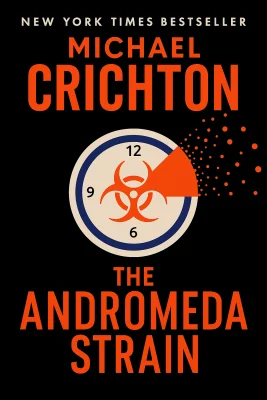
The Andromeda Strain
Categories
Fiction, Classics, Science Fiction, Audiobook, Horror, Mystery, Thriller, Science Fiction Fantasy, Novels, Suspense
Content Type
Book
Binding
Mass Market Paperback
Year
2003
Publisher
Avon
Language
English
ASIN
0060541814
ISBN
0060541814
ISBN13
9780060541811
File Download
PDF | EPUB
The Andromeda Strain Plot Summary
Introduction
In the Nevada desert, beneath layers of concrete and steel, five scientists descended into humanity's most secret laboratory as death swept across a small Arizona town. Within hours, every living soul in Piedmont lay dead in the streets, victims of something that had fallen from space. The Scoop VII satellite, designed to collect organisms from the upper atmosphere, had returned with more than anyone bargained for. Now the Wildfire team faced a terrifying reality: an alien organism that killed with ruthless efficiency, and humanity's survival hung on understanding something completely beyond earthly experience. The clock was already ticking. Unknown to the scientists buried five levels underground, their quarantine had failed. The organism was evolving, changing, adapting to Earth in ways no one could predict. What began as a mission to contain an extraterrestrial threat would become a desperate race against an enemy that defied every assumption about life itself.
Chapter 1: First Contact: Death Descends from Above
The first sign of disaster came through static-filled radio transmissions from the Arizona desert. Lieutenant Roger Shawn and Private Lewis Crane had tracked the Scoop VII satellite to the tiny town of Piedmont, population forty-eight. Their van, equipped with sophisticated radio direction-finding equipment, had brought them to what should have been a routine recovery mission. Instead, they found something that would haunt the final recordings of their lives. "Sir, we see bodies. Lots of them. They appear to be dead," Shawn's voice crackled through the speakers at Vandenberg Air Force Base. The transmission grew increasingly disturbed as the two men described corpses scattered throughout the streets, people who seemed to have simply dropped where they stood. Then came the most chilling observation: a figure in white robes walking among the dead, stepping over bodies as if they were obstacles in his path. The final transmission ended with screams and the crushing sound of metal. Vandenberg lost contact with Caper One at exactly 11:46 PM. In the mission control room, Lieutenant Edgar Comroe stared at the silent radio, understanding that something unprecedented had occurred. The Scoop program, designed to collect microorganisms from the edge of space, had brought back something that turned a peaceful desert town into a graveyard in a matter of hours. As he reached for the red phone to alert his superiors, Comroe had no way of knowing he was initiating humanity's first biological crisis. Major Arthur Manchek received the call thirty minutes later. A methodical engineer who prided himself on logical thinking, Manchek reviewed the evidence with growing unease. The satellite had been in perfect condition during its orbital flight. The town had shown no signs of distress before the satellite's arrival. Yet within hours of contact, everyone was dead. Everyone except one man in white robes, captured on reconnaissance photographs, walking among the corpses with apparent immunity. The decision came swiftly. Manchek authorized the implementation of Wildfire Alert, a protocol that had been theoretical until this moment. Deep in classified files, a phone number existed for exactly this scenario. As he dialed the binary sequence that would awaken the Wildfire team, Manchek felt the weight of what he was unleashing. The world's most advanced biological containment facility was about to face its first real test.
Chapter 2: Assembly of the Wildfire Team: Scientists Against the Unknown
Jeremy Stone's dinner party ended abruptly when military personnel arrived at his Stanford home. The Nobel laureate in bacteriology had spent years designing the Wildfire protocol, never fully believing it would be activated. Now, as he was escorted to a waiting aircraft, the theoretical had become terrifyingly real. The satellite recovery at Piedmont meant that for the first time in human history, Earth faced contamination from space. Stone's brilliant mind had anticipated this possibility during the planning phases of America's biological warfare defense programs. Along with four other scientists, he had designed Wildfire as humanity's insurance policy against exactly this scenario. Dr. Charles Burton, a pathologist known for his methodical approach to understanding how organisms kill. Dr. Peter Leavitt, a clinical microbiologist whose pessimistic worldview made him perfectly suited to expect the worst. Dr. Christian Kirke, an anthropologist whose logical mind could find patterns where others saw chaos. And Dr. Mark Hall, the team's surgeon and the project's crucial "Odd Man." Hall represented the most controversial aspect of Wildfire's design. Government studies had determined that unmarried men made better decisions in nuclear crisis situations. Since Wildfire's underground laboratory was equipped with an atomic self-destruct device, Hall carried the unique responsibility of being the only team member authorized to prevent or allow detonation. His single status, the researchers believed, freed him from the emotional constraints that might paralyze married men when facing decisions that could kill millions. The team converged on a secret airfield in Nevada, each man grappling with the reality that their academic theories were about to be tested against an unknown biological threat. Stone carried photographs from the Piedmont reconnaissance flights, images that defied explanation. Bodies scattered in streets with no apparent cause of death. No signs of struggle, no indication of panic. Just death, swift and inexplicable, that had claimed an entire community in a matter of hours. As their aircraft descended toward the hidden Wildfire facility, the five scientists understood they were entering uncharted territory. The organism they were about to face had traveled across the vacuum of space, survived re-entry, and demonstrated the ability to kill with an efficiency that suggested intelligence. Whether that intelligence was natural evolution or something more deliberate remained to be discovered in the sterile corridors below.
Chapter 3: Survivors Among the Dead: The Clues in Piedmont
Stone and Burton's helicopter touched down in Piedmont as the desert sun cast long shadows across the silent streets. Encased in pressurized biological suits, the two scientists moved through a landscape that resembled a battlefield without violence. Bodies lay where they had fallen, some clutching their chests, others collapsed mid-step. The buzzards had already been gassed to prevent them from carrying contamination beyond the town limits, their carcasses scattered among the human dead. The satellite itself had been taken to Dr. Benedict's house, where the town physician had apparently tried to examine it before succumbing to whatever had killed the rest of Piedmont. They found Benedict seated at his desk, textbooks open around him, his eyes wide with an expression of startled surprise. The Scoop VII capsule sat nearby, its hull cracked open with crude tools. The doctor's final act had been curiosity, and it had killed him along with everyone else in town. Yet not everyone had died the same way. As Stone and Burton continued their survey, they discovered that some residents had survived long enough to engage in bizarre behavior. An elderly woman had hanged herself, leaving a note about Judgment Day. A man had drowned himself in his bathtub, holding his head underwater with impossible determination. Others had consumed poison or committed acts of self-destruction that suggested madness had preceded death. The organism didn't simply kill; it drove people insane first. The pattern began to emerge as they completed their grim census. Most victims had died quickly, dropping where they stood as their blood clotted throughout their bodies. But a subset had lived longer, their minds affected by the organism in ways that led to suicide and bizarre behavior. Two categories of death from a single cause, suggesting that the organism affected different people in different ways. The question that would haunt their investigation had already formed: what made some people vulnerable to quick death while others descended into madness? Then came the sound that changed everything. Through the silence of the dead town, they heard crying. Following the sound to its source, they found a baby, perhaps two months old, screaming in his crib while his parents lay dead nearby. The infant was healthy, hungry, and very much alive. In the basement of another house, they discovered their second survivor: Peter Jackson, an elderly man weakened by blood loss but conscious and coherent. Two people had survived what had killed forty-six others, and understanding why would determine whether humanity could survive what was coming.
Chapter 4: Laboratory Labyrinth: Descent into Containment
The Wildfire laboratory represented the pinnacle of biological containment technology, a five-level underground complex where each descending floor maintained higher levels of sterility than the one above. Hall found himself subjected to increasingly rigorous decontamination procedures as the team descended toward Level V, where the Scoop capsule waited in absolute isolation. Automated systems analyzed his body chemistry, stripped away clothing that was immediately incinerated, and subjected him to chemical baths designed to eliminate any possible contamination. The facility operated on a simple but terrifying principle: if containment failed, a nuclear device would sterilize the entire installation. Hall carried the key that could prevent this atomic cleansing, a responsibility that weighed heavily as he learned the laboratory's capabilities. Teams of scientists working in pressurized suits could examine specimens through mechanical hands, their every action transmitted through servo systems that translated human movement into precise manipulations of the deadly organism. Dr. Leavitt experienced his first seizure as they approached Level V, collapsing in the corridor as warning lights triggered his epileptic condition. The flashing emergency signals sent him into convulsions, revealing a medical condition he had hidden from his colleagues. Stone and Hall managed his care while dealing with their own mounting stress, realizing that the team was already beginning to fracture under pressure they had barely begun to face. Meanwhile, Burton established his autopsy protocols in sterile chambers where he could examine tissue samples from Piedmont's victims. The microscopic analysis revealed the organism's method of killing: total coagulation of the blood supply, turning liquid circulation into solid mass within seconds. Yet this discovery only deepened the mystery, as it failed to explain why two people had survived or why others had lived long enough to go insane. Level V represented the ultimate in biological security, but it also created a psychological pressure none of them had anticipated. Cut off from the outside world, breathing recycled air in artificial environments, the team found themselves in a race against time that was as much psychological as scientific. The organism waited in its sealed chamber, patient and alien, while four scientists struggled to understand something that might be beyond human comprehension.
Chapter 5: The Crystalline Enemy: Understanding Andromeda
Under the electron microscope's intense magnification, the organism revealed its true nature. Unlike any life form found on Earth, it displayed a perfect geometric structure: hexagonal crystals arranged in precise mathematical patterns that suggested engineering rather than evolution. Each unit interlocked with its neighbors like pieces of an impossible puzzle, creating a structure that pulsed from green to purple as it reproduced with mechanical precision. Stone and Leavitt watched in fascination as the organism demonstrated capabilities that defied biological understanding. It required no traditional nutrients, consuming carbon dioxide and converting energy directly into matter through processes that resembled controlled nuclear reactions more than cellular metabolism. The creature produced no waste, achieved perfect efficiency, and grew at exponential rates when provided with the right conditions. It was evolution perfected, or perhaps something that had never needed to evolve at all. The spectroscopic analysis confirmed their worst fears. The organism contained none of the amino acids that formed the building blocks of Earth life. No proteins, no DNA, no RNA. It was constructed from simple ring molecules arranged in complex patterns that generated properties far beyond their individual components. Like a computer built from simple switches that could perform calculations no single switch could accomplish, the organism achieved intelligence through structure rather than chemistry. Burton's biological tests revealed the organism's preferred environment with chilling clarity. It thrived in pure carbon dioxide under ultraviolet radiation, conditions that existed in the upper atmosphere and in space itself. Earth's oxygen-rich environment was hostile to its growth, but not fatal. The organism was perfectly adapted for existence in the vacuum between worlds, designed to travel, survive, and colonize wherever it landed. As they studied its crystalline perfection, the team began to understand they were facing something unprecedented in human experience. This was not evolution as Earth understood it, but something engineered, purposeful, and terrifyingly efficient. The organism designated Andromeda represented either the ultimate achievement of natural selection or proof that intelligence existed elsewhere in the universe. Either possibility meant that humanity's assumptions about life itself were catastrophically wrong.
Chapter 6: Mutation and Crisis: The Changing Threat
The first sign that their understanding was incomplete came through the laboratory's automated monitoring systems. Gaskets throughout Level V began failing simultaneously, their synthetic materials dissolving as if exposed to acid. Hall realized the connection to the crashed military aircraft over Utah, whose pilot had reported his rubber components disintegrating moments before his death. The organism was changing, mutating from something that killed humans to something that consumed synthetic materials. The implications struck them with terrifying clarity. If the organism had been stable, they might have contained and studied it safely. But they were dealing with something that transformed itself constantly, adapting to new environments with a speed that made conventional biological research impossible. The creature that had killed Piedmont was no longer the same organism they held in isolation. It had become something new, something that fed on the very materials that kept their laboratory sealed. Burton found himself trapped in the autopsy lab as containment failed around him, the seals dissolving under assault from the mutated organism. His colleagues watched helplessly through monitors as he faced death with the same swift efficiency that had claimed Piedmont. Yet Burton survived, breathing air thick with organisms that should have killed him in seconds. The mutation had rendered Andromeda harmless to humans, but its appetite for synthetic materials threatened to release it into an unprepared world. Hall's investigation of the survivors revealed the key to human immunity. Peter Jackson's chronic alcoholism and aspirin consumption had created a state of metabolic acidosis that made his blood chemistry hostile to the original organism. The baby's constant crying had produced a similar effect, altering the acid-base balance of his blood beyond the organism's tolerance range. Survival hadn't been random; it had been biochemical, based on conditions that disrupted the organism's ability to reproduce in human bloodstream. The discovery offered hope even as their situation deteriorated. They understood how the organism killed and how it could be stopped. But time was running out. The mutated form that consumed synthetic materials could escape containment and spread across Earth's surface, where it might continue evolving in directions no one could predict. The team faced a choice between nuclear sterilization that would destroy their research and the risk of releasing an unpredictable alien intelligence into Earth's biosphere.
Chapter 7: Race Against Destruction: Preventing Catastrophe
The nuclear countdown began automatically as containment systems failed throughout Level V. Hall found himself separated from the detonation controls by sealed blast doors, with less than three minutes to reach a substation before the atomic device would sterilize the facility and everything within a five-mile radius. The explosion would scatter mutated organisms across the desert, creating thousands of variations that might adapt to destroy human civilization itself. Fighting through the central core access shaft, Hall battled automated defense systems designed to prevent exactly what he was attempting. Ligamine darts struck him repeatedly as he climbed toward Level IV, each hit delivering paralytic doses calculated to stop a laboratory animal. His greater body mass kept him moving, but barely, as respiratory paralysis began shutting down his nervous system with each labored breath. The irony of the situation struck him even as consciousness faded. The organism had evolved beyond its original threat, becoming something that consumed rubber and plastic rather than human life. The atomic device that was designed to protect Earth from biological contamination would instead spread a relatively harmless mutation across the globe, where it would continue evolving in unpredictable directions. The cure had become worse than the disease. With seconds remaining, Hall's key found its target and stopped the countdown. The nuclear detonation that would have created a new crisis was averted, leaving the team to deal with an organism that had already moved beyond their ability to contain it. The mutated Andromeda had escaped into the upper atmosphere hours earlier, carried by natural air currents beyond any possible human intervention. As reports arrived from Los Angeles, the scientists realized their victory was incomplete. The organism had passed over the city without causing harm, apparently having evolved beyond its original deadly nature. But they had learned a crucial lesson about humanity's vulnerability to threats from space. Earth's biological defenses were designed for terrestrial life, not for organisms that followed completely different rules of existence.
Summary
The Andromeda crisis ended not with human triumph, but with the humbling realization that Earth's encounter with alien life had been survived by luck rather than wisdom. The organism that had killed Piedmont had evolved beyond human threats, becoming something that fed on synthetic materials before presumably returning to the upper atmosphere from which it came. The Wildfire team had learned to understand their enemy just as it transformed into something entirely different. The broader implications of their experience resonated far beyond the classified walls of the underground laboratory. Humanity had faced its first contact with extraterrestrial intelligence and discovered how unprepared it was for such encounters. The organism's crystalline perfection suggested engineering rather than evolution, hinting at intelligences that operated by rules Earth life had never encountered. Whether Andromeda represented a scout, a test, or simply a cosmic accident remained unknown. In the aftermath, as NASA quietly suspended its space missions and the Wildfire facility continued its vigilant watch, the scientists carried with them the knowledge that Earth's isolation was an illusion. The universe contained life forms that could cross the void between worlds, adapt to alien environments, and evolve at speeds that made human responses seem geological in their slowness. The Andromeda strain had been survived, but it had also served as a warning. Earth's next encounter with the cosmos might not end with humanity's narrow escape from the stars.
Best Quote
“The rock, for its part, is not even aware of our existence because we are alive for only a brief instant of its lifespan. To it, we are like flashes in the dark.” ― Michael Crichton, The Andromeda Strain
Review Summary
Strengths: The book contains all the right elements typical of Crichton's writing, making it a very good read. The reviewer appreciates the book's compelling premise involving an expert scientific team dealing with an alien threat. Weaknesses: The ending is described as "unbelievably anticlimactic." The reviewer's enjoyment was diminished due to reading it immediately after "Sphere," which shares a similar premise and was preferred by the reviewer. Overall: The reviewer rates the book three stars, attributing this to the timing of reading it after "Sphere." Despite this, the book is recommended, with the advice to space out reading it and "Sphere" to enhance enjoyment.
About Author

Michael Crichton
Crichton extends the boundaries of storytelling through meticulous scientific research and a fast-paced narrative style, drawing readers into worlds where science and suspense intertwine. His dedication to scientific accuracy and engaging plots is evident in his diverse body of work, including novels written under pseudonyms like John Lange and Michael Douglas. His early book, "A Case of Need", showcases this blend of medical expertise and thrilling plotlines, earning him the Edgar Award and setting the stage for a prolific career. Crichton's writing consistently challenges readers to explore complex themes of technology, ethics, and human nature.\n\nFor Crichton, the method of embedding factual scientific elements within his narratives not only heightened the realism but also educated his audience, making his novels both entertaining and informative. He leveraged his medical background, having graduated from Harvard Medical School, to craft stories that were both credible and compelling. Readers benefit from his ability to simplify intricate scientific concepts without diluting their complexity, fostering a deeper understanding of the possible implications of scientific advancements. Therefore, his work remains highly relevant to readers interested in science fiction and thriller genres.\n\nCrichton's impact on literature is undeniable, with over 200 million books sold globally and translations in thirty-eight languages. His narratives have transcended the written word, with thirteen of his books adapted into films, expanding his reach and influence. The author’s unique approach to weaving science into fiction has left a lasting legacy, appealing to a wide range of audiences who appreciate the fusion of factual science with imaginative storytelling. This short bio underscores Crichton's role in shaping the modern landscape of science fiction and thriller novels, illustrating why his works continue to captivate and inform readers worldwide.
Read moreDownload PDF & EPUB
To save this Black List summary for later, download the free PDF and EPUB. You can print it out, or read offline at your convenience.
The Andromeda Strain
by Michael Crichton
