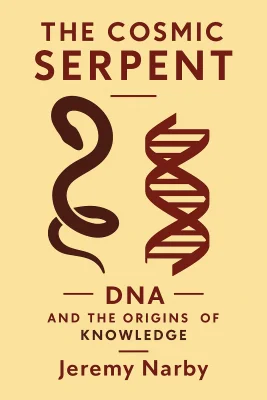
The Cosmic Serpent
DNA and the Origins of Knowledge
Categories
Nonfiction, Psychology, Philosophy, Science, History, Religion, Spirituality, Anthropology, Audiobook, Biology
Content Type
Book
Binding
Paperback
Year
1999
Publisher
TarcherPerigee
Language
English
ASIN
0874779642
ISBN
0874779642
ISBN13
9780874779646
File Download
PDF | EPUB
The Cosmic Serpent Plot Summary
Introduction
In the heart of the Peruvian Amazon, a young anthropologist sits cross-legged on a wooden platform as darkness envelops the forest. The bitter taste of ayahuasca still lingers on his tongue when suddenly, brilliant fluorescent serpents materialize before his eyes. These serpents speak without words, conveying a profound message about human existence and our place in the cosmos. This transformative encounter would launch him on a journey spanning continents and disciplines, connecting ancient shamanic wisdom with cutting-edge molecular biology in ways that challenge our fundamental understanding of life. This intellectual adventure explores the startling parallels between indigenous knowledge systems and modern science. At its core lies a provocative question: what if shamans, through their plant-induced visions, gain access to biological information at the molecular level? What if their cosmic serpents, ladder-like vines, and spiraling staircases to heaven represent the same double helix structure that Western science only discovered in 1953? By weaving together anthropology, biology, and personal experience, the author illuminates the potential common ground between seemingly opposed worldviews, suggesting that wisdom flows not just through academic channels but through the living network of all existence.
Chapter 1: The Anthropologist's Journey into Amazonian Mysteries
When Jeremy Narby arrived in the Ashaninca village of Quirishari in 1985 as a twenty-five-year-old anthropology doctoral student, he was determined to document indigenous resource management practices. His goal was straightforward: to demonstrate that these forest-dwelling people used their environment rationally, contrary to what government development experts claimed. The young anthropologist was firmly grounded in Western rationality and materialistic thinking, skeptical of anything that couldn't be empirically verified. During his fieldwork, Narby frequently heard references to ayahuasqueros—shamans who used hallucinogenic plants to acquire knowledge. The locals matter-of-factly explained that their extensive botanical expertise came from drinking ayahuasca, a bitter brew that allowed them to communicate with the spirits of plants. When one Ashaninca man showed him a medicinal plant that could cure a deadly snake bite, Narby asked how he had discovered this property. The answer was simple: "One learns these things by drinking ayahuasca." The man wasn't joking. This posed a dilemma for the rational anthropologist. His scientific training told him that hallucinations couldn't be a source of real information—that would be the definition of psychosis. Yet these seemingly "primitive" people had developed sophisticated ecological knowledge, including the preparation of curare, a complex muscle-paralyzing substance requiring precise ingredients and techniques. Modern pharmaceutical companies routinely derived valuable medicines from plants identified by indigenous healers. The contradiction was stark. Eventually, curiosity overcame skepticism. In the neighboring community of Cajonari, a man named Ruperto Gomez offered to guide Narby through an ayahuasca session. "You know, brother Jeremy, to understand what interests you, you must drink ayahuasca," Ruperto insisted. Despite initial reservations, Narby agreed. That night, after drinking the bitter brew, he was transported into a realm of intense visions dominated by two enormous, terrifying snakes that communicated with him telepathically. The experience profoundly shook his worldview, suggesting there might be forms of knowledge acquisition beyond the rational methods he had been taught to trust. This encounter marked the beginning of Narby's intellectual transformation. The shamans claimed that ayahuasca was "the television of the forest" through which they received biological information. Rather than dismissing this as superstition, Narby began to wonder if there might be a neurological basis for these claims. Could these hallucinatory experiences somehow provide access to information about the molecular properties of plants? His quest to understand this enigma would eventually lead him to examine the connections between shamanic visions and the molecular foundations of life itself.
Chapter 2: Plant Teachers and the Serpent of Knowledge
Carlos Perez Shuma, an experienced Ashaninca shaman in his mid-forties, became Narby's primary guide into the world of indigenous knowledge. Carlos had lost his parents to epidemics when he was five, learned shamanic practices from his uncle, and later studied at an Adventist mission where he mastered Spanish. This unusual combination of traditional and Western education made him an ideal bridge between worlds. During their recorded conversations, Carlos explained the shamanic path with disarming directness. "My uncle was a tabaquero," Carlos recounted. "I watched him take lots of tobacco, dry it a bit in the sun, and cook it until the mixture was good and black. When he ate his tobacco, he could give people good advice." The uncle's healing methods confused missionaries, who claimed he was "listening to his Satan." But Carlos's uncle would challenge patients seeking his help: "Why do you ask me to cure you, when you say you know God now that you are at the mission? Why don't you ask the pastor to pray?" Yet he would heal them anyway, using tobacco, precise diagnosis, and plant remedies that consistently proved effective. Intrigued by this process, eight-year-old Carlos began his apprenticeship, learning to consume tobacco despite its overwhelming bitterness. "That's the secret of tobacco," his uncle told him. Over time, Carlos expanded his knowledge to include ayahuasca under his father-in-law's guidance. When Narby asked about the enormous snakes he had seen in his ayahuasca vision, Carlos replied matter-of-factly, "Next time, bring your camera and take their picture. That way you will be able to analyze them at your leisure." When Narby laughed, saying the visions wouldn't appear on film, Carlos insisted they would "because their colors are so bright." Carlos explained that the tabaqueros and ayahuasqueros received their knowledge directly from nature itself: "That is how nature talks, because in nature, there is God, and God talks to us in our visions." According to Carlos, tobacco attracted the maninkari—invisible spirits or animate essences found in animals, plants, mountains, and crystals. These beings were the source of all knowledge: "The maninkari taught us how to spin and weave cotton. Before, our ancestors lived naked in the forest. Who else could have taught us to weave? That is how our intelligence was born." Most striking was Carlos's explanation of the relationship between shamanic plants: ayahuasca was "the mother" while tobacco was "the child." When pressed further about who truly owned these plants, Carlos answered: "The owner of these plants, in truth, is like God; it is the maninkari." And what was the true nature of the enormous serpents seen in ayahuasca visions? "Its because the mother of ayahuasca is a snake," Carlos explained simply. In other words, the mother of the mother of tobacco is a snake. This ancestral knowledge system revealed a complex cosmology where the boundaries between plants, animals, and humans blurred. The shamanic worldview positioned humans within an intelligent, communicative network of life rather than above it. While Western science studied nature as an object, shamans engaged with it as a subject. Their methods of acquiring knowledge—through hallucinations, dreams, and direct communication with plants—challenged the very foundations of scientific epistemology, suggesting alternative pathways to understanding the natural world that modern rationality had forgotten or deliberately excluded.
Chapter 3: Molecular Visions: When Shamans See DNA
In 1992, at the Earth Summit in Rio de Janeiro, a curious contradiction emerged. Representatives of the world's governments, pharmaceutical companies, and scientific institutions suddenly acknowledged the value of indigenous botanical knowledge. Treaties were signed recognizing the importance of compensating traditional knowledge "equitably." Yet there was a glaring omission in these discussions: no one mentioned the source of this knowledge as claimed by indigenous people themselves—hallucinatory communication with plants. Scientists had long been astounded by the botanical expertise of Amazonian peoples. The ayahuasca brew itself represented sophisticated biochemistry: it combined plants containing DMT (dimethyltryptamine), a powerful hallucinogen that's ineffective when swallowed alone, with plants containing MAO inhibitors that prevent stomach enzymes from neutralizing the DMT. As ethnobotanist Richard Evans Schultes noted, "One wonders how peoples in primitive societies, with no knowledge of chemistry or physiology, ever hit upon a solution to the activation of an alkaloid by a monoamine oxidase inhibitor." This mystery deepened with the revelation that the most renowned shamans insisted their knowledge came directly from plant-induced hallucinations. Salvador Chindoy, a respected healer from Colombia's Sibundoy Valley, maintained that plants themselves taught him their medicinal properties through hallucinations. Yet scientists dismissed these claims, as Western knowledge maintains that hallucinations cannot convey real information and that plants cannot communicate in human-like ways. Narby's personal experience with ayahuasca had given him a different perspective. The visions of enormous, fluorescent serpents that so many ayahuasca users reported seemed too consistent to be random mental noise. Could there be something to the shamans' claims? While reading Michael Harner's account of his ayahuasca experience among the Conibo Indians in the 1960s, Narby encountered a crucial clue. Harner had seen "dragon-like creatures" who showed him how they had "created life on the planet in order to hide within the multitudinous forms." In a footnote, Harner added: "In retrospect one could say they were almost like DNA, although at that time, 1961, I knew nothing of DNA." This connection sparked Narby's investigation into the potential relationship between shamanic visions and molecular biology. He discovered that the Desana people of Colombia depicted the human brain with a snake lodged between the two hemispheres. Their shamans described "two intertwined snakes... imagined as spiralling rhythmically in a swaying motion from one side to another." The Desana also claimed that "in the beginning of time their ancestors arrived in canoes shaped like huge serpents." Similar twin serpent imagery appeared across cultures that used ayahuasca. The Yagua spoke of creation by cosmic twins. The Australian Aborigines, separated from other cultures for 40,000 years, described creation by a "Rainbow Snake" associated with quartz crystals—just like the Desana. When Narby examined the visionary paintings of Pablo Amaringo, a retired Peruvian ayahuasquero, he found them filled with double helixes, zigzag ladders, and twisted snakes. This global pattern of twin creator serpents, cosmic ladders, and serpentine vines connecting heaven and earth suggested a profound correspondence. What if shamans, in their defocalized state of consciousness, were perceiving the molecular foundations of life itself? What if DNA—the twisted ladder of life common to all organisms—was what cultures worldwide had been describing as the cosmic serpent? The implications were revolutionary: indigenous people might have been accessing and describing the molecular level of reality long before Western science developed the tools to see it.
Chapter 4: Twisting Languages: Genetic Code and Spiritual Communication
The connection between DNA and shamanic visions extended beyond visual similarities into the realm of language. Narby discovered that Yaminahua shamans of the Peruvian Amazon used what they called "twisted language" (tsai yoshtoyoshto) to communicate with spirits during ayahuasca ceremonies. This mysterious speech relied heavily on metaphor—fish became "peccaries," jaguars became "baskets," anacondas became "hammocks"—based on obscure but real visual connections. When asked why they spoke this way, one shaman explained: "With twisted ones I circle around them—I can see them clearly." The metaphoric language mirrored the refractory nature of the spirits themselves, which were described as being "both like and not like" the things they animated. As anthropologist Graham Townsley noted, this twisted language was "the only proper naming possible" for beings that had no stable or unitary nature. The word "twist" shares the same root as "two" and "twin," literally meaning "double and wrapped around itself." This linguistic pattern echoed the physical reality of DNA, which consists of two complementary strands wrapped around each other. The genetic text itself contains redundancies that scientists call "degenerate"—different three-letter "words" that code for the same amino acid, like synonyms in human language. Just as shamans used metaphorical double-talk to describe spirits, geneticists described DNA using words like "alphabet," "text," "transcription," and "translation." Within the human genome, only about 3 percent of DNA directly codes for proteins. The remaining 97 percent, once dismissed as "junk DNA," contains mysterious repeat sequences and even palindromes—words that read the same backward and forward. Scientists found tens of thousands of passages like ACACACACACACACAC repeated throughout the genome. Some sequences repeat half a million times. The majority of DNA's message remains untranslated, its purpose unknown. Further complicating this genetic language, the coding sections (exons) are interrupted by non-coding segments (introns) that must be precisely edited out before the message is translated into proteins. Some genes consist of up to 98 percent introns—meaning only 2 percent contains actual genetic information. Like the spirits described by shamans, DNA presents itself as a paradoxical entity that simultaneously reveals and conceals information. The parallels between shamanic and genetic language extended to sound as well. Shamans across Amazonia insist that spirits communicate through music and that their healing songs come directly from the spirits themselves. Anthropologist Angelika Gebhart-Sayer described how Shipibo-Conibo shamans perceived "visual music" projected by spirits—three-dimensional images that coalesced into sound, which the shamans then imitated with corresponding melodies. These descriptions matched the accounts of DMT research subjects who reported seeing "sound-emitting, three-dimensional images" under the influence of the hallucinogen. This linguistic correspondence suggested that shamans might indeed be accessing information at the molecular level through altered states of consciousness. The spirits described in indigenous cosmologies—animate essences common to all life forms—paralleled the scientific understanding of DNA as the universal basis of life. Both systems recognized that beneath the apparent diversity of living beings lies a common language—a twisted, paradoxical code that must be carefully deciphered to reveal its meaning. The shamans' approach to this knowledge through metaphor, music, and defocalized consciousness offered a complementary pathway to the rational, reductive methods of Western science.
Chapter 5: The Blind Spot of Modern Science
Modern biology has achieved remarkable insights into the molecular foundations of life, yet it harbors a fundamental blind spot. At its core lies what Jacques Monod called "the postulate of objectivity"—the systematic denial that nature has any purpose or consciousness. This axiom is not scientifically proven but is considered essential to the scientific method. As Monod stated, "It is impossible to escape it, even provisionally or in a limited area, without departing from the domain of science itself." This materialist philosophy reached its zenith with the discovery of DNA and the formulation of the theory of natural selection in molecular terms. Francis Crick declared that "chance is the only true source of novelty" in nature, while Francois Jacob asserted that processes in living beings "are in no way different from those analyzed by physics and chemistry in inert systems." Yet these certainties rested on unprovable presuppositions. The complexity that molecular biology revealed should have inspired humility rather than certainty. Each human cell contains approximately 125 billion miles of DNA—enough to wrap around Earth five million times. This DNA employs a universal genetic code that bears striking similarities to human languages, using meaningless elements (A, G, C, T) that form units of significance when combined, just as letters form words. Until the discovery of the genetic code, such coding systems were considered "exclusively human phenomena"—requiring intelligence to exist. The sophistication of cellular machinery prompted scientists to describe proteins as "miniature robots," ribosomes as "molecular computers," and DNA as a "text" or "program." Yet most biologists displayed a striking lack of astonishment at these discoveries, considering life merely "a normal physicochemical phenomenon." They described a world of apparent intelligence and intention while simultaneously denying that nature possesses either quality. When confronted with the astronomical improbability of life arising by chance, biologists retreated into tautology. The chances of a single specific protein emerging randomly are approximately 1 in 10^260—a number vastly exceeding the atoms in the observable universe. Yet life appeared on Earth relatively quickly after conditions permitted, with bacterial fossils dating back 3.5 billion years. The fossil record shows species appearing suddenly with fully formed organs rather than through gradual transformation, contradicting the expectations of natural selection theory. Karl Popper, the philosopher who established falsifiability as the cornerstone of scientific method, concluded that "Darwinism is not a testable scientific theory, but a metaphysical research programme." The theory's circular reasoning—those who survive are the most able to survive—made it impossible to falsify. As biologist Robert Wesson noted, "No simple theory can cope with the enormous complexity revealed by modern genetics." Biology's inability to reconcile these contradictions stems from its fragmented approach to knowledge. By separating mind from matter and observer from observed, it creates artificial divisions that prevent a holistic understanding of life. The rational gaze focuses on parts rather than wholes, leading to what biologist Lynn Margulis called "a self-flattering imposture." This myopia is particularly evident in biology's dismissal of indigenous knowledge systems, which approach nature as a communicative, conscious network rather than as inert matter. The limitation is not with science itself but with its philosophical presuppositions. As Narby observed, "We see what we believe, and not just the contrary; and to change what we see, it is sometimes necessary to change what we believe." By recognizing these blind spots, biology might open itself to complementary ways of knowing that could enrich rather than threaten its foundations, potentially leading to a more complete understanding of life's profound mysteries.
Chapter 6: Indigenous Wisdom in a Fragmented World
In the heart of the Peruvian Amazon, a fundamental contradiction emerged. Indigenous people like the Ashaninca, long dismissed as primitive by Western civilization, possessed sophisticated knowledge that pharmaceutical companies eagerly sought to exploit. Yet these same companies refused to acknowledge the source of this knowledge as described by the indigenous people themselves—direct communication with the spirits of plants through defocalized states of consciousness. The Rio Earth Summit in 1992 exposed this contradiction. Government representatives signed treaties recognizing the importance of indigenous ecological knowledge and pledged "equitable" compensation. Meanwhile, indigenous delegates at their own parallel conference declared opposition to the Convention on Biodiversity because it lacked concrete mechanisms to guarantee compensation for their knowledge. Experience had taught them caution—pharmaceutical companies had a history of sampling indigenous plant remedies, synthesizing the active ingredients in laboratories, and patenting them without sharing benefits. Curare provides the classic example of this knowledge appropriation. Amazonian hunters developed this muscle-paralyzing substance over millennia as a blow-gun poison. In the 1940s, Western medicine discovered its usefulness in surgery, where it revolutionized procedures by relaxing muscles without deepening anesthesia. Yet the indigenous developers of curare received no compensation or recognition. Scientists even doubted that "Stone Age Indians" could have developed something so sophisticated, suggesting they must have stumbled upon it by chance experimentation—despite the improbability of accidentally discovering a process requiring the precise combination of seventy plant species boiled for seventy-two hours while avoiding toxic vapors. This dismissive attitude extended to education. Western-style education consistently failed among Amazonian Indians, whose knowledge transmission relied on practice and direct experience rather than abstract concepts. After ten years of classroom education, most indigenous students barely reached a second-grade level. Yet without basic skills in reading, writing, and arithmetic, indigenous people remained at a severe disadvantage in defending their rights and negotiating fair compensation for their knowledge. The Ashaninca word for "healer" or "shaman" is sheripiari—literally, "the person who uses tobacco." These practitioners maintained that spiritual knowledge is not marketable by definition. The sacred cannot be sold, and using such knowledge for personal power constitutes black magic. This presented a profound dilemma in a world where everything—including genetic sequences—was for sale. How could indigenous intellectual property be properly valued within a capitalist framework that commodified all knowledge? Despite these challenges, ayahuasca-based shamanism continued to thrive as an indigenous knowledge system. Representing wisdom accumulated over thousands of years in Earth's most biologically diverse region, it maintained connections between mythology and direct experience that Western knowledge had severed. As Narby observed, confiscating indigenous lands and imposing foreign education that turned young people into "amnesiacs" threatened the survival not only of these people but of an entire way of knowing—"as if one were burning down the oldest universities in the world and their libraries, one after another." The relationship between indigenous and Western knowledge systems revealed not only a clash of worldviews but the fragmentary nature of modern thinking itself. By compartmentalizing knowledge into disconnected disciplines and separating mind from matter, Western science had created blind spots that prevented it from recognizing the validity of alternative approaches to understanding reality. Indigenous wisdom, with its emphasis on interconnection, direct experience, and the consciousness pervading all living beings, offered not a primitive predecessor to science but a complementary perspective that might help heal the divisions within Western knowledge itself.
Chapter 7: Bridging Ancient Knowledge and Modern Discovery
When Narby returned to the Peruvian Amazon years after his initial fieldwork, he visited a school for bilingual, intercultural education where young people from ten indigenous societies were learning to teach both traditional and Western knowledge. After presenting his hypothesis about the relationship between ayahuasca visions and DNA, a voice called from the back of the room: "Are you saying that scientists are catching up with us?" This question captured the essence of Narby's investigation. By examining shamanism and biology simultaneously, he had discovered remarkable correspondences that challenged conventional understandings of knowledge acquisition. Both systems recognized DNA as the foundation of life—shamans through their visions of cosmic serpents and scientists through microscopes and X-ray crystallography. Both acknowledged its fundamental unity across all species—shamans by communicating with the "animate essences" common to all life forms and scientists by demonstrating that the genetic code is universal. The similarities extended further. Shamans worldwide described a ladder, vine, or rope connecting heaven and earth—an axis mundi that gave access to hidden knowledge and was often guarded by serpents. Scientists described DNA as a twisted ladder or spiral staircase containing all the information needed to create life. Shamans spoke of twin creator beings of celestial origin; the DNA double helix consists of two complementary strands wrapped around each other. The Aztec word coatl meant both "serpent" and "twin," while Claude Lévi-Strauss noted that twin creator beings appeared in myths across cultures. Even more intriguing was the potential neurological basis for these connections. Narby discovered that DNA emits ultra-weak photons (biophotons) at exactly the wavelength of visible light. This emission is coherent—like a "biological laser"—giving precisely the luminescent, holographic quality that ayahuasca users describe in their visions. Certain receptors in the brain, when stimulated by substances like DMT (found in ayahuasca) or nicotine (used in shamanic tobacco rituals), trigger cascades of reactions that ultimately affect DNA. Could shamans be perceiving these biophotons emitted by the DNA in their own cells and throughout the living world? This hypothesis suggested a profound integration of subjective and objective approaches to knowledge. Scientific discovery often emerges from a combination of focused and defocused consciousness—researchers immerse themselves in data, then receive insights while jogging, daydreaming, or bathing. As W.I.B. Beveridge noted in The Art of Scientific Investigation, the most characteristic circumstances of an intuition include "a period of intense work on the problem... abandonment of the work perhaps with attention to something else, then the appearance of the idea with dramatic suddenness." Shamanic practices deliberately cultivate this defocalized consciousness through techniques including controlled dreams, prolonged fasting, isolation, rhythmic drumming, and hallucinogens. Rather than rejecting rationality, they complement it with approaches that access information unavailable to the focused mind. The ayahuasqueros' "twisted language" and the metaphorical communication they report from spirits parallel the paradoxical nature of DNA itself—both material and informational, singular and double, static and dynamic. When Narby returned to Quirishari and told Carlos Perez Shuma that he had discovered scientific confirmation of the shaman's teachings, Carlos simply asked: "What took you so long?" This response encapsulated the patient wisdom of indigenous knowledge systems, which have preserved their understanding of life's interconnectedness through millennia of colonization and dismissal by Western rationality. The true bridge between these knowledge systems may lie in recognizing their complementarity rather than forcing one to conform to the other's standards. As Narby concluded, both science and shamanism contain partial truths that, when viewed stereoscopically, reveal a more complete picture of reality. By acknowledging the blind spots in our own ways of knowing and remaining open to alternative perspectives, we might develop a more integrated understanding of life that honors both empirical observation and direct experience, both molecular structures and the consciousness that pervades them.
Summary
The journey through the molecular and mythological realms reveals a profound truth: knowledge flows through multiple channels. By examining the cosmic serpent imagery found in cultures worldwide alongside the twisted ladder of DNA, we discover that shamans may have been perceiving aspects of molecular biology for millennia through defocalized states of consciousness. The indigenous understanding of life as an interconnected web of animate essences parallels modern discoveries about the universal genetic code, while challenging the artificial separations that fragment Western knowledge. This convergence of ancient wisdom and modern discovery offers a path toward healing our relationship with both knowledge and nature. When we move beyond the false dichotomy between objective science and subjective experience, we open ourselves to a more complete understanding of reality. The true wisdom lies not in choosing between rationality and intuition, but in recognizing their complementarity—much like the two strands of DNA that twist together to form the blueprint of life. By integrating these approaches, we might recover our place within the web of consciousness that connects all living beings, accessing knowledge that flows not just through books and laboratories, but through the very molecular foundations of existence itself.
Best Quote
“This is perhaps one of the most important things I learned during this investigation: We see what we believe, and not just the contrary; and to change what we see, it is sometimes necessary to change what we believe.” ― Jeremy Narby, The Cosmic Serpent: DNA and the Origins of Knowledge
Review Summary
Strengths: The review highlights the book's balance between scholarship and accessibility, noting its extensive academic foundation with a significant portion dedicated to footnotes and bibliography. Jeremy Narby's interdisciplinary approach, combining anthropology, biochemistry, and mythology, is praised. His bold thesis on DNA's potential sentience and critique of scientific terminology, such as "junk DNA," are also commended. Weaknesses: The review mentions a desire for more personal experience with Ayahuasca from Narby, suggesting that this aspect was underexplored in the book. Overall: The reader finds "Cosmic Serpent" to be essential reading, challenging Western scientific paradigms and advocating for a more intuitive knowledge platform. The book is recommended for its thought-provoking content and scholarly depth.
About Author

Jeremy Narby
Narby investigates the profound intersections between indigenous knowledge and modern science, specifically through the lens of shamanic traditions and ethnobotany. By living among the Asháninka people of the Peruvian Amazon, he cataloged their extensive use of rainforest resources and explored how their shamanic practices, especially involving ayahuasca, offer insights into molecular biology and DNA. This hypothesis is compellingly presented in his influential book "The Cosmic Serpent: DNA and the Origins of Knowledge", which challenges conventional scientific paradigms by suggesting that indigenous shamans can access biological information through altered states of consciousness.\n\nHis writing style, which combines scientific rigor with anthropological narrative, seeks to foster a deeper understanding of the intelligence inherent in nature and the valuable insights offered by indigenous systems of knowledge. Beyond traditional academic circles, Narby's work resonates with those interested in sustainable practices and ecological stewardship, as it promotes a respectful integration of indigenous wisdom with contemporary scientific methods. This integration is evident in "Intelligence in Nature: An Inquiry into Knowledge", where Narby investigates intelligence across natural systems, blending indigenous perspectives with scientific exploration.\n\nFor readers and scholars alike, Narby's contributions offer a vital reconsideration of how knowledge is acquired and understood. By advocating for the acknowledgment and preservation of indigenous cultures, he not only enriches the academic discourse but also supports tangible initiatives like land rights and cultural empowerment through his role with Nouvelle Planète. This synthesis of advocacy and scholarship positions Narby as a pivotal figure in bridging the gap between indigenous practices and scientific inquiry, providing a nuanced perspective that challenges and extends the boundaries of both fields.
Read moreDownload PDF & EPUB
To save this Black List summary for later, download the free PDF and EPUB. You can print it out, or read offline at your convenience.

The Cosmic Serpent
by Jeremy Narby
