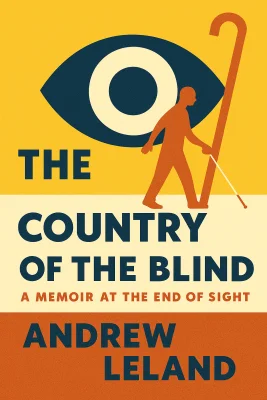
The Country of the Blind
A Memoir at the End of Sight
Categories
Nonfiction, Biography, History, Memoir, Audiobook, Medicine, Medical, Biography Memoir, Book Club, Disability
Content Type
Book
Binding
Hardcover
Year
2023
Publisher
Penguin Press
Language
English
ISBN13
9781984881427
File Download
PDF | EPUB
The Country of the Blind Plot Summary
Introduction
# Vision Lost: A Personal Journey Through Blindness The doctor's diagram looked like ice cubes melting in hot water—two small, wobbly ovals floating in the center, with skinny shapes drifting along the sides. This was what remained of Andrew's vision: about six percent of what a fully sighted person sees. As he sat in that sterile office, staring at the visual representation of his diminishing world, he realized he wasn't just losing his sight—he was about to enter an entirely different universe of human experience. The clinical words hung in the air like a verdict: "When those go, your mobility will become more limited." 本书chronicles one man's extraordinary transformation from the initial shock of a retinitis pigmentosa diagnosis to his profound discovery of blindness as not merely a medical condition, but a rich, vibrant culture filled with innovation, community, and unexpected gifts. Through intimate storytelling and honest reflection, this journey reveals how losing one's sight can paradoxically open entirely new ways of seeing the world. Rather than a narrative of tragedy and limitation, this becomes an exploration of human adaptability, the power of community, and the remarkable resilience that emerges when we learn to navigate life's most challenging transitions with courage and curiosity.
Chapter 1: The Diagnosis: Coming to Terms with Vision Loss
Those teenage nights in the Santa Fe hills should have been carefree adventures, following older friends through piñon trees and juniper bushes under starlit skies. But Andrew kept walking directly into branches while his companions navigated effortlessly through the darkness. His friends laughed, attributing his clumsiness to being particularly stoned, and Andrew played along with the role of bloodshot wise guy. Yet privately, a growing anxiety gnawed at him—something was fundamentally wrong with his night vision. Movie theaters became sources of embarrassment and confusion. While others confidently left their seats in darkened auditoriums, Andrew remained frozen, unwilling to navigate through the forest of knees and legs until the lights came up. When he mentioned his struggles to his mother, she dismissed them casually—everyone has trouble seeing in the dark, she said. But Andrew knew this was different. Late-night internet searches led him to a self-diagnosis that would later prove accurate: retinitis pigmentosa, a genetic condition that gradually destroys the cells responsible for peripheral and night vision. Years later, Dr. Heckenlively at UCLA confirmed what Andrew had already discovered through his own research. The diagnosis came with a timeline that felt both reassuring and terrifying: good vision through his twenties and thirties, followed by accelerating degeneration in middle age. There was no treatment, but science was advancing—perhaps by the time he was truly blind, there would be a cure. The doctor asked if he could see stars, and Andrew realized with a shock that he couldn't. This simple detail brought the reality home for his mother more powerfully than any medical explanation. The journey from suspicion to confirmation illuminates how we often understand our own bodies better than we're willing to admit. The clinical language of medicine can both clarify our condition and distance us from the lived reality of what we're experiencing. Andrew's story reveals the complex dance between denial and acceptance that accompanies any life-altering diagnosis, showing us that the path to understanding our new reality often begins long before we receive official confirmation of what we already know in our hearts.
Chapter 2: Finding Community: Entering the World of the Blind
Walking into the National Federation of the Blind convention in Orlando, Andrew was immediately overwhelmed by a sound he had never experienced: three thousand white canes tapping a percussion symphony across the massive convention center's tiled floors. For the first time in his life, blindness was the norm rather than the exception. The acoustic landscape was entirely different from any gathering he had ever attended—dozens of canes colliding and navigating, creating a rhythmic soundtrack that spoke of confidence and purposeful movement rather than hesitation or limitation. The convention revealed blindness as a rich, complex culture with its own fierce politics, distinctive humor, and unwavering commitment to independence. Andrew met people who had been discriminated against in employment, denied basic services, and treated as incompetent by the sighted world, yet here they were organizing legislative battles, debating policy with sophisticated arguments, and living remarkably full lives. He watched blind parents confidently guide their sighted children, blind professionals lead heated discussions about accessibility rights, and blind activists plan their next campaign for equal treatment under the law. At the final banquet, Andrew witnessed something that shook him to his core. As the NFB president delivered an impassioned speech about equality and independence, the room erupted in an emotional crescendo that seemed to release years of accumulated frustration and hope. People were screaming, crying, embracing, and cheering with an intensity that spoke to deep wells of shared experience. A ten-year-old boy named Isaac, who had been casually chatting with Andrew earlier about finding a tomato at school lunch, was now clapping enthusiastically alongside adults who had fought decades-long battles for recognition and respect. This first encounter with blind community taught Andrew that disability could be a source of profound strength and identity rather than simply limitation or loss. The convention showed him that the most powerful response to marginalization isn't individual heroism or inspirational overcoming, but collective action rooted in mutual support and shared determination. The raw emotion in that ballroom represented something far more significant than a support group—it was a civil rights movement in action, demonstrating that communities formed around shared challenges often become the most powerful forces for social change.
Chapter 3: Identity in Transition: Between Sighted and Blind Worlds
Andrew's relationship with his white cane embodied all the complexities of his evolving identity and his reluctance to cross the invisible line between the sighted and blind worlds. For months, he carried the folded cane in his bag like a shameful secret, only unfolding it in the darkest, most crowded spaces where his partial vision completely failed him. The cane represented more than a mobility tool—it was a visible declaration of disability that would fundamentally change how others perceived him and how he understood himself. The reactions were immediate and often deeply uncomfortable. Strangers would grab his shoulders without warning, steering him away from perceived dangers he had already detected. Others questioned his legitimacy with suspicious glances and muttered comments—one man sneered "You can see" as Andrew passed by, as if partial vision somehow disqualified him from using mobility aids. The cane seemed to erase his complexity as a person, reducing him to a single characteristic in others' minds while simultaneously providing practical benefits like clearing paths through crowds and alerting others to give him appropriate space. Andrew's partial vision created a particularly challenging liminal space that defied easy categorization. He was too blind to navigate confidently without assistance in many situations, yet too sighted to fully identify with the blind community's experiences and perspectives. At restaurants, he could read large-print menus when held close to his face but couldn't see servers approaching his table. He could recognize familiar faces at close range but missed crucial social cues from across a room. This in-between existence meant constantly calibrating his identity depending on the situation, never quite belonging fully to either world. The experience of living between categories reveals how much of identity is socially constructed rather than simply biological or medical. Andrew's journey shows that becoming disabled isn't just about adapting to physical limitations—it's about negotiating entirely new relationships with community, independence, and self-perception in a world that often sees disability in purely binary terms. His story illuminates the courage required to embrace a new identity while grieving the loss of an old one, and the ongoing work of defining oneself in the face of others' assumptions and expectations.
Chapter 4: Navigating Daily Life: Adaptation and Technology
Learning to cook as a blind person required Andrew to completely reimagine the kitchen as a space of systematic organization rather than visual convenience. Every spice needed a designated location that he could find by touch and memory. He learned to identify ingredients by their distinctive smells and textures, to listen carefully for the sounds that indicated when food was properly cooked, and to arrange his workspace so that knives, cutting boards, and ingredients followed a logical pattern that eliminated dangerous surprises. What had once been automatic now required conscious planning and the application of techniques passed down through generations of blind cooks. Technology became both a gateway to independence and a source of constant frustration. Screen readers could transform any digital text into rapid-fire synthesized speech, opening vast libraries of books and information that had previously been inaccessible. Yet these same tools revealed how much of the digital world had been designed without any consideration for users who couldn't see—websites that became incomprehensible mazes when navigated by keyboard, images without descriptive text, and forms that disappeared into digital black holes when approached with assistive technology. Each new app or website became a test of whether its creators had bothered to consider users like Andrew. The white cane evolved from a symbol of limitation into a sophisticated navigation instrument that provided detailed information about the world around him. Andrew learned the proper sweeping technique—moving the cane from side to side in rhythm with his steps, using it to detect curbs, obstacles, and changes in terrain texture. The cane became an extension of his body, gathering environmental information that his eyes could no longer process. Yet mastering these skills required acknowledging that his old methods of moving through the world were no longer sufficient, a psychological adjustment that proved as challenging as the physical techniques. Perhaps most difficult was learning to ask for help while maintaining his sense of agency and independence. Andrew had to develop nuanced strategies for accepting assistance without surrendering control—learning when to gracefully accept offered help and when to politely decline, how to direct helpers effectively without seeming ungrateful, and how to maintain dignity in situations where he genuinely needed support. This delicate balance between self-reliance and interdependence became a daily negotiation that required both practical skills and emotional resilience, ultimately teaching him that true independence often means knowing how to collaborate effectively with others.
Chapter 5: The Sensory Experience: Learning to See Differently
Reading braille transformed Andrew's entire relationship with language and the written word. At first, the raised dots felt like meaningless bumps under his fingertips, creating frustration rather than comprehension. Gradually, patterns began to emerge from the chaos—the letter 'a' was a single dot in the upper left corner, 'b' was two dots stacked vertically. Each successfully decoded word felt like solving a complex puzzle, requiring patience and concentration that visual reading had never demanded. Simple words like "be" and "edge" became small victories that marked his progress into a new form of literacy. The physical act of braille reading engaged his entire body in ways that visual reading never had. His head would unconsciously move from side to side as his fingers traveled across each line, mimicking the eye movements of sighted reading while creating an entirely different rhythm and pace. His fingertips developed extraordinary sensitivity, able to distinguish subtle differences in dot height, spacing, and the texture of different papers. Reading became a full-body experience that connected him directly to the text through touch, creating an intimacy with language that surprised him with its depth and immediacy. Sound took on new dimensions and critical importance as Andrew learned to navigate by listening to the acoustic signatures of different environments. He discovered that his cane made distinctly different sounds when tapping metal, wood, or carpet, and that these audio cues could guide him through complex spaces. Restaurants became intricate soundscapes where he identified locations by the clatter of dishes, the rhythm of conversation, and the distinctive footsteps of servers moving between tables. His ears began processing layers of auditory information that had always been present but previously filtered out in favor of visual input. The transition revealed how much sensory information sighted people unconsciously ignore or suppress in favor of visual dominance. Without sight commanding his attention, Andrew's other senses became more acute and reliable sources of environmental information. He could identify people by their distinctive walking patterns, navigate familiar spaces using memory and sound, and gather detailed information about his surroundings through smell, touch, and careful listening. This wasn't simply compensation for a lost sense—it was the discovery of an entirely different way of perceiving and understanding the world, one that revealed details and nuances that his sighted experience had never noticed.
Chapter 6: Relationships and Dependency: Love in the Shadow of Blindness
Andrew's marriage to Lily required constant renegotiation and mutual adaptation as his vision continued to decline. Simple activities like walking together through crowded sidewalks became sources of unexpected tension when Lily would unconsciously speed ahead, leaving Andrew struggling to keep pace while navigating obstacles he couldn't clearly see. Her initial reactions were often frustration—why couldn't he just walk faster or pay better attention?—until she remembered his visual limitations and felt guilty for her impatience. These moments of forgetting and remembering became a recurring pattern that demanded patience, communication, and grace from both partners. The birth of their son Oscar added profound new dimensions to Andrew's anxieties about his blindness and its impact on his family. He found himself haunted by apocalyptic fantasies where his visual limitations would render him unable to protect his wife and child in emergency situations. The traditional masculine role of family protector felt fundamentally compromised by his disability, creating deep anxiety about his worth and effectiveness as both husband and father. Yet in the daily realities of parenting—changing diapers, feeding, comforting a crying baby—his blindness proved largely irrelevant to his ability to provide loving, competent care. Oscar's matter-of-fact acceptance of his father's "bad peepers" provided a powerful model for how blindness could be integrated into family life without drama, pity, or excessive accommodation. When Oscar warned visiting friends to clean up their toys so his dad wouldn't trip, he was simply stating a practical reality without shame or embarrassment. His natural adaptations—describing movies aloud, reading signs when asked, offering his arm when needed—showed how love instinctively creates accessibility without making it feel like burden or charity. The child's unselfconscious acceptance often contrasted sharply with adults' awkwardness and over-solicitude. The evolution of their family relationships demonstrated that successful partnerships require ongoing adaptation and mutual accommodation regardless of disability status. Lily learned to describe visual information naturally and conversationally, to modify her walking pace without making it feel like a concession, and to organize their shared spaces in ways that supported Andrew's independence while meeting her own needs. These adjustments weren't sacrifices or acts of heroic caregiving, but expressions of love that made their shared life more harmonious and functional. Their marriage revealed that interdependence, rather than complete independence, might actually be the foundation of all meaningful human relationships.
Chapter 7: Cultural Representations: Art, Literature, and Media
The art world's relationship with blindness revealed both significant barriers and unexpected opportunities for deeper engagement with creative expression. When Andrew visited galleries and museums, he often felt like he had become part of the exhibition himself, with other visitors whispering about what a blind person could possibly gain from looking at paintings or sculptures. Yet some progressive institutions offered "touch tours" that allowed blind visitors to experience artworks through direct physical contact, feeling the texture of bronze sculptures, the grain of wooden pieces, and specially created tactile representations of famous paintings that conveyed composition and form through raised surfaces and varied textures. Audio description emerged as a crucial bridge between visual media and blind audiences, revealing itself to be a sophisticated art form that required both technical skill and creative sensitivity. Andrew learned about the complex craft of describing films and television shows, where skilled professionals must convey essential visual information in the brief gaps between dialogue without overwhelming or interrupting the original soundtrack. The best audio description felt seamless and unobtrusive, enhancing rather than disrupting the viewing experience by capturing not just what was happening on screen, but the emotional resonance of visual storytelling—how a character's posture conveyed defeat, or how lighting and color created specific moods and psychological states. Literature took on entirely new meanings and dimensions when experienced through different sensory modalities. Reading braille connected Andrew directly to the physical structure of text through touch, creating an intimate relationship with language that felt fundamentally different from both visual reading and listening to audiobooks. The tactile experience of reading—fingers moving across raised dots, the sound of pages turning, the weight of books in his hands—became an integral part of the literary experience rather than simply a means to access content. Some of history's greatest authors, including Jorge Luis Borges, had created their most celebrated works after losing their sight, suggesting that blindness might offer unique creative perspectives and insights rather than simply limiting artistic expression. The representation of blindness in popular culture remained frustratingly stereotypical and limited, typically portraying blind characters as either helpless victims requiring rescue or individuals possessed of supernatural abilities that compensated for their lost sight. These portrayals failed to capture the ordinary reality of blind people's lives, where practical adaptation, community support, and assistive technology enabled full participation in society without requiring either pity or miraculous powers. The gap between these fictional representations and lived experience highlighted the urgent need for more authentic and nuanced portrayals that could help both blind and sighted audiences better understand the true nature of blindness as a different way of experiencing the world rather than a tragic limitation.
Summary
Andrew's journey through vision loss reveals that blindness is not the personal tragedy our culture imagines it to be, but rather a different way of experiencing and engaging with the world that offers its own insights, communities, and possibilities. Through his honest exploration of diagnosis, identity transformation, daily adaptation, and community discovery, he demonstrates that the greatest barriers facing blind people are often social and architectural rather than inherent to the condition itself. The assumption that sight is essential for a meaningful, productive, and joyful life crumbles when confronted with the reality of blind people living rich, complex, and deeply fulfilling lives filled with love, creativity, professional achievement, and social contribution. 本书's most powerful insight is that disability can become a source of strength, innovation, and profound human connection rather than simply limitation or loss. Andrew's discovery of blind culture—with its distinctive humor, sophisticated politics, and hard-won wisdom—demonstrates how marginalized communities create their own forms of resilience, mutual support, and collective power. His evolving relationships with family members show how love naturally generates accessibility and accommodation, while his exploration of technology, art, and literature reveals entirely new ways of engaging with information, beauty, and creative expression. For anyone facing major life transitions, grappling with unexpected challenges, or seeking to understand the experience of disability, this memoir offers both practical wisdom and profound hope that adaptation is not only possible but can lead to discoveries about resilience, community, and what it truly means to live a fully human life.
Best Quote
“Disability can be considered as a biological fact (your eyes don't work) or a social construct (blindness is problematic only insofar as the world is built for the sighted).” ― Andrew Leland, The Country of the Blind: A Memoir at the End of Sight
Review Summary
Strengths: The review highlights the book's comprehensive exploration of blindness, combining travel guide elements, cultural insights, and philosophical reflections. The author's personal journey with retinitis pigmentosa adds depth, and the narrative is enriched with literary references. The book is praised for its engaging storytelling and enlightening perspective on disability justice. Overall: The reader expresses a highly positive sentiment, describing the book as a "10-star" read and a "remarkable exploration of blindness." It is recommended for those interested in disability justice and the philosophical aspects of blindness, with the potential to leave a lasting impact on its audience.
About Author

Andrew Leland
Leland interrogates the complexities of identity and perception through his multifaceted work, particularly focusing on disability and vision loss. His memoir, "The Country of the Blind: A Memoir at the End of Sight", exemplifies this exploration by weaving personal narrative with broader cultural and historical contexts. For readers, the book offers an intellectual and emotional journey into the world of blindness, challenging conventional perceptions and inviting a deeper understanding of disability. Therefore, it is no surprise that this book was recognized as one of the best of the year by major publications, including "The New Yorker" and "The Washington Post".\n\nAs an accomplished author and audio producer, Leland's methods extend beyond writing to include teaching and podcast production. His career includes serving as an editor at "The Believer" and hosting the arts and culture podcast "The Organist". These roles allow him to engage with a broad audience, sharing insights into the human experience while challenging societal norms. His feature on Protactile communication for "The New Yorker" further underscores his commitment to disability advocacy, earning him the 2023 Linguistic Journalism Award. This diverse approach ensures that his work resonates with academics, creatives, and general readers alike, offering them rich, cross-disciplinary insights.
Read moreDownload PDF & EPUB
To save this Black List summary for later, download the free PDF and EPUB. You can print it out, or read offline at your convenience.
The Country of the Blind
by Andrew Leland
