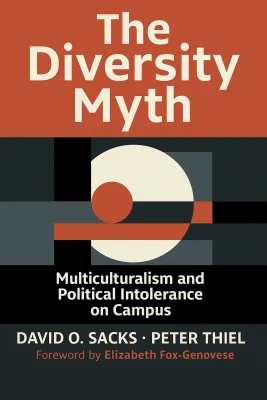
The Diversity Myth
Multiculturalism and Political Intolerance on Campus
Categories
Nonfiction, Psychology, Philosophy, History, Education, Politics, Sociology, Social Justice, Cultural, Race
Content Type
Book
Binding
Paperback
Year
1997
Publisher
Independent Institute
Language
English
ASIN
0945999763
ISBN
0945999763
ISBN13
9780945999768
File Download
PDF | EPUB
The Diversity Myth Plot Summary
Introduction
# The Diversity Myth: How Multiculturalism Destroys Intellectual Freedom The transformation of American higher education from institutions of rigorous intellectual inquiry into centers of ideological indoctrination represents one of the most significant cultural shifts of the late twentieth century. What began as seemingly reasonable calls for greater inclusivity and cultural awareness has evolved into a comprehensive system that systematically undermines the very foundations of liberal education. The mechanisms through which this transformation occurs—from curriculum overhaul to speech restrictions, from residential programming to faculty hiring practices—reveal how abstract ideological commitments translate into concrete institutional changes that reshape human behavior and thought. This analysis exposes the fundamental contradiction at the heart of contemporary diversity initiatives: while claiming to promote tolerance and inclusion, these programs actually create new forms of intolerance and exclusion based on rigid ideological conformity. By examining the specific processes through which multiculturalism operates within academic institutions, we can understand not merely what happened at one university, but how cultural revolutions unfold in democratic societies. The patterns established in higher education have since spread throughout American institutions, making this examination essential for understanding the broader cultural and political dynamics reshaping contemporary society.
Chapter 1: The Western Culture Wars: Stanford's Ideological Revolution
The chant "Hey hey, ho ho, Western Culture's got to go!" that echoed across Stanford's campus in January 1987 marked more than student protest—it announced a fundamental challenge to the philosophical foundations of liberal education. The target was Stanford's Western Culture requirement, a freshman course introducing students to the great works and ideas that shaped Western civilization. Yet the deeper target was the concept of universalism itself: the belief that certain truths and insights transcend accidents of birth and remain accessible to all human beings regardless of race, gender, or cultural background. The protestors' success in replacing Western Culture with "Cultures, Ideas, and Values" represented a philosophical revolution disguised as curricular reform. Where the old program assumed that works like Plato's Republic or Shakespeare's plays contained insights relevant to all students, the new framework embraced particularism—the notion that what one can know is determined by group identity. This shift from universal to particular knowledge claims had profound implications: if only women can truly understand women's experiences, only minorities can interpret minority perspectives, then the entire premise of liberal education collapses. The process by which this change occurred reveals how political pressure can override academic judgment. Faculty members who might have defended the Western tradition found themselves intimidated by charges of racism and sexism. The administration, rather than protecting intellectual freedom, capitulated to activist demands while simultaneously misleading parents and alumni about the nature of the changes. This pattern of public accommodation and private deception would become characteristic of institutional responses to multicultural pressure. The replacement curriculum demonstrated that multiculturalism was not genuinely interested in studying other cultures. Instead of learning Chinese philosophy or Islamic theology, students encountered contemporary political activism dressed up as cultural study. The new courses shared a common theme: the condemnation of Western civilization as uniquely oppressive and the celebration of its supposed victims. The Western Culture debate established a template that would be replicated across American higher education, making opposition appear inherently bigoted while producing not greater diversity but enforced conformity to a new orthodoxy.
Chapter 2: Defining Multiculturalism: Political Agenda Disguised as Academic Reform
Multiculturalism's power lies partly in its definitional elusiveness. When challenged, advocates retreat to vague generalities about "harmony, unity, and equity" or "ways for our racial minorities and majority to acknowledge and build mutual respect." Such formulations are deliberately meaningless, designed to disarm opposition by making multiculturalism appear synonymous with basic human decency. Yet the actual implementation of multicultural policies reveals a much more specific and controversial agenda. The foundational questions that any coherent multicultural program must answer—which groups count as "cultures," how conflicts between groups are resolved, how dissent within groups is handled—cannot be answered by demographic facts alone. The multicultural movement's solutions to these problems reveal its true nature: it privileges certain groups over others, automatically favors the more "oppressed" group in any conflict, and dismisses dissenters within favored groups as suffering from "false consciousness." This framework becomes coherent only when understood as the political agenda of 1960s radicals who have achieved positions of institutional power. The same faculty and administrators who once protested against "the system" now control that system and use it to advance their unchanged political goals. Multiculturalism provides a respectable academic veneer for what is essentially a continuation of 1960s leftist politics by other means. The transformation of campus life under multicultural auspices demonstrates this hidden agenda in action. Policies ranging from grape boycotts to speech codes to hiring preferences all make sense when viewed as implementations of radical political values, even when they contradict multiculturalism's stated commitment to diversity and tolerance. The Office for Multicultural Development's mission to "inculcate ideas" while avoiding student "resistance" reveals the authoritarian impulse beneath multicultural rhetoric. The ultimate test of multiculturalism's commitment to diversity comes when that diversity threatens multicultural orthodoxy itself. In such cases, the response is swift and severe. Students who challenge multicultural assumptions, even inadvertently, face ostracism and punishment. The result is not a celebration of difference but the enforcement of conformity through the systematic elimination of dissent.
Chapter 3: Manufacturing Victims: How Campus Policies Create Artificial Oppression
The multicultural project extends far beyond the classroom into every aspect of campus life, seeking to reshape student identities through residential programming, orientation activities, and social policies. This comprehensive approach reflects the understanding that cultural transformation requires more than intellectual conversion—it demands the reconstruction of personal identity itself. Students must learn not just to think differently but to see themselves and others in fundamentally new ways. Freshman orientation serves as the initial stage of this identity reconstruction, immediately dividing students along racial lines through separate programs and activities. Students who arrive at university with relatively similar backgrounds—most are middle-class products of integrated schools—are quickly taught to see themselves as fundamentally different from their peers. The resulting self-segregation in dining halls and dormitories is not a natural expression of cultural difference but the predictable result of institutional policies designed to emphasize group distinctions. The creation of racial theme houses represents the institutionalization of this segregation. These facilities remove minority students from the broader campus community while subjecting them to intensive programming designed to strengthen their racial consciousness. Students who might otherwise form friendships across racial lines are instead encouraged to see such relationships as betrayals of their authentic identities. The residential education system functions as a comprehensive indoctrination apparatus, with carefully selected staff members who view their role as political rather than educational. Resident assistants and resident fellows openly acknowledge their mission to challenge students' existing beliefs and values, using techniques ranging from bathroom stall propaganda to mock kidnappings. The goal is not to help students mature intellectually but to convert them to approved political positions. This systematic manipulation of social environment and peer relationships represents a form of psychological engineering that would be recognizable to students of totalitarian movements. By controlling the information students receive, the social pressures they experience, and the interpretive frameworks they are taught to use, the multicultural apparatus shapes both thought and identity in ways that most students never fully recognize or understand. The result is the creation of artificial victim identities that depend entirely on institutional reinforcement for their maintenance.
Chapter 4: Speech Codes and Thought Control: Enforcing Multicultural Orthodoxy
The enforcement of multicultural orthodoxy requires not just the promotion of approved ideas but the active suppression of dissenting viewpoints. Speech codes, conduct policies, and social sanctions work together to create an environment where students learn to self-censor rather than risk the consequences of expressing forbidden thoughts. This system of control operates through both formal rules and informal pressures that make nonconformity psychologically and socially costly. The expansion of concepts like "harassment" and "hate speech" to include virtually any expression that might offend members of favored groups creates a chilling effect on campus discourse. Students quickly learn that certain topics are off-limits and certain viewpoints are unacceptable, regardless of their truth or merit. The result is not the elimination of prejudice but the creation of a climate of fear and hypocrisy in which genuine dialogue becomes impossible. The manipulation of disciplinary procedures to favor accusers from protected groups while denying due process to the accused represents a fundamental corruption of justice. When the burden of proof is lowered and the presumption of innocence abandoned in cases involving race, gender, or sexual orientation, the university abandons its commitment to fairness in favor of political expediency. Such policies may satisfy activist demands, but they create new injustices while solving none of the old ones. The psychological impact of this system extends far beyond its immediate victims. Students who witness the punishment of their peers for expressing unpopular views learn to internalize the restrictions, engaging in self-censorship that becomes habitual. Over time, they may lose the ability to think critically about the very topics that most need critical examination. The result is a generation of graduates who have been trained to conform rather than to question. The ultimate irony of political correctness is that it produces the opposite of its stated goals. Rather than creating a more tolerant and inclusive environment, it generates resentment and backlash among those who feel unfairly targeted. Rather than promoting understanding between different groups, it increases suspicion and hostility by making honest communication impossible. The enforcement mechanisms reveal their essentially arbitrary character through the randomness of their targets, where individuals can be destroyed for minor infractions or even for attempting to support multicultural goals in insufficiently orthodox ways.
Chapter 5: The Diversity Paradox: How Inclusion Mandates Produce Intellectual Conformity
The central paradox of multiculturalism lies in its simultaneous celebration of diversity and enforcement of conformity. While promoting superficial differences based on race, gender, and sexual orientation, the multicultural movement demands strict adherence to a narrow range of political and social views. The result is a campus population that may look diverse but thinks with remarkable uniformity on all important questions. True intellectual diversity would require the presence of genuinely different perspectives on fundamental questions of politics, morality, and human nature. Instead, multicultural diversity offers only variations on a single theme: the oppression of victim groups by Western civilization and its contemporary representatives. Whether the focus is on race, gender, class, or sexual orientation, the underlying narrative remains constant, and dissent from this narrative is not tolerated. The faculty hiring policies that prioritize demographic characteristics over intellectual merit ensure that this uniformity will be perpetuated and intensified over time. When professors are selected primarily for their race or gender rather than their scholarly achievements or intellectual independence, the result is an academy staffed by ideological conformists who happen to have different skin colors or sexual orientations. Such "diversity" is purely cosmetic and actually reduces the likelihood of genuine intellectual challenge or innovation. The student body, subjected to four years of intensive indoctrination by this ideologically uniform faculty, emerges with a false sense of sophistication that masks profound intellectual impoverishment. Graduates may be fluent in the jargon of multiculturalism and sensitive to the concerns of various victim groups, but they lack the knowledge of history, philosophy, and literature that would enable them to think independently about the great questions of human existence. The broader social consequences of this pseudo-diversity are already becoming apparent as multicultural graduates assume positions of influence in government, media, and other institutions. Their shared assumptions and blind spots create an echo chamber effect that reinforces existing biases while eliminating the intellectual competition necessary for social and political health. The result is not the vibrant pluralism that democracy requires but a stultifying orthodoxy that stifles innovation and debate.
Chapter 6: Elite Hypocrisy: Egalitarian Rhetoric Masking Administrative Corruption
The multicultural revolution produced a new class of administrators and faculty who combined egalitarian rhetoric with elitist behavior, creating a system of unprecedented hypocrisy and corruption. These "egalitarian elites" positioned themselves as champions of the oppressed while enjoying privileges and perquisites that would have embarrassed the robber barons they claimed to oppose. The indirect cost scandal that ultimately brought down university leadership revealed the extent to which multicultural leaders had exempted themselves from the moral standards they imposed on others. While preaching about social justice and economic equality, administrators systematically looted the federal treasury to fund lavish lifestyles. Taxpayers were billed for yacht maintenance, antique furniture, flower arrangements, and other luxuries that had no conceivable connection to educational purposes. The scandal exposed the fundamental contradiction at the heart of the multicultural project. The same administrators who demanded sensitivity to the plight of the oppressed showed callous indifference to the taxpayers who funded their experiments. The same faculty who denounced capitalism and materialism eagerly participated in the systematic misappropriation of public funds. The same students who protested against inequality remained largely silent about the corruption occurring in their own institution. The response to scandal revealed the psychological mechanisms that enabled such hypocrisy. Rather than acknowledging wrongdoing, leaders blamed the public for failing to understand the complexities of university administration. They portrayed themselves as victims of ignorant criticism while maintaining that every expenditure was justified by the university's educational mission. This response demonstrated how the multicultural worldview had created a class of individuals who were psychologically incapable of recognizing their own moral failures. The corruption extended throughout the multicultural apparatus. Bookstore management enriched themselves through vacation homes and luxury cars while claiming to serve student interests. Residential education officials violated the drug policies they enforced on students. Ethnic center directors engaged in sexual harassment while positioning themselves as advocates for the oppressed. In each case, the perpetrators' multicultural credentials provided protection from accountability. The pattern of corruption revealed the inherent instability of a system based on moral posturing rather than genuine ethical principles. The egalitarian elites had created a framework that exempted them from criticism by defining any opposition as evidence of bias or insensitivity. This immunity from accountability inevitably led to abuse, as individuals discovered they could engage in increasingly egregious behavior without facing consequences.
Chapter 7: Cultural Revolution: Dismantling Western Civilization's Philosophical Foundations
The multicultural project represented far more than educational reform—it constituted a systematic assault on the philosophical foundations of Western civilization. This attack proceeded through the deconstruction of key concepts such as objective truth, individual merit, and universal human nature, replacing them with relativistic alternatives that undermined the possibility of rational discourse and moral judgment. The transformation of the curriculum served as the primary vehicle for this cultural revolution. Traditional courses that emphasized the development of critical thinking and engagement with enduring questions were replaced by ideologically driven alternatives that prioritized group identity and political consciousness. Students were no longer expected to grapple with fundamental questions about justice, truth, and human nature, but rather to absorb the correct attitudes about oppression and liberation. The attack on Western foundations extended beyond the formal curriculum to encompass every aspect of university life. Residential education programs indoctrinated students in multicultural ideology through mandatory workshops and consciousness-raising sessions. Grading systems were modified to eliminate failure and reduce competition. Religious expression was marginalized while secular ideologies were promoted through official channels. The multicultural assault on reason manifested itself in the elevation of subjective experience over objective analysis. Students were taught that their feelings and personal narratives constituted valid forms of knowledge that could not be questioned or criticized. This epistemological relativism made rational debate impossible, since any criticism of multicultural claims could be dismissed as insensitivity to the lived experience of oppressed groups. The destruction of merit-based evaluation represented another crucial element of the cultural revolution. Traditional standards of academic achievement were denounced as culturally biased instruments of oppression, while alternative forms of assessment emphasized group identity and political consciousness. This transformation ensured that multicultural ideology would be protected from intellectual challenge, since its premises could not be subjected to rigorous scrutiny. The ultimate target of the multicultural revolution was the concept of human universality that underlies Western civilization. The idea that all human beings share certain fundamental characteristics and aspirations was replaced by a vision of irreducible cultural difference that made communication and understanding across group boundaries impossible. This fragmentation of humanity into competing victim groups represented the antithesis of the universal humanism that had inspired the greatest achievements of Western culture.
Summary
The multicultural transformation reveals how seemingly benign calls for diversity and inclusion can mask a comprehensive assault on the intellectual and moral foundations of liberal education. The replacement of individual merit with group identity, objective truth with subjective experience, and universal principles with cultural relativism has created a system that is simultaneously tyrannical and chaotic, demanding absolute conformity to an ideology that celebrates difference while enforcing rigid orthodoxy. The experiment demonstrates that multiculturalism functions not as a genuine embrace of diversity but as a new form of cultural imperialism that seeks to remake society according to its own narrow vision. The culture of victimization and blame that emerged from this transformation has now spread throughout American institutions, creating a society where grievance has replaced aspiration and where the pursuit of justice has been replaced by the pursuit of advantage. Only by understanding the true nature of this transformation can we hope to restore the principles of individual dignity, rational discourse, and universal human rights that once made democratic civilization a beacon of hope for the world.
Best Quote
About Author

Peter Thiel
Thiel reframes the landscape of innovation by advocating for transformative rather than incremental progress. His work emphasizes creating groundbreaking technologies that advance society beyond existing paradigms, as articulated in his acclaimed book, "Zero to One". Thiel's philosophical approach to business, intertwined with practical strategies, encourages entrepreneurs to pursue unique solutions and embrace monopolistic success. This perspective is particularly beneficial for those seeking to disrupt traditional markets and establish new avenues for growth.\n\nIn addition to his literary contributions, Thiel's investment strategy blends technological optimism with a contrarian edge, as demonstrated through his involvement with companies like PayPal, Facebook, and Palantir Technologies. As a venture capitalist, he supports startups that prioritize innovation over competition. Moreover, through initiatives such as the Thiel Fellowship and Thiel Foundation, he fosters an environment that encourages young minds to pursue ambitious projects without traditional academic constraints. This bio highlights Thiel's impact as a thought leader in Silicon Valley, where his ideas have inspired a generation to think boldly about the future.\n\nReaders engaged with Thiel's philosophy find value in his incisive critiques of conventional wisdom, which challenge them to reconsider assumptions about technology and society. His direct and provocative writing style offers insights into the dynamics of competitive business landscapes, making his work particularly relevant for entrepreneurs and innovators. Thiel's vision extends beyond mere financial success, aiming to shape the future by encouraging ventures that have the potential to redefine industries and improve the human condition.
Read moreDownload PDF & EPUB
To save this Black List summary for later, download the free PDF and EPUB. You can print it out, or read offline at your convenience.
The Diversity Myth
by Peter Thiel
