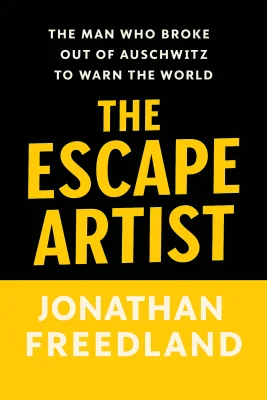
The Escape Artist
The Man Who Broke Out of Auschwitz to Warn the World
Categories
Nonfiction, Biography, History, Memoir, Audiobook, Biography Memoir, Historical, Holocaust, World War II, War
Content Type
Book
Binding
Hardcover
Year
2022
Publisher
Harper
Language
English
ASIN
0063112337
ISBN
0063112337
ISBN13
9780063112339
File Download
PDF | EPUB
The Escape Artist Plot Summary
Introduction
# The Escape Artist: Rudolf Vrba's Mission to Warn the World In the spring of 1944, as Nazi Germany's machinery of death reached its most horrific efficiency, two young men accomplished what many believed impossible: they escaped from Auschwitz-Birkenau and lived to tell the world what they had witnessed. Rudolf Vrba, barely nineteen years old, had transformed from a curious Slovak teenager into one of history's most crucial witnesses, carrying in his extraordinary memory the first comprehensive account of the Holocaust's industrial killing process. Born Walter Rosenberg in 1924, Vrba's journey from a small-town Jewish boy to an internationally recognized scientist and Holocaust witness reveals the profound power of individual courage in humanity's darkest hour. His story transcends typical survival narratives, demonstrating how one person's refusal to remain silent can alter the course of history and save hundreds of thousands of lives. Through his remarkable tale, readers discover the critical importance of bearing witness to truth, the extraordinary resilience of the human spirit under unimaginable circumstances, and the lasting impact that moral courage can have across generations when someone chooses action over passivity in the face of systematic evil.
Chapter 1: Early Life: The Making of a Witness
Walter Rosenberg's childhood in the Slovak town of Trnava was marked by an intellectual curiosity that would later prove essential to his survival and mission. Born into a middle-class Jewish family, young Walter displayed an exceptional memory and analytical mind that set him apart from his peers. His father Elias owned a successful lumber business, and the family lived comfortably until the rise of fascism began to cast its shadow over Central Europe. The transformation of Czechoslovakia in the late 1930s provided Walter with his first education in how quickly civilized society could turn against its own citizens. When the pro-Nazi Slovak Republic was established under Father Jozef Tiso, anti-Jewish laws proliferated with alarming speed. Walter watched as Jewish children were expelled from schools, businesses were confiscated, and his neighbors began to view his family as outsiders rather than fellow citizens. Despite the mounting restrictions, Walter's hunger for knowledge remained undiminished. When Jews were barred from attending regular schools, he continued his education in secret, sharing forbidden chemistry textbooks with friends and maintaining his dreams of scientific achievement. This period of clandestine learning taught him invaluable lessons about adaptation and resistance that would prove crucial during his imprisonment at Auschwitz. The deportation orders that arrived in 1942 forced seventeen-year-old Walter to make a fateful decision that would define the rest of his life. Rather than report for what the Nazis euphemistically called "resettlement in the East," he chose to flee, believing that his youth and intelligence gave him the best chance of survival. His capture and subsequent transport to Majdanek concentration camp, and later to Auschwitz, marked the beginning of an ordeal that would transform him from a frightened teenager into one of history's most important witnesses. The qualities that emerged during Walter's youth would prove essential to his later mission. His exceptional memory, analytical thinking, and refusal to accept injustice passively were all forged during these formative years when his world was systematically destroyed around him.
Chapter 2: Inside Auschwitz: Cataloguing Industrial Death
Walter's arrival at Auschwitz-Birkenau in June 1942 coincided with the camp's transformation into the epicenter of Nazi genocide. Assigned prisoner number 44070, he quickly understood that survival required not just physical endurance but acute psychological adaptation and an almost superhuman capacity for observation. Unlike many prisoners who tried to block out the horror around them, Walter made a conscious decision to remember everything he witnessed. His various work assignments provided him with an unprecedented view of the camp's operations. In the gravel pits, he experienced the brutal labor conditions designed to work prisoners to death. In the "Kanada" warehouse complex, where the belongings of murdered Jews were sorted and processed, he witnessed the scope of the genocide through mountains of suitcases, clothing, and personal effects. Each item told the story of a family that had believed they were being resettled, only to be murdered within hours of their arrival. Walter's most crucial assignment came when he was selected to work on the railway ramp where new transports arrived. Here, he witnessed the selection process firsthand, watching as SS doctors divided new arrivals with casual gestures that determined who would live as slaves and who would die immediately. He observed the elaborate deceptions used to maintain calm among the victims, from reassuring words about work assignments to the disguising of gas chambers as shower facilities. The psychological toll of this work was enormous, but Walter channeled his anguish into a methodical documentation project. He began memorizing transport numbers, dates of arrivals, countries of origin, and approximate numbers of victims. His analytical mind catalogued the efficiency of the killing process, the capacity of the gas chambers, and the systematic nature of the deception that made such large-scale murder possible. By early 1944, Walter possessed perhaps the most comprehensive knowledge of Auschwitz's operations held by any prisoner. He understood that the Nazi genocide depended on secrecy and lies, and that knowledge could be a powerful weapon against it. This realization would drive his determination to escape and warn the world before it was too late.
Chapter 3: The Great Escape: Breaking the Impossible Barrier
The escape that Walter Rosenberg and his fellow Slovak prisoner Alfréd Wetzler accomplished on April 7, 1944, was the result of meticulous planning, extraordinary courage, and an intimate understanding of the camp's security systems. Their plan exploited a critical weakness in Auschwitz's defenses: the temporary gap in the outer perimeter that occurred when guards changed shifts and search patterns. Walter and Fred's strategy was audacious in its simplicity yet terrifying in its execution. They would hide in a carefully constructed bunker within the camp's outer zone and wait for three days and nights while the SS searched for them with dogs and guards. Only after the search was officially called off would they emerge and attempt to reach the Slovak border fifty miles away. The plan required them to remain absolutely motionless for seventy-two hours in a cramped space, knowing that discovery meant not just death but torture first. The bunker had been prepared by previous escapees and camouflaged with Soviet tobacco soaked in gasoline to confuse the dogs' sense of smell. For three agonizing days, Walter and Fred listened to the sounds of their hunters just feet away, controlling their breathing, suppressing coughs, and fighting the psychological terror of their situation. Every footstep, every bark of a dog, every shouted command could signal their discovery and execution. When they finally emerged on the night of April 10, the two men faced a new set of challenges. They had to navigate hostile territory filled with German patrols, collaborators, and informers while traveling on foot toward the Slovak border. Their journey took them through forests, across rivers, and over mountains, sustained by minimal food and the knowledge that capture would mean not just their own deaths but the loss of the crucial information they carried. The escape succeeded because of the unbreakable bond between the two men and their shared understanding that they were not just fleeing for their own lives but carrying a mission to warn the world. Their successful breakout made them the first Jews to escape from Auschwitz and survive to tell their story, transforming them from prisoners into messengers with the power to save hundreds of thousands of lives.
Chapter 4: The Vrba-Wetzler Report: Truth as a Weapon
Upon reaching Slovakia in late April 1944, Walter and Fred faced their greatest challenge yet: convincing the world to believe their testimony about the unthinkable horrors they had witnessed. Their detailed account, compiled over several intensive days of questioning by Jewish council officials, became known as the Vrba-Wetzler Report, a thirty-two-page document that provided the first comprehensive, eyewitness testimony of the Nazi extermination program. The report's power lay in its methodical, almost scientific approach to documenting mass murder. Walter's exceptional memory allowed him to provide specific dates, transport numbers, and death tolls that gave the testimony undeniable credibility. The document included precise descriptions of the camp's layout, the gas chambers' capacity, the cremation process, and the elaborate deception used to maintain order among victims until their final moments. Most crucially, it warned that Hungarian Jews were next on the Nazi list for extermination. However, the path from testimony to action proved frustratingly complex. The report faced skepticism from some who found its revelations too horrific to believe, bureaucratic delays as it passed through various channels, and political calculations that prioritized other wartime objectives. Some Jewish leaders were reluctant to spread information they feared might cause panic or interfere with ongoing negotiations with Nazi authorities. Despite these obstacles, the report gradually began to have a profound impact. When Swiss newspapers published excerpts in June 1944, it marked the first time detailed information about Auschwitz reached the general public. The document reached Pope Pius XII, President Franklin Roosevelt, and Prime Minister Winston Churchill, generating unprecedented international pressure on the Hungarian government to halt deportations. The report's most significant success came in saving the Jews of Budapest. International pressure based on Walter and Fred's testimony convinced Regent Miklós Horthy to stop the planned deportation of the capital's 200,000 Jews. This intervention, directly attributable to the Auschwitz Report, represented one of the most successful rescue operations of the Holocaust, demonstrating that truth, when courageously delivered and properly acted upon, could indeed serve as a weapon against genocide.
Chapter 5: Post-War Scholar: Science and Survival
After the war, Walter's transformation into Rudolf Vrba reflected both his desire for a new identity and his commitment to building a life based on the scientific pursuits that had sustained him through his darkest hours. He pursued advanced studies in biochemistry, eventually becoming a respected researcher and professor whose work contributed significantly to our understanding of brain chemistry and cellular metabolism. Vrba's post-war career took him from Prague to Israel, then to England, and finally to Canada, where he established himself at the University of British Columbia. His scientific research focused on how cells respond to stress and maintain themselves under extreme conditions, work that had obvious parallels to his wartime experiences, though he rarely made these connections explicit in his professional publications. Throughout his academic career, Vrba maintained the same meticulous attention to detail that had served him in Auschwitz. His scientific papers were models of precision and clarity, reflecting the analytical skills that had helped him survive the death camp and document its operations so effectively. The scientific method that had helped him catalogue genocide continued to influence his approach to research and truth-telling. Yet Vrba's past as an Auschwitz survivor and the author of one of the most important Holocaust testimonies continued to shape his life in profound ways. He served as a witness in numerous war crimes trials, helping to bring Nazi perpetrators to justice. His exceptional memory and comprehensive knowledge of camp operations made him an invaluable prosecution witness against SS officers and administrators who had participated in the genocide. The transition from survivor to scientist was not without personal challenges. Vrba struggled with trust, intimacy, and the psychological aftermath of his ordeal, finding that the courage that had served him so well during the war did not easily translate to peacetime relationships. His commitment to truth and precision, while admirable in scientific and historical contexts, sometimes put him at odds with others who preferred more comfortable narratives about survival and resistance.
Chapter 6: Legacy of Witness: Memory, Justice, and Warning
Rudolf Vrba's later years were marked by his tireless efforts to ensure that the lessons of the Holocaust were neither forgotten nor distorted. He participated in documentaries, wrote extensively about his experiences, and challenged Holocaust deniers in court, most notably during the 1985 trial of Ernst Zündel in Canada. His testimony demonstrated his continued commitment to defending historical truth against those who would minimize or deny the genocide. The ultimate impact of the Vrba-Wetzler Report reveals both the power of bearing witness and the tragic consequences of delayed action. While the document eventually contributed to saving approximately 200,000 Budapest Jews through diplomatic pressure, it came too late for the hundreds of thousands who had already been murdered. This bitter reality haunted Vrba throughout his life, as he grappled with questions about what might have been accomplished with swifter dissemination and action. Vrba's relationship with some Holocaust institutions and survivor organizations was complicated by his unwillingness to soften his criticism of those who had suppressed or delayed the distribution of his report. He believed that had the information been immediately shared with Jewish communities facing deportation, many more lives could have been saved. His insistence on confronting these uncomfortable truths sometimes made him a controversial figure within the survivor community. The recognition that eventually came to Vrba included honorary doctorates, speaking engagements at major universities, and acknowledgment from historians of his crucial contribution to Holocaust documentation. Yet he remained focused on those who had not been warned in time, viewing his escape and testimony as incomplete missions rather than accomplished heroics. Vrba's legacy extends far beyond his dramatic escape or his scientific achievements. His story demonstrates that individual moral courage can indeed alter the course of history, even in humanity's darkest moments. His unwavering commitment to truth-telling, despite institutional resistance and personal cost, offers a powerful example for anyone confronting injustice or bearing witness to atrocities.
Summary
Rudolf Vrba's extraordinary journey from Walter Rosenberg, a curious teenager in Slovakia, to one of history's most important witnesses demonstrates that individual courage and moral clarity can indeed change the world, even in the face of systematic evil. His escape from Auschwitz and subsequent testimony saved hundreds of thousands of lives while providing the world with its first comprehensive understanding of the Holocaust's true scope, proving that truth, carefully gathered and courageously shared, remains one of humanity's most powerful weapons against tyranny and genocide. The most profound lesson from Vrba's life lies in his understanding that survival is not merely about enduring hardship but about maintaining one's sense of responsibility to others, even strangers, in the face of dehumanizing circumstances. His story challenges us to consider our own obligations when confronted with injustice and reminds us that the preservation of human dignity often requires extraordinary acts of moral courage. For anyone seeking to understand how ordinary individuals can perform extraordinary acts of resistance, or those working to ensure that the lessons of history remain relevant to contemporary struggles for human rights, Vrba's legacy offers both inspiration and a sobering reminder that the fight against evil requires not just outrage but careful preparation, strategic thinking, and the willingness to act when action seems impossible.
Best Quote
“Only when information is combined with belief does it become knowledge, and only knowledge leads to action.” ― Jonathan Freedland, The Escape Artist: The Man Who Broke Out of Auschwitz to Warn the World
About Author

Jonathan Freedland
Freedland reframes the boundaries between journalism and fiction to illuminate complex socio-political landscapes. By writing under the pseudonym Sam Bourne, he crafts thrillers that merge political, religious, and historical intrigue, engaging readers in narratives that ponder identity, power, and morality. Freedland’s journalistic roots are evident in his fiction; his methodical approach to storytelling mirrors his investigative rigor, as seen in his books such as "The Righteous Men", which explores religious and historical themes, and "To Kill the President", a political thriller that probes contemporary power dynamics.\n\nBeyond his fiction, Freedland’s non-fiction works delve into societal reforms and personal identity. His book "Bring Home the Revolution" calls for cultural and constitutional change in Britain, while "Jacob’s Gift" reflects on generational stories to explore themes of identity and belonging. These works underscore Freedland’s commitment to examining the intersections of personal and political narratives. His impact is especially significant for readers interested in how storytelling can bridge journalistic insight and narrative suspense, offering a multifaceted view of pressing global issues.\n\nFreedland’s contributions to both journalism and literature have earned him recognition, including the Somerset Maugham Award for "Bring Home the Revolution" and the Orwell Special Prize for Journalism. His work benefits those who seek to understand the intricacies of political and social dilemmas through both factual and imaginative lenses. This bio captures Freedland's unique ability to translate journalistic integrity into compelling fiction, making his works a valuable resource for anyone keen on exploring the depths of political and historical intrigue through a narrative that is both informative and engaging.
Read moreDownload PDF & EPUB
To save this Black List summary for later, download the free PDF and EPUB. You can print it out, or read offline at your convenience.
The Escape Artist
by Jonathan Freedland
