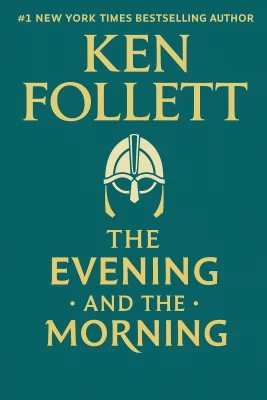
The Evening and the Morning
Categories
Fiction, Audiobook, Historical Fiction, Romance, Fantasy, Adult, Historical, British Literature, Adventure, Medieval
Content Type
Book
Binding
Hardcover
Year
2020
Publisher
Viking
Language
English
ASIN
0525954988
ISBN
0525954988
ISBN13
9780525954989
File Download
PDF | EPUB
The Evening and the Morning Plot Summary
Introduction
# Forged in Darkness: Building Light from Medieval Chaos The morning mist clung to the English Channel like a funeral shroud as Edgar watched the Viking longships emerge from the gray waters. Dragon prows cut through the waves with predatory grace, carrying death toward the defenseless village of Combe. At eighteen, Edgar had planned to flee that very morning with his beloved Sungifu, their secret boat hidden among the reeds, their future mapped out in whispered promises. Instead, he found himself sprinting toward the monastery bell tower, his lungs burning as he pulled the rope with desperate strength. The bronze bell's warning cry split the morning air, but salvation had come too late. The raiders left Combe a graveyard of ash and bone. Edgar's father lay dead among the burning boatyards, his craftsmanship reduced to cinders. Sungifu died fighting her attacker, her skull cracked against stone steps like a broken promise. When the smoke cleared and the screams faded, Edgar stood among the ruins with his mother Mildred and brothers, holding nothing but grief and the bitter knowledge that love was a luxury the living could not afford. Yet from this devastation would rise something unexpected—a story of how ordinary people forge extraordinary destinies from the wreckage of their shattered worlds.
Chapter 1: The Viking Dawn: When Worlds Burned to Ash
The attack came with the dawn, swift and merciless as a blade across the throat. Edgar had been awake for hours, his heart hammering with anticipation as he prepared for the most important day of his young life. The boat he had built in secret lay hidden among the marsh reeds, sturdy enough to carry him and Sungifu across the bay to freedom. She would be waiting at their meeting place, ready to abandon her brutal husband Cyneric and start fresh in a distant village where Edgar had already secured work. But the morning brought death instead of deliverance. Ten Viking longships materialized from the mist like nightmares given form, their crews howling war songs that chilled the blood. Edgar's dreams of escape shattered as he watched five hundred raiders pour onto the beach, their axes gleaming with hunger for English gold and blood. The boy who had planned to flee became the man who stayed to fight, racing through the village to warn his neighbors of the approaching slaughter. The battle was brief and brutal. Edgar's father died defending the harbor, cut down by a bearded giant whose weapon sang through the air with terrible efficiency. The boatyard that had been their family's pride burned like a funeral pyre, consuming generations of craftsmanship in minutes. But it was Sungifu's death that carved the deepest wound in Edgar's soul. He found her broken body in the ruins of her home, her beauty destroyed by violence, her dreams of freedom ended by a Viking blade. When the raiders finally departed, their ships heavy with plunder and captives, Edgar knelt among the smoking ruins and wept for everything he had lost. His mother Mildred, weathered by grief but unbroken, gathered her surviving sons around her. The family had nothing left but each other and the clothes on their backs, but they had something more precious than gold—they had survived. The question now was whether survival was enough to build a future from the ashes of the past.
Chapter 2: New Foundations: Love and Deception at Dreng's Ferry
The farm at Dreng's Ferry was a cruel joke played by fate on the desperate. Thirty acres of marshy ground that had already defeated one family, offered to Edgar's clan by Bishop Wynstan with the cold charity of a man disposing of inconvenient problems. The buildings leaked, the fields flooded with every rain, and the ferry that gave the place its name had rotted to uselessness. But Edgar possessed his father's gift for seeing potential in broken things. Dreng himself was a vicious miser who surrounded himself with damaged women like a spider collecting flies. His two wives, Leaf and Ethel, moved through the compound with the careful steps of those who had learned to avoid their husband's fists. Blod, a pregnant Welsh slave, endured worse treatment as Dreng prostituted her to travelers for a few extra coins. Edgar watched this casual cruelty with growing disgust, but he needed work, and Dreng needed a new ferry. The boat Edgar built was a masterpiece of practical engineering, a flat-bottomed vessel that could carry heavy loads across the treacherous river currents. Dreng grudgingly paid him a pittance, but Edgar had gained something more valuable than silver—a foothold in this harsh new world. His brothers Erman and Eadbald married Dreng's daughter Cwenburg in an unusual arrangement, two husbands sharing one wife to make the failing farm viable. As Edgar threw himself into construction work, building stone brewhouses and learning to forget the girl who had died in his arms, he began to understand that survival required more than skill with tools. It demanded the ability to navigate the treacherous currents of human nature, to build alliances as carefully as bridges, and to recognize that sometimes the strongest foundations were laid not in stone, but in the bonds between people who refused to surrender to despair.
Chapter 3: Unveiled Corruption: The Bishop's Silver Lies
Brother Aldred arrived at Dreng's Ferry with the righteous fury of a scholar who had seen too much corruption masquerading as holy work. The young monk from Shiring Abbey possessed a rare combination of learning and moral courage that made him dangerous to men like Dean Degbert, who ran the local minster like a family business. Degbert lived openly with his wife and children, conducting perfunctory services while his brother Dreng terrorized the village with impunity. But it was Bishop Wynstan's quarterly visits that truly puzzled Aldred. The bishop would arrive bearing gifts for the villagers—sides of bacon, silver coins, small luxuries that bought silence and complicity. Then he would closet himself with Degbert and the minster's jeweler, Cuthbert, for days of secretive activity that left the workshop reeking of hot metal and chemical fumes. The careful way certain silver coins were handled, the nervous energy that infected the clergy, the timing that coincided perfectly with rent collections—all of it pointed to something far more sinister than mere ecclesiastical corruption. Edgar became Aldred's eyes and ears in the hamlet, his builder's attention to detail revealing what others missed. When Edgar followed Wynstan to the port town of Combe, he witnessed the bishop gambling with suspicious confidence, losing heavily to a Norman merchant yet showing no distress at his losses. The truth emerged when Aldred convinced the merchant to have his winnings weighed by a local jeweler—the coins were light, half silver and half copper, their surfaces treated with acid to create the illusion of purity. Wynstan wasn't just a corrupt bishop; he was a counterfeiter operating on a massive scale. The remote minster served as his private mint, where genuine silver collected as rents could be transformed into twice as many false coins. It was a scheme of breathtaking audacity, protected by the isolation of Dreng's Ferry and the complicity of men who had been bought with comfort and silence. But now Aldred possessed the evidence to bring down one of the most powerful men in the kingdom, if he could survive long enough to present it.
Chapter 4: Webs of Power: Murder in Noble Halls
Sheriff Denewald saw his opportunity the moment Aldred laid out the evidence of Wynstan's crimes. Here was a chance to strike at the heart of the family that had dominated Shiring for too long, to prove that even bishops were not above the king's justice. The sheriff assembled a force of armed men and prepared to raid the minster during Wynstan's next visit, when the counterfeiting operation would be in full swing. But Wynstan had not survived years of corruption without learning to watch for threats. His network of informants reached deep into the community, and whispers of the sheriff's interest soon found their way back to him. The bishop began making preparations of his own, calling in favors and applying pressure to potential witnesses. Edgar found himself caught in the crossfire when Wynstan's agents delivered a simple message—testify against the bishop, and his family would lose their farm. The raid erupted in violence that shocked even the hardened men-at-arms who carried it out. When Sheriff Den's forces surrounded the minster, they found Wynstan and Cuthbert working at their illegal craft, the forge glowing red-hot as silver and copper melted together in the crucible. Wynstan's rage was magnificent and terrible to behold when Aldred pushed past him to reveal the counterfeiting operation. The bishop struck the monk with his fist, then turned on the workshop itself like a man possessed. The molten metal sprayed across the room in a deadly arc when Wynstan shattered the crucible with an iron hammer. Godwine, one of Den's men, died instantly as the liquid fire struck his face, burning through flesh and bone to reach his brain. Aldred screamed as a smaller splash seared through his leg, leaving a wound that would never fully heal. In the smoke and chaos, with a good man dead and the evidence scattered, Wynstan had achieved a kind of victory even in defeat. The corruption was exposed, but the forces that protected it remained intact, wounded but not destroyed.
Chapter 5: Exile and Captivity: The Price of Truth
The trial of Bishop Wynstan became a masterclass in the manipulation of justice, conducted on the steps of Shiring Cathedral where the accused man's ecclesiastical authority could not be ignored. Ealdorman Wilwulf presided with the casual arrogance of a man who had never doubted his ability to control outcomes, while his brother stood in pristine white robes that seemed to mock the very concept of guilt. Wynstan's defense was audacious in its simplicity—he claimed to be the victim, not the perpetrator. The counterfeiting operation had been conducted without his knowledge by the weak-willed jeweler Cuthbert, who had succumbed to greed and betrayed his bishop's trust. When Cuthbert protested that he had been coerced, Wynstan shook his head sadly and warned against adding perjury to the list of crimes. The assembled magnates watched this performance with growing unease, but few possessed the courage to challenge a bishop whose brother commanded the largest army in the region. Edgar's family was among the first to feel Wynstan's wrath after his acquittal. The fish traps that had provided their salvation were declared illegal, the farm lease terminated, and Edgar found himself once again homeless with winter approaching. Yet in this darkest hour, he discovered reserves of strength he had not known he possessed, and allies in unexpected places. Lady Ragna, the Norman bride who had recently married Wilwulf, offered Edgar's family sanctuary in her own lands, recognizing the value of loyal allies in a world where betrayal was commonplace. But even Ragna's protection could not shield Edgar from the deeper consequences of his defiance. Wynstan's agents made it clear that the young builder's life would be forfeit if he remained in England. With a heavy heart, Edgar made the decision to flee across the Channel to Normandy, where his skills might find employment far from the bishop's reach. As he boarded the ship that would carry him into exile, Edgar looked back at the shore where his dreams had been born and buried, wondering if he would ever see England again.
Chapter 6: Blood and Liberation: Breaking the Chains
The years in Normandy passed like a fever dream of stone and mortar, as Edgar threw himself into his craft with the desperate intensity of a man trying to forget. He worked on cathedrals and castles, bridges and fortifications, his reputation growing with each project. In Cherbourg, he met Clothild, the master mason's daughter, whose kindness offered the promise of a new beginning. But England called to him with a voice that sounded suspiciously like Ragna's, and Edgar found himself unable to build a life on foreign soil. The message came from Prior Aldred, now risen to lead the diocese after his predecessor's death. The monk had not forgotten his friend's sacrifice, and he offered Edgar something precious—the chance to return home and build a great cathedral that would stand as a monument to faith and justice. Edgar told the messengers he would return, knowing he was probably walking back into heartbreak but unable to choose any other path. Meanwhile, in England, Ragna had endured her own trials. Her marriage to Wilwulf had produced twin sons, but it had also revealed the depths of her husband's weakness and cruelty. When Wilwulf took a young Welsh slave girl as his new favorite, barely acknowledging Ragna's existence, she began to understand that survival in this world required more than noble birth and beauty. It demanded the ability to forge alliances, command loyalty, and when necessary, to strike back at those who would destroy her. The confrontation came when Wilwulf's brother Wigelm, emboldened by the ealdorman's declining health, attempted to force himself on Ragna. The struggle was brief but decisive, ending with Wigelm's body floating face-down in Edgar's old canal. Ragna had discovered that she was capable of killing when cornered, and the knowledge was both liberating and terrifying. She had broken the chains that bound her to a life of submission, but the price of freedom was higher than she had ever imagined.
Chapter 7: Cathedral Rising: Love Triumphant in Stone
Edgar's return to England coincided with the most dangerous period of Ragna's life. Wynstan, now aware that his nephew was dead and suspecting the truth behind Wigelm's drowning, moved to eliminate the Norman woman who had become too dangerous to ignore. But Edgar's arrival changed the balance of power, bringing with him not just his considerable skills but also the backing of Prior Aldred and the reformed church. The reunion between Edgar and Ragna was everything the builder had dreamed of during his years of exile and more than he had dared to hope. They came together with the desperate passion of people who had been given an unexpected second chance, their love undimmed by the years of suffering they had endured. When Edgar learned what Ragna had been forced to do to survive, he felt no revulsion, only admiration for her strength and determination to protect her children. Their wedding was a celebration that drew nobles and commoners from across the region. Edgar, now granted lands and the title of thane by a grateful King Ethelred, stood before the altar as Ragna's equal at last. Bishop Aldred, Edgar's old friend who had risen to lead the diocese, performed the ceremony with tears of joy in his eyes. The three companions who had survived the Viking massacre, who had built something beautiful from the ashes of destruction, were finally united in triumph. But their greatest achievement was still taking shape in stone and mortar. The new cathedral would be Edgar's masterpiece, a building that would stand for centuries as testament to what could be accomplished when vision met determination. Ragna brought her administrative skills and political connections to the project, while Aldred provided the spiritual authority and scholarly resources needed to make their dream a reality. As the walls rose higher with each passing season, the cathedral became more than just a church—it was proof that human beings, at their best, could create beauty from chaos and hope from the depths of despair.
Summary
In the end, Edgar's greatest construction was not the cathedral that would bear his name through the centuries, but the life he built with Ragna and Aldred in the town that grew around their shared dreams. From the ashes of a Viking massacre, they had created something that would outlast kingdoms and outlive kings—a community founded on the radical notion that civilization was worth fighting for, that knowledge was worth preserving, and that love was worth any sacrifice. The dark ages were dark not because the sun failed to shine, but because hope was such a rare and precious commodity. Edgar, Ragna, and Aldred proved that even in the bleakest times, a few determined souls could kindle a light that would burn for generations. Their bridge between worlds became a bridge between eras, carrying the wisdom of the past into the promise of the future. In building their cathedral, they had built something even more enduring—proof that ordinary people, when tested by extraordinary circumstances, can forge foundations strong enough to support the weight of history itself.
Best Quote
“In dog philosophy it was always better to go somewhere than to be left behind.” ― Ken Follett, The Evening and the Morning
Review Summary
Strengths: The review highlights Ken Follett's descriptive writing style, which effectively transports readers to the Dark Ages. It praises the book's well-crafted plot and character development, noting the diverse range of characters and their interconnected stories. The book's ability to stand alone as a prequel without requiring prior knowledge of the series is also emphasized. Weaknesses: The review mentions a slow start as a potential drawback, suggesting that the book requires patience as it gradually introduces characters and their narratives. Overall: The reviewer expresses a positive sentiment, recommending the book for its rich storytelling and historical depth. Despite a slow beginning, the book is seen as rewarding for those who persist, particularly fans of the series.
About Author

Ken Follett
Follett synthesizes historical narratives with thrilling plots, weaving intricate tales that resonate with readers worldwide. His work, notably characterized by a deep understanding of history and human nature, explores themes such as conflict, ambition, and the resilience of communities. With a background in philosophy from University College, London, Follett channels his analytical skills into crafting novels that are not only entertaining but also thought-provoking. His breakout book, "Eye of the Needle," exemplifies this approach with its gripping World War II setting and rich character development, while "The Pillars of the Earth" transports readers to medieval times, focusing on the ambitious construction of a cathedral.\n\nIn his writing, Follett utilizes meticulous research and complex narratives to immerse readers in different eras, thereby offering them a profound understanding of the past. This method allows readers to gain insights into the socio-political dynamics of various historical periods, enhancing their appreciation for how history shapes the present. "The Evening and the Morning," a prequel to "The Pillars of the Earth," further illustrates this by setting the stage for Kingsbridge's transformation during the Anglo-Saxon era. Readers who enjoy detailed historical contexts and intricate storylines find Follett's work particularly rewarding, as it not only entertains but also educates.\n\nFollett's contributions extend beyond his literary achievements. He has played a significant role in literacy advocacy, having been the president of Dyslexia Action and chair of the National Year of Reading. His involvement in these initiatives underscores his commitment to education and community service. Meanwhile, his recognition as a Fellow of University College, London, and his impact on readers highlight his influence both as an author and as a public figure dedicated to promoting literacy and learning.
Read moreDownload PDF & EPUB
To save this Black List summary for later, download the free PDF and EPUB. You can print it out, or read offline at your convenience.

The Evening and the Morning
by Ken Follett
