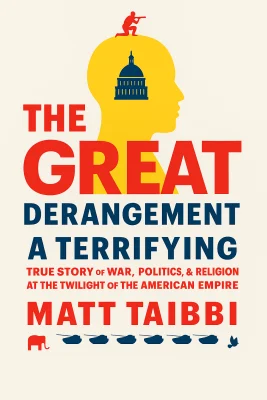
The Great Derangement
A Terrifying True Story of War, Politics, and Religion at the Twilight of the American Empire
Categories
Nonfiction, History, Religion, Politics, Cultural, American, Journalism, Humor, American History, War
Content Type
Book
Binding
Hardcover
Year
2008
Publisher
Spiegel & Grau
Language
English
ASIN
0385520344
ISBN
0385520344
ISBN13
9780385520348
File Download
PDF | EPUB
The Great Derangement Plot Summary
Introduction
In the summer of 2006, a Rolling Stone reporter found himself in the most unlikely of places: kneeling in a circle with fellow Christians in a Texas church basement, holding hands and praying for guidance. What began as a journalistic assignment to understand America's political divisions had become something far more profound—a journey into the heart of a nation that had lost its ability to distinguish between truth and fiction, between genuine faith and manufactured outrage. This extraordinary exploration takes us behind the scenes of American democracy's most troubling contradictions. From the corridors of Congress where meaningful legislation dies in committee while representatives name post offices, to the packed megachurches where End Times prophecies mix with geopolitical strategy, to the coffee shops where 9/11 conspiracy theorists gather to decode what they believe are the lies that shape our world. What emerges is not just a critique of our broken institutions, but a deeply human story about what happens when people lose faith in the very idea of shared reality. This book offers both a mirror to our fractured moment and a path toward understanding how we might begin to heal the wounds that divide us.
Chapter 1: The Evangelical Infiltration: Inside a Texas Megachurch
The journey into America's spiritual underground began with a rented room in San Antonio, where the author discovered Pastor John Hagee's television ministry promising that those who "give up more than you deserve" would receive "more than they dreamed." Armed with little more than curiosity and a fabricated backstory about a circus clown father who beat him with oversized shoes, he infiltrated the 18,000-member Cornerstone Church, one of America's most influential evangelical institutions. What he found was a sophisticated operation that blended genuine spiritual community with political indoctrination. The church's "Government of Twelve" cell structure wasn't just about Bible study—it was designed to survive potential government persecution and to mobilize Christian voters for specific political causes, particularly unwavering support for Israel. Pastor Hagee, despite his folksy demeanor, maintained close ties to Washington power brokers and AIPAC, the Israeli lobby, using his pulpit to promote a foreign policy agenda that many of his parishioners couldn't even locate on a map. The most revealing moment came during a "Deliverance" ceremony, where hundreds of churchgoers purported to vomit demons into paper bags while Hagee cast out everything from "the demon of handwriting analysis" to "the demon of philosophy." The theatrical absurdity masked a deeper truth: these weren't just religious services, but exercises in surrendering critical thinking to authority. The author realized that once you've accepted that your intellectual capacity is demonic, questioning political orthodoxy becomes not just difficult, but spiritually dangerous. Yet beneath the manipulation lay genuine human need. The lonely widows, struggling veterans, and isolated suburbanites who filled the pews weren't seeking political ideology—they were searching for community, meaning, and hope in an increasingly atomized society. The tragedy wasn't their faith, but how that faith was being weaponized by those who understood their vulnerabilities all too well.
Chapter 2: Congressional Theater: How Washington Fails the People
While Americans prayed for deliverance in Texas churches, their elected representatives were performing their own form of theater three thousand miles away in Washington. The author's investigation of Congress revealed an institution that had perfected the art of appearing busy while accomplishing nothing of substance. Days were filled with naming post offices after deceased celebrities and passing resolutions congratulating Little League teams, while real legislative business happened in pre-dawn committee meetings deliberately scheduled when no press or public could observe. The cynicism was breathtaking. Republican Congressman Joe Barton, chairman of the House Energy and Commerce Committee, used Hurricane Katrina as cover to ram through legislation that had nothing to do with disaster relief and everything to do with rewarding campaign donors. His "Gasoline for America's Security Act" was supposedly an emergency response to storm-damaged refineries, yet it primarily rolled back Clean Air Act provisions that would benefit coal plants nowhere near the hurricane's path. When questioned about combat aircraft losses in Iraq—losses that couldn't possibly have occurred given that insurgents had no anti-aircraft capabilities—Barton's staff simply stonewalled. The most revealing moment came when Barton, defending his disaster relief bill, told the Rules Committee about the "famous British scientist Faraday" who showed Queen Victoria the first electric lamp. When she dismissed it as a novelty, Faraday supposedly replied, "Your Highness, of what use is a newborn baby?" Barton's point was that his bill, like Faraday's lamp, would prove revolutionary despite initial skepticism. The problem was obvious: the bill wouldn't provide any relief to hurricane victims, improve energy security, or accomplish any stated purpose. Barton was comparing useful legislation to a newborn baby—both, apparently, useless in the present but potentially valuable someday. This wasn't governance; it was performance art designed to provide cover for systematic corruption. The real business of Congress—the earmarks, no-bid contracts, and regulatory favors that kept campaign donations flowing—happened in darkness while the public was distracted by meaningless partisan theater. The system had evolved to serve everyone except the voters who made it possible.
Chapter 3: Conspiracy Nation: The Rise of 9/11 Truth Movement
When the author criticized 9/11 conspiracy theorists as "clinically insane" in a throwaway online column, he expected mild pushback. Instead, he triggered an avalanche of rage that revealed the breadth and intensity of America's alternative reality ecosystem. Within hours, his inbox filled with death threats from people convinced that anyone defending the "official story" was part of a murderous conspiracy. This wasn't a fringe movement—polls showed that nearly half of New York City residents believed the government had advance knowledge of the attacks. Meeting with the protesters who gathered outside his office led to surreal encounters with characters like Nico Haupt, a deranged German immigrant who screamed accusations of treason while spraying spittle across a Manhattan diner. Yet beneath the lunacy lay a more troubling phenomenon: educated, well-meaning Americans who had constructed elaborate alternative histories based on misinterpreted documents and selective reading of news reports. They pointed to a Project for the New American Century paper mentioning a "new Pearl Harbor" as smoking-gun evidence of government complicity, apparently unaware that the document actually argued against the military interventions they claimed it promoted. The movement's foundational flaw wasn't its skepticism of official narratives—that skepticism was often justified—but its replacement of critical thinking with pattern-seeking paranoia. Truthers believed that Dick Cheney and Paul Wolfowitz would openly confess their criminal conspiracy in a publicly available policy paper, then execute a plan so complex it required the silent cooperation of thousands of government employees, structural engineers, airline pilots, emergency responders, and journalists. They had created a fantasy version of American power that was simultaneously more competent and more evil than reality. Most tragically, the 9/11 Truth Movement represented a kind of narcissistic delusion—the belief that ordinary Americans were so dangerous to the ruling class that elaborate mass murder was necessary to control them. In reality, the political elite had already learned they could ignore public opinion entirely without resorting to violence. The Truthers were flattering themselves with dreams of being important enough to kill, when the system had long ago figured out how to render them irrelevant without firing a shot.
Chapter 4: War and Delusion: Observations from Iraq
The gap between American fantasy and foreign reality became starkly apparent during the author's embedded reporting with U.S. troops in Iraq. The 615th Military Police unit he accompanied were good kids—professional, dedicated, genuinely caring toward each other in the way that military units at their best can be. But they were also trapped in a mission that made no sense to anyone, including themselves. Their job was to train Iraqi police who were too terrified to leave their stations, while the Americans themselves had no clear understanding of why they were there or what success would look like. The absurdity reached its peak during a visit to an Iraqi police station where the Americans were teaching self-defense techniques to officers who wouldn't respond to explosions happening blocks away. While bombs detonated nearby, a civilian contractor from Georgia demonstrated headlock escapes to Iraqis who would never voluntarily engage suspects in hand-to-hand combat. The whole operation was theater designed to justify the enormous sums being spent on "training" programs that existed primarily to employ American contractors at taxpayer expense. What made the situation tragic wasn't the soldiers' incompetence—they performed their duties with skill and dedication—but the fundamental disconnect between their capabilities and their mission. These young Americans could organize complex military operations, maintain sophisticated equipment, and work effectively as a team. But none of those skills addressed the underlying political and economic problems that drove Iraqi violence. They were mechanics asked to perform surgery, engineers tasked with diplomacy, warriors deployed as social workers. The moment of clarity came when Sergeant Biederman, after sitting through another pointless day of fake police training while explosions echoed outside, looked up and asked the only question that mattered: "What the fuck are we doing here?" It was a question that should have been asked in Washington before the first soldier ever deployed, but by then it was too late for anything but honest confusion. The war had become a jobs program disguised as a military operation, sustained by institutional momentum rather than strategic purpose.
Chapter 5: Broken Democracy: The Failure of Two-Party Politics
The 2006 midterm elections were celebrated as a triumph of democracy, proof that Americans could still hold their leaders accountable through the ballot box. The Democratic takeover of Congress was supposed to restore checks and balances, end the war in Iraq, and clean up the culture of corruption that had flourished under Republican rule. Instead, it revealed the fundamental bankruptcy of the two-party system and the impossibility of meaningful change within existing structures. The author's conversations with Bernie Sanders, the Vermont independent who had become a Democratic senator, illustrated the problem perfectly. Sanders, once a reliable voice for outsider politics, now found himself defending the "realities" of Senate procedure when pressed about the Democrats' failure to end the war. The same man who had spent years criticizing the insider game was now explaining why that game couldn't be changed, why the Democratic leadership had to accommodate conservative Democrats like Ben Nelson even if it meant abandoning their antiwar campaign promises. The Democrats' strategy was cynical in its transparency. They would pass symbolic antiwar legislation knowing it would be vetoed, then use that veto to fundraise for the 2008 elections while quietly approving continued war funding. The peace movement, rather than holding Democrats accountable, became complicit in this charade. Professional activists like Brad Woodhouse, who had previously promoted the war as Erskine Bowles's spokesperson, now led "antiwar" organizations that existed primarily to provide political cover for Democratic betrayal. Most telling was Cindy Sheehan's departure from the organized peace movement after being attacked by fellow Democrats for criticizing Nancy Pelosi and Harry Reid's war funding votes. The woman who had become the face of antiwar activism was expelled from her own movement for taking antiwar positions too seriously. Her subsequent embrace of 9/11 conspiracy theories wasn't coincidental—when legitimate political channels are closed, people seek alternative explanations for their powerlessness. The system had become so corrupt that conspiracy theories offered more hope than democracy.
Chapter 6: Media Manipulation and the Death of Objective Truth
The collapse of shared reality didn't happen by accident—it was the inevitable result of decades of media manipulation that had trained Americans to view all information as suspect. The author traced this breakdown to the Reagan era's "Joe Isuzu" commercials, which pioneered the technique of selling products by openly lying about them. This created a media environment where obvious falsehoods coexisted with subtle deceptions, making it impossible for ordinary citizens to distinguish between legitimate journalism and sophisticated propaganda. By the Bush era, this confusion had reached crisis levels. The president could claim that terrorists "hate our freedom" without being laughed off the stage, while mainstream journalists competed to compare his vacant stare to Winston Churchill's steely resolve. Cable news became a parade of talking heads paid to defend predetermined positions rather than analyze events honestly. Even sports coverage required more rigorous fact-checking than political reporting, where access to power mattered more than accuracy. The 9/11 Truth Movement and Christian End Times prophecy were symptoms of this breakdown rather than its cause. When people can't trust mainstream sources of information, they inevitably turn to alternative explanations that seem to make sense of their confusion. The problem wasn't that Americans were becoming more gullible—it was that they were living in a media environment deliberately designed to obscure rather than illuminate truth. Conspiracy theories flourished not because people were crazy, but because official explanations had become so obviously inadequate. What made the situation genuinely dangerous wasn't the existence of alternative theories, but the complete absence of reliable arbiters of factual disputes. In previous eras, respected institutions like universities, major newspapers, or government agencies could settle factual questions even if they couldn't resolve political disagreements. By the 2000s, all of these institutions had lost credibility with large segments of the population, leaving Americans to construct their own versions of reality from the debris of a collapsed information system.
Chapter 7: Seeking Salvation: Political and Spiritual Escape Routes
As the 2008 election approached, signs emerged that Americans were beginning to reject the manufactured divisions that had defined their political culture for a generation. The Ron Paul campaign attracted former Rush Limbaugh listeners who had experienced political conversions, realizing they had more in common with antiwar liberals than with the neoconservative establishment. On the Democratic side, John Edwards's populist message about "corporate Democrats" drew standing ovations from audiences tired of being told to vote against Republicans rather than for positive change. These movements shared a common recognition that the real division in American politics wasn't between left and right, but between ordinary citizens and the insider class that profited from their division. The author encountered families who had stopped speaking over political differences during the Bush years, only to reunite when they realized they'd been manipulated into hating each other while their real interests were ignored. J.C. Braithwaite, a former neoconservative who had won citizenship awards in school, found herself at antiwar protests alongside her formerly liberal brother, both of them recognizing they'd been "chumped" by the political system. Even Barack Obama's appeal, despite his obvious connections to Wall Street and the Democratic establishment, represented something new in American politics. His refusal to campaign on anti-Republican hatred, his rejection of the culture war rhetoric that had defined political discourse for decades, pointed toward a different kind of political conversation. Voters were exhausted by being told whom to hate and increasingly interested in candidates who offered positive visions rather than negative mobilization. The key insight was that the Crossfire paradigm—the manufactured left-right conflict that had sustained political elites for decades—was losing its power to organize public opinion. When people stopped seeing politics as a team sport and started evaluating policies based on their actual effects, the corruption and incompetence of the ruling class became impossible to hide. A population that had been trained to hate each other was beginning to recognize their common interests as citizens who had been systematically betrayed by leaders of both parties.
Summary
This remarkable journey through America's political and spiritual underground reveals a nation caught between breakdown and breakthrough, where the collapse of traditional institutions has created both dangerous delusions and unexpected opportunities for renewal. Through intimate portraits of megachurch congregants, conspiracy theorists, and disillusioned activists, we see how ordinary Americans respond when their leaders fail them completely—sometimes with dangerous fantasy, sometimes with genuine wisdom, but always with a deep hunger for authentic community and truthful leadership. The most hopeful discovery is that America's divisions, while real and painful, are not as fundamental as our political class pretends. The Christian widow praying for meaning, the veteran questioning an endless war, and the activist seeking real change share more common ground than the manufactured culture wars suggest. Their separate journeys toward truth, however misguided at times, reflect a healthy rejection of the lies and manipulations that have defined American political discourse for too long. By understanding their stories with compassion rather than contempt, we can begin to imagine a politics based on genuine human needs rather than artificial divisions—one that honors both our hunger for transcendence and our capacity for reason, creating space for the better angels of our national character to finally emerge.
Best Quote
“Being a wiseass in a groupthink environment is like throwing an egg at a bulldozer.” ― Matt Taibbi, The Great Derangement: A Terrifying True Story of War, Politics, and Religion at the Twilight of the American Empire
Review Summary
Strengths: The review provides a detailed historical context, tracing America's issues back to its foundational principles and lack of traditional governance experience. It highlights Taibbi's insightful analysis of America's post-9/11 trajectory and the resultant cultural and political shifts. Weaknesses: The review suggests that Taibbi may overemphasize the role of government in the nation's decline, potentially oversimplifying complex socio-political dynamics. It also implies that Taibbi's predictions might be somewhat exaggerated or speculative. Overall: The review presents a critical examination of Taibbi's work, acknowledging his foresight and depth of analysis while questioning some of his conclusions. It suggests a thought-provoking read for those interested in understanding America's contemporary challenges.
About Author

Matt Taibbi
Taibbi critiques power dynamics by exploring the intersections of political corruption, media critique, and economic inequality. As a former contributing editor for "Rolling Stone" and a prolific author, he is renowned for his incisive style marked by sharp polemics and vivid metaphors. Taibbi's work often illuminates systemic failures within the criminal justice system, employing investigative depth and satirical tones to engage readers. His notable books, including "The Great Derangement" and "Griftopia", dissect complex socio-political landscapes, while "I Can’t Breathe" delves into the critical issue of police brutality, exemplifying his commitment to addressing societal injustices.\n\nReaders benefit from Taibbi's method of intertwining participatory journalism with critical analysis, offering a lens through which to view the multifaceted issues that define modern America. By transitioning to independent journalism on Substack, he extends his reach, providing an unfiltered perspective on contemporary events. This approach not only attracts those interested in media behavior and political commentary but also empowers readers to question prevailing narratives. Meanwhile, his satirical edge and willingness to tackle controversial topics make his bio an essential read for those seeking to understand the intricacies of power and influence in today's world.\n\nIn addition to his journalistic endeavors, Taibbi's impact is reflected in accolades such as the National Magazine Award for commentary, underscoring his influence in the field. Through his extensive body of work, he challenges audiences to critically engage with the realities of political and economic power structures, making his contribution to investigative journalism both profound and enduring.
Read moreDownload PDF & EPUB
To save this Black List summary for later, download the free PDF and EPUB. You can print it out, or read offline at your convenience.
The Great Derangement
by Matt Taibbi
