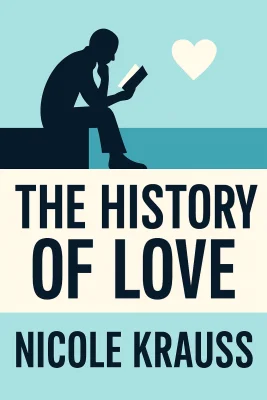
The History of Love
Categories
Fiction, Historical Fiction, Romance, Adult, Book Club, Contemporary, Love, Novels, Adult Fiction, Literary Fiction
Content Type
Book
Binding
Paperback
Year
2006
Publisher
W. W. Norton & Company
Language
English
ASIN
0393328627
ISBN
0393328627
ISBN13
9780393328622
File Download
PDF | EPUB
The History of Love Plot Summary
Introduction
In the cramped darkness of a Manhattan apartment, an old man named Leo Gursky hoards debris like a shield against invisibility. At eighty, he's survived forests and wars, but the greatest terror remains: dying unnoticed. Meanwhile, across Brooklyn, fourteen-year-old Alma Singer carries survival manuals in her backpack and searches for the mystery behind her name—a name borrowed from a book her dead father once gave her mother. The History of Love connects their worlds through three generations of loss and longing. Leo once loved a girl named Alma in Poland, wrote her a book of devotion, then watched the Nazis destroy everything he knew. That same book, stolen and republished under another man's name, eventually reaches Alma Singer through her father's gift. When a stranger offers her mother money to translate the mysterious text, both Leo and Alma begin parallel quests that will reveal the true cost of survival and the impossible persistence of love across decades of silence.
Chapter 1: The Boy Who Loved a Girl Named Alma
Leo Gursky's story begins in a Polish village that no longer exists. At ten, he fell in love with Alma Mereminski, a girl whose laughter became the question he wanted to spend his life answering. They played in fields where everything was possible—sticks became swords, pebbles became diamonds, and love felt permanent as stone. By seventeen, they made love in a barn, their bodies discovering each other with desperate tenderness. Leo promised he would never love another as long as he lived. When Alma asked what would happen if she died, he swore even then he would remain faithful. To prove his devotion, he wrote her a book, filling page after page with chapters about love's history—how angels dream, how silence began, how the first emotions were born. But history had other plans. In 1941, as Nazi tanks rolled toward their village, Alma's father scraped together enough money to send her to America. Leo promised to follow, swearing on his life he would find her. The morning she left, he pressed his manuscript into her hands—every word a map back to him. He never saw her again. Instead, he spent three years hiding in Polish forests, eating bark and rats, surviving only because love made him too stubborn to die. When liberation came, Leo discovered the magnitude of his losses: parents, siblings, neighbors, an entire world erased. Only his love for Alma remained, a compass pointing toward an impossible reunion.
Chapter 2: Words Lost in Exile
Leo arrived in New York Harbor carrying nothing but Alma's address and a heart full of rehearsed speeches. He found her in Brooklyn, married to another man, holding a five-year-old boy who had Leo's eyes. The child was Isaac—Leo's son, conceived in that barn years ago, now calling another man father. Standing in Alma's living room, Leo understood the cruelest mathematics of survival. She had believed him dead, had married for safety, had built a life that couldn't accommodate ghosts. Three times he asked her to leave with him. Three times she refused, tears streaming down her face as she chose the life she knew over the love she remembered. Leo vanished into the city's anonymous crowd, becoming a locksmith who opened doors for others while remaining locked out of his own happiness. He followed his son from a distance, memorizing Isaac's schedule, standing across from schools and playgrounds to catch glimpses of the boy who would never know his real father. Years passed in this strange exile. Leo aged alone in his apartment, collecting the debris of an unlived life. He perfected the art of being seen—making scenes in stores, spilling change, anything to prove his existence to strangers. The greatest fear wasn't death itself, but dying unwitnessed, becoming another invisible man swept away without a trace.
Chapter 3: The Book That Traveled Through Many Hands
Leo's manuscript traveled its own path of exile. His friend Bruno Litvinoff had carried it from Poland to Chile, where he published it under his own name as "The History of Love." The theft wasn't born from greed but desperation—Bruno, dying of loneliness, believed Leo dead and Rosa, his young wife, needed proof of his literary worth. The book found modest success in Chile, enough to give Bruno a brief taste of recognition before illness claimed him. After his death, Rosa discovered the truth: letters from Leo, very much alive in New York, asking for his manuscript back. Wracked with guilt, she destroyed the evidence and told Leo the book was lost in a flood. But books, like love, find unexpected ways to survive. A copy made its way to Argentina, where a young Israeli engineer named David Singer discovered it in a Buenos Aires bookstore. He bought it on impulse, drawn to its chapters about eternal love and impossible devotion. Years later, courting an English girl named Charlotte on a kibbutz, he gave her the book as a declaration—this is how I would love you, if I could write. When David died young of cancer, Charlotte put the book away, too painful a reminder of what she'd lost. It sat on her shelf for years, accumulating dust and memory, until a letter arrived from someone claiming to need it translated. The stranger offered more money than Charlotte had seen in years, enough to make her pull the book down and begin transforming Litvinoff's Spanish back into English.
Chapter 4: The Girl Named After a Character
Alma Singer inherited her name from a book she'd never read, carrying it like a question mark through her teenage years. At fourteen, she was all sharp edges and preparation—backpack full of survival gear, notebooks detailing arctic plants, a Swiss Army knife that belonged to her dead father. She'd appointed herself the family's emergency coordinator, the one who would keep them alive when civilization collapsed. Her mother Charlotte drifted through their Brooklyn house like a ghost, translating dead languages behind walls of dictionaries. Her brother Bird, eleven and convinced he was one of the thirty-six righteous men who keep the world from ending, built strange structures in vacant lots and wet his bed with the weight of cosmic responsibility. Alma watched them both with the fierce protectiveness of someone who'd already lost one parent. When the translation job arrived, Alma saw opportunity. The mysterious client, Jacob Marcus, seemed lonely in his letters, a potential solution to her mother's isolation. She began intercepting their correspondence, adding personal touches to Charlotte's formal responses, crafting the voice of a woman ready to love again. But as Alma read the translated chapters, she discovered something disturbing. While all other characters bore Spanish names, one remained stubbornly Polish: Alma Mereminski. The coincidence felt too large for chance. She began to suspect this wasn't fiction at all, but hidden history—a real woman's story, perhaps even the woman she'd been named for.
Chapter 5: Invisible Lives Becoming Visible
Leo's isolation cracked the day he received a package containing his own manuscript, typed in English under Isaac's name. His son had somehow found the book, recognized its truth, and was publishing it as his final work. The revelation staggered Leo—after sixty years of invisibility, Isaac had seen him. Racing to Isaac's funeral, Leo arrived too late for goodbye but not for understanding. In Isaac's house by the lake, he found signs of a son who'd lived thoughtfully, surrounded by books and carefully chosen objects. Leo put on Isaac's coat, walked in his shoes, trying to inhabit the life he'd been locked out of for so long. Meanwhile, Alma's investigation led her through New York's bureaucratic maze, tracking Alma Mereminski through marriage records and death certificates. She discovered that her namesake had indeed existed, had married a man named Moritz, had a son named Isaac. The pieces assembled themselves into an impossible pattern—the mysterious translator's client wasn't Jacob Marcus at all, but Isaac Moritz, using the name of his most famous character. But Isaac was dead, had died just as Alma reached out to him. The revelation hit her like grief for a stranger who wasn't quite a stranger. She'd been seeking someone to heal her mother's loneliness and found instead a ghost, another person lost to the mathematics of bad timing.
Chapter 6: When Past and Present Finally Converge
Bird, determined to prove his worth as one of the righteous, traced the connections his sister had missed. Using his lemonade-stand earnings, he called every Gursky in the phone book until he found Leo. With the certainty of childhood, he recognized a man who needed help and set out to deliver Charlotte's translation personally. Leo, meanwhile, had received Alma's note left on Isaac's door. He wrote back, asking her to meet him at the Central Park Zoo, signing the letter with his real name. On the appointed Saturday, two people sat waiting on park benches—an eighty-year-old man with a safety-pinned card identifying his burial plot, and a fifteen-year-old girl with a letter from someone she didn't recognize. They almost missed each other. Alma passed Leo three times before noticing his homemade dog tag. When she introduced herself, he laughed with the sound of six decades collapsing into a moment. Here was his Alma's namesake, carrying forward the name he'd made famous with his devotion. They talked as afternoon faded to evening. Leo told her about the girl he'd loved, the book he'd written, the son who'd never known his father's name. Alma told him about her search, her mother's translations, the mysterious connections that had brought them together. In each other, they found what they'd been seeking—Leo discovered he wasn't invisible after all, and Alma found the living thread connecting her to the story she'd been named for.
Summary
In the end, Leo Gursky learned that love's greatest victory isn't possession but continuation. His book survived war and theft, his son's recognition reached him beyond death, and his beloved's name lived on in a girl who carried it with fierce curiosity. The History of Love became exactly what he'd written it to be—not just one man's devotion, but love's entire catalog, every way hearts find each other across time and loss. The convergence of their stories reveals love's most persistent truth: that it survives not in the lovers themselves but in the spaces between people, the invisible threads connecting stranger to stranger across generations. Leo's love for Alma created ripples that reached a girl sixty years later, who in turn brought that love full circle to its source. In recognizing each other, they proved that nothing truly loved ever disappears—it only waits, patient and invisible, for the right moment to be found again.
Best Quote
“Once upon a time there was a boy who loved a girl, and her laughter was a question he wanted to spend his whole life answering.” ― Nicole Krauss, The History of Love
Review Summary
Strengths: The review highlights the novel's beautiful prose and complex narrative structure, featuring multiple plot lines and well-developed characters. The emotional depth and exploration of themes such as love and loss are praised, with particular emphasis on the connection between the characters and the book within the story, "The History of Love." Weaknesses: The reviewer initially hesitated to read the book due to preconceived notions based on the author's personal connections, which may have delayed their engagement with the novel. Additionally, the review lacks a detailed analysis due to time constraints and the reviewer's sleep deprivation. Overall: The reader expresses a positive sentiment towards "The History of Love," ultimately recommending it for its emotional impact and literary beauty, despite initial misconceptions and personal biases.
About Author

Nicole Krauss
Krauss delves into the intricacies of human memory and identity, weaving them into narratives that reflect both personal and historical traumas. Her works, including "Man Walks Into a Room" and "The History of Love", reflect her deep engagement with themes of loss and connection. Whereas her early career began in poetry, Krauss’s transition to fiction allowed her to explore complex emotional landscapes through richly layered storytelling. Her academic background in English literature and art history has evidently influenced her narrative style, adding depth and rigor to her exploration of the human condition.\n\nReaders of Krauss’s novels find themselves immersed in interconnected stories that challenge perceptions of time and self. Her method of interlocking narratives offers unexpected convergences, which enhances the emotional impact and encourages reflection on personal and collective histories. For instance, in "Forest Dark", the metafictional elements invite readers to ponder existential questions of identity and displacement. Meanwhile, her collection of short stories, "To Be a Man", further showcases her ability to delve into diverse facets of human experience, earning the Wingate Literary Prize in 2022.\n\nKrauss's books have gained international acclaim and numerous awards, establishing her as a pivotal figure in contemporary literature. Her narratives are well-suited for those who appreciate profound emotional depth coupled with literary sophistication. This short bio emphasizes the author’s ability to connect with audiences worldwide, using fiction as a vehicle to explore universal themes. Through her distinct voice, Krauss continues to contribute meaningfully to the literary landscape, providing both a mirror and a window into the complex fabric of human life.
Read moreDownload PDF & EPUB
To save this Black List summary for later, download the free PDF and EPUB. You can print it out, or read offline at your convenience.
The History of Love
by Nicole Krauss
