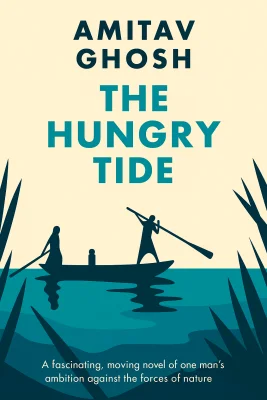
The Hungry Tide by Amitav Ghosh
Categories
Fiction, Historical Fiction, Literature, India, Asia, Book Club, Contemporary, Novels, Indian Literature, Literary Fiction
Content Type
Book
Binding
Paperback Bunko
Year
0
Publisher
The Borough Press
Language
English
ASIN
B01MTN72U9
File Download
PDF | EPUB
The Hungry Tide by Amitav Ghosh Plot Summary
Introduction
# Where Rivers Meet the Sea: Tides of Memory and Belonging The train wheezed to a halt at Canning station, and two strangers stepped onto the muddy platform, each carrying secrets that would soon entangle in the tidal waters of the Sundarbans. Kanai Dutt, a polished translator from Delhi, had come to collect his dead uncle's writings—a mysterious packet that had waited twenty years to be opened. Piya Roy, a marine biologist from Seattle with Bengali features but no knowledge of the language, clutched research permits and equipment, hunting for dolphins in waters her refugee parents had fled decades earlier. Neither could have imagined that their paths would converge with Fokir, an illiterate fisherman whose knowledge of these waters ran deeper than any university training, or that together they would witness both the ancient rhythms of the tide country and the violent forces that had once destroyed an entire community. In this amphibious world where tigers swam between islands and the past refused to stay buried, their separate quests would merge like tributaries flowing toward an inevitable reckoning with history, love, and the price of survival.
Chapter 1: Convergence in the Tide Country: Strangers Drawn to Ancient Waters
The collision happened on the crowded train—tea spilling across Kanai's papers as the carriage lurched, mutual irritation transforming into curious conversation. Piya revealed her mission to survey the Irrawaddy dolphins of the Sundarbans, while Kanai spoke reluctantly of visiting his aunt Nilima in Lusibari, summoned by news of his uncle Nirmal's final writings. When the train pulled into Canning, Kanai found himself extending an invitation that would prove fateful. At the ferry dock, Piya's encounter with a forest guard turned ugly fast. The uniformed official demanded bribes, confiscated her equipment, and assigned her a launch owned by a thuggish man called Mejda. The guard's rifle and leering demeanor made her skin crawl, but her research grant was tight and time limited. She had no choice but to endure their crude gestures and suspicious glances as they pushed deeper into the waterways. Kanai rode separately on the Trust's launch toward Lusibari, listening to Nilima's stories of the hospital she had built while her husband chased revolutionary dreams. The seventy-six-year-old woman watched passengers wade through hip-deep mud at low tide, her eyes pained by memories of better days when the Matla River ran full and proud. The Sundarbans received them both with characteristic indifference—a landscape that had swallowed countless dreams and ambitions, where the only constant was change itself. As their boats pushed through channels the color of milky tea, past islands that appeared and vanished with the tides, neither stranger could foresee how these waters would strip away their certainties and reshape their understanding of what it meant to belong.
Chapter 2: Voices from the Past: Nirmal's Notebook and the Morichjhãpi Tragedy
In his uncle's dusty study, Kanai unwrapped the packet with trembling hands. Inside lay a single notebook, its pages covered in Nirmal's cramped handwriting. The first lines made his breath catch: "I am writing these words in a place that you will probably never have heard of—an island called Morichjhãpi." The date was May 1979, just months before Nirmal's death. This was no collection of poems but a journal written in desperate haste, a man's attempt to bear witness to events he knew would be forgotten. Morichjhãpi had been a government reserve until 1978, when thousands of refugees appeared overnight. They were Dalits who had fled Bangladesh after Partition, imprisoned for decades in resettlement camps in central India, finally breaking free to reclaim their ancestral waters. Nilima's face crumpled when Kanai told her. The authorities had declared Morichjhãpi a protected forest, she explained, her voice barely above a whisper. They were determined to evict the settlers. The final clash came in mid-May 1979—exactly when Nirmal wrote his notebook. Among the refugees was Kusum, a young widow with fierce eyes and a five-year-old son named Fokir, who had known suffering but carried herself with unbreakable dignity. Nirmal, the gentle schoolmaster, had found himself drawn into their struggle, visiting the island with Horen, an old fisherman who knew every creek and channel. What started as curiosity became obsession as he fell under the spell of Kusum's quiet strength and the community's determination to build something from nothing but hope and mud. The notebook revealed the massacre that followed—government boats surrounding the island, cutting off escape routes. Those who resisted were shot. Those who surrendered were loaded onto trucks and shipped back to the camps they had fled. Kusum was among the dead, her body lost to the hungry waters. But her son survived, rescued by Horen and raised in the old ways of the forest.
Chapter 3: Following the Dolphins: Science Meets Traditional Knowledge
Piya's expedition began with disaster and grew worse. When she refused the guard's demand for her Walkman, he shoved her overboard into the churning waters of a tidal channel. The river closed over her head like a fist, salt water filling her lungs as expensive equipment dragged her toward the muddy bottom where countless bones lay buried. But salvation came from an unexpected source. Fokir Mandol, a weathered fisherman with salt crystals dusting his chin, witnessed her fall and dove in without hesitation. His strong hands found her in the murky depths and hauled her back to the surface, where his five-year-old son Tutul waited in their small wooden boat. Fokir spoke no English, Piya no Bengali, yet when she showed him a laminated card depicting an Irrawaddy dolphin, his face lit with recognition. He pointed toward deeper channels where few boats ventured, toward waters that held secrets older than memory. Without words, they struck a bargain—she would pay him to guide her to the dolphins, and he would show her wonders beyond the reach of scientific instruments. The next morning, mist rose from the water like smoke as Fokir navigated by instinct through channels that seemed to exist only in his memory. Then she heard it—the soft snort of dolphins breathing, scattered around the boat like invisible sentries. Her heart raced as she unpacked her equipment. These were Irrawaddy dolphins, exactly as Fokir had promised, but their behavior puzzled her. Instead of ranging freely along the coast, they seemed confined to a single stretch of deep water, circling like prisoners in an aquatic cell. As the tide ebbed, more animals appeared. As it rose, they began to disperse. A revolutionary hypothesis formed in her mind—what if these dolphins had compressed annual migration patterns into daily cycles, following the rhythm of tides instead of seasons?
Chapter 4: Crossing Boundaries: When Different Worlds Collide
Kanai joined the expedition as translator, drawn by Piya's fierce independence and the mystery of what had brought her to this remote place. He was a man accustomed to control, to understanding every situation through language and culture. But the tide country operated by different rules, where boundaries between civilization and wilderness shifted with each tide. Their work meshed perfectly despite the gulf between them. Piya's GPS-guided depth soundings followed the same geometric patterns as Fokir's fishing lines. Her scientific instruments confirmed what his intuition already knew—a kidney-shaped depression in the riverbed, fifteen to twenty feet deeper than the surrounding shallows. It was exactly the kind of refuge river dolphins used during dry seasons, except these dolphins were using it twice daily. Fokir guided them to shore near the ruins of Garjontola, an abandoned village where mangroves grew from crumbling walls. They pushed through the green barrier to a small clearing where a leaf-thatched shrine stood on stilts. Inside were painted figures—a large-eyed woman in a sari and between them a tiger with bold stripes. This was Bon Bibi, Fokir indicated, the forest goddess who protected those who entered her domain with pure hearts. As they returned to the boat, Fokir pointed to marks in the mud—the paw prints of a large cat. Piya's skepticism warred with sudden fear. She had come to study dolphins, but the Sundarbans had its own agenda, its own lessons about the fragile boundaries between human and natural worlds. The collision between worldviews came that night when a tiger, driven by hunger or madness, swam across the river to attack a village. The villagers trapped it in a livestock pen, blinded it with sharpened bamboo, then set the structure ablaze while the animal roared its agony into darkness. Piya tried to intervene, her American sensibilities recoiling from medieval barbarity, but Fokir held her back with strong arms as she struggled and screamed.
Chapter 5: The Storm's Fury: Testing Bonds Between Land and Water
The weather began to change as reports came in of a massive cyclone building in the Bay of Bengal. Fishing boats raced for shelter while the sky darkened with ominous metallic sheen. Piya and Fokir were far from the main boat when the first winds struck, following dolphins through increasingly rough water as the storm gathered strength. Kanai had returned to the launch, shaken by his experience on the island and ready to retreat to Delhi's safety. He offered Piya a chance to come with him, to leave this dangerous place for his urban world's comfort. But she refused, driven by growing obsession with the dolphins and a connection to Fokir she couldn't fully understand. As the storm intensified, the boats were separated. Horen, the old fisherman who had once taken Nirmal to Morichjhãpi, made the agonizing decision to return to port without waiting. He knew the waters better than anyone, understood that to stay meant death for everyone aboard. Kanai watched the empty horizon with growing dread, knowing he had failed to protect the woman he was beginning to love. Meanwhile, Piya and Fokir battled mounting waves in their small boat, racing against time to reach shelter before the cyclone's full fury struck. The dolphins had vanished, driven deep by changing pressure, leaving them alone on water that grew more violent with each passing hour. As their boat's hood was torn away by wind and supplies scattered, they faced the terrible possibility that they might not survive to see another dawn. The storm hit with the force of a moving mountain, turning familiar waterways into chaos of wind and water. Fokir managed to beach their boat on Garjontola just as massive waves began surging inland, carrying them deep into flooded forest where they lashed themselves to a tree with an old sari.
Chapter 6: Sacrifice and Transformation: What the Tides Take and Give
For hours they clung to their perch as the hurricane raged around them, bodies pressed together against the fury of wind and rain. Debris flew past like missiles—entire trees, pieces of buildings, bodies of animals caught in the storm's path. When the eye passed over, they glimpsed a tiger in a nearby tree, another refugee from the flood, before winds resumed from the opposite direction. In the storm's second half, Fokir positioned himself between Piya and the wind, using his body as a shield against flying debris. She felt every impact that struck him, every blow his flesh absorbed to keep her safe. When a massive tree stump hurtled out of darkness and crushed him against the trunk, she heard him whisper the names of his wife and son before his breath faded forever. Piya held his lifeless body through the remaining hours of storm, feeling his weight grow cold against her back while the hurricane spent its final fury on the drowned forest. When dawn finally came, she was alone among skeletal remains of trees, surrounded by a carpet of leaves and debris that stretched to every horizon. The dolphins were gone, familiar landmarks erased, and the man who had saved her life was dead in her arms. They found her the next day, navigating by GPS through the transformed landscape to where rescue boats waited. Fokir's body was brought back to Lusibari for cremation, and Piya sat with his widow Moyna through long nights of mourning, two women bound together by shared loss and love for a man who had belonged more to water than land. Kanai returned from Delhi to find Piya changed, hollowed out by grief and guilt but somehow rooted in the place that had claimed so much from her. She had lost her equipment, her data, everything except the GPS unit that still held the routes Fokir had shown her—a digital map of knowledge passed down through generations of fishermen who had learned to read the secret language of tides and currents.
Chapter 7: New Tides Rising: Legacy and Belonging in the Sundarbans
Months later, Piya established a research station in Lusibari, using international funding to study dolphins while providing work for local fishermen like Horen. She named the project after Fokir, honoring the man whose death had taught her that some forms of knowledge couldn't be measured or quantified, only lived and passed on through acts of love and sacrifice. Nilima watched from her hospital as the American woman learned Bengali from Moyna, as she traded jeans for saris and her nomadic life for something resembling home. The tide country had claimed another refugee, another seeker who had come looking for one thing and found something entirely different. Kanai finished reading his uncle's notebook and felt the weight of words that demanded to be shared, stories that refused to stay buried despite the passage of decades. The tide country had claimed Nirmal as surely as it had claimed Kusum, leaving behind only traces—footprints in mud, marks on a page, memories that shifted like sandbars with each telling. Piya's research confirmed her revolutionary hypothesis—the Sundarbans dolphins had indeed compressed seasonal migration into daily rhythm, adapting to this unique ecosystem where river met sea in endless dance of interpenetration. But more than scientific discovery, she had found what Nirmal wrote in his lost notebook—that home isn't a place you're born to, but a place you choose to defend, even when the cost is everything you thought you were. The mangroves grew over the ruins of Morichjhãpi, erasing evidence of the refugees' brief defiance against forces that would deny them a place to call home. But their stories lived on in Nirmal's notebook, in Piya's research station, in the memory of those who understood that some truths are worth preserving even when the world conspires to forget them.
Summary
The Sundarbans had always been a place where boundaries dissolved—between land and water, past and present, the human and the wild. For Kanai, Piya, and Fokir, it became the stage for a collision between different ways of knowing and being in the world. The translator learned that some truths couldn't be rendered in words, the scientist discovered that the most important data couldn't be quantified, and the fisherman paid the ultimate price for knowledge that lived in his bones rather than books. In the end, the tide country kept its own accounts. It took Nirmal's revolutionary dreams and Fokir's life, but it gave back something equally precious—the understanding that love and sacrifice create their own forms of immortality. Piya's research station became a monument not just to the dolphins she studied, but to the man who had guided her to them and the uncle whose notebook had started it all. In the place where rivers meet the sea, where nothing stays the same but everything endures, the stories of the lost and living flowed together like tributaries joining the eternal tide, carrying forward the voices of those who had dared to call this impossible place home.
Best Quote
“How do you lose a word? Does it vanish into your memory, like an old toy in a cupboard, and lie hidden in the cobwebs and dust, waiting to be cleaned out or rediscovered?” ― Amitav Ghosh, The Hungry Tide
Review Summary
Strengths: The review highlights the book's engaging narrative, which intertwines present and past through characters like Piya, Kanai, and Nirmal. It praises the book's ability to transport readers to the Bay of Bengal, offering a vivid depiction of the region's culture and the life of boatmen. The inclusion of real facts and local myths adds depth and intrigue to the story. Overall: The reviewer conveys a positive sentiment towards the book, appreciating its adventurous and culturally rich storyline. The narrative's ability to evoke reflection on life's wastefulness is noted, suggesting a recommendation for readers interested in sea adventures and cultural explorations.
About Author

Amitav Ghosh
Ghosh interrogates the complexities of colonialism and its lasting effects on identity and environment through his diverse literary works. His books often merge historical fiction with non-fiction, addressing profound themes such as postcolonial identity, transnational migration, and climate change. The intricate narratives of his novels like "The Shadow Lines" and the Ibis Trilogy highlight the intersections of personal and political history, demonstrating how past events shape contemporary South Asian identity. By weaving together individual stories within larger historical contexts, Ghosh invites readers to explore the intricate web of global interconnectedness and cultural hybridity.\n\nHis book, "In An Antique Land," is a testament to his ability to blend anthropology and history, offering readers a unique perspective on cultural exchanges and migrations. Meanwhile, "The Great Derangement: Climate Change and the Unthinkable" challenges readers to confront the looming environmental crises and reconsider humanity's role within it. Ghosh's work appeals to readers interested in understanding the broader implications of historical events on personal and national identities, while also urging them to reflect on ecological concerns.\n\nThe author’s contributions have been recognized with numerous awards, including the prestigious Jnanpith Award in 2018, marking him as the first English-language writer to receive this honor. His narrative innovation and thematic depth continue to impact both literary circles and global thinkers, fostering a deeper appreciation for the interconnectedness of human experiences. This bio highlights Ghosh’s ability to synthesize complex themes into engaging stories, enriching the literary landscape and offering valuable insights for those interested in the nuanced interplay of history, culture, and environment.
Read moreDownload PDF & EPUB
To save this Black List summary for later, download the free PDF and EPUB. You can print it out, or read offline at your convenience.
The Hungry Tide by Amitav Ghosh
by Amitav Ghosh
