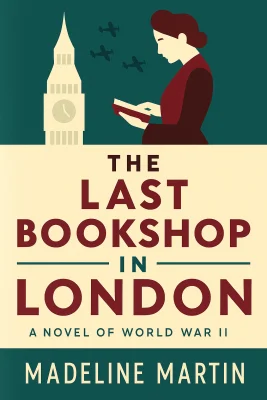
The Last Bookshop in London
Categories
Fiction, Audiobook, Historical Fiction, Romance, Book Club, Historical, British Literature, World War II, Books About Books, War
Content Type
Book
Binding
Paperback
Year
2021
Publisher
Hanover Square Press
Language
English
ASIN
133528480X
ISBN
133528480X
ISBN13
9781335284808
File Download
PDF | EPUB
The Last Bookshop in London Plot Summary
Introduction
The train wheezed into Farringdon Station on that August morning in 1939, carrying two young women who believed they were escaping to a better life. Grace Bennett pressed her face to the window, watching London's checkerboard advertisements blur past, unaware that she was arriving at the doorstep of history's most brutal chapter. Beside her, Viv clicked her lipstick closed with the practiced confidence of someone who had always known exactly where she was going. They clutched battered suitcases and gas masks, those ghastly reminders that war might come calling at any moment. Grace had never wanted to be brave. She'd spent twenty-three years in the shadow of others, first her dying mother, then her cruel uncle who'd thrown her out with nothing but the address of a friend's friend in London. Now she found herself in a city that would demand everything of her. Within months, the sirens would wail, the bombs would fall, and Grace would discover that courage wasn't something you were born with—it was something you found buried between the pages of books, in the quiet moments before the world exploded around you.
Chapter 1: Reluctant Beginnings: Grace's Arrival in Pre-War London
Mrs. Weatherford's green door opened to reveal a woman Grace barely remembered from childhood visits—rounder now, with silver threading through her dark hair and spectacles perched on her nose. Behind her, the narrow townhouse smelled of meat and vegetables, the first proper meal Grace had imagined in months. "Grace, you're the spitting image of your mum," Mrs. Weatherford breathed, touching her fingers to her mouth. The words hit Grace like a physical blow, awakening the grief she'd carefully buried since Beatrice's death. Colin appeared on the stairs, no longer the boy Grace remembered but a tall, gentle man whose face flushed at the sight of her and Viv. He carried their suitcases with careful politeness, the same kindness Grace recalled from their childhood games. Mrs. Weatherford bustled them into the sunny kitchen, chattering about the king and queen, about sugar shortages, about anything except the weight of loss that hung between them. The Anderson shelter squatted in the back garden like a metal beast, half-buried among the torn-up flower beds where Mrs. Weatherford had once grown prize-winning roses. Now there were only sandbags and shoveled earth, the bones of preparation for a war that hadn't yet begun. That first night, Grace lay in the brass bed she would share with Viv, listening to the foreign sounds of London beyond the blackout curtains. She had come here because she had nowhere else to go, but as sleep finally claimed her, she wondered if she had simply traded one form of exile for another. The next morning brought her first glimpse of her new employment. Primrose Hill Books crouched between two respectable townhouses on Hosier Lane, its black paint peeling and windows grimy with neglect. Mr. Evans looked up from his cluttered counter with the expression of a man being asked to swallow medicine. "I don't need help," he announced before Grace could speak. But Mrs. Weatherford had already extracted his reluctant agreement, and Grace found herself standing among towers of books that seemed to multiply in the shadows. This was her sanctuary, her chance to prove herself worthy of something more than her uncle's contempt. She just had no idea how to begin.
Chapter 2: The Power of Words: Discovering a Love for Literature
Mr. Evans treated the bookshop like a private library, disappearing into the maze of shelves with whatever volume had caught his fancy that day. Grace spent her first weeks wrestling with dust and disorder, gradually imposing some kind of sense on the chaos. She labeled sections, cleared pathways, and slowly began to understand the strange ecosystem of readers who drifted through the door. George Anderson appeared on a rain-soaked Thursday, tall and dark-haired with green eyes that seemed to hold secrets. He moved through the shop with the confidence of long familiarity, and when an elderly woman asked for a mystery novel Grace had never heard of, he stepped in with easy grace. "If I may," he said, and Grace watched him guide the woman to exactly the right shelf, pulling down the perfect book as if he had memorized every spine in the place. Later, he lingered at the counter while Grace rang up his purchases, explaining the shop's hidden logic with a smile that made her stomach flutter. He recommended books with the passion of someone describing a lover, speaking of adventures that required no train fare and wisdom that demanded no tuition. "What's the last book you read?" he asked, and Grace felt heat flood her cheeks. "I don't really read," she admitted. The shock that crossed his face was almost comical. "Then you must start with this." He pressed a worn copy of The Count of Monte Cristo into her hands before departing, leaving Grace to study the battered leather binding and wonder what secrets lay within. That night, she opened the book with trembling fingers. The first page led to the second, then the third, and suddenly she was lost in Edmond Dantès' world of betrayal and revenge. When Mrs. Weatherford called her for dinner, Grace startled as if waking from a dream. She had discovered something she never knew she'd been missing—the intoxicating power of story.
Chapter 3: When the Bombs Fell: Finding Purpose in London's Blitz
September brought Germany's invasion of Poland and Chamberlain's grim announcement crackling through the wireless. Grace sat on Mrs. Weatherford's blue sofa, listening to the words that would reshape everything: "This country is at war with Germany." The air raid siren wailed immediately after, sending them scrambling to the Anderson shelter with gas masks and trembling hands. They crouched in the damp metal cocoon, waiting for death to rain from the sky, but the planes never came. False alarm, the BBC announced later. Just practice for the real thing. Weeks passed in strange suspension. The children disappeared from London's streets, evacuated to countryside strangers. Men vanished into uniforms. Sandbags sprouted around doorways like protective warts, and everyone carried gas masks they hoped never to use. Then came that first Saturday afternoon in September when Grace was sitting in King Square Gardens, reading in a shaft of warm sunlight. The siren sounded, but she barely looked up—until she saw the black dots speckling the blue sky like insects. The bombs fell on the East End in distant flashes of light and billows of smoke. Grace stood transfixed, watching London bleed for the first time. This was real. This was war. That night, George's letter arrived at the bookshop, already censored to ribbons. He had volunteered for the RAF, he wrote. He was sorry to miss their planned dinner, but duty called. Enclosed was a book—his own copy of The Count of Monte Cristo, worn soft by countless readings. Grace clutched the letter to her chest as the sirens wailed again and the first bombs fell on London proper. In the Anderson shelter, she pressed her face against Mrs. Weatherford's shoulder and realized that everyone she loved was about to be torn away by war.
Chapter 4: A Community of Readers: The Bookshop as Sanctuary
The bombs came nightly now, and Londoners adapted with grim creativity. Grace joined the Air Raid Precautions service, patrolling dark streets with Mr. Stokes while incendiaries rained like lethal fireworks. She learned to read destruction in the whistle of falling bombs, to count heartbeats in the terrible silence before impact. But the days belonged to books. It began by accident. During an afternoon raid, Grace was shepherding customers to Farringdon Station when someone asked about the novel she was carrying. Trapped underground with bombs thundering overhead, she found herself reading aloud to calm a frightened mother. Her voice carried over the din of war, weaving stories that transported listeners beyond the reach of German planes. Word spread. Soon people came to the bookshop specifically for Grace's readings, gathering on the floor while she perched on the stairs and brought characters to life with different voices. Middlemarch became Jane Eyre became A Tale of Two Cities, each story a bridge across the chasm of fear. Mr. Evans watched from behind his spectacles, pride gleaming in his eyes. "You're changing this war," he told her one afternoon. "One book at a time." The shop transformed. Grace organized the chaos into welcoming sections, created displays that drew the eye, and fostered the kind of community that made strangers feel like family. Customers lingered to discuss plots and characters, finding in literature what the blacked-out city could no longer provide: light, hope, connection. Even Mrs. Nesbitt from next door grudgingly admitted that Grace had accomplished something remarkable. Though she followed it immediately with criticism about copying her window displays. On quiet evenings, Grace would sit in the shop's peaceful corners and read, losing herself in worlds where heroes always found their courage and love conquered all. She was learning to believe that such things might be possible, even in a world gone mad with war.
Chapter 5: Loss and Inheritance: Carrying Forward Mr. Evans's Legacy
The telegram arrived on a gray November morning, formal and devastating: Colin Weatherford had been killed at Dunkirk. Mrs. Weatherford crumpled to her knees in the entryway, keening like a wounded animal. Grace held her as they both wept for the gentle boy who had been too kind for war, too sweet for the brutal mathematics of survival. The house fell silent after that. Mrs. Weatherford stopped attending WVS meetings, stopped caring about anything except the ritual of grief. She would sit motionless for hours, staring at Colin's empty chair, while London burned around them. Grace threw herself into work with desperate energy. She expanded the bookshop's offerings, helped displaced booksellers from Paternoster Row after the devastating bombing, and read with increased passion to crowds who needed stories more than food. But the effort couldn't fill the hole Colin's death had torn in their small world. Mr. Evans understood. His own daughter had died years before, he confessed one evening, along with his wife. "You look like her," he said simply. "Alice. It nearly broke me at first, but now—now I'm grateful for the reminder of what love looks like." He began staying later, helping with inventory and customer recommendations, teaching Grace the subtle art of matching reader to book. They worked in companionable silence, two people who understood that books could be both escape and anchor in a world determined to drift toward chaos. When his heart finally gave out on a cold April morning, Grace found him collapsed behind the counter, Alice's name on his lips. She performed the resuscitation techniques her ARP training had taught her, but some battles couldn't be won with determination alone. The solicitor's visit brought an astonishing revelation: Mr. Evans had left everything to Grace. The shop, the flat above, even the precious books he'd saved from Nazi flames. "He knew no one would care for it like you," the lawyer explained. Standing alone in Primrose Hill Books for the first time as its owner, Grace understood the weight of inheritance. This wasn't just a business—it was a trust, a responsibility to keep stories alive in a world bent on destroying them.
Chapter 6: From Ashes to Pages: Rebuilding The Last Bookshop in London
The night of May 10, 1941, brought London's worst bombing yet. Grace woke in Farringdon Station to the sound of hell unleashing itself on the city above. For six hours, German planes dumped incendiaries and high explosives with methodical precision, turning central London into an inferno. When the all-clear sounded and Grace emerged into the smoky dawn, her first thought was for the shop. She ran through streets littered with broken glass and burning timber, her heart hammering against her ribs. Primrose Hill Books stood, but barely. Windows blown out, door missing, roof partially collapsed. Books scattered like wounded birds across the floor, their pages fluttering in the wind that now whistled through the gaps. Grace stood in the wreckage, clutching a paper flower from her ruined window display, and felt something break inside her chest. This was her life's work, Mr. Evans's legacy, the community she'd built from nothing. All of it reduced to rubble and ash. But she had reckoned without London's spirit. Mr. Stokes appeared first, then Jack from the construction crew, then Mrs. Kittering with tears streaming down her cheeks. By afternoon, dozens of people were picking through the debris, sorting salvageable books from the loss. They worked through the night, hammering and painting and arguing over where the philosophy section should go. Grace woke the next morning to find them installing a new sign above the door: "The Last Bookshop in London." Below it, in Grace's careful script: "All welcome." And beneath that, Jimmy's defiant addition: "Except Hitler." The shop that rose from the ashes was rough-hewn and mismatched, built from scraps and determination. But it was beautiful in the way that survival is beautiful, in the way that community forged in crisis becomes stronger than what came before. "You saved my life," Jack told her as they surveyed their handiwork. Others echoed his words—the woman who'd found solace in stories after losing her children, the professor who'd discovered fellowship among fellow readers, the girl who'd learned courage from fictional heroines. Grace had thought she was just selling books. Instead, she had been building something precious: a sanctuary where stories mattered more than bombs, where hope could flourish in the darkest hours.
Chapter 7: War's End: New Chapters and Lasting Connections
Victory in Europe came on May 8, 1945, with church bells and dancing in the streets. Grace watched from her bookshop as London celebrated, people spilling from pubs and offices to embrace strangers and weep with joy. The war was over, but its changes remained. Viv had found purpose in the ATS, manning anti-aircraft guns with deadly precision. Mrs. Weatherford had adopted Jimmy and Sarah, filling her empty house with new laughter. The bookshop had evolved into Evans & Bennett, painted robin's egg blue and thriving with customers who had become family. George returned in August, still handsome in his pressed RAF uniform, still carrying books instead of flowers. He found Grace reading by the window, sunlight streaming across pages that had survived bombs and fire to bring joy to another generation. "I never thought reading could be more beautiful," he said, "until this moment." Their embrace tasted of reunion and possibility, of all the letters they'd written and all the stories still to be shared. He pulled a small American paperback from his pocket—The Great Gatsby—and asked if she might read it to him. "I'd be honored," Grace replied, and meant it. Around them, the shop hummed with quiet activity. Customers browsed shelves built from salvaged wood, their conversation mixing with the afternoon light. Jimmy was reading to a group of children returned from countryside exile. Mrs. Weatherford was helping a young mother find something suitable for bedtime stories. This was what they had fought for, Grace realized. Not territory or ideology, but the simple right to gather peacefully around stories that reminded them what it meant to be human.
Summary
Grace Bennett arrived in London as a refugee from her own life, carrying nothing but a suitcase and borrowed courage. She left as the owner of something precious: a bookshop that had become the beating heart of a community, a place where stories transcended the boundaries of class and circumstance to create connection in a world gone mad with division. The Last Bookshop in London was never really about books—it was about the people who found themselves reflected in those pages, who discovered that courage wasn't the absence of fear but the decision to keep reading despite it. In Grace's voice, strangers found family. In borrowed stories, they found the strength to write their own. War had taught them all hard lessons about loss and sacrifice, but it had also revealed something luminous: that human connection could survive any bombing, that stories could outlast any tyrant, and that sometimes the most profound victories happened not on battlefields but in the quiet corners where people gathered to remember what they were fighting for. The last bookshop in London became the first light in a new world, proof that some things are too essential to destroy.
Best Quote
“Reading is...” His brows knit together and then his forehead smoothed as the right words appeared to dawn on him. “It’s going somewhere without ever taking a train or ship, an unveiling of new, incredible worlds. It’s living a life you weren’t born into and a chance to see everything colored by someone else’s perspective. It’s learning without having to face consequences of failures, and how best to succeed.” He hesitated. “I think within all of us, there is a void, a gap waiting to be filled by something. For me, that something is books and all their proffered experiences.” ― Madeline Martin, The Last Bookshop in London
Review Summary
Strengths: The book is set in London during WWII, highlighting the resilience and compassion of characters amidst the Blitz. The narrative explores the power of storytelling to unite a community, and the absence of offensive language is appreciated. The character development, particularly Grace's growth in understanding and compassion, is noted positively. Weaknesses: The storyline is described as bland and lacking excitement. The narrative is often more descriptive than demonstrative, failing to evoke strong emotions. The pacing is slow, especially in the first ten chapters, and the writing does not engage the reader effectively, leading to a low rating and forgettable experience. Overall: The reader's sentiment is mixed, with appreciation for character development and thematic elements, but disappointment in the execution and engagement level. The recommendation is low, with the book considered unremarkable and uninvolving.
About Author

Madeline Martin
Martin explores the transformative power of literature through her deeply researched historical fiction, often focusing on the preservation of knowledge during periods of crisis. Her novels, such as "The Keeper of Hidden Books," delve into the impact of books and reading amidst the tumult of World War II, examining how characters preserve banned literature against oppressive regimes. This emphasis on historical events through the lens of human emotion and resilience is a hallmark of her storytelling, which appeals to readers who appreciate both rich historical detail and the emotional depth of characters' experiences.\n\nDriven by her early exposure to European history as a military brat in Germany, Martin's writing method includes extensive research and character development. This dedication is evident in her shift from a corporate career to writing, fueled by the inspiration she found in Diana Gabaldon's "Outlander." Her ability to inhabit her characters' perspectives allows her to craft narratives that resonate with authenticity and depth, making her works compelling to those who enjoy historical settings interwoven with personal stories. Moreover, Martin's books, including "The Last Bookshop in London," not only entertain but also encourage readers to reflect on the enduring significance of literature throughout history.\n\nHer recognition as a New York Times, USA Today, and Publisher's Weekly bestselling author underscores her impact in the literary world. Her books have been translated into over twenty-five languages, demonstrating her international appeal and the universal themes within her stories. Martin's journey from a business analyst to a renowned author serves as inspiration for aspiring writers, emphasizing perseverance and the importance of mastering one's craft. Through workshops and presentations, she shares her writing process, further cementing her role as a guiding voice in historical fiction.
Read moreDownload PDF & EPUB
To save this Black List summary for later, download the free PDF and EPUB. You can print it out, or read offline at your convenience.
The Last Bookshop in London
by Madeline Martin
