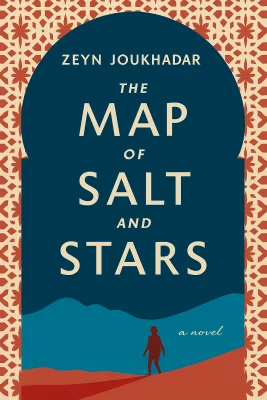
The Map of Salt and Stars
Categories
Fiction, Audiobook, Historical Fiction, Fantasy, Adult, Book Club, Historical, Contemporary, War, Middle East
Content Type
Book
Binding
Hardcover
Year
2018
Publisher
Touchstone
Language
English
ISBN13
9781501169038
File Download
PDF | EPUB
The Map of Salt and Stars Plot Summary
Introduction
# The Cartographer's Daughter: Maps of Memory and Migration The bomb falls on a Tuesday evening in Homs, splitting Nour's world like a cracked egg. One moment the twelve-year-old is whispering stories to the fig tree in her family's garden, the next she's pulling her wounded sister from the wreckage of their home, watching everything they'd built in Syria crumble into dust and ash. The yellow walls that once held their laughter now bleed smoke into the darkening sky. What follows is a journey that mirrors one taken eight centuries before, when a girl named Rawiya disguised herself as a boy to map the medieval world with the legendary cartographer al-Idrisi. Both girls must navigate territories where home becomes memory, where survival demands transformation, and where the most important maps are the ones carried in the heart. As Nour's family flees across hostile borders toward an uncertain refuge, they follow routes traced by countless refugees before them, guided by a painted canvas that holds secrets deeper than geography itself.
Chapter 1: When Walls Crumble: The Shattering of Home
The dining table snaps like burnt toast. Nour reaches for the salt when the shell hits, turning their house into a tomb of concrete and twisted metal. The yellow walls she's known all her life become rubble in seconds, burying everything familiar beneath chunks of ceiling and splintered wood. She claws her way out, tasting plaster dust and blood, calling for her family through the smoke. Her mother Amara emerges from the kitchen covered in white powder, moving with the mechanical precision of shock. But it's seventeen-year-old Huda's scream that cuts through everything, a sound that seems to rise from the earth itself. Her sister lies pinned beneath concrete, metal fragments from the shell embedded so deep in her arm they'll become part of her forever. As Nour helps pull away the debris, she sees how pain can transform a face into something unrecognizable, how a single moment splits time into before and after. Abu Sayeed appears through the smoke like a guardian angel. The geologist who spent his life reading stories written in stone now reads the story written in their shattered home. This isn't random destruction but methodical erasure, house by house, neighborhood by neighborhood. They stumble through streets littered with glass and spent shell casings, past neighbors' homes reduced to skeletal frames. Behind them, their yellow house continues bleeding smoke into the Syrian sky, joining the constellation of destroyed homes that marks war's new geography. In her pocket, Nour clutches a fragment of blue and white ceramic from their fountain, the only piece of their old life the explosion allowed her to keep.
Chapter 2: Rivers of Displacement: First Steps into Exile
The bus to Damascus wheezes through checkpoints where teenage soldiers examine their papers with bored suspicion. Nour presses her face to the cracked window, watching familiar landscapes transform into something alien. Olive groves stand skeletal against the sky, their ancient trunks scarred by shrapnel. Villages that once hummed with life sit empty, windows like dead eyes staring at nothing. In Damascus, they find refuge in Umm Yusuf's cramped apartment, where displaced families compress their universes of loss into single rooms. Little Rahila, Umm Yusuf's three-year-old daughter, wears fuzzy earmuffs even in the heat, hiding the pulpy mass where an explosion tore away half her ear. Her silence speaks louder than screams, another child whose voice the war has swallowed. Sitt Shadid, Umm Yusuf's mother, moves through the chaos with dignity earned through surviving too much to be broken by anything new. She feeds them from nearly empty pots, sings lullabies in a voice like warm honey, somehow making bare floors feel like home. But safety proves illusory. At the border crossing, they meet an old storyteller, a hakawati whose café was shelled, whose livelihood became memory. His eyes hold the weight of all the tales he told in Damascus before war scattered his audience like leaves. He speaks truth everyone knows but won't voice: "Stories ease the pain of living, not dying. People think dying hurts, but it doesn't. Living hurts us." When authorities tell them asylum applications take years with no guarantees, Amara makes the decision defining everything that follows. They'll leave Damascus, leave Syria entirely, trusting their lives to ancient routes that carried travelers across the Mediterranean for millennia. They'll join the invisible river of refugees flowing toward uncertain shores, becoming part of humanity's oldest story: the search for home.
Chapter 3: Crossing Hostile Borders: Desert Trials and Loss
The truck across the Libyan desert becomes a mobile prison, packed with desperate families who sold everything for passage to Algeria. Esmat, a boy Nour's age, travels with his grandfather, carrying the old man's heart medication in a hidden sock. The smugglers rule through casual violence, beating anyone who asks for water or shows weakness. At the Algerian border, crossing becomes nightmare. Guards shoot first, their bullets writing death sentences in sand as families scatter across the desert. Nour watches Esmat fall behind, his small body crumpling as she and her sister Zahra run for their lives. The boy who dreamed of playing football again becomes another casualty of borders drawn in blood. For days, the sisters wander the Sahara, water running out as sun turns sand into furnace. At night they huddle under their mother's old prayer rug, the same carpet that once held honor in their Homs home. Now it's their only shelter against desert cold, patterns faded but still capable of holding them together. Zahra trades her gold bracelet, their father's last gift, for passage on the smuggler's truck. Now she has nothing left to sell except hope itself. They walk until shoes fall apart, until lips crack and skin burns, until horizon becomes shimmering mirage of everything lost. When the Amazigh man finds them, they're barely conscious, bodies shutting down from dehydration and exhaustion. He speaks a language they don't understand, but his eyes hold the same kindness they saw in Abu Sayeed's face. Some forms of humanity transcend language and borders. In the Sahara's vast emptiness, they've found another guardian angel, another person willing to risk everything to help strangers survive.
Chapter 4: The Sea's Cruel Accounting: Separation and Survival
The aid ferry to Libya rocks in Benghazi's harbor, its hull scarred by journeys between desperation and hope. Amara makes her choice in the space between heartbeats. Huda needs surgery that might save her life or take her arm. The infection has spread too far for half-measures. Nour watches her mother disappear into the crowd, Huda's fevered body limp in her arms. The ferry's horn sounds like a funeral dirge, calling the living toward uncertain salvation. She and Zahra hide in the cargo hold, surrounded by crates smelling of rotting fruit and diesel fuel. The rocket strike comes without warning, hull splitting like overripe melon. Water rushes in with the sea's hunger, swallowing everything. Nour's lungs fill with salt and darkness, her mother's painted map the only anchor in a world gone liquid. She breaks surface gasping, Zahra's unconscious form floating beside her like a broken doll. On Misrata's rocky shore, they count losses. The map survives, protected by plastic and prayer. But they're alone now, two girls in a world that devours innocence. The trucks that find them carry new promises and older lies: passage to Algeria, to Morocco, to Spanish enclaves where Europe meets Africa in an embrace sharp as a knife's edge. Abu Sayeed had been their compass, the man who understood stone's language and read their shattered home's story. Now his absence becomes presence all its own, a gravity pulling at them throughout their journey. The dead leave holes in the world that can never be filled, only learned to navigate around. His weathered hands had caught Nour's ankle when their raft plummeted toward churning sea, his strength keeping her from disappearing into green depths. But heroes in war zones are often claimed by the very acts defining their heroism.
Chapter 5: Guides in the Wilderness: Finding Light in Darkness
The refrigerated truck carrying them toward Morocco becomes a tomb of ice and rotting fruit, cold burning their skin like fire. Nour and Zahra huddle together, breath forming crystals in darkness, bodies slowly shutting down as hypothermia claims them degree by degree. When doors open in Ceuta, they spill out like broken dolls, skin blue-white with cold. Spanish guards who find them speak in rapid syllables sounding like childhood songs, voices painted in colors Nour has never seen. But kindness has its own universal language, and they're taken to CETI, the detention center where refugees wait for decisions that may never come. In the desert between borders, an Amazigh woman named Itto finds them with her patient camels. She's one of the free people whose ancestors knew these lands before empires carved them into nations. Her tea tastes of mint and starlight, her stories weaving connections between earth and sky that make Nour remember what belonging means. The old woman teaches her that a person can be two things at once: Syrian and American, lost and found, broken and whole. The desert isn't empty but alive with memory, each grain of sand a story waiting to be told. When they part at Ouargla's market, Itto points to stars and reminds Nour that some things cannot be taken away. The CETI detention center squats on Ceuta's edge like a concrete tumor, walls topped with razor wire glinting in Mediterranean sun. Nour studies the fence separating her from the city beyond, calculating angles and distances with desperation's precision. Freedom is twenty feet away and might as well be on the moon. But sometimes the impossible becomes inevitable, and love proves to be the most reliable compass, pointing always toward reunion's possibility.
Chapter 6: Parallel Paths: Ancient Routes and Modern Journeys
Eight centuries earlier, a girl named Rawiya disguised herself as a boy to join the legendary mapmaker al-Idrisi on an expedition across the known world. Her journey from medieval Ceuta to the courts of Sicily parallels Nour's desperate flight, both girls forced to hide their true selves for survival, both following routes carved by necessity rather than choice. Rawiya's sling found its mark when the great roc descended from eastern skies, the stone striking the creature's eye with a crack echoing across desert. The bird's shriek of rage and pain followed them for days, a promise of vengeance shadowing their steps across two continents. She learned that some legends are simply truths waiting to be witnessed. In Damascus's great library, Rawiya walked through markets where scholars debated philosophy while merchants hawked spices from lands beyond every map's edge. The cathedral of knowledge held texts in Arabic, Greek, Latin, and tongues without names. But knowledge had its price: Fatimid agents shadowing their steps, Almohad spies who would kill for the secrets they carried. When armies converged on the city, Rawiya found herself caught between empires, her sling the only thing standing between companions and war's chaos. The stones she hurled carried her father's teachings' weight, each one a prayer cast into wind. But prayer isn't always enough to turn aside history's tide. The silver planisphere that al-Idrisi spent years creating became a target for those seeing only material worth. When rebellion tore through Sicily and King William's court burned, they fled into exile, carrying maps and memories toward uncertain shores. Rawiya's secret was finally revealed: she was a woman who had traveled the world disguised as a man, who had slain monsters and charted unknown lands.
Chapter 7: The Convergence: Where All Maps Lead Home
Uncle Ma'mun's house sits on one of Ceuta's seven hills like a ship anchored in time. The fountain in his courtyard holds space for the tile Nour carries around her neck, the final piece of a puzzle spanning centuries and continents. When she sets it in place, the pattern completes itself with a prayer's satisfaction. The door opens to reveal a man whose eyes hold echoes of her father's laughter, whose beard grows wild with unexpected reunion's joy. Behind him, shadows move in lamplight, resolving into resurrection's impossible geometry. Amara stands at the window, back to the door, watching the strait where two worlds meet. The embrace that follows is a collision of grief and gratitude, of loss transformed into found. Huda lies in the bed by the window, left arm gone but spirit intact, hijab still decorated with faded roses Nour carried in memory across deserts and seas. The infection took her arm but spared her life, a bargain written in flesh and bone. They're not the same people who fled Syria in darkness. Scars map their bodies like constellations, each mark a survival story. Nour's synesthesia has grown stronger, painting the world in colors without names. She can taste tears' salt, smell healing wounds' purple, hear safety's golden silence. The map that carried them across continents reveals its final secret when Nour scratches away paint. Beneath colors lie words in her mother's hand: poems of loss and longing, of hope deferred but not destroyed. Each country holds a verse, each border a line speaking to the universal human hunger for home. In medieval Ceuta, Rawiya's story ended where it began, in Benzú village, in the house where she was born. Her marriage to Khaldun celebrated love's ability to transcend boundaries dividing us. Al-Idrisi returned to his childhood home, maps complete, wandering days behind him. But stories never truly end, they transform, passing from generation to generation like genetic memory.
Summary
In the end, both journeys lead to the same destination: not a place on any map, but understanding that home is something we carry within us. Nour and Rawiya, separated by nine centuries but united by courage, discover that the most important borders are the ones we cross within ourselves. The maps they follow and create are more than geographical tools; they're testimonies to the human spirit's refusal to be contained by artificial boundaries dividing nations and peoples. The painted canvas that guided Nour's family across continents was never about finding a destination but about remembering that we're all travelers on the same journey, all seeking the place where we belong. In Ceuta, where Africa and Europe almost touch, where the Mediterranean holds memory of every crossing, the blue and white tiles of the fountain tell their own story of completion. Sometimes, if we're very lucky, we discover that home was never a place we had to reach, but a story we had to tell, a pattern we had to complete, one precious fragment at a time.
Best Quote
“I am a woman and a warrior. If you think I can't be both, you've been lied to.” ― Jennifer Zeynab Joukhadar, The Map of Salt and Stars
Review Summary
Strengths: The review highlights the book's beautiful themes, poetic writing, and the portrayal of hope and strength in adverse circumstances. It is praised for offering a perspective that reminds readers of their privilege and the goodness that can be found even in difficult situations. Weaknesses: The reviewer criticizes the book for its excessive use of intricate detail and synesthesia, which they found overwhelming. The narrative is described as being buried under a "mountain of metaphor," with repeated themes and imagery that failed to coalesce effectively. Overall: The reader's sentiment is mixed. While they appreciate the book's thematic depth and lyrical language, they found the detailed descriptions and metaphors excessive. The book is recommended for those seeking perspective but may not appeal to readers who prefer straightforward narratives.
About Author

Zeyn Joukhadar
Joukhadar reflects on the intersections of identity, migration, and cultural heritage through his literary works, connecting readers to complex themes like the Syrian refugee crisis and Arabic astronomy. With a background in biomedical research, his transition into literature is marked by a meticulous attention to detail and a deep exploration of human experiences. In his book "The Map of Salt and Stars," he masterfully intertwines historical narratives with contemporary issues, providing a multi-layered understanding of displacement and belonging. Meanwhile, "The Thirty Names of Night" delves into themes of identity and transformation, earning critical acclaim and winning the Lambda Literary Award and Stonewall Book Award.\n\nHis writing has appeared in esteemed publications such as Salon and The Paris Review, showcasing his narrative prowess. As a mentor with the Periplus Collective and a member of the Radius of Arab American Writers, Joukhadar supports emerging writers of color, fostering diverse voices in the literary community. This commitment extends beyond his books, influencing readers who seek stories that challenge and enrich their perspectives. Through his work, Joukhadar has become an important contemporary voice, bridging cultural gaps and prompting reflection on complex social issues.
Read moreDownload PDF & EPUB
To save this Black List summary for later, download the free PDF and EPUB. You can print it out, or read offline at your convenience.
The Map of Salt and Stars
by Zeyn Joukhadar
