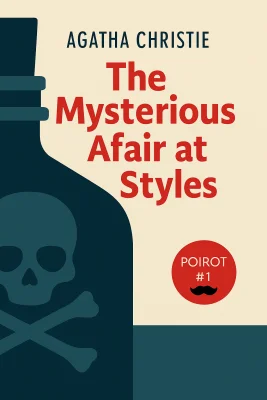
The Mysterious Affair at Styles
Categories
Fiction, Classics, Audiobook, Mystery, Thriller, Crime, Mystery Thriller, Agatha Christie, Murder Mystery, Detective
Content Type
Book
Binding
Paperback
Year
2020
Publisher
Warbler Classics
Language
English
ISBN13
9781734452594
File Download
PDF | EPUB
The Mysterious Affair at Styles Plot Summary
Introduction
The old English manor house stood silent in the July heat, its windows catching the last rays of sunlight like watchful eyes. Inside Styles Court, Emily Inglethorp lay dying, her body wracked with violent convulsions as strychnine coursed through her veins. But this was no accident—someone in the household had carefully planned her murder, weaving a web of deception that would challenge even the brilliant mind of Hercule Poirot. Captain Arthur Hastings had come to Styles seeking rest after his war wounds, invited by his old friend John Cavendish. What he found instead was a house simmering with tension, where Mrs. Inglethorp's recent marriage to the much younger Alfred had created bitter divisions among the family. When the wealthy matriarch died screaming her husband's name, it seemed the case was solved before it began. Yet as Poirot would soon discover, the truth lay buried beneath layers of carefully constructed lies, where every clue pointed in multiple directions and the real killer watched from the shadows, confident in their perfect crime.
Chapter 1: An Uneasy Household: Relationships and Tensions at Styles Court
Hastings arrived at Styles Court on a sweltering July afternoon, grateful for John Cavendish's invitation to recuperate at the family estate. The grand old house seemed peaceful enough, surrounded by manicured gardens and rolling Essex countryside, but tensions simmered beneath its genteel surface like poison waiting to strike. Emily Inglethorp ruled her domain with an iron will disguised as maternal generosity. At seventy, she had shocked everyone by marrying Alfred Inglethorp, a man twenty years her junior with an elaborately groomed black beard and theatrical mannerisms. The family barely concealed their disgust. John Cavendish, her elder stepson, struggled to maintain civility while his finances crumbled. His wife Mary moved through the house like a caged wildcat, her tawny eyes holding secrets that made Hastings' pulse quicken. The household tensions crystallized around Evelyn Howard, Mrs. Inglethorp's companion and fiercest defender. A woman of military bearing and blunt speech, she had served the family faithfully for years until Alfred's arrival poisoned the well. "Mark my words," she warned Hastings with grim certainty, "that man will murder her in her bed. I know his type—fortune hunters who'd sell their souls for money." Her words proved prophetic in ways no one could have imagined. The final piece of this domestic puzzle was young Cynthia Murdoch, Mrs. Inglethorp's ward, who worked at the Red Cross hospital dispensary. Her cheerful presence provided the only brightness in a house growing darker by the day. Lawrence Cavendish, John's younger brother, watched her with the tortured intensity of unrequited love, his artistic temperament making him jump at shadows. When the storm finally broke, each of them would be forced to reveal the secrets they'd hidden behind polite facades.
Chapter 2: The Fatal Cup: Mrs. Inglethorp's Mysterious Death
The afternoon of July 16th crackled with electricity that had nothing to do with the approaching thunderstorm. Mrs. Inglethorp had quarreled violently with someone—the servants whispered of raised voices and bitter accusations echoing through the house. By evening, the old woman appeared shaken but determined, calling for her solicitor and making cryptic references to unfinished business that could no longer wait. The household retired early that night, exhausted by the day's emotional turmoil. Mrs. Inglethorp took her usual cup of cocoa and settled into her locked bedroom, unaware that death was already coursing through her veins. The strychnine worked slowly at first, giving her false hope as she drifted toward sleep. Then the convulsions began with savage intensity, her body arching in agonizing spasms as the poison reached its full effect. The household awakened to her screams piercing the night air. John and Lawrence threw themselves against her locked door while the servants wailed in the corridors below. When they finally broke through, they found Mrs. Inglethorp in her final moments, her eyes wide with terror as she gasped out her dying words: "Alfred—Alfred—" The name hung in the air like an accusation that would damn her husband before any investigation could begin. Dr. Bauerstein arrived first, his dark beard and piercing eyes making him look more like an undertaker than a physician. He worked frantically over the dying woman while the family watched in helpless horror. But it was too late—Emily Inglethorp was beyond earthly help, taking her secrets to the grave while leaving behind a puzzle that would challenge the greatest detective mind of the age. Alfred Inglethorp's convenient absence that night only deepened the mystery and pointed an even more damning finger at the obvious suspect.
Chapter 3: The Belgian Detective: Poirot's Methodical Investigation
Hercule Poirot entered the case like a small, dapper whirlwind, his egg-shaped head tilted thoughtfully as he surveyed the scene at Styles Court. The little Belgian refugee had found sanctuary in the village after fleeing the war, his reputation as a brilliant detective preceding him like a dangerous perfume. Hastings summoned him with desperate hope, knowing that conventional investigation would miss the subtle threads connecting this carefully woven crime. Poirot's methods defied conventional logic, focusing on seemingly trivial details that others dismissed. He examined the victim's bedroom with the intensity of a scholar reading ancient manuscripts, noting a coffee cup ground to powder, candle grease on the carpet, and a fragment of green fabric caught in a door bolt. Each clue whispered secrets to his extraordinary mind, building a picture that challenged every assumption the family had made about Mrs. Inglethorp's death. The detective's questioning revealed cracks in everyone's alibis and motives buried deeper than graves. He discovered that the victim had destroyed a will in her bedroom fireplace on one of the hottest days of the year—an act that made no sense unless she had uncovered something terrible about her own household. His gentle probing of the servants uncovered a web of small deceptions and hidden resentments that painted the Cavendish family in increasingly sinister shades. Most disturbing of all was Poirot's growing conviction that Alfred Inglethorp, the obvious suspect, was somehow innocent of his wife's murder. The evidence against him seemed almost too perfect, too carefully arranged by someone who understood how suspicion naturally flowed. As the little detective's green eyes gleamed with dangerous knowledge, he began to perceive the true scope of the conspiracy that had claimed Emily Inglethorp's life—and the shocking identity of her real killer.
Chapter 4: Contradictory Evidence: The Web of Suspicion Widens
The inquest revealed contradictions that deepened the mystery rather than solving it. Alfred Inglethorp's testimony crumbled under cross-examination as the chemist identified him as the man who had purchased strychnine the day before the murder. Yet Poirot discovered that Inglethorp had an unshakeable alibi—he had been seen miles away with Mrs. Raikes, the farmer's wife, at the exact time of the poison purchase. Someone had impersonated him with theatrical precision, using his distinctive beard and clothing as a perfect disguise. The evidence against other family members mounted like storm clouds gathering overhead. Lawrence Cavendish's fingerprints were found on a strychnine bottle at the hospital dispensary where Cynthia worked, and his medical training made him knowledgeable about poisons. Mary Cavendish had been caught in obvious lies about her whereabouts during the murder, her green land-worker's smock providing the fabric fragment found in her mother-in-law's room. Each revelation painted another family member in darker shades of guilt. Poirot's investigation uncovered a sophisticated plot involving bromide powders that would delay the strychnine's effects, explaining why Mrs. Inglethorp had not died immediately after drinking her coffee. The murderer had needed time to establish an alibi and remove evidence, counting on the victim's delayed death to confuse the timeline. But they had made crucial errors in their overconfidence, leaving traces that only Poirot's extraordinary mind could interpret correctly. The detective's most shocking discovery came when he realized that Mrs. Inglethorp had never actually drunk the poisoned coffee—it had spilled on her carpet, leaving a tell-tale stain. The strychnine had been administered through her nightly medicine, precipitated by bromide powders that caused the poison to settle at the bottom of the bottle. This revelation eliminated several suspects while pointing toward someone with intimate knowledge of both chemistry and the victim's nightly routine, narrowing the field to a handful of people with means, motive, and deadly opportunity.
Chapter 5: The Unexpected Arrest: John Cavendish in the Dock
The arrest of John Cavendish sent shockwaves through the household that reverberated like thunder across the countryside. Scotland Yard detectives found damning evidence hidden in his room: the strychnine bottle from the village chemist and gold-rimmed spectacles matching those worn by Alfred Inglethorp. The case against him seemed ironclad—financial desperation, a bitter quarrel with his stepmother, and physical evidence that placed the murder weapons in his possession. The trial at the Old Bailey became a sensation, with fashionable London society packing the courtroom to witness the downfall of an old family. The prosecution painted John as a cold-blooded killer who had murdered the woman who raised him, driven by greed and sexual scandal. His affair with Mrs. Raikes provided motive, while his forged alibi note and disguised appearance at the chemist's shop demonstrated premeditation of the most calculating kind. Sir Ernest Heavywether's defense strategy proved as brilliant as it was ruthless, systematically destroying the prosecution's timeline while casting suspicion on Lawrence Cavendish. The evidence against both brothers was disturbingly similar—both had motive, opportunity, and knowledge of poisons. The defense attorney's brutal cross-examination of witnesses created reasonable doubt by suggesting that either brother could have committed the crime, leaving the jury confused about which Cavendish was actually guilty. Mary Cavendish's steadfast support for her husband provided the trial's most poignant moments. Her proud reserve cracked as she watched the man she had learned to love facing the gallows, their marriage finally rekindling under the crucible of mortal danger. But Poirot watched from the gallery with troubled eyes, knowing that the wrong man sat in the dock while the real killer walked free, confident that their perfect plan had succeeded beyond their wildest dreams.
Chapter 6: The Final Revelation: Unmasking the Conspiracy
Poirot's dramatic confrontation came not in the courtroom but in the drawing room at Styles Court, where he assembled the entire household for a final reckoning. His green eyes gleamed with dangerous knowledge as he revealed the true scope of the conspiracy that had claimed Emily Inglethorp's life. The crime had been planned by two people working in perfect coordination—Alfred Inglethorp and Evelyn Howard, whose bitter enmity had been an elaborate performance designed to deflect suspicion. The detective's reconstruction of events was masterful in its deadly precision. Evelyn Howard had disguised herself as Alfred Inglethorp to purchase the strychnine, her height and mannish voice making the deception credible to a chemist who barely knew the victim's husband. Meanwhile, Alfred had established his alibi through his affair with Mrs. Raikes, creating an unbreakable defense while his accomplice procured the murder weapon. Their plan relied on Alfred being suspected, arrested, and then dramatically cleared—double jeopardy laws would protect him forever after his inevitable acquittal. The murder itself had been fiendishly clever, using Mrs. Inglethorp's own medicine as the delivery system for the poison. Howard's medical knowledge allowed her to add bromide powders that would precipitate the strychnine, causing it to collect at the bottom of the medicine bottle. The victim would consume a fatal dose only when she took her final portion, giving the killers time to establish their alibis and remove evidence. Poirot's most devastating revelation was the discovery of a torn letter hidden in plain sight among the spills in Mrs. Inglethorp's bedroom. Alfred had written to his accomplice about their "stroke of genius" regarding the bromides, but had been forced to destroy the evidence hastily when surprised by his wife's early return. As he read the incriminating fragments aloud, Alfred Inglethorp's composure finally cracked, his desperate attack on the detective confirming his guilt beyond any shadow of doubt.
Summary
The web of deception at Styles Court unraveled with the precision of a Swiss timepiece, revealing the dark hearts that had beaten beneath its civilized veneer. Alfred Inglethorp and Evelyn Howard were led away in chains, their elaborate conspiracy exposed by the brilliant mind of Hercule Poirot. John Cavendish walked free from the Old Bailey, his marriage to Mary restored by the crucible of near-death that had burned away their pride and mutual misunderstanding. The household could finally breathe freely, knowing that justice had prevailed over the most cunning of killers. Yet the case left shadows that would linger long after the courtroom drama ended. The Mysterious Affair at Styles had shown how easily evil could masquerade as virtue, how those closest to us might harbor the darkest intentions. Poirot's first English case established his reputation as a detective capable of seeing through the most elaborate deceptions, setting him on a path that would lead to countless other mysteries. In the end, truth had triumphed over lies, but at a cost that reminded everyone present that innocence, once lost, could never be fully reclaimed.
Best Quote
“Instinct is a marvelous thing. It can neither be explained nor ignored.” ― Agatha Christie, The Mysterious Affair at Styles
Review Summary
Strengths: The review highlights the unique portrayal of Hercule Poirot, noting his developing eccentricities and impressive deductive skills. The narrative is described as a cleverly written murder mystery with engaging twists and turns, maintaining suspense about the real culprit. The contrasting perspectives of Poirot and Hastings add depth to the storytelling. Overall: The reviewer expresses a positive sentiment towards the book, appreciating its clever writing and the intriguing character dynamics. The reader was impressed by Poirot's methods and found the story engaging, suggesting a strong recommendation for fans of mystery and detective fiction.
About Author

Agatha Christie
Christie investigates the complexities of human motives through her intricate detective novels, creating iconic characters like Hercule Poirot and Miss Marple. Her work is renowned for its cleverly woven plots and psychological depth, which often explore themes of greed, jealousy, and revenge. With her distinctive ability to craft suspenseful narratives within confined settings, she has left an indelible mark on the crime fiction genre. Her success in this realm is further evidenced by her enduring play, "The Mousetrap", the longest-running in modern theater history.\n\nThe author’s early career faced challenges with publisher rejections, yet her persistence led to the creation of a literary empire, amassing over two billion book sales worldwide. Writing under the pseudonym Mary Westmacott, she extended her literary reach beyond crime fiction to romance, demonstrating her versatility. Christie's influence extends to a wide audience, captivating readers with her logical deduction and engaging storytelling. Her work appeals to those who appreciate the intricate puzzles and rich character portrayals that define her stories.\n\nChristie's literary achievements include a variety of notable works such as "The Mysterious Affair at Styles", "Murder on the Orient Express", and "And Then There Were None". Recognized as the best-selling novelist of all time, her novels have been translated into over 100 languages, illustrating her global impact. Furthermore, her contributions to literature were honored with the title of Dame Commander of the Order of the British Empire. This short bio captures how Agatha Christie's innovative approach and enduring creations continue to influence and inspire both readers and writers in the field of detective fiction.
Read moreDownload PDF & EPUB
To save this Black List summary for later, download the free PDF and EPUB. You can print it out, or read offline at your convenience.
The Mysterious Affair at Styles
by Agatha Christie
