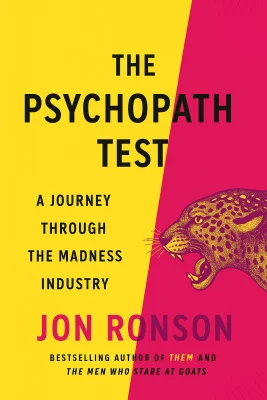
The Psychopath Test
A Journey Through the Madness Industry
Categories
Nonfiction, Psychology, Science, Mental Health, Audiobook, Sociology, True Crime, Mental Illness, Journalism, Book Club
Content Type
Book
Binding
Paperback
Year
2012
Publisher
Riverhead Books
Language
English
ISBN13
9781594485756
File Download
PDF | EPUB
The Psychopath Test Plot Summary
Introduction
In a quiet Costa Coffee in Bloomsbury, a neurologist named Deborah sits across from a journalist, sliding a mysterious book across the table. The book, titled "Being or Nothingness," has arrived unsolicited at her workplace, along with identical copies sent to academics worldwide. No one knows who sent it or why. This simple encounter would launch an extraordinary investigation into one of the most powerful yet invisible industries of our time: the business of defining madness. What begins as a puzzle about anonymous packages becomes a profound exploration of how we categorize human behavior, who holds the power to label others as "mad," and the far-reaching consequences of these labels. The author embarks on a journey through psychiatric hospitals, corporate boardrooms, and research laboratories, meeting everyone from patients labeled as psychopaths to the scientists who created the tests that define them. Along the way, he discovers that the line between sanity and madness is far blurrier than we imagine, and that the very act of seeking out "crazy" behavior in others might reveal something unsettling about ourselves. This investigation will challenge everything you think you know about mental health, human nature, and the hidden forces that shape our understanding of normalcy.
Chapter 1: The Puzzle of Being or Nothingness
The mystery began with a book that defied explanation. Academics across the globe received identical copies of a slim, expensively produced volume called "Being or Nothingness," postmarked from Gothenburg, Sweden. The book contained cryptic verses, pages with words carefully cut out, and twenty-one completely blank pages alternating with twenty-one pages of text. Most puzzling of all was a sticker on each copy: "Warning! Please study the letter to Professor Hofstadter before you read the book. Good Luck!" The recipients, brilliant minds from various fields, gathered on blogs and message boards, convinced they had been handpicked for some elaborate intellectual challenge. They theorized about viral marketing campaigns, religious propaganda, even recruitment tests for shadowy organizations. Some suggested the answer lay in invisible ink or secret codes hidden within the missing words on page thirteen. The more they analyzed, the more convinced they became that only their collective intelligence could crack such a sophisticated puzzle. The truth proved both simpler and more profound than anyone imagined. The book's creator was not a brilliant conspiracy or a team of masterminds, but a single Swedish psychiatrist named Petter Nordlund, driven by an obsessive compulsion to create and distribute his cryptic creation. What the academics had interpreted as genius was actually the product of one man's psychological fixation. The "missing piece" they sought was not a hidden code or incomplete information, but the recognition that madness itself had been the driving force behind the entire elaborate scheme. This revelation would become a perfect metaphor for the journey ahead: our tendency to seek rational explanations for irrational behavior, and how the supposedly crazy can have profound effects on the supposedly sane world around them.
Chapter 2: Psychopathy: The Science of Spotting Monsters
In a maximum-security prison in Vancouver during the 1960s, psychologist Bob Hare began conducting experiments that would revolutionize how we understand dangerous minds. He strapped psychopathic inmates to machines that measured their physical responses, then told them he would count backward from ten and deliver a painful electric shock when he reached one. The results were startling: while normal prisoners showed dramatic increases in perspiration and heart rate as the countdown proceeded, the psychopaths remained eerily calm, their bodies registering virtually no fear of impending pain. Even more disturbing was what happened when Hare repeated the experiment. Despite having just experienced the agony of electric shock, the psychopaths showed no anticipatory fear the second time around. It was as if they had no memory of pain, no ability to learn from negative consequences. This discovery led Hare to develop his famous PCL-R Checklist, a twenty-point assessment tool that would become the gold standard for diagnosing psychopathy. The checklist included traits like superficial charm, grandiose self-worth, lack of remorse, and shallow emotions. Hare's research revealed that psychopaths aren't just more dangerous because they lack conscience; they're fundamentally different in how their brains process fear, pain, and consequences. Their amygdalae, the brain regions responsible for processing fear and emotional responses, function abnormally. This means they can commit horrific acts without the psychological barriers that constrain most people. Yet this same deficit can sometimes propel them to positions of power, where ruthlessness is rewarded and emotional detachment is seen as strength. Understanding psychopathy became less about identifying movie-villain monsters and more about recognizing that some of the most successful people in our society might be missing crucial emotional components that the rest of us take for granted.
Chapter 3: Power and Manipulation in High Places
Al Dunlap's Florida mansion was a shrine to predators. Everywhere you looked, there were sculptures of lions with bared teeth, eagles with fish in their talons, sharks circling the globe, and panthers ready to pounce. The man known as "Chainsaw Al" had made his fortune firing people with apparent relish, shutting down factories across America while his companies' stock prices soared. When questioned about his collection of predatory animal sculptures, Dunlap was unapologetic: "I have a great belief in and a great respect for predators. Everything I did I had to go make happen." During their conversation, Dunlap cheerfully admitted to many traits on the psychopathy checklist, reframing each as a business positive. Superficial charm became leadership charisma. Lack of remorse freed him to move forward and achieve great things. Shallow emotions protected him from "nonsense feelings" that might interfere with tough decisions. When shown crime scene photographs of blown-apart faces that would horrify most people, he responded with curious detachment: "What enters my mind is, What happened here? Why did it happen?" His reaction was intellectual, not emotional. The small town of Shubuta, Mississippi, tells the other side of Dunlap's success story. Once a thriving community built around the Sunbeam toaster plant, it became a ghost town after Dunlap's cost-cutting measures. Boarded-up shops line the main street, the jail has closed, and the old movie theater sits in ruins, its last film appropriately titled "Night of the Living Dead." Wall Street research reports from the time reveal the callous mathematics behind such decisions: analysts celebrated mass layoffs with phrases like "trading buy rating" and projections of soaring stock prices based on human suffering. This reveals a troubling possibility that successful psychopaths don't just exist in isolation, but operate within systems that reward their behavior. The financial markets, corporate boards, and business culture can amplify psychopathic traits, turning individual callousness into societal-level consequences. When lack of empathy becomes a competitive advantage and human costs are reduced to numbers on spreadsheets, we may be witnessing psychopathy scaled up to institutional levels.
Chapter 4: The Dark Side of Diagnosis
Inside a medium-security psychiatric hospital in Ontario during the 1960s and 70s, Dr. Elliott Barker believed he had found the cure for psychopathy. Inspired by the radical therapeutic communities of the era, including R.D. Laing's experimental Kingsley Hall in London, Barker created the "Total Encounter Capsule" at Oak Ridge. He led groups of young psychopathic murderers and rapists into a small green room where, under the influence of LSD and completely naked, they would spend eleven-day stretches confronting their deepest emotional truths. The early years seemed promising. These hardened criminals began showing tenderness toward one another, learning to express vulnerability and care. Some even requested to delay their parole hearings, wanting to complete their therapy. Barker was convinced he was witnessing a revolutionary breakthrough in treating the supposedly untreatable. The program expanded under his protégé Gary Maier, who introduced dream workshops, mass chanting sessions, and eventually culminated in giving LSD to twenty-six serial killers simultaneously. The devastating truth emerged years later when researchers studied the long-term outcomes. While 60% of untreated criminal psychopaths typically re-offend after release, a staggering 80% of Barker's "cured" patients went on to commit new crimes. The treatment had made them worse. One patient, Cecil Gilles, was declared cured and within days had sexually assaulted a fourteen-year-old girl and thrown her unconscious from a bridge. Peter Woodcock, the multiple child-killer who had participated in the program, later admitted: "I did learn how to manipulate better, and keep the more outrageous feelings under wraps better." The Oak Ridge experiment demonstrates the dangerous allure of believing we can easily "fix" complex psychological conditions. What seemed like emotional breakthrough was actually psychopaths learning to fake empathy more convincingly. The program's failure reveals how psychopaths can exploit even well-intentioned therapeutic interventions, turning them into training grounds for more sophisticated manipulation. Most sobering of all, it shows how the desire to cure can blind us to the possibility that some conditions might be resistant to treatment, and that our interventions might sometimes cause more harm than good.
Chapter 5: False Labels and Real Suffering
Colin Stagg's nightmare began with a case of mistaken identity. When Rachel Nickell was brutally murdered on Wimbledon Common in 1992, stabbed forty-nine times in front of her toddler son, police turned to criminal profiler Paul Britton for help. Britton predicted the killer would be a sexual psychopath living alone near the common, with a collection of violent pornography. Stagg, who lived in a nearby bedsit and had been cautioned for sunbathing naked on the common, seemed to fit perfectly. Unable to find evidence against Stagg, police launched an elaborate honey trap operation designed by Britton. An undercover policewoman named "Lizzie James" contacted Stagg, pretending to be attracted to his sexual fantasies. Over months of correspondence, she gradually escalated her requests, eventually claiming she could only love a man who had committed murder. She told him she had once participated in satanic rituals involving drinking a baby's blood and slitting a woman's throat, and that the memory excited her sexually. Despite Lizzie's increasingly desperate attempts to elicit a confession, Stagg repeatedly insisted he hadn't killed Rachel Nickell. His responses revealed a lonely man desperately trying to please someone he thought might become his girlfriend. When she finally pushed him to claim responsibility for the murder, he sadly replied, "I think you're aiming a bit high." Stagg was arrested anyway and spent fourteen months in custody before a judge threw out the case, calling the honey trap "deceptive conduct of the grossest kind." The real killer, Robert Napper, remained free during Stagg's imprisonment and murdered a mother and her four-year-old daughter. The case reveals how profiling and psychological labeling can create tunnel vision, leading investigators to force evidence to fit their preconceived notions rather than following where it actually leads. Stagg's story shows how being labeled as psychologically dangerous can destroy a life even without conviction, as he spent sixteen years being rejected for jobs amid persistent rumors that he had "gotten away with murder." The case serves as a cautionary tale about the power of psychological labels and the danger of reducing complex human behavior to simple diagnostic categories.
Chapter 6: Media's Obsession with the Right Kind of Madness
Charlotte Scott discovered a disturbing secret during her years as a television researcher booking guests for talk shows. Working on programs like Jerry Springer and Jeremy Kyle, she developed what she called her "medication method" for identifying the perfect guests. She would ask potential participants what prescription drugs they were taking, then research those medications online to determine if they were "too mad" or "just mad enough" for television. Schizophrenia and psychotic episodes were "no-nos" because the producers feared guests might harm themselves after appearing on camera. But depression treated with Prozac was perfect: "I know she's not THAT depressed, but she's depressed enough to go to a doctor and so she's probably angry and upset." If someone wasn't on any medication at all, Charlotte would be disappointed, knowing they probably weren't emotionally volatile enough to create compelling television. This systematic exploitation of mental health conditions reveals the entertainment industry's calculated approach to human suffering. Reality TV shows across the spectrum use similar methods to identify people whose psychological vulnerabilities can be transformed into ratings. The participants often don't realize they're being selected specifically for their mental health conditions, believing instead that their personal stories are what make them interesting to producers. The media's hunger for the "right sort of madness" creates a feedback loop that shapes public perception of mental illness. We're entertained by people who are slightly madder than we fear we might be, in ways we can recognize and feel superior to. This not only exploits vulnerable individuals but also reinforces stigma around mental health conditions while simultaneously normalizing the public consumption of psychological distress. The industry's careful calibration of madness for entertainment purposes reveals how mental health has become a commodity, with human suffering packaged and sold as content for mass consumption.
Chapter 7: The Boundaries Between Sanity and Insanity
David Shayler's transformation from respected MI5 whistleblower to delusional conspiracy theorist illustrates how the line between heroic and insane can shift dramatically. Initially celebrated for exposing alleged government assassination plots, Shayler became a media darling when he revealed intelligence service secrets. His credibility as a former spy gave weight to his claims about government wrongdoing, and journalists eagerly sought his expertise. But as Shayler's theories became increasingly extreme, the media's interest followed a predictable arc. His claims that the July 7th London bombings were faked generated some coverage, but when he proposed that the planes hitting the World Trade Center were actually "missiles surrounded by holograms," he suddenly became a hot media commodity again. Producers loved the hologram theory because it was the perfect kind of crazy: outlandish enough to seem obviously false, yet specific enough to be entertaining. However, when Shayler declared himself the Messiah, media interest evaporated almost completely. His announcement that he was Jesus Christ, complete with ancient evidence and astrological signs, was apparently the wrong sort of madness for television. The hologram theory had been digestible insanity that audiences could laugh at while feeling superior. Messianic delusions crossed into territory that was either too sad or too uncomfortable for entertainment consumption. Shayler's story reveals how society has specific appetites for different types of madness. We're fascinated by conspiracy theorists and eccentric behavior that makes us feel comparatively normal, but we shy away from obvious mental illness that might evoke genuine sympathy or discomfort. The media's selective attention to different aspects of Shayler's deteriorating mental state shows how we curate madness for public consumption, choosing the versions that serve our need for entertainment while avoiding those that might challenge us to respond with compassion. This reflects a broader cultural tendency to treat mental illness as a spectacle rather than a human condition deserving understanding and support.
Summary
What began as a simple mystery about anonymous books revealed something far more profound about how we define, label, and commodify human behavior that deviates from the norm. The Swedish psychiatrist's obsessive creation and distribution of his cryptic book demonstrated that madness itself can be a powerful creative force, rippling outward to influence entire communities of rational people. His story became a perfect metaphor for how we seek logical explanations for irrational behavior, often missing the simple truth that sometimes there is no grand conspiracy, just individual human struggles manifesting in unexpected ways. The journey through psychiatric hospitals, corporate boardrooms, and media production offices reveals that the madness industry is both more powerful and more fallible than we imagine. While some people genuinely suffer from conditions that require understanding and support, others become trapped by labels that reduce them to their most problematic behaviors. The most unsettling discovery is that many of us participate in this industry without realizing it, whether by consuming entertainment that exploits mental illness, working in systems that reward psychopathic traits, or simply by our tendency to define others by their maddest moments. Perhaps true sanity lies not in perfectly fitting society's definition of normal, but in recognizing the complex humanity that exists in everyone, including those whose minds work differently from our own.
Best Quote
“There is no evidence that we've been placed on this planet to be especially happy or especially normal. And in fact our unhappiness and our strangeness, our anxieties and compulsions, those least fashionable aspects of our personalities, are quite often what lead us to do rather interesting things.” ― Jon Ronson, The Psychopath Test: A Journey Through the Madness Industry
Review Summary
Strengths: The book is described as "genial" and "interesting," maintaining the reader's interest despite its unconventional approach. It offers a unique perspective on psychopathy and psychiatric diagnosis, featuring engaging interviews with diverse individuals, including a corporate executive and a former death-squad leader. Weaknesses: The book is criticized for being less profound and gripping compared to Martha Stout's "The Sociopath Next Door." It is described as more of a personal exploration rather than a focused study on sociopathy, with a somewhat disjointed narrative and introspective authorial digressions that may not always be relevant. Overall: The review suggests that while the book may not be the definitive study on sociopathy, it remains an intriguing and well-executed read. It is recommended for those interested in the broader implications of psychiatric diagnoses and the prevalence of psychopathy, despite its less structured approach.
About Author

Jon Ronson
Ronson probes the eccentric fringes of society, deftly weaving skepticism with curiosity to unveil the complexities of human behavior and ideology. With a distinctive narrative style rooted in gonzo journalism, he immerses himself in his stories as a faux-naïf character, enabling readers to see through his inquisitive lens. His work spans various media, including print, film, and podcasts, where he delves into topics like public shaming, conspiracy theories, and mental health, often satirizing irrational beliefs. Therefore, his approach not only illuminates these topics but also questions the boundaries between normalcy and deviance.\n\nThe author’s books such as "Them: Adventures with Extremists" and "The Psychopath Test" demonstrate his ability to penetrate the minds of those on society’s periphery, offering insights that resonate with a wide audience. Meanwhile, his book "The Men Who Stare at Goats" exposes the surreal aspects of military experiments, underscoring his skill in revealing hidden truths within absurd subjects. Readers benefit from his incisive explorations, which challenge their perceptions and deepen their understanding of contemporary social phenomena. His content, including the BBC podcast "Things Fell Apart," further establishes his impact across the Atlantic.\n\nRonson’s contributions extend beyond writing to include screenwriting, notably for the Netflix film "Okja," and the creation of the theatrical show "Life and Trust." His work has earned him accolades such as the Broadcasting Press Guild Award for podcast of the year. A patron of Humanists UK, Ronson’s bio reveals a commitment to understanding the human condition. His multifaceted career, marked by incisive explorations and engaging storytelling, continues to captivate audiences and encourage critical reflection on societal norms.
Read moreDownload PDF & EPUB
To save this Black List summary for later, download the free PDF and EPUB. You can print it out, or read offline at your convenience.
The Psychopath Test
by Jon Ronson
