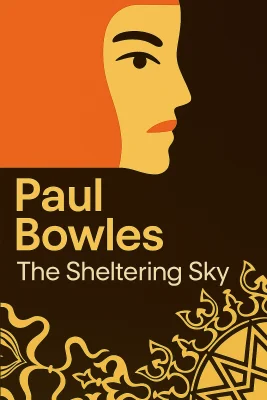
The Sheltering Sky
Categories
Fiction, Classics, Travel, Historical Fiction, Africa, Literature, American, Novels, Literary Fiction, Morocco
Content Type
Book
Binding
Paperback
Year
2006
Publisher
Penguin Books
Language
English
ASIN
0141023422
ISBN
0141023422
ISBN13
9780141023427
File Download
PDF | EPUB
The Sheltering Sky Plot Summary
Introduction
# Beneath the Sheltering Sky: A Journey into Darkness The fever had taken hold of Port Moresby like a desert wind, burning through his body as he lay dying in a mud-walled room in the Saharan outpost of Sba. His wife Kit pressed a damp cloth to his forehead, watching helplessly as the man who had dragged her across an ocean in search of authentic experience slipped away into delirium. Outside, the endless wasteland stretched toward horizons that promised nothing but more emptiness. They had come to North Africa as refugees from their own lives, fleeing the mechanized decay of post-war America for something raw and untouched. Port insisted he was not a tourist but a traveler, one who moved slowly across years and continents, belonging nowhere and everywhere. But the desert demands a price from those who dare cross its threshold. As Port's breathing grew shallow and Kit found herself truly alone among strangers, the sheltering sky above began to crack, revealing the abyss that had always lurked beneath their carefully constructed existence.
Chapter 1: The Escape to North Africa: Troubled Marriage in Foreign Lands
The ship spat them onto the burning docks of Oran like refuse from another world. Port adjusted his glasses against the Mediterranean glare, his pale intellectual features already showing strain from the journey. He had convinced Kit that North Africa would save them, that somewhere in the vastness of the Sahara they would rediscover what their marriage had lost. Kit watched the approaching shoreline with elegant resignation, her agreement born not from enthusiasm but from desperate hope that distance might heal what proximity had wounded. Their companion Tunner bounded up the deck stairs, his American optimism intact despite the assault of heat and alien sounds that struck them like a physical blow. Arab merchants pressed close with their wares, children begged with practiced desperation, and everywhere the sun reflected off white walls with blinding intensity. Port reveled in the chaos, seeing authentic experience. Kit recoiled, already missing the ordered world they had abandoned. In their hotel room overlooking the maze of narrow streets, Port spread his multicolored maps across the sticky table, planning their route deeper into the unknown. He spoke of places with names like music—Ain Krorfa, Bou Noura, El Ga'a—as if these syllables held the key to their salvation. Kit said nothing, but already sensed they were not traveling toward something, but away from everything that had once anchored them to life. That first night, as the muezzin's call drifted across the city, Kit lay awake listening to Port's excited plans. The donkeys brayed in the streets below, vendors called their wares in Arabic, and the air trapped the day's heat like an oven. She watched her husband's profile in the darkness, this man who believed that movement could cure the glacial deadness at his core, and felt the first stirrings of dread that would follow her across the desert.
Chapter 2: Deeper into the Desert: Identity Lost and Stolen
The bus lurched through mountain passes, carrying them deeper into the interior where European influence faded like a mirage. Port pressed his face to the window, drinking in the alien landscape of red rock and scattered palms, while Kit dozed fitfully against his shoulder. In the fourth-class car, she encountered the raw face of Africa—the diseased man with the triangular void where his nose should have been, the crush of bodies wrapped in burnouses, the overwhelming stench of humanity pressed too close together. At the mountain town of Ain Krorfa, they took rooms in a crumbling hotel where a nervous French proprietor apologized for primitive conditions while pocketing their money with obvious relief. Among the other guests were Mrs. Lyle and her son Eric, mysterious English travelers who spoke in half-sentences and shared glances that excluded the world. Eric was a pale young man who seemed both childish and ancient, his eyes darting about like those of a trapped animal. Port's discovery came with the violence of a physical blow. His passport was missing, torn from his luggage by invisible hands in the night. He tore through their belongings with increasing desperation, certain he had locked it safely away. Kit helped him search, but they found nothing. The document had simply vanished, taking with it Port's official identity and his legal right to exist in this foreign land. The theft was more than mere inconvenience—it was a symbolic severing of his connection to the civilized world. Without papers, Port became a non-person, dependent on the goodwill of colonial authorities who viewed paperless Americans with suspicion. Kit watched her husband's growing paranoia with alarm, sensing that the loss of his passport had triggered something deeper than anger. The desert had begun its work of stripping away everything that defined him, and Eric Lyle had disappeared into the native quarter, leaving behind only the echo of his mother's frantic explanations.
Chapter 3: The Fever in Sba: Port's Decline and Death
The fever began as a chill that no amount of desert sun could warm, creeping through Port's bones as they prepared to leave Bou Noura for the legendary city of El Ga'a. Kit watched his deterioration with growing alarm, but her suggestions of medical attention fell on deaf ears. Port was determined to reach his ultimate destination, the place that represented for him the final escape from civilization's constraints. El Ga'a revealed itself as a city under siege. The meningitis epidemic had transformed the legendary desert metropolis into a death trap, its ancient walls now serving as quarantine barriers rather than protection from nomad raids. The hotel proprietress refused them entry, her voice shrill with terror as she shouted warnings through bolted doors. Kit found herself stranded in blazing sun with a delirious husband and no refuge in sight. A young Arab who had befriended Kit during their journey proved their salvation, negotiating passage on a produce truck heading south to the remote settlement of Sba. The price was exorbitant, but Kit paid without question, understanding that money had become meaningless in the face of survival. As darkness fell, they carried Port's inert form through deserted streets to the waiting vehicle, his body limp as a corpse in their arms. In Sba, the French military doctor Captain Broussard offered little hope and less comfort. Port lay dying in a cell-like chamber with mud walls and a single barred window, his intellectual curiosity giving way to fevered rambling about landscapes that existed only in his mind. Kit arranged their few possessions around the crude mattress, trying to create some semblance of civilization while watching helplessly as he slipped in and out of delirium. The end came suddenly on a night when the desert wind howled around the garrison walls, Port's breathing growing labored, then stopping altogether as dawn broke over the endless wasteland.
Chapter 4: Into the Abyss: Kit's Flight from Reality
The night after Port's burial in the small Christian cemetery behind the fort, Kit made a decision that would have seemed impossible to her former self. She unlocked the door of their room, stepped over her husband's belongings, and walked out into the desert darkness. Behind her lay everything that connected her to civilization—her passport, her money, her identity as Mrs. Port Moresby. Ahead stretched the unknown. She had no plan, only an overwhelming need to escape the suffocating sympathy of the French officers and the terrible finality of that wooden cross planted in sandy soil. The desert night was cold and vast, filled with sounds she couldn't identify. She walked without direction, guided only by instinct that told her to keep moving, to put distance between herself and the place where her old life had ended. Dawn found her collapsed beside a tamarisk tree in a dry riverbed, her European clothes torn and dusty. She might have died there if not for the caravan that appeared like a mirage on the horizon—a line of camels and robed figures moving with ancient purpose across the wasteland. When she stumbled into their path, arms raised in desperate supplication, they stopped. The caravan master was an elderly Tuareg named Mohammed, his face wrapped in indigo cloth that left only his eyes visible. His companion was younger, perhaps thirty, with the lean build and predatory grace of a desert nomad named Belqassim. They spoke no French, and Kit's Arabic was nonexistent, but desperation transcended language barriers. She opened her small bag and showed them her remaining money—worthless European currency that meant nothing in this economy of survival. But she had other assets, and her very strangeness made her valuable in ways she was only beginning to understand.
Chapter 5: Belqassim's Captive: A Woman Disguised and Desired
The caravan traveled by night and rested by day, following routes older than memory across the trackless waste. Kit learned to endure the camel's rolling gait, the burning sun, and the constant presence of sand in her mouth and eyes. More challenging was learning to navigate the complex dynamics of her new companions, who were smugglers moving contraband across borders that existed only on European maps. It was Belqassim who first approached her when they made camp in a hidden oasis. His intentions were unmistakable, and Kit found herself facing a choice that would have been unthinkable in her former life. She could resist and face the consequences in this lawless place, or surrender to forces beyond her control. The decision, when it came, felt less like choice than inevitability. Their lovemaking was unlike anything she had experienced with Port. Where her husband had been intellectual and restrained, Belqassim was purely physical, demanding and generous in equal measure. He took her with a possessiveness that should have been frightening but instead felt like salvation. In his arms, she discovered appetites she had never known she possessed, while the degradation she should have felt was replaced by strange liberation. As they traveled deeper into the Sahara, approaching the ancient city where Belqassim's family lived, he began preparing her for a new role. He brought her men's clothing—flowing robes and a turban that concealed her hair and softened her feminine features. With her sun-darkened skin and altered appearance, she could pass for a young Arab man, he explained. It was the only way she could enter his world without causing scandal that might destroy them both. Kit accepted the transformation without protest, understanding that the woman who had once worried about dinner parties and theater subscriptions no longer existed.
Chapter 6: The Wives' Discovery: Paradise Shattered
The great city rose from the desert like a fever dream, its mud walls and minarets shimmering in the heat. Kit, now disguised as a young man named Ali, followed Belqassim through narrow streets that tunneled through the very buildings. The architecture was a labyrinth designed to confuse outsiders and protect secrets within, leading to Belqassim's family compound—a world unto itself housing his father, brothers, their wives, children, and servants. Kit was given a small room on the roof, supposedly to recover from the madness that had befallen her in the desert. It was perfect cover for her true identity. For weeks, she lived in this strange paradise, receiving afternoon visits from Belqassim in the privacy of her chamber. Their lovemaking took on new intensity in these civilized surroundings, and he brought her gifts—jewelry, perfumes, silks—treating her like a treasured concubine while maintaining the fiction that she was merely a disturbed young man under his protection. But paradise was built on deception, and deceptions unravel. It began with small things—curious glances from servants, whispered conversations that stopped when she appeared. The women of the household, confined to their quarters but not blind to the world around them, began to suspect something was amiss. The discovery came through a child, a precocious boy who served as spy for the women, creeping into Kit's room one morning and confirming through innocent play what the wives had begun to suspect. The confrontation was swift and brutal. Kit awoke from an afternoon nap to find herself surrounded by Belqassim's three wives, their faces twisted with rage and betrayal. They tore away her disguise, revealing her female form to their horrified eyes. What followed was a beating that left her bloodied and broken, saved only by Belqassim's timely arrival. But even his intervention could not restore the delicate balance that had made her presence possible. Her paradise had become a prison, and the walls were closing in.
Chapter 7: Return to Civilization: Escape from Rescue
The escape came in the darkest hour before dawn, when even the most vigilant guards dozed at their posts. Kit had been confined to her room since the wives' discovery, guarded by an ancient slave woman who dozed fitfully by the door. But desperation breeds cunning, and she slipped past the sleeping guard, navigating the twisting corridors by memory and instinct toward the great door that led to the street. She found another way through the women's quarters, where Belqassim's wives sat drumming and singing, lost in their own ritual. They helped her escape, perhaps out of sisterly sympathy, or perhaps simply to be rid of the foreign woman who had brought such chaos to their ordered world. The streets of the ancient city were empty in the pre-dawn darkness, but Kit knew she could not linger. By morning, Belqassim would discover her absence, and his pursuit would be swift and merciless. Her flight across the desert was a blur of terror and exhaustion. She traveled with anyone who would take her—merchants, pilgrims, smugglers—always moving south, always seeking distance from the life she had left behind. Her European features, darkened by sun and hardship, allowed her to pass as a local woman when necessary, but her eyes held a wildness that marked her as someone fleeing from more than mere poverty. The end came in a small oasis town where French colonial authorities maintained a telegraph office. Kit, driven by some instinct she couldn't name, attempted to send a message to the outside world. But the words she scrawled—"CANNOT GET BACK"—were incomplete, inadequate to express the transformation she had undergone. The blue-eyed French clerk looked at her with suspicion, recognizing something foreign in her manner despite her native dress. Within hours, she was in custody, identified through the passport she had somehow retained throughout her journey.
Summary
The rescue that brought Kit back to civilization was, in truth, a kind of death. As the small plane carried her north toward the Mediterranean coast, she sat strapped in her seat like a prisoner, watching the desert recede below. The American consular officials who had found her saw only a disturbed woman who had suffered some kind of breakdown in the desert. They could not see that the person they were rescuing no longer existed—that Kit Moresby had died somewhere in the vast emptiness of the Sahara, leaving behind only a shell that remembered fragments of a former life. In the coastal city of Oran, she was handed over to Miss Ferry from the American consulate, a brisk woman who saw only another troublesome expatriate to be processed and shipped home. Kit submitted to the arrangements with the docility of the defeated, but her compliance masked a deeper truth. The final image is of Kit disappearing into the crowded streets of Oran, slipping away from her official escorts like water through cupped hands. The desert had taken Port's life, but it had given Kit something perhaps more precious and terrible—the knowledge that identity itself is as shifting and impermanent as sand, and that true freedom lies in the courage to let everything familiar blow away on the wind.
Best Quote
“Death is always on the way, but the fact that you don't know when it will arrive seems to take away from the finiteness of life. It's that terrible precision that we hate so much. But because we don't know, we get to think of life as an inexhaustible well. Yet everything happens a certain number of times, and a very small number, really. How many more times will you remember a certain afternoon of your childhood, some afternoon that's so deeply a part of your being that you can't even conceive of your life without it? Perhaps four or five times more. Perhaps not even. How many more times will you watch the full moon rise? Perhaps twenty. And yet it all seems limitless.” ― Paul Bowles, The Sheltering Sky
Review Summary
Strengths: The review highlights the book's engaging and fascinating narrative, providing a vivid depiction of post-World War II North Africa. The story's exploration of alienation and existential despair is noted as a compelling aspect. Weaknesses: The review points out a lack of psychological depth regarding the characters' motivations and backgrounds. The portrayal of the husband as an "Ugly American" and the depiction of challenging travel conditions are also mentioned as potential drawbacks. Overall: The reader finds the novel intriguing and rich in local color, though it leaves some questions about character development unanswered. The book is recommended for those interested in existential themes and historical settings.
About Author

Paul Bowles
Bowles interrogates the intricate interplay between existentialism and cultural collision through his exploration of North African settings. His writing often draws from personal experiences, capturing the existential themes of human vulnerability and alienation. By relocating to Tangier, Morocco, in 1947, Bowles immersed himself in a rich cultural landscape that profoundly influenced his literary work. His novels, such as "The Sheltering Sky" and "The Spider’s House", delve into the psychological depths of characters navigating the cultural crossroads of Arab and Western societies. These works offer a poetic meditation on human psychology under extreme conditions, employing a sparse yet precise prose style that unveils underlying tensions beneath surface realities.\n\nAs an author, Bowles shifted from a career in music composition to focus on writing, gaining critical acclaim for his vivid portrayals of cultural and existential themes. His contribution to literature extends beyond novels to include short story collections, poetry volumes, and translations, notably of Jean-Paul Sartre’s "No Exit". Readers are drawn to his works for their ability to convey complex emotions and psychological depth within an autobiographical poetic framework. His book "The Sheltering Sky" particularly stands out, not only for its narrative but also for its later adaptation into a film by Bernardo Bertolucci. Although Bowles did not receive major mainstream awards, his impact on 20th-century literature remains significant, offering readers a profound engagement with North African cultures and existential dilemmas. This bio highlights his enduring legacy in bridging music and literature while enriching the expatriate and avant-garde literary scenes.
Read moreDownload PDF & EPUB
To save this Black List summary for later, download the free PDF and EPUB. You can print it out, or read offline at your convenience.
The Sheltering Sky
by Paul Bowles
