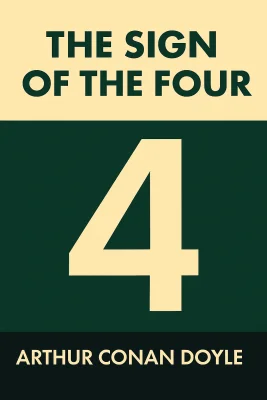
The Sign of the Four
Categories
Fiction, Classics, Audiobook, Mystery, Historical Fiction, Thriller, 19th Century, Crime, Mystery Thriller, Detective
Content Type
Book
Binding
Kindle Edition
Year
2012
Publisher
Amazon Digital Services, Inc
Language
English
ASIN
B0082XO4JU
File Download
PDF | EPUB
The Sign of the Four Plot Summary
Introduction
London fog swirls thick through Baker Street as Dr. Watson confronts his brilliant yet troubled companion. Sherlock Holmes raises a hypodermic needle, the cocaine solution glinting in the gaslight. The great detective's mind rebels against stagnation, craving the mental exaltation that only the most intricate mysteries can provide. On this grey September evening, salvation arrives in the form of Miss Mary Morstan—a governess whose father vanished ten years ago, leaving behind only questions and an annual gift of lustrous pearls from an unknown benefactor. What begins as a simple missing person case spirals into something far darker. The mysterious correspondent summons Mary to a midnight rendezvous, promising justice for wrongs committed decades past. Hidden within the shadows of colonial India lies a treasure worth half a million pounds, stained with betrayal and blood. Four men once swore an oath over stolen jewels, and now their legacy of greed threatens to consume everyone it touches. Holmes and Watson find themselves drawn into a web of murder, pursuit, and vengeance that stretches from the opium dens of London to the fever-ridden Andaman Islands.
Chapter 1: The Curious Case of Miss Morstan's Pearls
The knock at Baker Street interrupts Holmes mid-demonstration. Mrs. Hudson announces Miss Mary Morstan, and Watson feels something shift in the room's atmosphere. The young woman enters with quiet dignity, her modest dress suggesting limited means despite the obvious refinement in her manner. Her father, Captain Arthur Morstan of the Indian Army, had vanished without trace from his London hotel ten years prior. Holmes leans forward, grey eyes sharp with interest as Mary unfolds her tale. Major Sholto, her father's commanding officer and only known associate in London, claimed ignorance of Captain Morstan's arrival. The official investigation yielded nothing but empty hotel rooms and abandoned luggage filled with curious artifacts from the Andaman Islands. Yet six years ago, something changed. An anonymous advertisement appeared in The Times, seeking Miss Morstan's address and promising information to her advantage. No explanation followed, only a small cardboard box containing a magnificent pearl. Every year since, on the same date, another pearl arrived by post. An expert had valued the collection as rare and extremely valuable. Mary produces the flat box, revealing six lustrous specimens that catch the lamplight like captured stars. Holmes examines the letter that brought Mary to their door. The finest quality paper, a man's thumbprint on the corner, and a curious message written in disguised handwriting. The correspondent instructs Mary to meet him at the third pillar outside the Lyceum Theatre at seven o'clock sharp. She may bring two friends, but no police. The promise is bold and unsettling: "You are a wronged woman, and shall have justice." Watson volunteers immediately, drawn by something in Mary's appeal that goes beyond mere professional duty. Holmes accepts the case with the detached precision of a surgeon preparing for an operation, but Watson notices his companion's eyes gleaming with anticipation. The game, as Holmes often says, is afoot. Whatever secrets lie buried in Captain Morstan's past, they are about to claw their way back into the light.
Chapter 2: Murder at Pondicherry Lodge
The fog-shrouded streets of London blur past their cab windows as they journey deeper into South London's questionable neighborhoods. Their mysterious guide, a nervous coachman, leads them through a maze of shabby terraced houses until they arrive at an isolated dwelling. The incongruity strikes Watson immediately—an Indian servant in yellow turban and white robes framed against the commonplace doorway of a suburban home. Thaddeus Sholto receives them in a room that seems transported from an Oriental palace. Rich tapestries line the walls, tiger-skins sprawl across amber carpets, and the air hangs heavy with aromatic smoke from an elaborate hookah. The small, bald man writhes his hands nervously as he speaks, his features never quite still. Watson listens with growing unease as Sholto reveals the truth about Captain Morstan's fate. Major John Sholto, Thaddeus's father, had possessed a terrible secret. He and Captain Morstan had come into possession of a considerable treasure during their service in India. When Morstan arrived in London to claim his share, a heated argument erupted. The captain, suffering from a weak heart concealed from all but Sholto, collapsed during the quarrel and died instantly. Fear of accusation led Sholto to conceal both the body and the treasure, a decision that haunted him until his deathbed. The story grows more sinister as Thaddeus describes his father's final moments. As the dying man attempted to reveal the treasure's location, a wild face appeared at the window—bearded, savage, filled with malevolent fury. The intruder vanished, but his calling card remained: a torn paper bearing the words "The sign of the four" pinned to the dead man's chest. The phrase matched markings on a mysterious document found among Captain Morstan's effects, signed by four names including one Jonathan Small. Now Bartholomew Sholto, Thaddeus's twin brother, has discovered the treasure's hiding place within their family estate at Pondicherry Lodge. But when they arrive at the sprawling mansion, something is terribly wrong. No lights burn in Bartholomew's laboratory windows, and the housekeeper's frightened whimpering echoes through the night air like a wounded animal's cry. The brothers' long-delayed reunion is about to become something far more terrible.
Chapter 3: The Science of Deduction in Action
Mrs. Bernstone's terror proves prophetic. Bartholomew Sholto sits dead in his chemical laboratory, his face twisted into a ghastly grin that mirrors his brother's features with horrible precision. The room reeks of exotic poisons, and a curious dart protrudes from behind the victim's ear—a thin thorn glazed with some deadly substance. Holmes moves through the scene like a predatory animal, every sense alert to the smallest detail. The treasure chest stands empty, but the method of entry fascinates Holmes more than the missing fortune. No conventional burglar could have penetrated this fortress-like room. The door was bolted from within, the windows secured, yet somehow the killer gained access. Holmes discovers the truth in the wooden-legged footprints on the windowsill and the rope secured to a hook in the wall. One man climbed; another waited below. In the secret garret above, Holmes makes a discovery that chills Watson to the bone. Scattered across the dust are the naked footprints of what appears to be a child—but no child could have committed such calculated murder. The prints are perfectly formed yet impossibly small, belonging to something neither wholly civilized nor entirely savage. Holmes examines them with the methodical patience of a naturalist, storing every detail for future reference. Inspector Athelney Jones arrives with his usual bluster, immediately arresting Thaddeus despite the obvious impossibility of his guilt. Holmes tolerates the official incompetence with bemused resignation, knowing that the real pursuit lies ahead. The killer has left a trail as clear as breadcrumbs to anyone with the wit to follow it. A wooden leg, creosote-stained clothing, and a mysterious accomplice whose very existence challenges Watson's understanding of human nature. As Jones drags the protesting Thaddeus away, Holmes outlines his deductions with surgical precision. Jonathan Small, the wooden-legged convict from the Andaman Islands, has returned to claim what he considers rightfully his. But Small did not act alone, and his companion represents something far more dangerous than mere criminal desperation. The hunt is about to begin, and Watson realizes they are pursuing prey more exotic and deadly than anything in his military experience.
Chapter 4: Pursuit on the Thames
The trail leads to the river, where Mordecai Smith's launch Aurora has vanished into London's maritime labyrinth. Holmes deploys his network of street children—the Baker Street Irregulars—to scour every wharf and landing stage along the Thames. Young Wiggins and his ragged companions scatter like sparrows, their sharp eyes and nimble feet capable of penetrating places where official police fear to tread. The chase becomes a waiting game, and Holmes paces their Baker Street rooms like a caged wolf. Mrs. Smith provides the breakthrough Holmes needs. The boatman's wife describes her husband's mysterious passenger—a brown, monkey-faced man with a wooden leg who came knocking in the night. The Aurora departed at three in the morning with Smith, his eldest son, and their paying customers, heavily loaded and bound for destinations unknown. Holmes realizes the fugitives have sought temporary shelter while planning their final escape to America or the colonies. The pursuit explodes into action when Holmes discovers the Aurora hidden at Jacobson's Yard, disguised as a boat under repair. Smith, flush with mysterious payment and reeking of gin, has arranged to collect his passengers at eight o'clock sharp. Holmes positions his forces with military precision—police launch ready, weapons loaded, and Toby the tracking dog straining at his leash to follow the lingering scent of creosote. As darkness falls over the Thames, the chase begins in earnest. The Aurora bursts from her hiding place like a startled deer, her engines straining against the muddy current. The police launch thunders in pursuit, furnaces roaring and paddle wheels churning the water to foam. Holmes stands in the bow, his lean frame silhouetted against the funnel's glow, urging every ounce of speed from their vessel. The gap slowly closes as they race past the Pool of London and into the broader reaches beyond Greenwich. The end comes with shocking suddenness at Plumstead Marshes. Jonathan Small hurls curses from the Aurora's stern, his wooden stump clearly visible in the searchlight's glare. Beside him crouches a small, dark figure that Watson barely recognizes as human—all tangled hair, burning eyes, and animal fury. The creature raises a blowpipe to its lips, and Holmes's revolver crashes in reply. The Islander topples into the Thames with a choking cry, while Small's launch runs aground in the mudflats, trapping the wooden-legged fugitive in the sucking clay.
Chapter 5: The Strange Story of Jonathan Small
The iron chest sits heavy and silent in Mary Morstan's drawing room, its ornate surface gleaming in the lamplight like a promise of untold wealth. Watson's hands tremble slightly as he applies the poker to the massive lock, aware that this moment will determine not just Mary's financial future, but the very possibility of his own happiness. The hasp springs open with a metallic snap that seems to echo through the elegant room like a gunshot. The box is empty. Years of anticipation, months of pursuit, lives lost and fortunes spent, all for nothing but hollow iron and vacant dreams. Yet as Watson stares into that echoing void, he feels not despair but liberation. The golden barrier that separated him from Mary Morstan dissolves like morning mist. Her gentle acceptance of his proposal transforms defeat into victory, proving that some treasures cannot be measured in rupees or counted in pearls. At Baker Street, Jonathan Small settles into his confession with the weary satisfaction of a man unburdening his soul. The wooden-legged convict tells his tale without embellishment or excuse, painting a vivid picture of colonial betrayal and convict desperation. Twenty years in the fever swamps of the Andaman Islands had taught him that survival requires compromises that civilized men cannot comprehend. The Agra treasure became both curse and salvation, binding four desperate men in an oath sealed with blood and broken by greed. Major Sholto's betrayal cut deeper than any physical wound. The officer had promised partnership but delivered only deception, abandoning his co-conspirators to rot in their island prison while he enjoyed wealth beyond imagination. Small's quest for vengeance consumed decades, transforming him from mere criminal into something approaching mythic force. His partnership with Tonga, the savage Islander, represented an alliance forged in mutual exile and shared hatred of civilization's hypocrisies. The confession reaches its climax with Small's description of the treasure's final disposition. Seeing capture inevitable as the police launch closed the gap, he scattered the Agra jewels across five miles of Thames mud rather than surrender them to Sholto's heirs. Diamonds and emeralds, rubies and pearls, all rest now beneath the river's dark current, free from human greed at last. Small's laughter echoes through the room as he contemplates the irony—four men destroyed by wealth that no one will ever possess.
Summary
The case concludes with bitter satisfaction for all involved. Jonathan Small faces the gallows with stoic acceptance, knowing that justice, however delayed, has finally been served. The treasure he protected so fiercely lies scattered across the Thames bottom, its curse broken by his final act of defiance. Inspector Jones claims credit for the capture while privately acknowledging Holmes's superior deductive powers. Even Thaddeus Sholto finds peace in his brother's death, freed from the family legacy of guilt and greed. Holmes returns to his cocaine bottle and chemical experiments, already restless for the next intellectual challenge. Watson prepares for marriage, his military pension suddenly adequate for modest domestic happiness. Mary Morstan, though financially no richer than before, possesses something far more valuable—the knowledge that her father died an honorable man, victim of circumstance rather than criminal conspiracy. The pearls that first brought her to Baker Street remain her only tangible inheritance, beautiful reminders of a love that transcended death itself. In the end, the greatest treasures prove to be those that cannot be stolen, bought, or buried—honor, love, and the satisfaction of truth finally revealed. The fog lifts from London's streets, but the shadows of betrayal cast by the Agra treasure will linger long after the last jewel has settled into Thames mud.
Best Quote
“My mind," he said, "rebels at stagnation. Give me problems, give me work, give me the most abstruse cryptogram or the most intricate analysis, and I am in my own proper atmosphere. I can dispense then with artificial stimulants. But I abhor the dull routine of existence. I crave for mental exaltation. That is why I have chosen my own particular profession, or rather created it, for I am the only one in the world.” ― Arthur Conan Doyle, The Sign of Four
Review Summary
Strengths: The review highlights improved structure and character depth compared to the book's predecessor. It mentions engaging elements such as a locked door mystery, a chase scene, and a less annoying digression than in "A Study in Scarlet." Weaknesses: The book is critiqued for feeling like a short story unnecessarily extended into a novella. The reviewer finds Sherlock Holmes' character to be an "obnoxious show-off," which detracts from their enjoyment. Additionally, despite its brevity, the book took the reviewer over a week to finish. Overall: The reviewer acknowledges improvements over "A Study in Scarlet" but remains unimpressed with Sherlock Holmes as a character, finding him unlikable. The book is seen as better than its predecessor but still not compelling enough for the reviewer to recommend enthusiastically.
About Author

Arthur Conan Doyle
Conan Doyle delves into the depths of human intellect and the complexities of crime through his iconic detective Sherlock Holmes. By weaving logic and deductive reasoning into his stories, Doyle not only redefined the crime fiction genre but also introduced readers to the dynamic relationship between Holmes and Dr. Watson. This partnership stands as a testament to the power of collaboration in solving mysteries, influencing countless writers and detectives portrayed in literature thereafter. Meanwhile, Doyle's early book, "J. Habakuk Jephson's Statement," further showcased his ability to enthrall audiences with tales of enigma, this time through the mystery of the Mary Celeste.\n\nBeyond crime fiction, Doyle's work spanned various genres, reflecting his wide-ranging interests and talents. He crafted fantasy and science fiction narratives with the Professor Challenger series, exploring scientific possibilities and human curiosity. His humorous takes on historical fiction, notably featuring Brigadier Gerard, displayed his ability to blend history with wit and entertainment. These varied themes demonstrate Doyle's versatility as an author and his keen ability to engage readers across different subjects.\n\nFor readers seeking an intricate blend of intellect, adventure, and humor, Doyle's works offer invaluable insights and entertainment. His impact extends beyond literary contributions, as he pioneered techniques in storytelling that remain influential today. This short bio summarizes not only his role in shaping crime fiction but also his broader contributions to literature, which continue to captivate and inspire audiences around the world.
Read moreDownload PDF & EPUB
To save this Black List summary for later, download the free PDF and EPUB. You can print it out, or read offline at your convenience.
The Sign of the Four
by Arthur Conan Doyle
