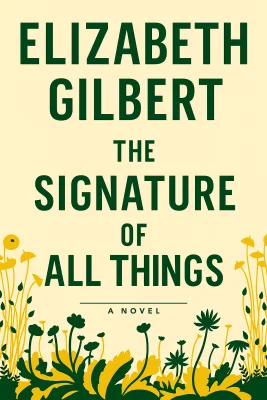
The Signature of All Things
Categories
Fiction, Nature, Audiobook, Historical Fiction, Adult, Book Club, Historical, Novels, Adult Fiction, Literary Fiction
Content Type
Book
Binding
Hardcover
Year
2013
Publisher
Riverhead Books
Language
English
ASIN
0670024856
ISBN
0670024856
ISBN13
9780670024858
File Download
PDF | EPUB
The Signature of All Things Plot Summary
Introduction
# The Signature of All Things: A Botanist's Journey Through Love and Discovery The winter morning when Alma Whittaker discovered her husband's secret drawings, snow fell silently on the grounds of White Acre estate, covering the dormant gardens where she had spent forty-eight years studying the microscopic wars between moss colonies. Inside Ambrose Pike's leather valise, hidden beneath his familiar brown jacket, lay dozens of intimate sketches of a beautiful Tahitian boy—each one signed with the cryptic phrase "Tomorrow Morning." The revelation struck her like a physical blow, shattering not only her understanding of the ethereal man she had married but the very foundations of love itself. Alma was no ordinary Victorian woman. The daughter of botanical magnate Henry Whittaker, she had built her reputation as America's foremost expert on bryology, publishing scientific papers that earned respect across Europe while remaining trapped in the gilded cage of spinsterhood. Her brief, impossible marriage to the mystical artist Ambrose Pike had promised to transform her ordered world of scientific observation into something wild and passionate. Instead, it revealed truths about desire, identity, and the unbridgeable distances between human hearts that would send her on a journey spanning decades and oceans—from the moss-covered stones of Pennsylvania to the coral reefs of the South Pacific, where the boy called "Tomorrow Morning" waited with answers that would change everything she thought she knew about the nature of existence itself.
Chapter 1: Seeds of Empire: The Making of a Botanical Heiress
Henry Whittaker's hands were still stained with soil when he built the first greenhouse at White Acre, but his eyes burned with the fire of empire. The crude boy who had stolen plants from Kew Gardens and survived Captain Cook's final voyage now commanded a botanical kingdom that stretched across continents. Exotic orchids from Madagascar bloomed beside palms from Brazil in his heated conservatories, while ships arrived monthly with specimens that most people would never see in a lifetime. His daughter Alma grew up among these wonders like a princess in a living fairy tale, but her crown was knowledge rather than jewels. While other girls her age learned embroidery and French, Alma dissected flowers under microscopes and memorized Latin taxonomies with the hunger of a scholar twice her age. Her mother Beatrix, a stern Dutch woman who believed intellectual faculties had been declining since the second century, personally tutored her daughter in four languages before she reached ten years old. The estate's formal gardens impressed visitors, but Alma found her true calling in a tumble of boulders behind the mansion where dozens of moss species waged silent wars for territory. Here she spent countless hours documenting the advance and retreat of tiny green armies, watching environmental changes shift the balance of power between competing colonies. What appeared to casual observers as simple plant growth revealed itself under her patient study as something far more complex—a miniature theater where the fundamental forces of life and death played out in slow motion. Henry recognized his daughter's exceptional mind and groomed her to inherit his empire, teaching her the ruthless business practices that had made him wealthy. He brought visiting scholars to White Acre's famous dinner table, where Alma learned to hold her own in debates about everything from the decomposition of human remains to the pulmonary function of aquatic birds. By her twenties, she was publishing scientific papers under the name "A. Whittaker" and corresponding with botanists across two continents. Yet for all her intellectual achievements, Alma remained unmarried as she approached her fiftieth year. Her large frame and rust-colored hair attracted no suitors, while her formidable intelligence intimidated those few men brave enough to attempt conversation. She had resigned herself to a life of scholarly solitude, finding companionship only in her microscopic subjects and the familiar rhythms of her father's botanical empire. The loneliness ate at her like acid, but she buried it beneath layers of scientific work and told herself that knowledge was companion enough for any reasonable person.
Chapter 2: The Microscopic Wars: Finding Purpose in Moss
The revelation came while Alma was reviewing her earliest published work on the parasitic plant Monotropa. Her juvenile illustrations showed the specimen growing from what looked like a lumpy mattress rather than the moss bed where it actually thrived. The realization struck her like lightning—she knew almost nothing about moss. Nobody did. In all her years of botanical study, moss had been background, something to scrape away to reveal more interesting specimens. That morning she walked to the limestone outcropping near the river where she had once harvested moss to stuff in the walls of her study. Kneeling beside the first boulder, she pressed her magnifying glass to her eye and gasped. Rising no more than an inch above the stone's surface was an entire world—a miniature Amazon jungle complete with valleys, mountains, and fjords. Different species had claimed different territories on the same rock, each adapted to its particular microclimate of sun, shade, moisture, and wind. The discovery transformed her understanding of scale and time. These tiny plants were the resurrection engines of the natural world, the first life to return to burned or barren ground. They moved in their own temporal dimension—Moss Time, as she came to think of it—too slow for human eyes to track but fast enough to transform landscapes over decades. A single colony might wage war for territory across multiple human generations, advancing and retreating according to laws she was only beginning to understand. Alma threw herself into bryology with the passion of a convert. She built the world's most comprehensive collection of moss specimens, cataloging over eight thousand varieties without ever leaving Pennsylvania. Her books "The Complete Mosses of Pennsylvania" and "The Complete Mosses of the Northeastern United States" earned international recognition, establishing her as the foremost expert in a field she had essentially created single-handedly. But the work revealed something darker beneath nature's apparent tranquility. The moss colonies were locked in endless competition for resources, with stronger species gradually overwhelming weaker ones through superior adaptation to environmental pressures. Victory went not to the most beautiful or complex organisms, but to those best suited for survival in their particular niche. The insight would prove prophetic years later when she encountered similar ideas in the work of Charles Darwin, though by then she would have traveled halfway around the world to learn truths about competition and survival that made her moss wars seem gentle by comparison.
Chapter 3: The Orchid Painter: When Art Meets Science
Ambrose Pike arrived at White Acre like a figure from a dream, carrying with him botanical illustrations so exquisite they seemed to pulse with life. The spotted Catasetum appeared moist and breathing, its lips glistening as if with morning dew. The Peristeria barkeri's golden blossoms looked ready to tremble in an unfelt breeze. Each print demonstrated a mastery of lithography that surpassed anything Alma had ever seen, created by a man who had spent eighteen years in the jungles of Guatemala documenting orchids that no Western botanist had ever catalogued. When Alma first encountered him in her mother's geometric garden, Ambrose was pacing its dimensions with long, deliberate strides, measuring proportions with the eye of a mathematician. His sandy hair caught the winter light, and his worn brown corduroy suit spoke of a man who owned little but valued what he had. When he burst into delighted laughter at discovering the garden's perfect Euclidean ratios, Alma knew she was witnessing something extraordinary. Their first conversation unfolded among her carefully marked moss specimens, where Ambrose listened with genuine fascination as she explained her theories about species competition and gradual change over vast periods of time. His questions revealed both intelligence and intuition, a mind that could grasp complex scientific concepts while maintaining an almost childlike wonder at the natural world's beauty. When she asked what drew him to orchids, he laughed and admitted he had never defended their intelligence and never would, but loved them despite their apparent lack of wit. At dinner that evening, Henry tested the young man with typical bluntness, demanding to know why the vanilla plantation in Tahiti had failed to produce fruit. Without hesitation, Ambrose diagnosed the problem—the vines were blooming but not being pollinated because Tahiti's native insects couldn't navigate the complex anatomy of vanilla orchids. The solution was simple hand pollination using small sticks and careful timing. Henry's eyes lit with the fire of profit realized as he recognized someone who understood both the delicate mechanics of flowers and the brutal mathematics of commerce. But it was Ambrose's ethereal beauty that truly captivated Alma. He possessed an otherworldly quality that made both men and women stop and stare, as if he existed on some higher plane where ordinary physical laws didn't apply. When he painted, his long fingers moved across canvas with reverent precision, and when he spoke of plants as conscious beings with their own spiritual essence, Alma felt her rational mind bend toward his mystical worldview. For the first time in her life, the brilliant botanist found herself thinking less about science than about the mysterious ache that had begun growing in her chest whenever this strange, beautiful man entered the room.
Chapter 4: A Marriage of Impossible Dreams: Love and Its Limitations
The proposal came not as a question but as an assumption, delivered during one of their long walks through the estate's winter gardens. Ambrose spoke of their natural sympathy, their shared understanding that transcended ordinary affection. He wanted to sleep beside her every night, he said, and listen to her thoughts forever. When he asked if she would accept "this" of him, Alma's heart hammered against her ribs as she said yes without fully understanding what "this" meant. Their wedding was a modest affair in White Acre's drawing room, witnessed only by Henry and the household staff. Alma wore brown silk and felt transformed, as if she had stepped into a life she had never dared imagine. Ambrose gave her a peculiar gift—a small envelope sealed with colored wax, containing what he called "a message of love" that she must never open. The mysterious present seemed perfectly in keeping with his otherworldly nature. That night they retired to Alma's bedroom as husband and wife. Ambrose took her hand and spoke of dreams and spiritual communion, of minds that could speak across the divide of flesh. Then he kissed her knuckles, extinguished the lamp, and fell into peaceful sleep while still holding her hand. Alma lay awake in the darkness, her body burning with unfulfilled desire, her mind reeling with confusion about what marriage was supposed to mean. Night after night, the pattern repeated with maddening consistency. Ambrose would speak of celestial love and spiritual union, then drift into serene slumber while Alma wrestled with longings she could neither voice nor satisfy. When she finally confronted him by appearing naked in his bath, his reaction was not surprise but terror—the look of someone confronted by a predator rather than a wife seeking intimacy. The truth emerged slowly and painfully. Ambrose had never intended a conventional marriage. He had asked for a mariage blanc—a chaste union of souls—believing that Alma understood and accepted this arrangement. In that strange moment when they had seemed to communicate without words, he had been asking for her consent to a sexless partnership. She had agreed, thinking he was proposing passionate love. "I would never ask for anyone's corporeal body," he explained, his voice heavy with sorrow. "I do not believe in it. I wish to be an angel of God, and I had hoped we could be angels together." When Alma cried out asking if she looked like an angel to him, his heartbreaking response was simply "Yes." The marriage could not survive such fundamental misunderstanding about the nature of human love itself.
Chapter 5: Exile and Revelation: The Hidden Truth Unveiled
Henry's solution was characteristically brutal and practical. Send Ambrose to Tahiti to manage the vanilla plantation, he declared—any fool could grow vanilla, but Alma had wasted a perfectly good husband on her romantic notions. The arrangement would benefit everyone: Ambrose could find purpose in the South Seas, the plantation would finally turn a profit, and Alma could salvage what remained of her dignity after the household gossip about newlyweds who couldn't share a bed. Alma knew she had to let him go. His presence had become torture—a constant reminder of her failure to inspire desire, her inability to bridge the gap between earthly love and celestial aspiration. She arranged his passage with Dick Yancey, telling herself it was an opportunity rather than an exile. At their final meeting in the hotel lobby, Ambrose looked pale and defeated, clutching his worn leather valise like a lifeline. Alma wanted to embrace him, to beg his forgiveness, to confess that she loved him still despite everything. Instead, she shook his hand formally and asked him never to speak of their marriage to anyone. Three years passed in gray succession. Alma buried herself in moss research with mechanical precision while her heart remained frozen in the moment of Ambrose's departure. Then came the letter from Tahiti—brief, formal, devastating. Ambrose Pike had died of fever, the missionary wrote, and had been given a Christian burial. He was remembered as a man of highest morality and purest character. Henry's death followed soon after, the old tyrant raging against mortality until his final breath, leaving Alma his entire fortune and the freedom to make choices she had never imagined possible. Dick Yancey's return from the Pacific brought the final piece of the puzzle. Without explanation, he thrust Ambrose's leather valise into her hands and growled two words: "Burn it." Inside, beneath her husband's familiar brown jacket, Alma found not botanical specimens but something that shattered her understanding of everything. Dozens of drawings, all of the same young Tahitian man, all rendered with exquisite care and unmistakable intimacy. The youth was beautiful, muscular, completely nude in every image. Some showed him sleeping, others running or swimming, still others in poses of frank arousal. On the back of each drawing, in Ambrose's elegant script, were the same two words: "tomorrow morning." The truth hit her like a physical blow. Ambrose Pike—the angel of Framingham, the man too pure for earthly love—had been a sodomite. His revulsion at her touch, his talk of celestial communion, his inability to consummate their marriage—all of it made terrible sense now. He had not been fleeing from desire itself, but from desire for women. Alma sat in her study, surrounded by evidence of her husband's secret life, and felt the last of her illusions crumble into dust.
Chapter 6: Journey to the Edge of the World: Seeking Answers in Tahiti
The decision came with startling clarity. Alma would go to Tahiti herself, would find the boy in those drawings, would learn the truth about Ambrose's final years. She gave away White Acre and most of her inheritance, keeping only enough money for travel and a simple life. The woman who had never been more than fifty miles from Philadelphia would sail to the other side of the world in pursuit of answers that might destroy what little peace she had managed to construct from the ruins of her marriage. The voyage on the whaling ship Elliot was a trial by water and wind that lasted seven brutal months. Alma endured storms that sent waves crashing over the deck, fever that left her delirious with strange dreams, and the crude company of sailors who treated her with rough kindness once they realized she wouldn't break under pressure. She learned to eat salt beef without complaint, to sleep through the roar of canvas and rigging, to find wonder in the vast emptiness of the Pacific Ocean. Captain Terrence, a hard man with a religious bent, praised her resilience after she weathered a particularly vicious gale without crying out in fear. "You are a right little daughter of Neptune, Miss Whittaker," he said, and Alma felt a fierce pride in having earned such recognition. The ocean both terrified and exhilarated her—here was nature on a scale that dwarfed human understanding, where waterspouts rose like pillars connecting sea to sky and phosphorescent waves turned the ship's wake into liquid starlight. As they sailed west through trackless waters, Alma felt herself changing in fundamental ways. The woman who had lived her entire life within the boundaries of White Acre was being stripped away, replaced by someone harder and more essential. She learned to navigate by unfamiliar constellations, to find her balance on a deck that never stopped moving, to exist in a world where the horizon was the only constant and survival depended on adapting to forces beyond human control. When Tahiti finally appeared—green peaks thrusting impossibly high from the blue Pacific—Alma felt not relief but a strange foreboding. This was where Ambrose had lived and died, where he had found whatever happiness was possible for a man like him. The island rose before her like a challenge, beautiful and alien, promising answers she might not want to hear. As the Elliot dropped anchor in the crystalline waters of Matavai Bay, Alma clutched Ambrose's valise to her chest and prepared to confront the ghosts that had driven her halfway around the world.
Chapter 7: Tomorrow Morning: Confronting the Past in Paradise
The wharf at Papeete assaulted Alma's senses with chaos that made Philadelphia seem like a monastery. Chinese pearl traders with long queues mingled with French sailors and Tahitian women selling unfamiliar fruits, while children darted between the adults like schools of fish and prostitutes approached newly arrived sailors with brazen efficiency. A dignified black rooster strutted up to Alma as if appointed to welcome her, allowing her to stroke his feathers while she waited for transportation to the mission at Matavai Bay. At the settlement, she found herself abandoned with her luggage on the black volcanic sand where Captain Cook had first landed. The Reverend Francis Welles was "in the coral," she was told—a phrase that baffled her until she realized he meant the coral reefs, not cattle corrals. As evening fell and her belongings remained unguarded, panic began to set in. Then she saw a small outrigger canoe shooting toward shore with remarkable speed, and out sprang what looked like an elf—a tiny, bowlegged man with wild white hair and flowing beard, his clothes held together with rope and determination. The Reverend Francis Welles proved as extraordinary as his appearance suggested, greeting Alma's unexpected arrival with cheerful equanimity as if visitors from Philadelphia regularly materialized on his beach. More surprising still, he immediately began speaking of Ambrose Pike with genuine affection. "We sorely miss Mr. Pike," he said, his bright blue eyes growing soft with memory. "He was a friend to the fatherless and fallen, an enemy of rancor and viciousness. I came to love him as a most cherished friend." That night, alone in Ambrose's cottage—a tiny thatched structure that locals avoided because it was "tainted by death"—Alma felt the weight of her journey settling upon her. She had traveled fifteen thousand miles to reach this small room where her husband had spent his final years. Every object told a story: his paintbrushes still stiff with dried pigment, his botanical specimens pressed between pages of books, his narrow bed where he had died alone with fever burning through his veins. But it was the silence that struck her most powerfully. After months of shipboard noise—creaking timbers, shouting sailors, wind howling through rigging—the tropical night seemed to hold its breath. Palm fronds rustled overhead with sounds like whispered secrets, waves broke gently on volcanic sand, and somewhere in the darkness a bird cried out with a voice that seemed to be saying "Think! Think! Think!" Tomorrow she would begin searching for the boy called "Tomorrow Morning," would try to piece together the truth about Ambrose's secret life in this paradise that had become his grave.
Chapter 8: Three Minds, One Truth: The Evolution of Understanding
The man called Tomorrow Morning arrived like a king returning to his kingdom. Alma watched from the beach as his fleet of outrigger canoes swept across Matavai Bay, their occupants singing songs of triumph that echoed off the surrounding peaks. The figure standing in the lead canoe was magnificent—tall, powerful, radiating an authority that made the entire settlement rush to greet him. When he turned to address the crowd, Alma's heart nearly stopped. This was the face from Ambrose's drawings, though no longer a boy but a man in his prime. Tomorrow Morning was Tamatoa Mare, one of the mission's most successful graduates who had become a legendary evangelist in the outer islands. He had converted thousands of pagans to Christianity through a combination of charisma, intelligence, and sheer force of personality. The Reverend Welles spoke of him with the pride of a father, never suspecting that this adopted son had once been intimately involved with Alma's late husband. When Alma finally confronted him with the truth of who she was, he showed no surprise—he had been expecting her, he said, and was prepared to tell her everything. In a hidden cave high in the mountains, carpeted with luminescent moss that glowed like emerald fire, Tomorrow Morning revealed the story of his relationship with Ambrose. It had been a meeting of two lonely souls: the mystical artist seeking spiritual transcendence, and the ambitious young Tahitian using his beauty and intelligence to survive in a world transformed by European contact. He spoke with brutal honesty about his nature as a conqueror, someone who took what he needed to thrive. He had allowed Ambrose to love him, to draw him, to believe in him as a kind of noble savage—all while planning his own rise to power. When Ambrose finally understood that he had been used, the revelation destroyed him. He had taken a shark's tooth to his own flesh in the Tahitian manner of expressing grief, but unlike the native women who knew how to control such self-mutilation, Ambrose had not stayed his hand. Tomorrow Morning carried the guilt of that death even as he continued his inexorable rise to become the most powerful native leader in the Society Islands. Years later, back in Amsterdam as Curator of Mosses at the Hortus Botanicus, Alma would learn that her insights about competition and survival had been independently discovered by Charles Darwin and Alfred Russel Wallace. Three minds had arrived at the same revolutionary truth about evolution through entirely different paths—Darwin through his voyage on the Beagle, Wallace through malarial fever in the Malay Archipelago, and Alma through patient observation of moss wars in Pennsylvania and human nature in Tahiti. The convergence seemed to prove that some truths were so fundamental they drew brilliant minds toward them like iron filings to a magnet, regardless of the personal cost of discovery.
Summary
Alma Whittaker died in Amsterdam in 1888, her theory of competitive alteration known only to Alfred Russel Wallace and a few family members. She never published her revolutionary insights about evolution, never received recognition as one of history's great scientific minds, never solved the puzzle of human altruism that had prevented her from sharing her discoveries with the world. But in her journey from the moss beds of Pennsylvania to the coral reefs of Tahiti, she had learned truths about love, desire, and survival that no amount of scientific fame could have taught her. Her story stands as a testament to the countless brilliant minds whose discoveries have been lost to history, and to the courage required to pursue truth wherever it leads. In the end, Alma's greatest achievement was not her scientific theory but her willingness to follow her questions across oceans and decades, to risk everything in pursuit of understanding the mysterious forces that drive both human passion and natural selection. She had lived as she studied her beloved mosses—with patience, precision, and an unshakeable faith that even the smallest truths were worth preserving for future generations to build upon, even if recognition would never come in her own lifetime.
Best Quote
“I would like to spend the rest of my days in a place so silent–and working at a pace so slow–that I would be able to hear myself living.” ― Elizabeth Gilbert, The Signature of All Things
Review Summary
Strengths: The review highlights Elizabeth Gilbert's lyrical and confident writing style, noting her ability to create well-considered characters and an absorbing story. The narrative brings the 18th and 19th centuries to life, with a strong anchoring in botany, and avoids pandering to social or political agendas. Weaknesses: The reviewer expresses disappointment with the book's progression, citing a descent into monotony and excessive focus on botany and sexual frustration. Characters like Prudence and Retta are mentioned as underdeveloped, and the narrative shift from Henry Whittaker to Alma is seen as less engaging. Overall: The reader's sentiment is mixed. Initially impressed by the writing and historical setting, the reviewer becomes disenchanted with the story's direction and character development, leading to a lukewarm recommendation.
About Author

Elizabeth Gilbert
Gilbert interrogates the complexities of self-discovery and personal growth through her vivid storytelling and reflective narratives. Her literary journey began without the influence of television, as she grew up on a Connecticut farm, nurturing a boundless imagination that would eventually captivate readers worldwide. Her early book, "Pilgrims," showcased her fiction prowess and earned her a PEN/Hemingway Award nomination, while "The Last American Man" explored biography and garnered critical acclaim. These works illustrate her method of blending personal exploration with broader cultural insights, thereby creating narratives that resonate deeply with a global audience.\n\nIn her most famous book, "Eat, Pray, Love," Gilbert charts a transformative journey across Italy, India, and Indonesia, exploring themes of spirituality and self-discovery. This memoir became a cultural phenomenon, topping bestseller lists and inspiring a film adaptation. Beyond this, she delves into creativity in "Big Magic: Creative Living Beyond Fear," encouraging readers to embrace their imaginative potential. Her work "City of Girls," set in the 1940s New York theater scene, further highlights her ability to weave historical settings with rich character explorations. Her conversational and insightful writing style invites readers to reflect on their own lives, offering them a pathway to introspection and growth.\n\nGilbert's impact extends beyond her literary contributions; she is also recognized for her influence in contemporary thought. Named one of Time magazine's 100 most influential people, her bio exemplifies a commitment to inspiring creativity and personal development. Her works appeal to those seeking both entertainment and profound insight, providing a framework for understanding the intricacies of human relationships and the pursuit of happiness.
Read moreDownload PDF & EPUB
To save this Black List summary for later, download the free PDF and EPUB. You can print it out, or read offline at your convenience.

The Signature of All Things
by Elizabeth Gilbert
