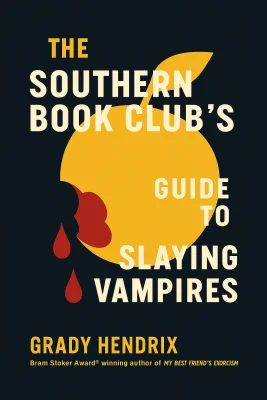
Categories
Fiction, Audiobook, Horror, Mystery, Thriller, Fantasy, Adult, Book Club, Paranormal, Vampires
Content Type
Book
Binding
Kindle Edition
Year
2020
Publisher
Quirk Books
Language
English
ASIN
B09JZQGJ33
File Download
PDF | EPUB
The Southern Book Club's Guide to Slaying Vampires Plot Summary
Introduction
# The Mothers Who Became Monsters: A Suburban Gothic The summer heat of 1993 pressed down on Mount Pleasant's Old Village like a fever dream when Patricia Campbell first saw her elderly neighbor crouched behind the garbage cans, gnawing on raccoon entrails. Ann Savage looked up with wild, mindless eyes and lunged, tearing off Patricia's earlobe with yellowed teeth before swallowing it whole, pearl earring and all. This wasn't how suburban paradise was supposed to unfold. Three days later, when Ann Savage died in the hospital from blood poisoning, a stranger appeared at her cottage door. James Harris arrived with a duffel bag stuffed with cash, a story about caring for his great-aunt, and a smile that made Patricia's skin crawl. What began as neighborly suspicion would spiral into a nightmare that would shatter families, destroy friendships, and force five suburban mothers to confront a darkness their comfortable world insisted couldn't exist. In the end, they would discover that the most dangerous monsters are the ones who invest in local real estate and smile at neighborhood barbecues.
Chapter 1: The Charming Stranger: When Evil Moves Next Door
The man who answered Ann Savage's door looked like he was dying. James Harris stood gaunt and pale, squinting through oversized sunglasses despite being indoors, his brittle blond hair catching the afternoon light. When Patricia introduced herself with a taco casserole and condolences, he seemed confused, disoriented. She found him collapsed on his bed minutes later, apparently unconscious, and performed CPR before he suddenly gasped back to life. Harris spun his story with practiced ease. A rare condition from a wolf bite in his youth had damaged his eyes, leaving him unable to tolerate sunlight. He'd come from Vermont to care for his great-aunt, though his home state shifted between different versions depending on when Patricia asked. What remained constant was his desperate need for help with basic tasks like opening bank accounts and transferring utilities. Patricia found herself drawn into his orbit despite every instinct screaming danger. She wrote checks for his deposits, drove him to appointments in his white van with tinted windows. He showed her that duffel bag stuffed with eighty-five thousand dollars in cash, claiming he'd found it hidden in Ann's crawl space. The money felt dangerous in her hands, thrilling and wrong. When Harris asked her to help him open a bank account without proper identification, Patricia heard herself saying yes. By the time Harris recovered his strength and color, transforming from sickly vagrant into handsome, charming neighbor, Patricia realized she'd made a terrible mistake. But it was too late. He'd been invited into her world, and vampires never forget an invitation. Within weeks, he was hosting dinner parties and joining investment circles, weaving himself into the social fabric of the Old Village with surgical precision. The men welcomed him into their golf games and business deals. The women found him helpful and considerate. Only Patricia seemed to notice that children in the nearby community of Six Mile had begun disappearing.
Chapter 2: Invisible Children: The Predator's Hidden Victims
The drive to Six Mile took Patricia through a landscape of poverty that most Old Village residents pretended didn't exist. Trailer homes on cinder blocks, yards full of broken cars, children in diapers playing in the dirt. She'd come to check on Mrs. Greene, the housekeeper recovering from a rat attack that had killed Carter's mother, but what she found was a community under siege. Mrs. Greene lived in a neat white house surrounded by the small homes that clustered around Mt. Zion A.M.E. church. Christmas decorations covered every surface inside, red and green lights twinkling year-round like a desperate attempt to hold onto joy. When Patricia asked about the children she'd heard chanting disturbing rhymes about "Boo Daddy," Mrs. Greene's expression grew grim. Three children had died since May. Eight-year-old Orville Reed had stepped deliberately in front of a truck after weeks of walking into the woods each evening and returning weak and disoriented. His teenage cousin Sean, who tried to follow Orville and discover what was happening, was found with his face scraped down to the skull against a live oak tree. Most disturbing was nine-year-old Destiny Taylor, whose mother had brought her to Mrs. Greene for advice. The child slept constantly, barely ate, and came home each night with leaves and twigs in her shoes. Mrs. Greene had seen a white van with Texas plates prowling the dirt roads of Six Mile. She'd copied down a partial license number that matched James Harris's vehicle. As Patricia listened to the litany of horrors, she realized the scope of what they were facing. Harris was feeding on the most vulnerable children in the community, the ones whose disappearances wouldn't make headlines or trigger investigations. The children of Six Mile were invisible to the white authorities across town, perfect prey for a monster who understood how power and privilege created blind spots. But when Patricia tried to voice her suspicions, she discovered that seeing monsters and proving their existence were two very different things.
Chapter 3: Silenced Warnings: When Society Chooses Comfort Over Truth
The night Patricia followed the dirt road into the pine woods behind Six Mile, she carried only a small flashlight and desperate hope. Destiny Taylor had vanished from her bedroom window, and Patricia knew with sick certainty where to find her. The white van sat at the end of a construction road, its tinted windows black against the night sky. Patricia crept through the darkness, her heart hammering against her ribs. When she reached the van's rear doors and pulled them open, the flashlight beam revealed a scene that would haunt her forever. James Harris crouched over Destiny's limp form, but his face had transformed into something inhuman. A long, chitinous appendage like a cockroach's leg protruded from his mouth, slowly retracting as he blinked in the sudden light. The little girl lay sprawled on the van floor, a dark purple mark marring the inside of her thigh where something had punctured the femoral artery. Harris lurched toward her, still disoriented by the light, and Patricia ran. She crashed through the pine forest, branches tearing at her clothes, her flashlight beam dancing wildly across tree trunks. Behind her, she heard the van's doors slam and an engine roar to life. By the time the police arrived, following Patricia's frantic directions, the construction road was empty. No van, no evidence, no proof of what she'd witnessed. The authorities found Destiny back in her bed the next morning, apparently unharmed. But Patricia had seen the truth, and when she tried to share it, she discovered that her own community had already chosen sides. The men had been meeting with James Harris for weeks, forming business partnerships and investment deals. Her husband Carter presented her with a bottle of Prozac and suggested she needed psychiatric help. The other women crumbled under pressure from their husbands one by one. When Harris himself appeared at Patricia's front door, smiling and gracious, accepting their apologies with wounded dignity, the capitulation was complete. The predator had successfully isolated his primary threat and turned her own community against her.
Chapter 4: The Ultimate Violation: A Mother's Worst Fear Realized
Three years passed in medicated tranquility. Patricia learned to smile and nod, to keep her suspicions locked away while James Harris became a fixture in their lives. He was the trusted family friend, the bachelor uncle who helped with homework and took the children on adventures. But Patricia noticed changes in her seventeen-year-old daughter Korey. The girl grew pale and listless, sleeping through days and wandering the house at night, dark circles shadowing her eyes. The truth revealed itself on a November night when Patricia heard sounds from Korey's bedroom. She opened the door expecting to find her daughter sneaking out to meet friends. Instead, she discovered James Harris naked between her daughter's legs, his face buried against her inner thigh, something dark and inhuman extending from his mouth into Korey's flesh. The sight shattered Patricia's mind into fragments. This was her baby, her little girl, being fed upon by the monster she'd tried so desperately to warn everyone about. Korey's face showed not pain but ecstasy, her body arching toward Harris as he drained her blood through some hideous appendage that retracted into his throat like a serpent. Patricia attacked with a soccer cleat, beating Harris's head until he released her daughter. Blood dripped from his mouth as he threw Patricia against the wall with inhuman strength. For a moment, his mask slipped completely, revealing the predator beneath the charming facade. "This is all your fault," he hissed, and Patricia knew he was right. Her obsession with protecting other children had blinded her to the danger in her own home. Harris escaped through the window, leaving Patricia to tend to Korey's wounds and face the horrible truth. The marks on her daughter's thigh weren't fresh but layered, overlapping, evidence of months of secret feeding. Her daughter had become addicted to the euphoric sensation of being consumed. The next morning, Patricia made the hardest decision of her life. She told Carter that Korey was using drugs and watched as their daughter was committed to a psychiatric facility. It was the only way to keep her safe from Harris's influence, even if it meant destroying their family in the process.
Chapter 5: Blood Sisters: Women United Against Darkness
The photograph changed everything. Patricia found it in Mrs. Greene's possession, a faded image from 1928 showing James Harris looking exactly as he did today, standing next to a man in overalls outside a house in Kershaw, South Carolina. Sixty-eight years, and he hadn't aged a day. Armed with this evidence and Mrs. Greene's collection of newspaper clippings documenting decades of missing children, Patricia went to her friend Slick Paley. The deeply religious woman studied the materials with growing horror, recognizing the pattern of predation that stretched back generations. But Slick's attempt to confront Harris directly led to disaster. She called him in Florida, threatening to expose his secrets unless he left town. His response was swift and brutal. Harris returned that very night and raped her in her own home while her family played board games downstairs, infecting her with something that began eating her alive from within. As Slick lay dying in the hospital, her immune system destroying itself, Patricia gathered the remnants of their book club. These women had read countless true crime stories, analyzed the methods of serial killers, studied the failures of law enforcement. They understood better than anyone how predators operated and how they were caught. The evidence was overwhelming: children continued to die in communities surrounding Harris's hunting grounds, he had seduced Patricia's daughter and was grooming her son, and the men who should have protected them had been completely compromised. "We're beyond the law now," Patricia told her friends as they gathered around Slick's hospital bed. "He's too well-connected, too careful. If we don't stop him, no one will." One by one, the women committed to the unthinkable. They would kill James Harris themselves, using the knowledge they'd gained from years of reading about murder to become murderers. It was the only way to protect their children and break the cycle of predation that had claimed so many lives.
Chapter 6: The Final Hunt: Becoming Monsters to Destroy One
The plan required Patricia to offer herself as bait. She dressed in black velvet and went to Harris's house on the night of the big football game, when the entire neighborhood would be distracted by television screens and alcohol. She played the role of the desperate housewife, claiming she wanted to leave her husband for him, begging him to make her like he was. Harris saw through her performance immediately, laughing at her amateur theatrics. But his arrogance became his weakness. He couldn't resist the opportunity to gloat over his complete victory. He had destroyed her credibility, seduced her daughter, won her husband's friendship, and integrated himself so thoroughly into their community that he was untouchable. "You're going to give me your family," he told her as she knelt at his feet in humiliation. "Your son already loves me more than you. Your daughter belongs to me. And you'll be grateful for whatever scraps of affection I throw your way." Patricia submitted to his feeding, feeling the terrible ecstasy that had addicted her daughter. The pleasure was overwhelming, but even as her body responded to his unnatural touch, her mind remained focused on the unlocked front door and the women waiting in the darkness. When Harris's mouth opened to reveal the lamprey-like appendage that drained his victims, Patricia forced herself to watch. She needed to see the monster fully revealed, to burn the image into her memory so she would never doubt what they were destroying. The attack came as Harris fed. Kitty Scruggs led the charge with a baseball bat, followed by Mrs. Greene with a hammer and Maryellen with a hunting knife. They were middle-aged suburban women in sensible shoes, but they fought with the fury of mothers defending their children. Harris was stronger and faster than any of them, but he had underestimated their determination. When Kitty drove the knife through his spine, paralyzing him, they dragged his body to the bathtub and began the grisly work of dismemberment. They worked through the night, reducing the monster to plastic-wrapped pieces while Grace Cavanaugh helped clean the crime scene with the expertise of a lifetime spent maintaining perfect homes.
Chapter 7: After the Kill: Living with Necessary Violence
The official story was simple: James Harris had packed up and left town, probably fleeing ahead of financial investigations into his business dealings. No one looked too hard for a man whose departure solved more problems than it created. The investment schemes collapsed, taking the men's money with them, but that seemed like justice to the women who knew the truth. Patricia's family slowly healed from the trauma. Korey recovered from her addiction in the psychiatric facility, though she would always carry scars from her encounter with the monster. Blue struggled to understand why his hero had simply vanished, but gradually accepted his mother's love as replacement for Harris's manipulation. The book club continued to meet, though they never again discussed what they had done. They returned to reading crime novels with a different perspective now, understanding intimately how ordinary people could be driven to extraordinary violence when the system failed. Slick Paley died on Thanksgiving Day, her body consumed by whatever Harris had planted inside her during the assault. Her friends took turns reading to her until the end, ensuring she didn't face the darkness alone. They had her cremated immediately, understanding that whatever was growing inside her could not be allowed to mature. Mrs. Greene moved back to Six Mile as families began returning to the community. The children played in the streets again without fear, though they would never know how close they had come to being consumed by an ancient evil. Patricia found strength in her new life as a divorced mother, working as a nurse again and raising her children with fierce protectiveness. She kept James Harris's money, blood money that could pay for her daughter's medical treatment and her son's education. It seemed fitting that the monster's resources should go toward healing his victims.
Summary
In the end, the women of the Old Village learned that monsters are real, and they don't always look like the creatures in their crime novels. Sometimes evil wears a charming smile and perfect manners, insinuating itself into communities through wealth and social connections. Sometimes the very people meant to protect us become unwitting accomplices to predation, choosing comfort over vigilance, social harmony over difficult truths. But they also learned that ordinary women possess extraordinary power when they choose to wield it. Mothers who spend their days carpooling children and hosting book clubs can become fierce protectors when their families are threatened. The same skills that maintain households and organize communities can be turned toward darker purposes when justice fails and survival is at stake. The true horror wasn't the supernatural monster they destroyed, but the very human systems that enabled his predation for so long. The women paid a terrible price for their victory, but they ensured that no more children would disappear into James Harris's darkness. In a world where monsters hide among us, sometimes the only defense is the willingness to become something monstrous ourselves.
Best Quote
“Sometimes she craved a little danger. And that was why she had book club.” ― Grady Hendrix, The Southern Book Club's Guide to Slaying Vampires
About Author

Grady Hendrix
Hendrix delves into the intricate tapestry of horror through the lenses of humor and societal commentary. His writing often features strong female protagonists and nostalgic elements from the 1980s, creating a unique blend of supernatural and everyday fears. Through novels like "Horrorstör," which depicts a haunted Scandinavian furniture store, and "My Best Friend’s Exorcism," set against the backdrop of his Charleston upbringing, he highlights the intersection of friendship and demonic possession. Moreover, Hendrix's approach extends beyond mere scares, as he crafts stories that offer reflections on societal anxieties, making his work both entertaining and thought-provoking.\n\nBy weaving horror with emotional depth and wit, Hendrix invites readers to explore familiar environments tinged with supernatural elements. His book "The Southern Book Club’s Guide to Slaying Vampires" is a testament to this method, combining domestic settings with vampire lore to explore themes of community and fear. Meanwhile, "We Sold Our Souls" tackles the Faustian bargain through the lens of heavy metal music, showcasing his ability to blend genre conventions with personal issues. Readers who appreciate horror with a dose of humor and social insight will find value in Hendrix's novels, as they offer both thrills and introspection.\n\nHendrix's impact extends beyond fiction, with his nonfiction work "Paperbacks from Hell" winning the Bram Stoker Award for its exploration of 1970s and 1980s horror literature. This highlights his dedication to understanding the genre's history and its cultural implications. His diverse career, beginning as a journalist and movie critic, enriches his storytelling with a critical eye and an appreciation for diverse narratives. For fans of horror that challenges conventions while delivering engaging tales, Hendrix's books provide a fresh perspective and a rich tapestry of emotions and themes.
Read moreDownload PDF & EPUB
To save this Black List summary for later, download the free PDF and EPUB. You can print it out, or read offline at your convenience.
The Southern Book Club's Guide to Slaying Vampires
by Grady Hendrix
