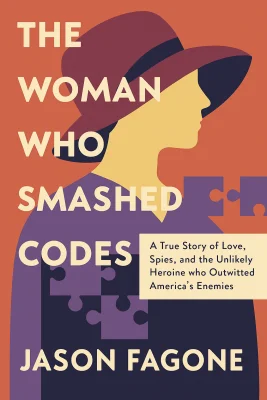
The Woman Who Smashed Codes
A True Story of Love, Spies, and the Unlikely Heroine who Outwitted America's Enemies
Categories
Nonfiction, Science, Biography, History, Audiobook, Biography Memoir, Book Club, Historical, World War II, War
Content Type
Book
Binding
Hardcover
Year
2017
Publisher
Dey Street Books
Language
English
ASIN
0062430483
ISBN
0062430483
ISBN13
9780062430489
File Download
PDF | EPUB
The Woman Who Smashed Codes Plot Summary
Introduction
# The Invisible Guardian: Elizebeth Friedman's Secret War In the summer of 1916, a young woman named Elizebeth Smith answered a peculiar job advertisement that would transform her from a small-town teacher into one of America's most formidable weapons against international espionage. Standing barely five feet tall with piercing hazel eyes and an insatiable curiosity about puzzles, she possessed no formal training in cryptography yet would go on to break some of the most sophisticated codes of the twentieth century. Her journey began with Shakespeare's hidden messages and culminated in dismantling Nazi spy networks across the Western Hemisphere, proving that brilliance and determination could overcome any cipher. Elizebeth's remarkable story illuminates three profound dimensions of modern history and human potential. Through her pioneering work in cryptanalysis, we witness how scientific thinking and methodical persistence can solve seemingly impossible problems, establishing entirely new disciplines that serve national security. Her struggles for recognition in a male-dominated field reveal both the barriers faced by women in intelligence work and the extraordinary contributions they made despite systematic discrimination. Finally, her partnership with fellow cryptanalyst William Friedman demonstrates how intellectual equals can build both personal and professional legacies that reshape their chosen fields while challenging conventional notions about collaboration and individual achievement.
Chapter 1: From Shakespeare to Secrets: The Accidental Cryptanalyst
Elizebeth Smith never intended to become America's premier female codebreaker. Born in 1892 to a Quaker family in rural Indiana, she was the eighth of nine children in a household where intellectual curiosity was valued but higher education for women was considered impractical. Her father, a stern farmer and local politician, saw little purpose in sending daughters to college, but Elizebeth's fierce determination proved stronger than his conventional wisdom. She worked her way through Hillsdale College as a seamstress, studying Greek and English literature while developing the analytical skills that would later serve her in ways she could never have imagined. After graduation, the limited career options available to educated women in 1915 left her feeling trapped and restless. Teaching at a small high school in rural Michigan felt like intellectual imprisonment, and her dreams of graduate study seemed financially impossible. In desperation, she traveled to Chicago in the summer of 1916, hoping to find work that would engage her literary training and scholarly interests. Her visit to the Newberry Library to examine Shakespeare's First Folio seemed like a final gesture before accepting defeat and returning to the constraints of small-town life. Fate intervened in the form of George Fabyan, an eccentric textile millionaire who burst into the library's reading room like a force of nature. Fabyan's sprawling estate outside Geneva, Illinois, called Riverbank Laboratories, was a peculiar wonderland where wealthy patronage funded investigations into everything from acoustics to genetics. Most intriguingly for Elizebeth, Riverbank housed a project dedicated to proving that Francis Bacon had hidden secret messages throughout Shakespeare's plays using an elaborate cipher system known as the bilateral cipher. Under the guidance of Elizabeth Wells Gallup, an elderly scholar convinced she had discovered Bacon's hidden autobiography embedded in the Bard's works, Elizebeth learned her first lessons in pattern recognition and systematic analysis. Though she would eventually conclude that Gallup's theories were fundamentally flawed, these early experiences taught her to see beyond surface appearances, to question accepted truths, and to approach complex problems with methodical rigor. More importantly, at Riverbank she encountered William Friedman, a brilliant young geneticist whose passion for mathematical puzzles perfectly complemented her intuitive grasp of linguistic patterns. The outbreak of World War I transformed Riverbank from an eccentric rich man's hobby into a vital national resource. When the U.S. government desperately needed experts to intercept and decode enemy communications, Fabyan offered his facilities and his small team of cipher enthusiasts. Suddenly, Elizebeth found herself analyzing real German spy messages instead of imaginary Baconian codes, solving communications that could determine the fate of ships at sea and the success of military operations. What had begun as a chance encounter with literary conspiracy theories had evolved into a career that would span two world wars and help protect democracy itself.
Chapter 2: Love and Codes: Partnership at Riverbank Laboratories
The years at Riverbank Laboratories from 1916 to 1921 proved transformative for both Elizebeth and William Friedman, establishing the scientific foundations of modern cryptanalysis while forging a personal and professional partnership that would endure for over fifty years. Working side by side in cramped quarters filled with cipher machines and stacks of intercepted messages, they developed techniques that remain fundamental to codebreaking today, essentially inventing the discipline through a combination of mathematical rigor, linguistic insight, and relentless experimentation. Their collaboration was so seamless that colleagues found it impossible to determine which partner contributed more to their remarkable successes. Elizebeth's intuitive ability to spot patterns in seemingly random text provided the creative breakthroughs that William's systematic approach could then analyze and systematize. Together, they learned to count letter frequencies, create statistical analyses of encrypted communications, and recognize the subtle regularities that revealed the underlying structure of enemy codes. Their work on German diplomatic and intelligence messages during World War I demonstrated that cryptanalysis could be taught as a rigorous science rather than practiced as an arcane art. The Riverbank Publications, a series of groundbreaking technical papers they produced during this period, became the foundational texts of American cryptology. Though officially credited primarily to William due to the gender conventions of the era, these works represented genuine intellectual collaboration between two brilliant minds. They established systematic methods for attacking different types of ciphers, provided mathematical frameworks for analyzing code patterns, and created training materials that would educate generations of future codebreakers. Intelligence agencies around the world relied on these techniques for decades to come. Their personal relationship deepened alongside their professional achievements. In May 1917, they eloped to Chicago for a simple civil ceremony that surprised their colleagues and scandalized William's traditional Jewish family. Their marriage represented more than romantic love; it was an alliance between intellectual equals who had found in each other not just companionship but perfect complementarity. They shared everything: breakthrough insights, methodical techniques, professional successes, and the growing recognition that their work was revolutionizing the secret world of intelligence operations. However, their years at Riverbank also revealed the controlling and ethically questionable nature of their patron. George Fabyan's possessive attitude toward his employees and his willingness to take credit for their innovations increasingly troubled the young couple. When they attempted to leave for better opportunities elsewhere, they discovered that Fabyan had been intercepting their mail and actively sabotaging their job prospects. Their eventual escape from Riverbank in 1921 required careful planning and considerable courage, but it freed them to pursue their separate destinies while maintaining their extraordinary partnership.
Chapter 3: Prohibition's Hidden War: Breaking Criminal Networks
The advent of Prohibition in 1920 created an unexpected opportunity for Elizebeth to apply her cryptanalytic skills to domestic law enforcement, launching a decade-long campaign against the sophisticated criminal networks that flourished during America's failed experiment with alcohol prohibition. Working for the Treasury Department and later the Coast Guard, she found herself at the center of a technological revolution in both crime and law enforcement, where radio communications had given smugglers unprecedented advantages that only systematic codebreaking could counter. The rum-running syndicates of the 1920s operated with military-like precision and international scope, using shortwave radios to coordinate operations across vast distances from Canada to the Caribbean. Ships anchored beyond the twelve-mile limit served as floating warehouses, while smaller, faster vessels darted to shore under cover of darkness, guided by coded radio instructions that specified landing sites, timing, and cargo distribution. The Consolidated Exporters Corporation, one of the largest operations, employed cipher systems more sophisticated than those used by most governments, constantly evolving their codes to stay ahead of law enforcement efforts. Elizebeth approached these criminal communications with the same scientific rigor she had applied to wartime intelligence, developing systematic methods for breaking even the most complex smuggling codes. She discovered that criminal organizations often used multiple layers of encryption, first encoding their messages using commercial telegraph codebooks to reduce transmission costs, then enciphering the results using mathematical keys or substitution systems. Her breakthrough insight was recognizing that human nature remained constant even in criminal enterprises: smugglers made predictable errors, used familiar terminology, and followed operational patterns that careful analysis could reveal and exploit. Her success rate proved extraordinary by any measure. Between 1927 and 1930, she solved over twelve thousand intercepted messages, leading directly to hundreds of arrests and the seizure of contraband worth millions of dollars. Her work extended far beyond simple codebreaking to encompass what would later be called signals intelligence, mapping entire criminal networks by analyzing communication patterns, identifying key players through their distinctive linguistic habits, and predicting future operations based on decoded planning discussions. When Prohibition ended in 1933, many criminal organizations seamlessly transitioned to drug smuggling, particularly opium and its derivatives from Asia and South America. Elizebeth adapted her techniques to this new challenge, working with translators to break codes in multiple languages and coordinating with international law enforcement agencies to track global trafficking networks. Her courtroom testimony in high-profile trials made her a minor celebrity, earning her the nickname "America's First Lady of Naval Cryptology," though she found the publicity both uncomfortable and potentially dangerous to her continuing work against increasingly sophisticated criminal adversaries.
Chapter 4: Nazi Hunters: Dismantling Enemy Spy Rings
As World War II approached, Elizebeth Friedman found herself thrust into the most significant and secretive mission of her career: hunting Nazi spies throughout the Western Hemisphere in a shadow war fought with radio waves and cipher machines rather than conventional weapons. Working from a cramped office in Washington's Naval Communications Annex, she became America's primary defense against a sophisticated espionage network that threatened to turn South America into a staging ground for attacks on the United States and a source of vital intelligence for the German war machine. The Nazi intelligence services had spent years methodically building clandestine radio networks across Latin America, recruiting agents from German immigrant communities and local fascist sympathizers while establishing communication links that could coordinate intelligence gathering, sabotage operations, and political subversion. These professionally trained operatives used state-of-the-art equipment including portable Enigma cipher machines, believing their communications were absolutely secure from Allied interception. Their confidence in their cryptographic security made them careless about operational procedures, a weakness that Elizebeth would exploit with devastating effectiveness. Her counterintelligence operation required unprecedented secrecy and international coordination. Working closely with the FBI, military intelligence services, and British codebreakers, she had to identify spy networks, penetrate their communications, and track their activities without alerting them to her success. This represented the ultimate test of her accumulated skills: she needed not only to solve increasingly complex cipher systems but to do so while maintaining the crucial deception that Nazi communications remained secure from Allied cryptanalysis. The intelligence her team extracted from thousands of intercepted messages revealed the breathtaking scope of Nazi ambitions in the Americas. She uncovered assassination plots against Allied officials, sabotage plans targeting the Panama Canal and American industrial facilities, and efforts to influence Latin American governments toward the Axis cause. One network centered in Argentina was actively planning to establish submarine bases along the South American coast, while another group in Brazil was systematically mapping Allied shipping routes and reporting convoy schedules that guided deadly U-boat attacks. The scope of Elizebeth's cryptanalytic achievements during this period was truly staggering. By war's end, her work had led to the arrest of hundreds of Nazi agents and the complete dismantling of enemy spy networks from Mexico to Argentina. She had successfully broken multiple variants of the supposedly unbreakable Enigma machine used by German intelligence services, often working alone with nothing but intercepted radio messages and her extraordinary analytical abilities. Most remarkably, the Nazis never realized that their most secret communications were being read in real-time by a small team of American cryptanalysts led by a woman whose name they never learned.
Chapter 5: Stolen Glory: Fighting for Recognition in Hoover's Shadow
Throughout her extraordinary career, Elizebeth Friedman faced the persistent challenge of achieving recognition for her contributions in a field dominated by men and shaped by institutional politics that consistently minimized women's achievements. This struggle reached its most frustrating peak during World War II, when FBI Director J. Edgar Hoover systematically appropriated credit for her cryptanalytic successes, transforming her invisible war against Nazi spies into dramatic stories of FBI detective work that obscured the true source of American counterintelligence victories. The pattern of stolen recognition had begun early in her career at Riverbank, where George Fabyan readily promoted his male researchers while treating Elizebeth more as a talented assistant than as the pioneering scientist she had become. When the foundational Riverbank Publications were issued, William's name appeared prominently while Elizebeth's contributions were minimized or omitted entirely, establishing a precedent that would persist throughout her professional life. Even her spectacular successes against Prohibition-era smugglers were often attributed to male supervisors or presented as team efforts that downplayed her individual brilliance. Hoover's appropriation of her wartime achievements represented the most egregious example of this systematic erasure. The FBI director possessed neither the technical expertise nor the legal authority to conduct the sophisticated cryptanalytic work that broke Nazi spy networks, yet when major espionage cases reached their dramatic conclusions, he invariably stepped forward to claim credit for the arrests and convictions that followed. His publicity machine transformed Elizebeth's painstaking analytical work into sensationalized accounts of FBI detective work, complete with staged photographs and fabricated narratives that completely obscured her role. The most painful example occurred with the Velvalee Dickinson case, where Elizebeth's brilliant analysis of seemingly innocent letters about dolls revealed a major Japanese espionage operation. When the case went to trial, FBI agents testified about the codebreaking work as if they had performed it themselves, while Elizebeth's actual contributions remained classified and unacknowledged. This pattern repeated itself in case after case, gradually erasing her achievements from the public record and denying her the professional recognition that her male colleagues took for granted. The personal cost of this treatment extended beyond mere professional disappointment to encompass a profound sense of injustice and historical erasure. While William Friedman received widespread recognition as one of America's greatest cryptanalysts, Elizebeth watched her equally important contributions disappear into classified files and false narratives. She maintained her professionalism and continued her vital work, but the systematic denial of credit for her achievements reflected broader patterns of discrimination that would take decades to acknowledge and correct. The irony was that Elizebeth's wartime cryptanalytic work was arguably more crucial to American security than many of the achievements that brought fame to her male colleagues. Her penetration of Nazi intelligence communications provided strategic advantages that helped win the secret war in the Americas, yet these successes remained hidden while less significant accomplishments received public acclaim. Only decades later, as classified documents were gradually released, would historians begin to understand the true scope of her contributions to Allied victory.
Chapter 6: Pioneer's Legacy: Transforming Intelligence Forever
Elizebeth Friedman's career spanned and helped define the transformation of cryptanalysis from an amateur pursuit practiced by a handful of enthusiasts into a sophisticated scientific discipline essential to modern national security. Her innovations in systematic codebreaking, development of training methodologies for new analysts, and successful application of cryptanalytic techniques across diverse challenges from criminal investigations to counterintelligence operations established foundations that continue to influence intelligence work in the digital age. Her approach to codebreaking emphasized the crucial balance between rigorous mathematical analysis and creative intuitive leaps, a combination that proved remarkably effective across the diverse challenges she encountered throughout her career. She demonstrated that successful cryptanalysis required not merely technical skill but also deep understanding of human psychology, organizational behavior, and the operational constraints that shaped how different groups used encrypted communications. Her ability to adapt these insights to rapidly changing technological and strategic circumstances made her invaluable during the most critical periods of twentieth-century history. Perhaps most importantly for future generations, Elizebeth's career illustrated the potential for individuals to make extraordinary contributions to national security even while working within institutional constraints and facing systematic discrimination. Her persistence in pursuing excellence despite limited recognition, her willingness to train and mentor younger analysts, and her unwavering commitment to public service over personal advancement exemplified the highest ideals of intelligence work. She proved that dedication to mission could overcome bureaucratic obstacles and that scientific thinking could solve problems that seemed impossible to previous generations. The gradual recognition of her achievements in recent decades has helped correct historical injustices while inspiring new generations of women to pursue careers in cryptanalysis, cybersecurity, and intelligence analysis. Her story has become a powerful symbol of hidden contributions to national security, reminding us that the most crucial work in protecting democratic societies often remains invisible to the public it serves. Modern intelligence agencies have begun to acknowledge her pioneering role in their official histories and educational programs, ensuring that her methods and achievements will influence future practitioners. Her technical innovations proved remarkably prescient, anticipating many approaches that became standard practice in the computer age. Her emphasis on systematic record-keeping, comprehensive traffic analysis, and the integration of technical intelligence with operational insights laid groundwork for modern signals intelligence operations. Her recognition that successful codebreaking required understanding not just mathematical patterns but also human behavior and organizational dynamics remains as relevant today as it was during her battles against Nazi spies and criminal networks.
Summary
Elizebeth Friedman's remarkable life demonstrates that intellectual courage combined with methodical persistence can overcome any cipher, whether encoded in ancient texts or enemy transmissions, and that true service to one's country often requires working in shadows while others claim the spotlight. Her transformation from a small-town teacher seeking literary work to America's most accomplished female cryptanalyst illustrates how individual brilliance, when combined with unwavering dedication to the greater good, can help shape the course of history even without public recognition or institutional support. Her legacy offers profound lessons about the power of scientific thinking applied to real-world challenges, the importance of questioning conventional assumptions, and the value of partnerships built on mutual respect and shared intellectual passion. For anyone facing seemingly insurmountable obstacles in male-dominated fields, working in areas where recognition may be limited, or seeking to make meaningful contributions to public service, Elizebeth's example demonstrates that the most significant achievements often come from those who focus on excellence rather than acclaim, understanding that protecting others sometimes means accepting that one's own story may remain untold for generations.
Best Quote
“For all the harmless innocence conjured by the word "library", the Friedmans knew the truth: a library, properly maintained, could save the world - or burn it down.” ― Jason Fagone, The Woman Who Smashed Codes: A True Story of Love, Spies, and the Unlikely Heroine who Outwitted America's Enemies
Review Summary
Strengths: The review highlights the book's compelling portrayal of Elizebeth Friedman's significant yet historically overlooked contributions to cryptography and her role in WWI and WWII. The narrative effectively addresses gender inequality, showcasing the challenges women faced in academia and professional fields. The book is praised for making the pay disparity and historical injustices against women clear and impactful. Overall: The reader expresses high admiration for the book, considering it one of the best they have read, even surpassing "Hidden Figures." The book is recommended for its enlightening content on gender issues and historical recognition, making it a valuable read.
About Author

Jason Fagone
Fagone delves into the intersections of science, technology, and culture with a narrative style that delves deep into human stories. His purpose as a journalist and nonfiction author is to uncover the complexities of innovation and its societal impacts, providing readers with a nuanced understanding of often overlooked figures and events. For example, in his book "The Woman Who Smashed Codes," Fagone brings to light the life of Elizebeth Smith Friedman, a pioneering codebreaker whose contributions were crucial to national security. His approach is characterized by thorough research and engaging prose, making complex subjects accessible to a broad audience.\n\nFagone’s method combines investigative reporting with storytelling, allowing readers to appreciate the human side of invention and discovery. His exploration of topics such as competitive eating in "Horsemen of the Esophagus" and the world of automotive innovation in "Ingenious" showcases his ability to bring diverse subjects to life. Meanwhile, his investigative work at the San Francisco Chronicle further demonstrates his commitment to long-term, in-depth stories that resonate with a contemporary audience.\n\nReaders benefit from Fagone's ability to synthesize complex information into compelling narratives, offering insights into how historical and technological developments shape our world. His bio reflects a career dedicated to shining a light on untold stories, and his work has earned him recognition, including a Knight-Wallace Fellowship. Fagone's contributions continue to engage readers who are interested in the profound effects of scientific and cultural phenomena on society.
Read moreDownload PDF & EPUB
To save this Black List summary for later, download the free PDF and EPUB. You can print it out, or read offline at your convenience.
The Woman Who Smashed Codes
by Jason Fagone
