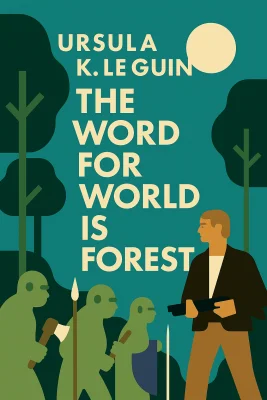
The Word for World Is Forest
Categories
Fiction, Classics, Science Fiction, Audiobook, Fantasy, Science Fiction Fantasy, Book Club, Novels, Novella, Speculative Fiction
Content Type
Book
Binding
ebook
Year
1989
Publisher
Language
English
ASIN
B0DTRHFVCX
File Download
PDF | EPUB
The Word for World Is Forest Plot Summary
Introduction
Deep in the green shadows of Athshe's endless forests, a small figure crouches over the broken body of his wife. Her fur is matted with blood, her breathing shallow and erratic. She dies in Selver's arms, another casualty of Captain Davidson's casual brutality. But this death will echo far beyond the confines of the logging camp where it occurs. The planet Athshe—its name meaning both "forest" and "world"—has been stripped and scarred by Terran colonists for four years. The native people, small and green-furred, have submitted to slavery with the passive resignation their species has always shown toward violence. They cannot kill. They have never killed. Until now. For in the moment Thele breathes her last, something ancient breaks inside Selver, something that will teach his people a terrible new dream—one that can only be acted out with fire and blood.
Chapter 1: The Forest and Its Invaders: Colonization of Athshe
Captain Don Davidson stands in the morning sunlight, surveying his domain with the satisfaction of a conqueror. Around him, the logging camp of Smith Island hums with activity as two hundred Terran colonists continue their methodical destruction of the ancient forest. Massive trees that have stood for centuries crash to earth under the bite of chainsaws, their timber destined for Earth's insatiable hunger for wood. The native Athsheans—"creechies" in Davidson's parlance—scurry about like green-furred insects, doing the manual labor their human masters assign them. They are small, barely a meter tall, with large dark eyes and an unsettling habit of dreaming while awake. Davidson watches them with contempt. They are weak, he thinks, barely more than animals despite their obvious intelligence. At Central Colony headquarters, anthropologist Raj Lyubov studies these same beings with fascination rather than disdain. Unlike Davidson, he has taken the time to learn their language, to understand their complex dream-culture. The Athsheans live in two states simultaneously—the "world-time" of daily existence and the "dream-time" where they process experience and find meaning. They are natural pacifists, incapable of violence, evolved beyond humanity's primitive aggression. Or so Lyubov believes. He has befriended one Athshean in particular, a quick-minded individual called Sam who serves as his interpreter and guide. Sam's real name is Selver, though few humans bother with native appellations. Selver works as a body-servant to three officers, invisible and efficient, learning the ways of his captors while maintaining the serene demeanor his people have perfected over millennia. The colony operates on principles of casual exploitation. The Athsheans are not technically slaves—they are classified as "Volunteer Autochthonous Labor Personnel." They live in compounds, work dawn to dusk, and exist at the complete mercy of their human overseers. Some, like Selver's wife Thele, work in the kitchens. Others haul timber or clear underbrush. All dream of home, of the deep forest where their people once lived in harmony with the endless trees.
Chapter 2: A God is Born: Selver's Transformation Through Grief
The night Thele dies changes everything. Davidson, inflamed by drink and the casual sadism that passes for authority among the colonists, has taken her to his quarters. What happens there transforms her from a living being into a broken thing that ceases to breathe in Selver's arms. The physical details matter less than their result: for the first time in recorded Athshean history, one of their kind experiences pure, undiluted rage. Selver finds Davidson the next morning and attacks him with bare hands. The fight is impossibly uneven—Davidson outweighs him by more than two to one—but Selver fights with the desperate fury of the utterly broken. He claws at Davidson's face, leaving permanent scars, refusing to submit even when beaten nearly unconscious. Only Lyubov's intervention prevents Davidson from killing him. In the aftermath, something has changed in Selver's brain. The neural pathways that once channeled aggression into dreams have ruptured. He lies in Lyubov's hut for days, burning with fever, while new patterns establish themselves in his mind. When he finally speaks, it is to describe visions of fire and death, of Athsheans rising against their oppressors with weapons in their hands. Lyubov, horrified by what he has witnessed, arranges Selver's escape to a distant settlement. But the damage is done. Word spreads through the forest networks of the Athshean who struck back, who showed his people that the humans could bleed and fall like any other creature. In hidden groves and underground warrens, the forest people begin to dream new dreams. Selver becomes something unprecedented in his culture: a "sha'ab," a god-translator who bridges the gap between dream and reality. He moves from settlement to settlement, speaking of liberation, teaching others to channel their suppressed rage into purposeful violence. The peaceful Athsheans listen with growing excitement and terror. Their ancestors' deepest taboos are crumbling before this small, scarred prophet who speaks of blood and fire with the calm authority of divine revelation.
Chapter 3: Blood on the Leaves: The Smith Camp Massacre
The attack comes at dawn on a day when Captain Davidson is away visiting the female colonists at Central. Nine hundred Athsheans emerge from the forest like living shadows, moving with coordinated precision that would be impossible without months of planning. They have studied their enemies well, noting guard rotations, weapon storage, and the colonists' patterns of vulnerability. The assault begins with sabotage—water pipes severed, power lines cut, communications disabled. Then comes fire as stolen explosives detonate in the ammunition depot and hangars. The night sky blazes orange as buildings collapse and aircraft burn. Through it all, the Athsheans move with deadly purpose, their traditional hunting weapons supplemented by stolen firearms. Two hundred Terran colonists die in the space of three hours. Some fight back, their superior weapons taking a heavy toll among the attackers, but they are overwhelmed by sheer numbers and the element of complete surprise. The Athsheans show no mercy to the males but spare no time for torture or degradation. This is not revenge but extermination, carried out with the methodical efficiency their species brings to every task. When Davidson returns that evening, he finds only ashes and corpses. The neat logging camp has become a charnel house of smoking debris and scattered bones. His men lie where they fell, their bodies already cooling in the tropical heat. The native compound stands empty, its gates thrown open, the "volunteer laborers" vanished back into the forest that spawned them. Among the dead, Davidson discovers a scene that will haunt him: his friend Oknanawi, the logging foreman, with an arrow through each eye like some obscene insect antenna. The image burns itself into Davidson's eidetic memory alongside his rage and humiliation. He salvages what weapons he can and retreats to his helicopter, his mind already planning terrible retribution. As he flies back to Central to report the massacre, Davidson catches sight of four small figures in a clearing below. Even from the air, he recognizes Selver among them. The recognition is mutual—the Athshean who destroyed his world looks up at the circling aircraft with calm acknowledgment, neither fleeing nor hiding. The war between species has begun in earnest.
Chapter 4: Distant Voices: The Ansible and the League of Worlds
The arrival of the starship Shackleton brings revelations that shatter the colonists' understanding of their place in the universe. Commander Yung and his passengers—a Cetian and a Hainish representative—carry news from Earth that is twenty-seven years in the making. Humanity is no longer alone in its expansion across the stars, and the rules of colonial exploitation have changed dramatically. The ansible, a device for instantaneous communication across interstellar distances, connects Athshe directly to Earth for the first time since the colony's founding. The messages that come through paint a picture of a transformed human civilization, one bound by treaties with other intelligent species and governed by ethical principles that colonial administrators like Colonel Dongh barely recognize. Raj Lyubov finds himself at the center of increasingly tense conferences as his reports on Athshean culture take on new significance. What had been academic observations of a "primitive" species become crucial intelligence about humanity's newest enemies. The League of Worlds demands explanations for the Smith Camp massacre, and Lyubov struggles to bridge the gap between two incompatible worldviews. Captain Davidson attends these meetings with growing contempt for what he sees as alien manipulation of human policy. The ansible messages forbid retaliation against the Athsheans, mandate the release of all native laborers, and essentially grant sovereignty to a species Davidson considers barely above animals. In his mind, the conspiracy is obvious: alien powers are using human compassion as a weapon to weaken Terran expansion. The Shackleton's representatives listen to accounts of the massacre with expressions of barely concealed horror. The Hainish diplomat, Lepennon, questions Davidson closely about the treatment of native workers, while the Cetian representative takes detailed notes on colonial policies. Their disgust becomes palpable as the full scope of the exploitation emerges. As the starship prepares to depart, carrying news of Athshe back to the League of Worlds, the colonists receive their new orders: strict non-interference with native populations, immediate cessation of all logging operations, and confinement to already-cleared areas. For Davidson, watching the alien-influenced humans abandon their own species' interests, the betrayal is complete. The real war, he realizes, is not with the creechies—it's with the traitors in human form who would sacrifice their own kind to appease alien masters.
Chapter 5: Fire in the Night: The Fall of Centralville
Selver moves through the forest like a spirit of vengeance, gathering followers from every settlement and refugee camp. His message is simple and terrible: the humans must be driven from Athshe completely, or they will consume the entire world. The male colonists can be allowed to live, but the females must die—not from cruelty, but from necessity. Without their women, the invaders cannot breed and spread like a plague across the forest lands. The assault on Central comes with surgical precision. Five thousand Athsheans converge on the main colony in the depths of night, moving through the darkness with the silence of natural predators. They have learned from Smith Camp, studying human defensive patterns and weaknesses. This time, they strike the power grid first, plunging the settlement into chaos before the attack begins in earnest. Explosions rock the night as ammunition depots detonate in sequence. The ansible transmitter, humanity's link to distant Earth, vanishes in a pillar of flame that can be seen for miles. Aircraft burn in their hangars while desperate colonists stumble through smoke-filled streets, trying to mount some kind of defense against enemies they can barely see. Raj Lyubov dies in the first minutes, crushed by a falling beam as he tries to rescue a terrified woman from a burning building. He falls face-down in the mud while around him the city of human ambition dissolves into ash and screaming. The irony is not lost on Selver, who finds his friend's body hours later and kneels beside it in grief and recognition. The man who tried to build bridges between species has become another casualty of the war his own people started. By dawn, Centralville is a smoking ruin. Nearly eight hundred colonists lie dead in the streets and rubble, while the survivors huddle in the few structures that escaped the flames. The Athsheans have taken control completely, herding the remaining humans into the former native compounds with a symmetry that speaks to their deep understanding of justice. As the sun rises over the destroyed city, Selver stands among the ashes of human civilization and feels no triumph, only a profound weariness. He has become what his people needed—a god of necessary death—but the cost has been his own soul. The peaceful world his ancestors knew is gone forever, replaced by something harder and infinitely more dangerous.
Chapter 6: The Last Conquistador: Davidson's Exile
With Central fallen and most colonial outposts destroyed, Captain Davidson finds himself the ranking military officer of a shattered enterprise. From his base on New Java, he commands fewer than sixty men against an entire world in rebellion. But Davidson refuses to accept defeat, seeing himself as the last true human on a planet of traitors and subhuman creatures. His men watch nervously as their captain's behavior grows increasingly erratic. Davidson speaks of vast conspiracies, alien infiltration, and the necessity of genocide as the only solution to the "creechie problem." He leads raids against nearby Athshean settlements, burning villages and slaughtering inhabitants with a systematic brutality that disturbs even his most loyal followers. The final confrontation comes when thousands of Athsheans surround New Java Camp under cover of darkness. Davidson's carefully planned defenses crumble within hours as overwhelming numbers of attackers pour over the walls. In the chaos of battle, he escapes in his helicopter with two subordinates, fleeing into the night sky as his command burns below. The aircraft crashes in the deep forest, killing his companions and leaving Davidson alone in the wilderness that has swallowed his entire civilization. He wanders through the trees in growing madness, his superior human intellect no match for an environment that operates by rules he has never bothered to learn. When Selver's warriors finally corner him, Davidson attempts one final act of defiance—spitting in his captor's face as if his contempt alone could restore his lost supremacy. But Selver responds with something far more devastating than violence: pity. The Athshean leader recognizes Davidson as a god of his own kind, a creature driven mad by the terrible gift of murder he brought to both their peoples. Instead of execution, Davidson receives the most fitting punishment imaginable: exile to Dump Island, a wasteland his own people created by clearcutting every tree. There he will live alone with the consequences of human greed, surrounded by the ecological devastation that represents everything the Terrans brought to Athshe. It is a prison built from his own species' handiwork—a monument to the blindness that destroyed them all.
Chapter 7: What Is, Is: The Irreversible Knowledge of Death
Three years later, the Terran fleet returns to find a transformed world. The surviving colonists huddle in their designated reservation, barely fifteen hundred souls out of the thousands who came to tame the forest. They exist on Athshean sufferance now, forbidden to cut trees or expand beyond their barren enclave. Their dreams of conquest have withered into mere survival. Selver has aged beyond his years, bearing the weight of being his people's first teacher of violence. He meets with the fleet representatives under an ancient oak, carrying with him Lyubov's linguistic studies and ethnographic notes—the dead anthropologist's attempt to bridge two incompatible ways of seeing the universe. The papers represent humanity's only lasting contribution to Athshean culture: understanding wrapped in tragedy. The League of Worlds has placed Athshe under permanent protection, forbidding any further colonial activity for five generations. The Terrans will be evacuated completely, leaving the forest people to rebuild their shattered civilization. But Selver knows that innocence, once lost, cannot be recovered. His people have learned to kill, and that knowledge will echo through their dreams forever. Commander Lepennon, the Hainish diplomat, recognizes Selver as something unprecedented—a being who has successfully translated the concept of murder from one reality to another. The achievement is as remarkable as it is terrible, marking the birth of a new kind of consciousness among the forest people. They are no longer the passive beings Lyubov studied, but something harder and infinitely more dangerous. As the Terran ships prepare to depart, carrying their broken survivors back to distant Earth, Selver reflects on the price of liberation. The old world of dream and forest harmony is gone, replaced by something that includes the possibility of violence as a permanent part of Athshean existence. His people are free, but freedom has cost them their innocence—a trade that may echo through generations yet to come.
Summary
In the ashes of first contact between human and Athshean civilization, Ursula K. Le Guin crafts a devastating examination of colonialism's true cost. Selver achieves his people's freedom by becoming something his species has never known—a killer—while Davidson's absolute conviction in human superiority leads him to the ultimate isolation of madness. Both are transformed by violence: one into a reluctant god of necessary death, the other into a monument to racial hatred's logical endpoint. The forest endures, as it always has, but it now shelters a people forever changed by their first taste of murder. Le Guin's vision suggests that some knowledge, once gained, cannot be forgotten—and that the price of freedom may be the loss of the very innocence that made freedom precious. In teaching the Athsheans to kill, humanity has created not subjects but mirrors of its own capacity for violence, ensuring that the echoes of this first war will reverberate through both species for generations yet to dream.
Best Quote
“Sometimes a god comes," Selver said. "He brings a new way to do a thing, or a new thing to be done. A new kind of singing, or a new kind of death. He brings this across the bridge between the dream-time and the world-time. When he has done this, it is done. You cannot take things that exist in the world and try to drive them back into the dream, to hold them inside the dream with walls and pretenses. That is insanity. What is, is. There is no use pretending, now, that we do not know how to kill one another.” ― Ursula K. Le Guin, The Word for World Is Forest
Review Summary
Strengths: The review highlights the novella's influence on other works, such as James Cameron's "Avatar" and George Lucas's "Ewoks," suggesting its significant impact on science fiction. It praises the novella's insightful exploration of dangerous ideas and cultural contrasts, particularly the Athsheans' dreaming culture versus the humans' lack thereof. The review appreciates the moral and ethical themes, as well as the poetic language used in the book. Overall: The reviewer expresses a highly positive sentiment towards "The Word for World is Forest," recommending it as a significant work in speculative fiction. The novella is praised for its thematic depth and cultural commentary, making it a worthwhile read for those interested in social science fiction.
About Author

Ursula K. Le Guin
Le Guin investigates complex social constructs through the lens of speculative fiction, using her profound understanding of anthropology to craft worlds that explore gender, politics, and otherness. Her works often depict characters from the Ekumen, a humanitarian organization that immerses itself in diverse cultures, as seen in her Hainish Cycle. This method allows her to juxtapose familiar societal issues with unfamiliar settings, enabling readers to question their own worldviews. In books like "The Left Hand of Darkness" and "The Dispossessed," Le Guin challenges norms and invites discourse on societal structures.\n\nHer narratives are enriched by her engagement with non-Western philosophies, a theme vividly portrayed in "The Telling" and "Solitude." These works integrate philosophical elements into their plots, fostering a deeper understanding of human connection and cultural difference. For the reader, Le Guin’s stories offer more than entertainment; they provide a framework for examining real-world issues in a fictional context, encouraging a broader perspective on global cultural dynamics.\n\nLe Guin's contributions to literature have been recognized with numerous awards, including the Hugo and Nebula, attesting to her influence in speculative fiction. Her authorial approach not only creates immersive narratives but also leaves a lasting impact on readers who seek to understand the intricacies of human and societal interaction. This brief bio underscores the richness of her writing, which continues to resonate with audiences seeking meaningful explorations of identity and culture.
Read moreDownload PDF & EPUB
To save this Black List summary for later, download the free PDF and EPUB. You can print it out, or read offline at your convenience.
The Word for World Is Forest
by Ursula K. Le Guin
