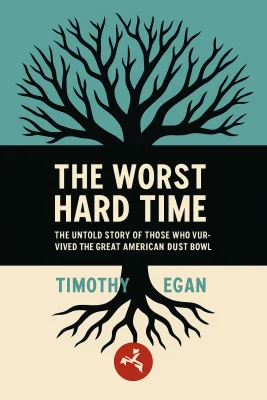
The Worst Hard Time
The Untold Story of Those Who Survived the Great American Dust Bowl
Categories
Nonfiction, History, Nature, Audiobook, American, Book Club, Historical, Environment, American History, Survival
Content Type
Book
Binding
Kindle Edition
Year
2018
Publisher
Houghton Mifflin Harcourt
Language
English
ASIN
B009SRQCPS
ISBN
0547347774
ISBN13
9780547347776
File Download
PDF | EPUB
The Worst Hard Time Plot Summary
Introduction
# The Dust Bowl: America's Environmental Catastrophe and Recovery On April 14, 1935, a wall of black dust two miles high rolled across the Great Plains, turning day into night and burying entire communities under tons of topsoil that had taken millennia to form. This was not merely a natural disaster, but the catastrophic culmination of humanity's most ambitious and destructive assault on the American landscape. The Dust Bowl represented a perfect storm where economic speculation, government policy, and environmental ignorance converged to create one of the nation's greatest ecological disasters. The story reveals how quickly prosperity can turn to devastation when short-term economic incentives override environmental wisdom. Within a single generation, thirty-three million acres of ancient grassland were transformed into wheat fields, then abandoned to the wind when markets crashed and drought struck. Through the experiences of families like the German-Russian immigrants who fled the Czar only to face another exodus, and communities like Dalhart, Texas, that fought desperately to survive, we witness both the human cost of environmental destruction and the remarkable resilience of ordinary people facing extraordinary hardship. This tragedy offers profound lessons about the delicate balance between human ambition and natural limits that remain urgently relevant as we face our own environmental challenges.
Chapter 1: The Great Plow-Up: Transforming Grasslands into Wheat Fields (1900-1930)
The transformation of the Great Plains began with a seductive lie wrapped in patriotic fervor. Railroad companies and government promoters promised that "rain follows the plow," that the very act of breaking prairie sod would somehow alter the climate itself. Between 1900 and 1930, this fantasy drove one of the most dramatic landscape changes in human history, as millions of acres of ancient grassland were torn up and planted with wheat in what historians would later call "the great plow-up." The timing seemed providential. World War I created an insatiable global demand for American grain, with wheat prices guaranteed at two dollars a bushel by the federal government. Families like the Folkers in No Man's Land and the Volga Germans fleeing Russian persecution found prosperity beyond their wildest dreams. Fred Folkers went from subsistence farming to earning thousands annually, enough for a new house, a piano, and a shiny Dodge automobile. Towns like Dalhart, Texas, sprang up almost overnight, growing from nothing to eight thousand people in less than three decades. New technology made destruction possible on an unprecedented scale. Tractors could do the work of ten horses, and the one-way plow could rip through prairie sod with devastating efficiency. The XIT Ranch, once the world's largest cattle operation, was carved up and sold to wheat farmers who promised even greater productivity. Suitcase farmers arrived from distant cities, plowed vast tracts during planting season, then returned home, leaving the land defenseless against the elements. Yet warning signs were evident to those who understood the ecosystem. Cowboys and Mexican sheepherders watched in horror as the protective carpet of buffalo grass disappeared. They knew this grassland had evolved over thousands of years to survive the extremes of heat, cold, drought, and wind that characterized the High Plains. The grass roots extended deep into the earth, holding soil in place and storing moisture for lean years. Without this natural protection, the land would be utterly vulnerable. The economic incentives, however, proved irresistible. As wheat prices soared, even conservation-minded farmers felt compelled to plow more acres to pay debts and capitalize on the boom. By 1930, the transformation was complete: the greatest grassland ecosystem in North America had been replaced by a vast wheat factory, setting the stage for environmental catastrophe of unprecedented proportions.
Chapter 2: Economic Collapse and Environmental Crisis: When Prosperity Turned to Dust (1930-1932)
The crash came with brutal swiftness that caught an entire region unprepared. Wheat prices that had reached two dollars a bushel during the war years plummeted to thirty cents by 1930, then to a devastating nineteen cents by 1932. Farmers who had borrowed heavily to buy land and equipment during the boom suddenly found themselves producing crops that cost more to grow than they could sell for. The mathematics of ruin were inescapable: spending thirty-five cents per bushel to produce wheat that sold for twenty-four cents meant bankruptcy with every harvest. The human cost of economic collapse was immediate and devastating. Families like the Lucases in Oklahoma watched their life savings evaporate as banks failed across the region. The First National Bank of Dalhart closed its doors in June 1931, taking with it the deposits of countless families who had trusted their future to the boom. Teachers went unpaid for months, working for worthless scrip that no merchant would honor. Children attended schools heated by cow chips, their textbooks falling apart from neglect. As if economic ruin were not enough, nature delivered its own crushing blow. The rains that had sustained the wheat boom simply stopped coming. The drought that began in 1930 was unlike anything in living memory, with some areas receiving less than ten inches of precipitation annually. Wells that had never run dry began to fail. The Cimarron River, once a reliable water source, dwindled to a trickle. Farmers watched helplessly as their crops withered in fields that had been transformed from grassland to dust. The combination of economic collapse and environmental stress created a vicious cycle of abandonment and destruction. Suitcase farmers who had rushed in during the boom years simply walked away, leaving millions of acres of broken land exposed to the wind. Even established homesteaders found themselves unable to maintain their properties. Without income from crops, they could not afford to replant or maintain windbreaks. The protective cover that might have held soil in place disappeared, leaving vast expanses of naked earth vulnerable to the elements. By 1932, the stage was set for environmental catastrophe. The economic incentives that had driven the great plow-up had vanished, but the ecological damage was irreversible. Thirty-three million acres of grassland that had taken millennia to establish were now bare soil, waiting for the wind to carry them away. The drought continued, and with each passing month, the exposed earth became more powdery and vulnerable. The first black blizzards were already beginning to form on the horizon.
Chapter 3: Black Blizzards: The Devastating Dust Storms That Darkened America (1932-1935)
On January 21, 1932, a phenomenon unlike anything in recorded history appeared on the horizon near Amarillo, Texas. A wall of dust ten thousand feet high and nearly two miles wide rolled across the landscape, turning day into night and introducing America to a new form of natural disaster: the black blizzard. This was not sand blowing in the wind, but the very topsoil of the Great Plains taking flight, carrying with it the dreams and livelihoods of an entire region. The storms defied easy categorization or scientific explanation. Weather bureau officials, trained to track hurricanes and tornadoes, found themselves struggling to describe these massive formations of airborne earth. The dust clouds moved like living things, rolling and churning across the prairie with their own internal dynamics. They carried static electricity so powerful it could knock a person down or short out a car's ignition system. The particles were fine enough to penetrate any barrier, seeping through the tiniest cracks in walls and windows to coat everything inside homes and businesses. For families like the Folkers in No Man's Land and the Whites in Dalhart, the black blizzards transformed daily life into a struggle for survival. Simple tasks like cooking or sleeping became ordeals as dust infiltrated every space. Hazel Shaw learned to set the dinner table only at the moment of eating, to keep pots covered while cooking, and to expect that the only clean spot on her pillow in the morning would be the outline of her head. Children developed chronic coughs, and the elderly began showing signs of what doctors would later identify as dust pneumonia. Black Sunday, April 14, 1935, brought the most devastating storm of all. Families huddled in their homes experienced what seemed like the end of the world as walls of black dirt engulfed entire communities. The storm was so dense that people couldn't see their own hands in front of their faces, and many became lost just yards from their homes. Visibility dropped to zero in minutes, trapping people in cars or forcing them to take shelter wherever they could find it. By 1935, the storms were occurring with frightening regularity, with some lasting twelve hours or more. The dust was not just a local phenomenon but was traveling vast distances, carrying the topsoil of Kansas and Oklahoma as far east as the Atlantic Ocean. Ships three hundred miles offshore reported dust falling on their decks, and cities like Chicago and Washington found themselves blanketed in prairie soil. Each storm represented the permanent loss of irreplaceable topsoil that had taken thousands of years to form, symptoms of a fundamental breakdown in the relationship between human activity and the natural world.
Chapter 4: Human Tragedy: Disease, Death, and Mass Exodus from the Plains (1934-1936)
By 1934, the airborne soil of the Great Plains had transformed from an inconvenience into a killer. Hospitals across the Dust Bowl region began filling with patients suffering from a new ailment that doctors struggled to understand and treat. Dust pneumonia, as it came to be known, was claiming lives from the youngest infants to the oldest grandparents, turning the very air into a weapon against human life. Dr. John H. Blue of Guymon, Oklahoma, reported treating fifty-six patients, finding their lungs filled with fine particles of silica-rich soil. The medical crisis was unprecedented in American history. Children were particularly vulnerable, their small lungs unable to cope with the constant assault of airborne particles. The Red Cross declared a medical emergency across the High Plains, opening six emergency hospitals and distributing thousands of respiratory masks. In Beaver County, Oklahoma, three hundred people were diagnosed with dust pneumonia in a single month. Secondary roads to isolated farms were often impassable due to drifting soil, making it impossible for the sick to reach medical care. Families faced impossible choices as they watched their children struggle to breathe. Some parents made the agonizing decision to give up their children, leaving infants on church steps in hopes that others could provide the care they could no longer afford. Hazel Shaw discovered one such abandoned baby on the steps of the Methodist church, a blue-faced infant who had survived two days in the cold and dust but later died of dust pneumonia despite rescue efforts. The crisis forced mass migration on a scale not seen since the Civil War. Families loaded their possessions into broken-down cars and headed west toward California, only to find themselves unwelcome as "Okies" regardless of which state they actually came from. The Ehrlich family, German immigrants who had already fled persecution in Russia, watched helplessly as their children fell ill, forcing them to send the youngsters away to relatives while the parents remained to tend their failing farm. Yet many families chose to stay, bound by pride, poverty, or simple stubbornness to the land that was destroying them. These "Last Man Club" members developed ingenious survival strategies: canning tumbleweeds for food, burning cow chips for fuel, and sealing their homes with wet sheets in futile attempts to keep out the dust. The question was no longer whether the land could be made productive again, but whether it could be made safe for human habitation.
Chapter 5: Government Response: New Deal Conservation and Emergency Relief (1933-1937)
Franklin Roosevelt's inauguration in March 1933 marked a revolutionary turning point in the federal government's relationship with both agriculture and environmental conservation. The new president recognized that the Dust Bowl represented more than a regional crisis; it threatened the agricultural foundation of American society itself. His administration launched what amounted to a war against soil erosion, deploying unprecedented federal resources to address an environmental catastrophe that transcended state boundaries and individual property lines. The Agricultural Adjustment Act represented a dramatic departure from laissez-faire economics, establishing the principle that government had a responsibility to ensure farmers could make a living from their labor. The program paid farmers to reduce production, slaughtering millions of pigs and plowing crops under to create artificial scarcity and drive up prices. While this seemed wasteful to many Americans struggling through the Depression, it provided immediate relief to families who had been producing crops at a loss for years. Roosevelt summoned Hugh Hammond Bennett, a soil scientist who had been warning for years about the dangers of erosive farming practices, to lead the newly created Soil Conservation Service. Bennett brought both scientific expertise and evangelical fervor to the task, declaring that Americans had become "the greatest destroyers of land of any race of people barbaric or civilized." His teams introduced revolutionary techniques like contour plowing, strip farming, and terracing designed to hold water and soil in place. The president's vision of a "shelterbelt" of 200 million trees stretching from Canada to Texas was ridiculed by many as impractical, but it represented a bold attempt to engineer a solution to an environmental crisis of unprecedented scale. The Civilian Conservation Corps put unemployed young men to work planting windbreaks and stabilizing soil across the devastated region. Roosevelt understood that saving the farmers meant saving the land itself. Perhaps most importantly, the New Deal established the principle that environmental disasters required federal intervention and collective action. The traditional American belief in individual self-reliance and local solutions proved inadequate when faced with a crisis that affected the entire nation. The dust storms that darkened the skies over Washington in May 1934 brought home to policymakers the reality that what happened on a wheat farm in Kansas could affect the entire country, setting the stage for modern environmental policy.
Chapter 6: Community Resilience: Survival Strategies in America's Wasteland (1935-1938)
As the Dust Bowl reached its devastating peak, communities across the High Plains demonstrated remarkable creativity and determination in their fight for survival. Daily life required extraordinary adaptations to an environment that seemed determined to destroy human habitation. Families developed elaborate rituals around the simple act of breathing clean air: sealing windows with wet sheets, stuffing rags into every crack, and keeping damp cloths over their faces even while sleeping. The town of Dalhart, Texas, became a symbol of both the crisis and the determination to survive it. Editor John McCarty of the Dalhart Texan launched a defiant campaign to reframe the disaster, writing tributes to the dust storms as "majestic spectacles of nature" and calling his readers "Spartans" who would emerge stronger from their trials. His boosterism seemed almost delusional to outsiders, but it reflected a deeper truth about communities that refused to surrender to catastrophe. The crisis brought out both the best and worst in human nature. Doc Dawson, ruined by his failed investments in farmland, opened a soup kitchen to feed the hungry. Uncle Dick Coon, despite his own financial troubles, continued to support community institutions and maintain his poker-faced optimism. When rabbits overran the dying landscape, townspeople organized massive drives that killed thousands of the animals in single afternoons. When traditional food sources failed, families learned to eat tumbleweeds and grind yucca roots for cattle feed. Children grew up in this alien landscape with a matter-of-fact acceptance that amazed adults. They learned to navigate by feel during the worst storms, to breathe through damp cloths as naturally as other children might wear winter coats, and to help their families with the endless task of digging out from under the latest deposit of someone else's topsoil. Schools developed protocols for dust storm emergencies, sometimes keeping children overnight when conditions became too dangerous for them to attempt the journey home. The community's survival ultimately depended on collective action and federal intervention working together. When local ranchers like Andy James called for cooperation with Hugh Bennett's soil conservation programs, they were acknowledging that individual effort was no longer sufficient. The demonstration projects established in the Texas Panhandle represented a new approach to land management, one that required farmers to think beyond their property lines and work together to heal the wounded landscape.
Chapter 7: Recovery and Lessons: Rebuilding the Plains Through Conservation (1936-1940)
The long road to recovery began with a radical reimagining of the relationship between humans and the land. Hugh Bennett's Soil Conservation Service launched the most ambitious environmental restoration project in American history, attempting to heal thirty-three million acres of damaged prairie through a combination of scientific innovation and community cooperation. The challenge was unprecedented: how to restore an ecosystem that had taken millennia to develop and had been destroyed in less than three decades. The first priority was stopping the hemorrhaging of topsoil through revolutionary farming techniques. Bennett's teams introduced contour plowing, strip farming, and terracing methods designed to hold water and soil in place. They planted millions of trees in shelterbelts, creating windbreaks that would protect fields from the devastating winds. The tree-planting program faced enormous skepticism from farmers who believed trees could not survive on the arid plains, but Roosevelt's vision of a green wall gradually took shape across the landscape. Perhaps more importantly, the conservation effort required a fundamental change in farming practices and attitudes. The Dust Bowl had demonstrated that treating land as a factory for producing commodities was ultimately self-destructive. The new approach emphasized working with natural systems rather than against them, understanding that soil was not just a medium for growing crops but a living ecosystem that required care and protection. The restoration work was painstakingly slow and often frustrating. Native grass species that had once covered the plains had to be reintroduced and carefully nurtured. Many areas were so damaged they required years of rest before any vegetation could take hold. Some of the most severely eroded land was purchased by the government and returned to grassland, acknowledging that certain areas should never have been plowed in the first place. By the late 1930s, the combination of conservation practices, government programs, and the gradual return of normal rainfall patterns began to show results. The black blizzards became less frequent and less severe. Grass began to grow again in areas that had been barren for years. Towns that had seemed doomed to abandonment found new life as their residents adapted to a more sustainable way of living on the land. The Great Plains would never again support the kind of reckless expansion that had led to the Dust Bowl, but they could once again support human communities willing to live within natural limits.
Summary
The Dust Bowl represents one of the most dramatic examples in American history of the collision between human ambition and environmental limits. The central tragedy was not drought or economic hardship, but the speed with which a thriving ecosystem was transformed into a wasteland through the pursuit of short-term profits. The disaster demonstrated how quickly natural systems can break down when pushed beyond their capacity, and how the consequences of environmental destruction inevitably become social and economic disasters that affect entire regions and generations. The lessons of the Dust Bowl remain urgently relevant as we face new environmental challenges on a global scale. The disaster proved that technological solutions alone are insufficient without fundamental changes in values and practices, that environmental problems transcend individual property rights and require collective action, and that the cost of prevention is always less than the price of recovery. Most importantly, it showed that restoration is possible when communities are willing to acknowledge their mistakes and work together toward sustainable solutions. Today, as we confront climate change, groundwater depletion, and biodiversity loss, the Dust Bowl reminds us that environmental catastrophes are often human-caused and therefore preventable, but only if we have the wisdom to learn from history and the courage to act on that knowledge before it is too late.
Best Quote
“Of all the countries in the world, we Americans have been the greatest destroyers of land of any race of people barbaric or civilized," Bennett said in a speech at the start of the dust storms. What was happening, he said, was "sinister", a symptom of "our stupendous ignorance.” ― Timothy Egan, The Worst Hard Time: The Untold Story of Those Who Survived the Great American Dust Bowl
Review Summary
Strengths: The review highlights Timothy Egan's storytelling prowess and his ability to make historical events emotionally accessible by focusing on personal narratives rather than just statistics. Egan's approach of following several families through the Dust Bowl years is praised for providing a human perspective on the era. His narrative style is compared favorably to notable works by authors like Sebastian Junger and David Finkel. Overall: The review conveys a positive sentiment towards Egan's "The Worst Hard Time," recommending it for its engaging narrative and insightful exploration of the Dust Bowl. It suggests the book is valuable for understanding historical events and their relevance to contemporary challenges.
About Author

Timothy Egan
Egan investigates the intersection of history and personal journey, offering readers a compelling narrative that blends fact with introspection. His writing purposefully delves into the resilience of human spirit amid adversity, as seen in "The Worst Hard Time," which chronicles the Dust Bowl's impact on individuals and communities. By interweaving historical events with personal stories, Egan connects broader themes of endurance and transformation. His method of storytelling extends beyond mere recounting; it reframes past events through the lens of individual experiences, providing a more relatable and profound understanding of history.\n\nThrough his books, readers gain insights into not only historical events but also the personal pilgrimages that define human experience. Egan's "A Pilgrimage to Eternity" exemplifies this approach, exploring Christianity's history through a personal journey across an ancient trail. Such narratives benefit readers interested in understanding how personal stories are woven into the fabric of larger historical contexts. Moreover, his exploration of cultural heritage in "The Immortal Irishman" provides a nuanced view of Irish-American identity, appealing to those curious about cultural intersections and identity formation.\n\nRecognized for his contributions to literature with awards like the National Book Award and the Carnegie Medal, Egan’s work has left a significant impact on the literary landscape. His bio reveals a focus on themes that resonate with a broad audience, from history enthusiasts to those exploring personal and cultural identities. Egan's ability to synthesize historical events with personal narratives not only enhances readers' understanding but also invites them to reflect on their own connections to history.
Read moreDownload PDF & EPUB
To save this Black List summary for later, download the free PDF and EPUB. You can print it out, or read offline at your convenience.

The Worst Hard Time
by Timothy Egan
