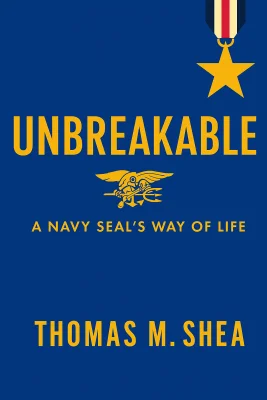
Unbreakable
A Navy SEAL's Way of Life
Categories
Nonfiction, Self Help, Memoir, Leadership, Mental Health, Military Fiction, War
Content Type
Book
Binding
Hardcover
Year
2015
Publisher
Little, Brown and Company
Language
English
ASIN
0316306517
ISBN
0316306517
ISBN13
9780316306515
File Download
PDF | EPUB
Unbreakable Plot Summary
Introduction
In the pre-dawn darkness of a military compound in Afghanistan, a Navy SEAL chief sits quietly in his makeshift room, writing what might be his final letter to his children. The walls around him bear the scars of rocket impacts, and tomorrow he will lead his men into another deadly mission. But tonight, his thoughts turn not to tactics or weapons, but to the voice inside his head—the internal dialogue that has kept him and his team alive through countless firefights and impossible odds. This is the story of Thom Shea, a veteran Navy SEAL who discovered that the difference between survival and death, between success and failure, lies not in physical strength or superior firepower, but in the mastery of one's own internal conversation. Through twenty-five years of combat, training, and leading America's elite warriors, Shea uncovered a profound truth: what we say to ourselves in our minds becomes our reality in the world. His journey from the mountains of Afghanistan to the training grounds of Coronado reveals thirteen essential lessons for developing what he calls an "Adamantine"—unbreakable—life. These lessons extend far beyond the battlefield, offering anyone facing overwhelming challenges a blueprint for transforming internal chaos into unstoppable determination.
Chapter 1: Facing Fear: The Forge of Internal Dialogue
The helicopter's ramp lowered into a wall of dust and darkness, and immediately two rocket-propelled grenades screamed through the air toward the landing zone. As Thom Shea rolled off the aircraft with his twenty-one teammates, the familiar voice in his head began its commentary: "This is going to be a long night." But instead of panic or retreat, something remarkable happened. His internal dialogue shifted from fear to focus: "This is who I am. This is what I do. My men need me, and I need them." This moment crystallized years of understanding about the power of internal dialogue—the constant stream of thoughts and self-talk that runs through every person's mind. Most people remain unconscious of this inner voice, letting it run wild with worry, doubt, and negativity. But Shea had learned to recognize and reshape his internal dialogue into a weapon more powerful than any rifle or grenade. When bullets began flying and his position came under heavy fire, his internal voice didn't scream about death or injury. Instead, it calmly assessed: "Find cover. Identify targets. Protect my men." This wasn't denial or reckless bravado—it was the deliberate cultivation of thoughts that served his mission rather than sabotaged it. The transformation didn't happen overnight. Earlier in his career, Shea's internal dialogue often worked against him, filled with self-doubt and distraction. He watched countless SEAL trainees quit not because they lacked physical capability, but because their internal dialogue convinced them they couldn't continue. "I can't do this," "This is too hard," "I'm not good enough"—these thoughts became self-fulfilling prophecies. The students who succeeded weren't necessarily stronger or faster; they were the ones who learned to reshape their internal conversation into something that pulled them forward rather than held them back. Through years of combat and training others, Shea discovered that mastering internal dialogue isn't about positive thinking or empty affirmations. It's about becoming conscious of the voice in your head and deliberately choosing thoughts that serve your goals and values. When fear arises—and it will arise—the key isn't to eliminate it but to change what you say to yourself about it. Fear becomes fuel when your internal dialogue frames challenges as opportunities to prove your character rather than threats to your survival.
Chapter 2: The Spartan Connection: Family as Warrior Strength
Miles away from the battlefield, Stacy Shea faced her own form of combat as she managed three children while her husband disappeared into the most dangerous corners of the world. The night before his deployment to Afghanistan, she looked into his eyes and saw something she'd never seen before—genuine fear. Not fear of dying, but fear of leaving his family forever. In that moment, she reached up, touched his face, and spoke words that would become his anchor through months of hell: "Thom, I need you to come back to us. Do not fear dying. It makes you weak." Those words weren't just comfort or encouragement—they were a strategic reshaping of his internal dialogue. Stacy understood intuitively what many military wives struggle to grasp: her husband's performance in combat was directly linked to the strength and clarity of their connection at home. She chose to become what ancient Spartans called the ultimate support system—a wife who didn't just endure her husband's warrior calling but actively empowered it. She studied Spartan culture and discovered that Spartan mothers and wives were renowned not for their tears and worry, but for their fierce commitment to sending their men to battle with unshakeable confidence. This wasn't about suppressing emotions or denying the reality of danger. Instead, Stacy consciously crafted her own internal dialogue to support both her family and her husband's mission. When other wives gathered to worry and complain about deployments, she chose to focus on strength and preparation. When her children asked why daddy was gone, she didn't speak of absence but of purpose: "Daddy is fighting to keep us safe. He's doing what he was born to do." Her internal dialogue became: "I am with him always, and he is with me." The power of this approach revealed itself in Shea's combat performance. During the most dangerous firefights, when exhaustion and stress threatened to overwhelm his decision-making, he would hear Stacy's voice cutting through the chaos: "Do not fear dying. It makes you weak." These words, planted in his internal dialogue through their connection, became a source of supernatural calm and clarity. He wasn't fighting just for mission success or even survival—he was fighting to return to a woman who needed and believed in him completely. The lesson extends far beyond military families. In any relationship or partnership, the internal dialogue of one person directly impacts the performance and well-being of the other. When we choose to plant seeds of strength, confidence, and purpose in our loved ones' minds rather than doubt, fear, and limitation, we become multipliers of their potential. The strongest people aren't those who face challenges alone, but those whose internal dialogue has been shaped by deep, authentic connection with others who truly need and believe in them.
Chapter 3: Pain and Purpose: Combat's Crucible
The first bullet missed Shea's head by inches, embedding itself in the ground where he lay prone behind his sniper rifle. Seven hundred yards away, an enemy sniper had him in his crosshairs, and for the next several minutes, they would engage in a deadly game of precision and patience. As fragments from the near-miss stung his face, Shea's internal dialogue didn't spiral into panic about his near-death experience. Instead, it shifted into hunter mode: "You're good, but not good enough. Now it's my turn." This moment exemplified a crucial discovery about human performance under extreme stress: pain and danger don't automatically create breakdown. Instead, they create opportunity—but only if your internal dialogue frames them correctly. As Shea adjusted his scope and calculated wind drift, his mind wasn't consumed with thoughts of death or injury. His internal conversation focused entirely on the task at hand: "Breathe. Relax. Find his position. One shot." When he finally squeezed the trigger and watched his opponent fall, the lesson was complete. The warrior who masters his internal dialogue in crisis doesn't just survive—he thrives. The path to this mastery hadn't been easy. Earlier in his career, during grueling adventure races that pushed him beyond physical limits, Shea learned that the body's breaking point comes long before the mind's—but only if the mind is properly trained. During a 700-mile race through brutal terrain, when his feet were bleeding and his body screamed for rest, his internal dialogue became his lifeline. Instead of "I can't continue," he learned to tell himself "One more mile. My team needs me. This is who I am." The transformation required years of deliberate practice. Shea noticed that failed SEAL candidates and unsuccessful adventure racers all shared one trait: their internal dialogue focused on what they couldn't do, what hurt, and what seemed impossible. The successful ones—regardless of their initial fitness level or natural talent—maintained an internal conversation focused on progress, purpose, and possibility. They didn't deny pain; they redefined it. Pain became proof of effort. Exhaustion became evidence of commitment. Obstacles became opportunities to prove character. This principle extends to any challenging situation in life. Whether facing a difficult career transition, a health crisis, or a relationship challenge, our internal dialogue determines whether we experience growth or breakdown. The question isn't whether pain and difficulty will come—they will. The question is what story we tell ourselves about that pain. When our internal dialogue frames challenges as opportunities to discover our true strength and purpose, we don't just endure—we emerge stronger, wiser, and more capable than before.
Chapter 4: Mastering Chaos: Leadership Under Fire
When the rocket-propelled grenade exploded just feet from Shea's position, showering him with debris and dust, his first thought wasn't about his own safety. His internal dialogue immediately shifted to his team: "Where are my men? Who needs help? How do we turn this chaos into victory?" As he crawled through the rubble to regroup his scattered platoon, he discovered the true nature of battlefield leadership: it's not about having all the answers, but about maintaining the right internal dialogue when everyone else is losing theirs. In the confusion following the explosion, several of his team members were calling out conflicting information. Enemy fire was coming from multiple directions, communication systems were failing, and the carefully planned mission had devolved into survival mode. But Shea had learned that in moments of maximum chaos, the leader's internal dialogue becomes the anchor point for everyone else's performance. His voice cut through the noise: "We are all alive. We know what to do. We own this battlefield." Those words weren't just commands to his men—they were declarations that shaped his own internal reality and, by extension, theirs. This understanding had developed through years of training SEAL candidates and observing what separated successful teams from failed ones. The best teams weren't those with the most talented individuals, but those whose members had learned to synchronize their internal dialogues around shared purpose and mutual support. When one team member's internal voice started spiraling toward panic or defeat, the others would recognize it and help reshape the group's collective mindset. "We need each other. We stay together. We win or lose together." The practical application went beyond mere motivation. During complex operations requiring precise coordination, Shea learned that each team member's internal dialogue directly affected their ability to process information, make decisions, and execute under pressure. A SEAL whose internal voice was consumed with fear or self-doubt would miss crucial details, hesitate at critical moments, and potentially endanger the entire mission. But a warrior whose internal dialogue focused on mission success and team unity became a force multiplier, elevating everyone's performance through his mental clarity and commitment. Leading under fire isn't just a military skill—it's a life skill that applies to any high-stakes situation. Whether managing a business crisis, navigating family challenges, or facing personal setbacks, the leader's internal dialogue sets the tone for everyone involved. When we learn to maintain thoughts focused on solutions, possibilities, and collective strength rather than problems, blame, and individual survival, we create the mental foundation for breakthrough performance even in the most challenging circumstances.
Chapter 5: Words that Shape Reality: The Power of Self-Talk
Lying in his makeshift bed after a particularly brutal firefight, Shea found his internal dialogue spinning toward darkness: "We're all going to die here. This mission is pointless. My family would be better off without me." For several minutes, he allowed these thoughts to consume him, feeling his energy and resolve drain away like water from a broken canteen. But then he remembered something crucial: these words weren't facts—they were choices. And he could choose different words. Deliberately and consciously, Shea began to reshape his internal dialogue: "I need to be here. This is who I am, and I enjoy combat. My men need me, and I need them." As he repeated these words, something remarkable happened. His body posture changed. His breathing deepened. His energy returned. The same battlefield, the same dangers, the same circumstances—but an entirely different internal reality created by consciously chosen words. This wasn't positive thinking or denial; it was the strategic deployment of language to create the mental state necessary for peak performance. The discovery had profound implications that extended far beyond combat. Shea began to notice that every successful person he'd encountered—from elite athletes to business leaders to master craftsmen—shared one trait: they had learned to control their internal dialogue rather than be controlled by it. They didn't hope for success or believe in their abilities; they spoke success into existence through the words they consistently chose to think and speak. Their internal dialogue wasn't accidental—it was architected. The contrast with unsuccessful people was striking. Those who struggled, failed, or gave up invariably used internal dialogue that worked against their goals. "I hope this works out," "I believe I can do it," "I'll try my best"—these phrases, seemingly positive, actually contained the seeds of failure. Hope implied doubt. Belief suggested uncertainty. Trying meant allowing for the possibility of not succeeding. The most powerful internal dialogue used words of knowing, commitment, and inevitable success: "I will accomplish this. I am meant to be here. This is what I do." The practical application became a cornerstone of Shea's training philosophy. He taught SEAL candidates to become conscious of their internal dialogue and to replace limiting language with empowering language. Instead of "I don't think I can make it through Hell Week," they learned to say "I am making it through Hell Week." Instead of "I hope I don't fail," they practiced "I succeed at everything I commit to fully." The words themselves became weapons against doubt, fear, and limitation. This principle transforms any area of life where language meets challenge. Whether facing a job interview, a difficult conversation, or a personal goal, the words we choose to think and speak create our reality. When we learn to consciously craft our internal dialogue using language that serves our highest aspirations rather than our deepest fears, we tap into a power that can overcome almost any obstacle or limitation.
Chapter 6: The Hungry Mind: Insatiable Drive in Combat
After five straight days of firefights, with ammunition running low and temperatures soaring above 120 degrees, any reasonable person would focus on survival and extraction. But as Shea surveyed his exhausted team and their tactical situation, his internal dialogue took an unexpected turn: "This is exactly where I want to be. We're not just surviving—we're hunting." This shift in perspective transformed what could have been a desperate situation into an opportunity for extraordinary performance. His hungry mind wasn't satisfied with merely making it through; it craved the challenge, the growth, the chance to prove what was possible when everything seemed impossible. This insatiable appetite for challenge had developed over years of deliberately seeking situations that most people would avoid. During his adventure racing career, when other competitors focused on finishing, Shea's internal dialogue drove him to find ways to win even when his body was breaking down. When training SEAL candidates, while others saw obstacles and limitations, he saw puzzles to solve and human potential to unlock. His mind wasn't just willing to engage with difficulty—it was hungry for it, treating every challenge as food for growth and mastery. The hunger manifested itself most clearly in his approach to learning and adaptation. After each mission, firefight, or training evolution, Shea's internal dialogue immediately shifted to analysis and improvement: "What worked? What didn't? What can we do better next time?" This wasn't the casual reflection of someone going through the motions, but the urgent curiosity of someone whose mind treated every experience as data for optimization. His appetite for learning was so intense that failure became fuel rather than discouragement, and success became a launching pad for greater challenges. This mental hunger created a feedback loop of continuous improvement that separated elite performers from everyone else. While most people's internal dialogue focused on comfort, safety, and avoiding difficulty, Shea had trained his mind to crave the very experiences that forge character and capability. His thoughts naturally gravitated toward harder missions, more complex problems, and greater responsibilities. The voice in his head didn't ask "How can I avoid this challenge?" but rather "How can I use this challenge to become more than I was?" The principle applies to any field where excellence matters. The most successful people aren't those who avoid difficulty, but those whose internal dialogue has developed an appetite for it. They've trained their minds to see obstacles as opportunities, setbacks as setups for comebacks, and challenges as chances to prove their character. When we cultivate this kind of mental hunger—this insatiable drive for growth and mastery—ordinary circumstances become extraordinary opportunities for breakthrough performance.
Chapter 7: Clarity Through Exhaustion: Finding Peace in Hell
In the midst of his most intense combat experience, with bullets flying overhead and explosions shaking the ground beneath him, Thom Shea experienced something unexpected: perfect clarity. As chaos raged around him, his internal dialogue simplified to its essence: "I am exactly where I need to be. This is the moment that matters. Nothing else exists." This wasn't the product of adrenaline or shock, but the result of years spent learning to find peace in the eye of any storm through mastery of his inner voice. The clarity came not despite the extreme circumstances, but because of them. When everything external was uncertain and dangerous, Shea's internal dialogue became his sanctuary—a place of absolute certainty and purpose that no external force could touch. His mind wasn't racing with worry about the future or regret about the past; it was completely present, completely focused, completely alive to the single moment at hand. This presence became a source of supernatural calm that allowed him to make life-or-death decisions with crystalline precision. This state of mind represented the culmination of everything he'd learned about internal dialogue. In the beginning, his inner voice had been chaotic, fearful, and reactive to circumstances. Through years of practice and increasingly challenging situations, he'd learned to quiet the noise and focus on what truly mattered. The battlefield became his meditation hall, combat became his prayer, and the constant threat of death became his teacher in the art of living fully present to each irreplaceable moment. The transformation had practical implications that extended far beyond combat effectiveness. Shea discovered that when internal dialogue becomes clear and purposeful, external circumstances lose their power to create internal chaos. The same mindset that brought peace in the midst of gunfire could bring clarity in the midst of family stress, business challenges, or personal setbacks. The key was learning to use his inner voice not to analyze or worry or plan, but to anchor himself completely in the present moment and its possibilities. As his combat deployment drew to a close, Shea realized he had discovered something profound about human potential. When we learn to master our internal dialogue completely—when we become conscious creators of our inner reality rather than unconscious victims of it—we can find peace anywhere, strength in any circumstance, and purpose in any situation. The voice in our head becomes not a source of limitation and fear, but a pathway to unlimited possibility and unbreakable peace.
Summary
Through the crucible of combat and the laboratory of extreme human performance, Thom Shea discovered that the difference between those who break and those who become unbreakable lies not in external circumstances, but in the mastery of internal dialogue. Whether facing enemy fire in Afghanistan or confronting the everyday battles of life, the voice in our head either becomes our greatest ally or our most dangerous enemy. The thirteen lessons embedded in his journey reveal that we all possess the power to reshape our inner conversation and, through it, reshape our entire reality. The path to an adamantine life—one that is truly unbreakable—requires the courage to become conscious of the constant stream of thoughts flowing through our minds and the discipline to deliberately craft that inner voice to serve our highest purposes. When we learn to replace fear with focus, doubt with determination, and limitation with possibility, we don't just survive life's challenges—we transform them into stepping stones toward extraordinary performance and unshakeable inner peace. The battlefield may end, but the war for mastery of our own minds continues every day, and in that ongoing campaign, victory is always within reach for those willing to take command of the voice within.
Best Quote
Review Summary
Strengths: The book offers a compelling and gritty view of a Navy SEAL's life, with valuable lessons on mastering internal dialogue and creating a positive mindset. It provides insightful life lessons drawn from the author's experiences, which are appreciated by readers. The narrative effectively conveys the brotherly philosophy of SEALs and is considered touching and memorable. Weaknesses: The writing is noted to be repetitive, with excessive focus on battle descriptions that detract from the core messages. Some readers found the explicit content inappropriate for a book intended for the author's children. The presentation style is perceived as over the top by some. Overall: The book is generally well-received for its life lessons and insights into the SEAL mindset, though its execution and content choices may not appeal to all readers. It is recommended for those interested in military life and personal development.
About Author

Thomas M. Shea
Shea delves into the intersection of special education and practical behavior management through a systems-based approach. His work, which spans over four decades, highlights the importance of addressing educational challenges in real-world classroom settings rather than relying on theoretical abstractions. By collaborating with co-authors and focusing on inclusive learning systems, Shea has developed frameworks that integrate parents, teachers, and communities in supporting students with exceptional needs and behavioral challenges. This focus is evident in his book "Behavior Management: A Practical Approach for Educators," which offers actionable strategies for educators to implement in diverse educational contexts.\n\nThroughout his career, Shea's literary contributions have emphasized family-school collaboration and social systems perspectives in special education. His books, including "Learners With Disabilities: A Social Systems Perspective of Special Education," showcase methods that benefit educators and families by promoting collaborative engagement. Readers who are educators, school administrators, and family members of students with disabilities can find value in Shea’s work, as it equips them with the tools needed to foster a more inclusive and supportive educational environment.\n\nShea's influence extends beyond English-speaking audiences, as some of his works have been translated into Spanish, broadening their reach and impact. This accessibility, along with his substantial ratings and reviews on platforms like Goodreads, underscores the continued relevance and application of his ideas within educational circles. The author’s commitment to practical educational approaches and the integration of diverse community members into the learning process makes his bio a noteworthy exploration of effective special education practices.
Read moreDownload PDF & EPUB
To save this Black List summary for later, download the free PDF and EPUB. You can print it out, or read offline at your convenience.
Unbreakable
by Thomas M. Shea
