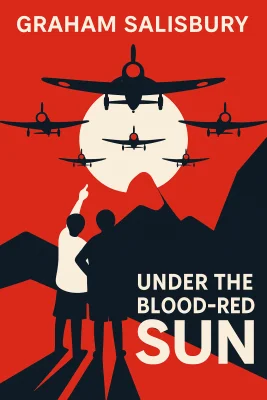
Under the Blood-Red Sun
Categories
Fiction, Historical Fiction, Young Adult, School, Historical, World War II, Adventure, Childrens, War, Middle Grade
Content Type
Book
Binding
Paperback
Year
2004
Publisher
Laurel Leaf, Paperback(2005)
Language
English
ASIN
B0073G99OW
ISBN
0553494872
ISBN13
9780553494877
File Download
PDF | EPUB
Under the Blood-Red Sun Plot Summary
Introduction
The morning sun painted Honolulu harbor silver when thirteen-year-old Tomi Nakaji first heard his grandfather singing the Japanese national anthem while waving the Rising Sun flag in their backyard. It was September 1941, three months before Pearl Harbor would burn, and the old man's defiant display of heritage would soon become a death sentence. Living on the Wilson estate where his mother worked as a maid, Tomi straddled two worlds—the American one where he played baseball with his haole friend Billy Davis, and the Japanese one where his issei grandfather preserved ancient traditions like the family katana hidden beneath Tomi's bed. But on December 7th, when amber planes with blood-red suns screamed overhead and turned the peaceful island into a war zone, those two worlds would collide with devastating force. In a single morning, everything Tomi knew would be stripped away—his father's fishing boat, his grandfather's pigeons, and finally the men themselves, swept up in the fear and fury that followed Pearl Harbor. What remained was a boy caught between shame and pride, forced to protect his family's honor while America questioned the loyalty of every Japanese face.
Chapter 1: Peaceful Days: Baseball, Pigeons, and Family Traditions
The trouble began when Grampa Joji decided to air his precious Japanese flag on the clothesline for the whole world to see. Tomi rushed home from baseball practice with Billy Davis, his haole friend, to find the massive red sun banner flapping in the breeze like a declaration of war. "Take that thing down!" Tomi shouted, his heart racing. "What if somebody sees it?" Grampa stood proud before his flag, his bald head gleaming in the afternoon sun. "You Japanee!" he scolded in his broken English. "Japanee inside. Like me, like Papa." But this wasn't Japan—this was Nu'uanu Valley in 1941, where tensions already simmered between races, where Mama worked as a maid for the Wilson family just to keep their small house on the estate. When Mama emerged from the house, she understood immediately. The flag could cost them everything—their home, her job, their place in this delicate world. She snatched the dripping cloth and dragged it inside while Grampa glared with wounded pride. He was issei, first-generation immigrant, carrying Japan in his bones even as his family tried to become American. Down in the peaceful field Tomi called diamond grass, he and Billy practiced curveballs while Papa's racing pigeons circled overhead. The birds were Papa's passion, trained to fly home across vast stretches of ocean. Grampa tended his prized chickens, selling eggs to make ends meet. These were the rhythms of their life—baseball and birds, work and tradition, the careful balance of fitting in while honoring the past. But even in those golden September days, shadows gathered. Keet Wilson, the landlord's son who had once been Tomi's friend, now stalked the property with his .22 rifle and growing hatred. Billy's brother Jake whispered about war in Europe, about German submarines attacking American ships. And in the harbor below, Papa worked his sampan the Taiyo Maru with his young helper Sanji, unaware that their peaceful fishing grounds would soon become a battlefield.
Chapter 2: The Day Everything Changed: Pearl Harbor Under Attack
December 7th dawned clear and still, perfect for baseball. Tomi and Billy met at diamond grass as always, but their game shattered when the first planes screamed overhead—amber fighters with blood-red suns diving toward Pearl Harbor. The earth shook with explosions as black smoke billowed from the naval base, transforming their paradise into hell. From the banyan tree lookout, the boys watched in horror as wave after wave of Japanese planes strafed the harbor. Ships burst into flames, planes spiraled into the sea trailing smoke, and the peaceful morning dissolved into chaos. "My God," Billy whispered as they clung to the swaying branches. "This is for real!" Then Grampa came running from the house, his Japanese flag clutched in trembling hands. As another Zero banked overhead, the old man frantically waved his banner, crying out in terror, "He no bomb, he no bomb! He see flag, he no bomb!" The pilot wagged his wings in acknowledgment before racing back toward the burning harbor. Tomi's blood turned to ice—if anyone had seen that exchange, they were all dead. The attack lasted through the morning, punctuated by strafing runs that sent machine gun bullets chewing through the valley. When silence finally fell, an ugly pall of smoke hung over the island like a funeral shroud. The radio crackled with emergency broadcasts: martial law declared, civilians ordered off the streets, rumors of invasion spreading like wildfire. At sunset, Honolulu went dark, the blackout turning their tropical home into a fortress under siege. That night, as jackhammers rattled in the cemetery digging mass graves for Pearl Harbor's dead, Tomi lay awake listening to his family's world crack apart. By morning, they knew Sanji was dead, shot from the sky by American planes that couldn't tell friend from foe. Papa was wounded, his boat sinking in the harbor. And somewhere in the darkness, men were making lists—lists of Japanese names, lists of people who would soon disappear.
Chapter 3: Aftermath: Suspicion, Loss, and Shattered Lives
Three days after Pearl Harbor, they came for the pigeons. The army officer was stone-faced, flanked by two policemen as he delivered the verdict: "Someone reported that you kept messenger pigeons. How long have you been sending messages to the enemy?" Mama gasped, covering her mouth as the accusation hit home. Tomi's beloved racing birds—Papa's pride and joy—branded as instruments of treason. The destruction was swift and merciless. One by one, Tomi and Grampa lifted the gentle birds from their lofts and slit their throats with Papa's razor-sharp fishing knives. Thirty-five pigeons died that morning, their blood turning the wet grass crimson while the soldiers watched impassively. The birds had no chance, no voice—they simply had to take it, just like the families now being torn apart across the island. Within days, the FBI came for Papa. Tomi watched through the kitchen window as they dragged his wounded father away in chains, his leg still bandaged from the strafing attack. The official charge was nebulous—potential sabotage, possible collaboration. The real crime was being Japanese in a world suddenly painted in black and white, where fear erased forty years of island life in a single morning. Mama worked frantically to erase their Japanese identity, burying letters and photographs, hiding Grandma's shrine, scrubbing away any trace that might bring more suspicion. Mrs. Wilson fired her without explanation. Neighbors who had smiled for years now crossed streets to avoid them. At the grocery store, Tomi felt hostile eyes tracking his movements, heard the whispered word that had become a curse: "Jap." Young Keet Wilson began stalking their property with renewed venom, his rifle gleaming as he shouted taunts about "messenger birds" and "Jap sympathizers." The golden days of baseball and friendship seemed like another lifetime, buried beneath the weight of war and racial hatred. But worse was yet to come—Papa was only the first to disappear into America's growing network of detention camps.
Chapter 4: The Search: A Dangerous Journey to Find Father
The voice in Tomi's head grew louder each day: "Go now. Find Papa before it's too late." Unable to bear the uncertainty, he slipped away one gray morning and walked to Honolulu harbor, where barbed wire now coiled like metallic serpents around every pier. Armed guards blocked the approaches to Sand Island, that flat spit of land where rumors placed the Japanese prisoners. The harbor had transformed into a fortress. Military convoys rumbled past while soldiers with dead eyes checked identification cards. But from his hiding place beneath a concrete bridge, Tomi spotted his opportunity—no barbed wire on the near shore, rain beginning to fall, visibility dropping. The swim looked impossible until desperation made it necessary. The oily water was warm but treacherous, tasting of fuel and fear. Halfway across, exhaustion nearly dragged him under, but the thought of Papa's wounded leg kept his arms moving. He crawled onto Sand Island's beach like some primitive creature, then belly-crawled through kiawe scrub toward the prison camp that materialized through the mist—neat rows of tents behind double fences, surrounded by empty sand. When the prisoners emerged from their mess hall, Tomi's heart nearly burst. There was Papa, limping with a makeshift cane, his proud shoulders bent by captivity. Their eyes met across the impossible distance of wire and fear, and Papa's silent command was clear: "Stay hidden. Don't move. Don't breathe." For hours they maintained that desperate vigil, father and son separated by fifty feet that might as well have been an ocean. As darkness fell, Tomi began the return swim, his body screaming with exhaustion. A tugboat's churning wake nearly dragged him under, its massive propeller missing him by inches. He made it to shore more dead than alive, only to be captured by military police who could have shot him as a saboteur. Instead, they drove him home in their jeep, delivering him to a family already shattered by too much loss.
Chapter 5: Holding Fast: Protecting Family Legacy and Identity
The arrest of Grampa Joji came without warning on a cold February morning. Two FBI agents materialized like death itself, dragging the old man from his chickens while he gasped desperate instructions in Japanese: "Katana o mamore! Nakaji no namae o mamore!"—Protect the sword! Protect the Nakaji name! As they shoved him into their black sedan, Tomi understood that the family's three-hundred-year-old samurai sword was now his responsibility. Hidden deep in the jungle, wrapped in silk and buried in a rotting log, the katana represented everything the FBI sought to destroy—honor, heritage, the unbroken chain connecting past to future. Charlie, the Hawaiian groundskeeper who was Grampa's closest friend, led Tomi to the hiding place with tears in his eyes. "That thing was very important to him," Charlie whispered. "His history... your history, Tomi." The blade gleamed like captured lightning when Tomi unwrapped it, feeling the weight of generations in his hands. Every Nakaji male had held this steel, had sworn to protect the family honor it embodied. Now that burden fell to a thirteen-year-old boy whose world was collapsing around him. But the katana's presence was a promise—as long as it survived, so did they. Keet Wilson discovered the secret during one of his stalking expeditions, cornering Tomi in the jungle clearing with his rifle raised. "Drop that thing," he snarled, jealous fury twisting his features. When Tomi refused to surrender the blade, Keet shot at it, the bullet nicking the ancient handle. But something had changed in Tomi's eyes, something that made even Keet step back. "You're not going to tell anyone about this sword," Tomi said quietly. "You're not that stupid." That night, Tomi oiled the blade and wrapped it carefully, then told five-year-old Kimi about their ancestors, about honor and sacrifice, about why some things were worth protecting even when the world demanded surrender. The little girl listened with solemn eyes, understanding that she too was now a guardian of something precious and endangered—the knowledge of who they were beneath America's suspicious gaze.
Chapter 6: Continuing Forward: Finding Strength in Friends and Family
School reopened in February, and Tomi discovered that the Rats—his baseball team of misfit friends—had endured their own trials. Mose and Rico Corteles, the Portuguese cousins, had watched FBI raids sweep through their Kaka'ako neighborhood. Billy Davis faced pressure from his father to transfer to the white private school, Punahou. But they remained loyal to each other and to Roosevelt High, where their teacher Mr. Ramos spoke passionately about freedom and the power to make choices. "Power is freedom to make our own choices," Mr. Ramos explained to his depleted class. "There are people in this world who would take that freedom away, who want to control every decision you make. That's why we fight wars—to protect the right to live as we choose." His words carried special weight for Tomi, whose father and grandfather had been stripped of every choice, reduced to numbers in a detention system built on suspicion and fear. On weekends, Tomi worked in the pineapple fields, sending every penny home to keep the family afloat. Mama returned to work for Mrs. Wilson, who had quietly overcome her fears thanks to intervention from the Davis family. The small kindnesses mattered—a can of kerosene, meat scraps, the simple human decency that survived when hatred seemed to rule the island. The Rats played one final baseball game against their rivals, the Kaka'ako Boys, on New Year's Day 1942. It was a battle between friends who understood they might never meet again on such neutral ground. The game turned into something larger than sport—a declaration that joy and friendship could survive even in wartime, that the bonds between young men transcended the artificial divisions that adults had created. When they won on Tough Boy's dramatic home run, the victory felt hollow and precious simultaneously. These might be their last carefree moments before the war claimed them all. But for now, walking through the gentle Hawaiian rain that Billy said meant heaven's approval, the Rats were still together, still young, still believing in tomorrow despite everything the world had thrown at them.
Chapter 7: The Long Wait: Hope in the Shadow of War
A postcard arrived in March, censored and mysterious, bearing Papa's careful words: "Do not worry about me. This is all a mistake that will be corrected soon." But by then everyone knew the truth—the "mistakes" were being shipped to camps on the mainland, to places like Crystal City, Texas, where Japanese Americans disappeared behind barbed wire and silence. Mr. Davis used his connections to confirm Papa's location, but could offer no hope for his return. The family adapted with the stoic grace that had carried them across oceans and generations. Kimi learned to cook rice and tend chickens, her small hands gathering eggs that might buy another day's survival. Mama worked with quiet dignity, accepting Mrs. Wilson's kindness without losing her pride. And Tomi grew into responsibilities no child should bear, selling eggs, working fields, becoming the man of a family scattered across continents. Visits to Sanji's widow and little Mari became sacred duties, connections to their shattered fishing community. Billy's gift of binoculars to the orphaned girl was a gesture that transcended racial barriers, proof that humanity could survive even war's poisonous influence. When Reiko wept with gratitude for a simple can of kerosene, Tomi understood how quickly the prosperous could become desperate, how thin the line between security and catastrophe. The katana remained hidden, oiled and protected, waiting for Grampa's return. Three pigeons came back to their abandoned lofts, and Tomi fed them secretly, knowing they represented continuity with a time when the sky held promise instead of threats. Lucky, their beagle, had puppies—Red for Billy, Azuki Bean for Kimi—small lives bringing hope to a household defined by absence. Spring brought rumors of Japanese American soldiers fighting and dying for America in Europe, their families still imprisoned behind wire. The irony was bitter but somehow reassuring—if men could die for a country that doubted their loyalty, perhaps redemption was possible. Perhaps the mistakes would indeed be corrected, though not soon enough for the generation that had sacrificed everything on the altar of wartime fear.
Summary
As 1942 bloomed into another Hawaiian summer, Tomi Nakaji had learned truths no thirteen-year-old should know. He had watched fear transform neighbors into enemies, seen loyalty rewarded with suspicion, and discovered that honor sometimes required standing alone against an entire world's mistrust. The family katana remained hidden, its blade still sharp, waiting for hands that might never return to claim it. Papa and Grampa had become numbers in a system built on prejudice and panic, their letters filtered through censors who saw only potential threats in words of love. Yet something unbreakable survived in that small house on the Wilson estate. Mama's quiet strength, Kimi's innocent determination, the friendship of the Rats who refused to let hatred divide them—these became Tomi's inheritance, more precious than any samurai sword. He had learned that true honor lay not in ancient steel but in daily choices: caring for Lucky's puppies, protecting his sister's dreams, maintaining dignity when the world demanded shame. The America that had failed his family was also the America of Billy Davis and Mr. Ramos, of Mrs. Wilson's grudging kindness and Charlie's unwavering friendship. When the war finally ended three long years later, not all the prisoners would return. Many had died behind wire, their dreams buried in foreign soil. But those who survived carried home more than bitter memories—they carried the knowledge that they had endured, that love had proven stronger than hate, that the next generation would inherit not shame but a deeper understanding of what it meant to be American. In the gentle morning light of diamond grass, where young men still played baseball and pigeons traced ancient paths across endless sky, the future remained unwritten, bright with possibility.
Best Quote
Review Summary
Strengths: The book is praised for its captivating narrative, well-written prose, and the portrayal of a significant historical perspective through the eyes of a Japanese-American boy, Tomi. The interactions between characters and the depiction of cultural dynamics in Oahu are highlighted positively. The inclusion of baseball as a thematic element is appreciated for its role in providing hope and distraction. Weaknesses: The review notes a lengthy introduction that delays the story's progression. Additionally, the treatment of Japanese-Americans post-Pearl Harbor and the character Keet Wilson's behavior are criticized. Overall: The reader finds the book entertaining and educational, particularly for those interested in history, despite some pacing issues. It is recommended for its unique perspective on WWII events.
About Author

Graham Salisbury
Salisbury navigates the complexities of growing up through his deeply evocative storytelling. His books, particularly the well-regarded "Under the Blood Red Sun", delve into themes of cultural identity and historical memory, focusing on the experiences of Japanese-Americans during World War II. Salisbury’s work is inspired by his own life experiences, having grown up on the Hawaiian islands of Oahu and Hawaii, and his drive to address issues such as racial tensions and fatherlessness stems from a genuine desire to reach young readers facing hardships. \n\nIn his writing process, Salisbury emphasizes exploration over instruction, allowing readers to witness characters as they confront and choose various life paths. His narrative approach is both accessible and profoundly informed by meticulous research and oral histories, providing a rich cultural tapestry for young readers to engage with. Salisbury’s historical novels, like "Blue Skin of the Sea", and the Calvin Coconut children’s series, bring Hawaiian culture vividly to life, offering readers insights into diverse legacies and moral complexities.\n\nSalisbury's contributions have not gone unnoticed; he has received numerous awards, including the Scott O’Dell Award for Historical Fiction and the PEN/Norma Klein Award. These accolades underscore the impact of his work in the literary field, particularly in creating narratives that resonate with and educate young readers. Through his books, Salisbury provides a valuable platform for exploring identity and ethical decision-making, ensuring his stories remain both impactful and enlightening.
Read moreDownload PDF & EPUB
To save this Black List summary for later, download the free PDF and EPUB. You can print it out, or read offline at your convenience.
Under the Blood-Red Sun
by Graham Salisbury
