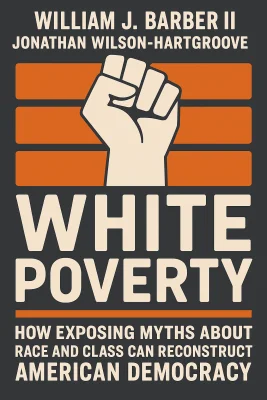
White Poverty
How Exposing Myths About Race and Class Can Reconstruct American Democracy
Categories
Nonfiction, History, Economics, Politics, Audiobook, Sociology, Social Justice, American History, Social Issues, Race
Content Type
Book
Binding
Hardcover
Year
2024
Publisher
Liveright
Language
English
ISBN13
9781324094876
File Download
PDF | EPUB
White Poverty Plot Summary
Introduction
In a small church nestled in the mountains of North Carolina, something extraordinary happened that would challenge everything we thought we knew about poverty in America. A room full of white residents, many who had never before engaged in civil rights activism, stood up to join hands with their Black neighbors in singing "Blessed Be the Tie That Binds." These weren't the usual suspects of progressive politics, but ordinary folks who had been struggling to make ends meet, watching their communities hollow out as factories closed and opportunities disappeared. What brought them together wasn't ideology but a shared recognition that the system wasn't working for any of them. This moment captures the heart of a profound truth that has been hidden in plain sight across America. While political narratives and media coverage have long portrayed poverty as primarily affecting communities of color, the reality is startling: the largest group of poor Americans is white. This isn't to diminish the disproportionate impact of poverty on Black, brown, and Native communities, but rather to reveal how the myths surrounding poverty have kept potential allies divided and the crisis itself invisible. When we face this hidden reality, we discover not just the scope of America's inequality, but also the potential for building the kind of broad coalition necessary to address it. The path forward requires us to see beyond the artificial divisions that have kept us apart and recognize the common ground that could unite us in creating an economy that works for everyone.
Chapter 1: The Moral Fusion Movement: Breaking Down Racial Divides
The summer of 2013 in North Carolina brought something unprecedented to the state capitol. Every Monday, an increasingly diverse crowd gathered on the steps of the statehouse in Raleigh, their voices rising in protest against policies that seemed designed to hurt the most vulnerable. What started as seventeen arrests grew into a movement that would see nearly a thousand people willingly go to jail over the course of that sweltering summer. These weren't professional activists or political operatives, but ordinary citizens who had reached a breaking point. Among them were doctors in white coats standing beside patients in wheelchairs, all united in their opposition to the legislature's refusal to expand Medicaid. There were teachers and preachers, students and seniors, Black and white and Latino faces forming a mosaic of North Carolina's people. The power of these Moral Mondays wasn't just in their numbers, but in their diversity. When a middle-aged white woman took the microphone to share that her son Mike had died of cancer because he couldn't get a colonoscopy without health insurance, her tears were met with knowing nods from across the racial spectrum. Her pain wasn't unique to her race or class, but part of a larger pattern of policy violence that touched families throughout the state. As she wiped her glasses and declared, "They talk about my son like it was his fault," the crowd understood that the shame of poverty and the denial of basic healthcare wasn't limited by color lines. This fusion of voices created something powerful enough to challenge the old stories that keep people divided. When the movement took its message to the mountains of Western North Carolina, they encountered white residents who had been abandoned by the very politicians who claimed to represent their values. In Mitchell County, an all-white crowd listened as their neighbors explained how the same policies hurting Black communities in Charlotte were devastating white families in the hollers. A lifelong Republican rose to say he was resigning from the party because the Tea Party wasn't the party of Abraham Lincoln he believed in. These mountain folks weren't looking for handouts, but they recognized that small farms and rural schools couldn't survive the budget cuts being imposed in the name of fiscal responsibility. The magic happened when people realized they had been pitted against each other by forces that didn't serve any of them. The woman who organized food drives for struggling families understood that the Black mother working two jobs in the city faced the same impossible choices she did. The white coal miner who had lost his pension recognized his struggle in the story of the Black sanitation worker fighting for dignity and fair wages. This wasn't about ignoring race or pretending racism doesn't exist, but about seeing how the systems of oppression work to keep all poor people down while the wealthy accumulate more power and resources. The moral fusion movement revealed that when people come together across racial lines to demand policies that lift everyone up, they become an unstoppable force for change.
Chapter 2: Myths That Blind: How Poverty Became Racialized
The images that flash across television screens when poverty makes the news tell a story that has shaped American consciousness for decades. A Black woman with children waiting in line for assistance. A family of color in substandard housing. These pictures, repeated countless times, have created a mental shorthand that equates poverty with Blackness in the American imagination. But this association isn't accidental or natural, it's the result of a deliberate campaign to reshape how Americans think about economic hardship and government assistance. The transformation began in the aftermath of the Civil Rights Movement, precisely when federal programs were being expanded to include everyone regardless of race. During the Great Depression, the face of American poverty was overwhelmingly white. Dorothea Lange's famous photograph "Migrant Mother" captured the struggles of a white woman trying to feed her children, and it became the iconic image of economic hardship in America. When Franklin Roosevelt spoke about "one-third of a nation ill-housed, ill-clad, and ill-nourished," the faces Americans pictured were predominantly white. Government programs designed to lift people out of poverty were seen as helping "real Americans" through temporary hard times. There was dignity in struggle, and assistance was viewed as a hand up for deserving families who had fallen on tough times through no fault of their own. The shift began in earnest with the presidential campaigns of Ronald Reagan, who popularized the story of a "welfare queen" in Chicago who supposedly drove a Cadillac to pick up her government benefits. This mythical figure, loosely based on an actual case of fraud that was prosecuted by the government, became a powerful symbol that transformed public perception of anti-poverty programs. Suddenly, government assistance wasn't about helping struggling families, but about enabling fraud and dependency among people who were supposedly gaming the system. The welfare queen was always portrayed as Black, and her story suggested that poverty programs were really about taking money from hardworking white families and giving it to undeserving Black people who were too lazy to work. This racialization of poverty served a dual purpose: it made it politically easier to cut programs that actually helped millions of white Americans, while simultaneously providing white voters with someone to blame for their own economic struggles. Instead of recognizing that deindustrialization, union-busting, and wage stagnation were policy choices that hurt workers of all races, white families were encouraged to see their Black neighbors as the source of their problems. Meanwhile, the reality that white Americans make up the largest group of people receiving government assistance was carefully hidden from view. Food stamps, Medicaid, Social Security disability, and housing assistance all serve more white Americans than Black Americans in raw numbers, but these facts don't fit the story that has been told for decades. By making poverty appear to be a "Black issue," politicians could gut the social safety net while maintaining the support of white voters who didn't realize they were voting against their own interests and often their own survival.
Chapter 3: The Wounds of White Poverty: Stories from the Forgotten
In a small Episcopal church in the hills of Eastern Kentucky, a young woman named Lakin stood before a mixed crowd of Black and white neighbors and began to share her story. Her voice trembled as she described growing up in a community where fear was passed down like a family heirloom. Fear of Black people, fear of immigrants, fear of anyone who didn't fit the narrow definition of what was acceptable. When Lakin realized she was gay, she discovered that the same hatred her family directed at others would now be turned on her. Despite working three minimum-wage jobs to put herself through college, she found herself homeless at times, sleeping in her car while her family treated her like a stranger. The contradiction was heartbreaking: these were people she loved and respected for their hard work and resilience, yet their fears had turned them against their own daughter. As Lakin spoke about collecting rainwater to boil for drinking when her father lost his construction job to addiction and despair, the room fell silent. Here was white poverty in its raw reality, stripped of political talking points and cultural stereotypes. Her family's struggles with unemployment, addiction, and shame were compounded by an isolation that made their pain feel like personal failure rather than systemic breakdown. Unlike communities of color that have developed cultural and spiritual resources to resist narratives of blame and inadequacy, many poor white communities have internalized the bootstrap mythology that tells them their suffering is their own fault. The wounds of white poverty run deep because they're inflicted in silence and shame. In Binghamton, New York, a middle-aged white woman described her earliest memory of being placed in foster care when her mother couldn't afford to keep her, receiving only a small doll with everything it needed to stay clean while her real family was torn apart by forces beyond their control. Years later, after raising four children while sometimes scavenging in dumpsters for food, she was finally diagnosed with PTSD. Her trauma wasn't from war or natural disaster, but from the daily stress of trying to survive in an economy that treated her as expendable while demanding everything she had to give. These individual stories reflect a larger pattern of policy violence that kills roughly 800 Americans every day, making poverty the fourth leading cause of death in the nation. The wounds speak of systematic abandonment by politicians who promise to represent working families while serving corporate interests that profit from low wages and weak social programs. They reveal how the same economic forces that devastate Black communities in urban centers also hollow out white communities in rural areas, creating deaths of despair through suicide, overdose, and stress-related illness. When we listen carefully to these wounds, they tell us that the crisis of poverty in America can't be solved by helping one group at the expense of another. The system that crushes poor white people is the same one that crushes everyone else, and healing requires us to come together rather than compete for scraps from an economy designed to concentrate wealth at the top while leaving the majority of Americans struggling to survive.
Chapter 4: Healthcare and Dignity: The Pungo Hospital Crisis
The small waterfront hospital in Belhaven, North Carolina had been the heartbeat of three rural counties for generations. Pungo Hospital wasn't just where babies were born and emergencies were treated, it was a symbol of the community's commitment to taking care of its own. So when word came that the hospital would be closing, it felt like a death sentence for the entire region. The nearest emergency room would be an hour away for some residents, a distance that could mean the difference between life and death for someone having a heart attack or stroke. Mayor Adam O'Neal, a stocky Republican who believed in family values and economic freedom, found himself in the unusual position of calling a Black preacher and civil rights leader for help. The partnership between Mayor O'Neal and the NAACP might have seemed unlikely to outside observers, but it made perfect sense to anyone who understood what was really at stake. The hospital's closure wasn't about market forces or economic efficiency, it was the direct result of political decisions made in the state capital. When Congress passed the Affordable Care Act, they planned for critical access hospitals like Pungo to receive funding through Medicaid expansion. But when Tea Party politicians branded the program "Obamacare" and refused to accept federal dollars, they effectively cut off the lifeline that kept rural hospitals operating. The vast majority of the half-million North Carolinians who were denied health coverage were white, but the political rhetoric made it sound like Medicaid expansion was a giveaway to undeserving Black families. Within days of the hospital's closure, the policy became personal in the most tragic way. Portia Gibbs, a 48-year-old white woman from Hyde County, was working in her yard with her husband when she began to feel unwell. What should have been a quick trip to the local emergency room became a desperate wait for a helicopter in a high school parking lot. The emergency medical workers did everything they could, but without a hospital nearby, there was no way to provide the immediate cardiac care that might have saved her life. Portia Gibbs became the first documented victim of a political decision that prioritized ideology over human life. The community's response to Portia's death revealed something powerful about the potential for moral fusion across racial lines. Her husband Barry joined a march from Belhaven to Washington D.C., walking 300 miles in the summer heat alongside Black and white neighbors who refused to let her death be forgotten. They weren't interested in partisan politics or abstract debates about healthcare policy. They understood that when politicians are willing to let people die to make a political point, those politicians have abandoned their basic responsibility to govern. The march wasn't just about saving rural hospitals, it was about declaring that policy murder was unacceptable regardless of who was being killed. Portia Gibbs's story became a powerful example of how the violence of extreme policies crosses racial lines, and how the fight for healthcare as a human right requires coalitions that refuse to be divided by the artificial boundaries of race and party. Her memory became a rallying cry for everyone who believed that in the richest nation in the history of the world, no one should die for lack of medical care.
Chapter 5: Poor People as Swing Voters: Building Political Power
In the aftermath of the 2016 election, political pundits spent countless hours analyzing the motivations of white working-class voters who had supposedly delivered victory to Donald Trump. But when the actual data was examined, a different picture emerged. Trump had won every income bracket above $50,000, while losing every bracket below that threshold by significant margins. The narrative about economically anxious white voters driving political change was based more on assumption than evidence. The real story was that poor people of all races had been abandoned by a political system that offered them no meaningful representation, leaving many to opt out of electoral participation entirely. This revelation pointed toward an enormous opportunity that most political strategists were missing. In almost every election, the largest group of eligible Americans is not Republicans or Democrats, but people who don't vote. And when researchers studied the demographics and motivations of non-voters, they found that the majority are poor or low-income people who feel disconnected from a political process that never speaks to their daily struggles. These aren't people who are satisfied with the status quo, they're people who have given up hope that electoral politics can make their lives better. But if a movement could reach them with a message that addressed their real concerns and offered concrete solutions, they represented the largest untapped political force in the country. The potential power of poor voters became clear during the 2019 Kentucky gubernatorial race, when Republican Governor Matt Bevin seemed poised for reelection despite his deep unpopularity. Bevin had embraced austerity policies that hurt poor communities across the state, but Kentucky had voted for Trump by 30 points just three years earlier, suggesting that partisan loyalty might overcome policy disagreements. Instead of accepting conventional wisdom, organizers with the Poor People's Campaign decided to test whether direct conversations about moral issues could mobilize new voters. They trained people from poor communities to talk to their neighbors about what was at stake, not in partisan terms, but in human terms. The results were stunning. Turnout increased by nearly 14 percentage points statewide, with some rural counties seeing increases of 17 percent. These weren't the usual Democratic strongholds, but areas that had been written off as solidly Republican. Poor white voters who had been told that their struggles were caused by immigrants or welfare recipients began to see through these divide-and-conquer tactics when their neighbors explained how the same policies affected everyone trying to get by on low wages. The increased turnout was enough to give Democrat Andy Beshear a narrow victory, and his election night speech echoed the moral language that had motivated the campaign: "Elections don't have to be about right versus left; they are still about right versus wrong." The Kentucky race proved that when poor people vote, they don't vote for politicians who blame them for their problems. They vote for leaders who promise to address the real sources of their struggles, and they're powerful enough to change the outcome when they show up in sufficient numbers.
Chapter 6: Lifting from the Bottom: Economic Justice for All
When President Biden won the 2020 election with a promise to "build back better," organizers who had spent years mobilizing poor communities knew that the language of reconstruction had to be backed up by policies that actually lifted people up. The lesson from rural construction work is simple: if you're going to move a building to higher ground, you have to start by getting underneath the foundation and lifting from the bottom. Try to lift from the top and you'll pull the roof off. Try to wrap something around the middle and the whole structure will crack apart. But lift from the bottom and the entire building rises together. This became the central metaphor for what economic justice would require in the aftermath of a pandemic that had exposed just how precarious life had become for most Americans. The invitation to deliver the inaugural sermon gave an opportunity to speak directly to the new administration about what lifting from the bottom would mean in practice. Standing in an empty sanctuary while the president and vice president watched from the White House, the message was clear: unity couldn't be achieved through compromise with those who wanted to maintain systems of oppression, but only through policies that addressed the root causes of division. The prophet Isaiah's vision of being "repairers of the breach" required more than good intentions, it demanded concrete action to "loose the chains of injustice" by paying people living wages and ensuring that everyone had access to basic necessities. But the gap between campaign promises and governing reality became apparent when key Democratic senators began backing away from commitments to raise the federal minimum wage and protect voting rights. Senator Joe Manchin from West Virginia, who had once expressed support for poor people in his state, now seemed more concerned with maintaining bipartisan relationships than delivering on promises made to constituents. When Pam Garrison, a straight-talking mountain woman who had spent her life rolling change to get gas money for minimum-wage jobs, confronted Manchin directly, she made the stakes crystal clear: "This is supposed to be a rescue package. Well, you can't take the biggest part of the rescue out." The betrayal by moderate Democrats revealed something important about the nature of political change. It's not enough to elect politicians who say the right things during campaigns; they have to be held accountable through sustained organizing pressure once they're in office. When Manchin and Senator Kyrsten Sinema from Arizona refused to override Republican obstruction of voting rights legislation, they were essentially telling millions of Americans that their voices didn't matter. The response had to be direct action that exposed the extremism of blocking policies that overwhelming majorities of Americans support. Walking from the Supreme Court to Manchin's office with a diverse crowd singing about stolen wages and stolen votes, the message was clear: accepting unnecessary suffering is no longer an option. When politicians choose to protect corporate interests over human needs, they're not being moderate or bipartisan, they're being complicit in a system that treats poor people as expendable. Real unity comes through policies that lift everyone up, not through compromise that leaves the most vulnerable behind.
Chapter 7: Rediscovering the Ties That Bind Us: Toward a Third Reconstruction
The story that shaped everything began in the tobacco fields of eastern North Carolina, where a great-grandmother named Keyes worked alongside Black and white neighbors during harvest season. These weren't strangers thrown together by economic necessity, but extended family members who had chosen each other as community across generations. When a young white man called her "Auntie," it wasn't a term of disrespect from the plantation era, but recognition of actual kinship. These relationships had survived Jim Crow segregation, economic hardship, and all the forces that tried to divide people by race. They represented the deeper truth of American identity: we are already a fusion nation, connected by bonds that run deeper than the political narratives that try to separate us. This reality of interconnection gets obscured by myths that tell us we're hopelessly divided, but the evidence of fusion is everywhere for those who have eyes to see. At Niagara Falls, watching the enormous power of water that begins as countless separate streams and springs, the metaphor became clear. Watershed moments in American history happen when all those individual tributaries of struggle and hope come together in one place with enough force to change the landscape. The Montgomery Bus Boycott was such a moment, bringing together years of resistance and organizing into a movement that could challenge Jim Crow. The current uprising for racial and economic justice represents another watershed, with streams of activism flowing together from every corner of the nation. From the hollers of Appalachia to the streets of major cities, poor people are refusing to be divided by the old stories that pit them against each other. In Buffalo, young Starbucks workers of every race are building unions not just to improve their own conditions, but to demonstrate that collective action works. In West Virginia, white mothers who have been told that Black people are their enemies are standing up to say they're tired of politicians who ignore their real needs while stoking cultural divisions. These individual acts of courage are creating the conditions for larger change, like tributaries feeding into a river that becomes powerful enough to carve new channels through the landscape. The mathematics of social change are encouraging: research shows that when just 3.5 percent of a population becomes actively engaged in sustained resistance, entire systems can be transformed. This isn't about converting everyone or waiting for a majority to wake up, but about building a committed core of people who refuse to accept that things have to stay the way they are. The spiritual principle is like Bernoulli's effect in physics, where accelerating flow creates a vacuum that pulls everything forward. When moral fusion movements accelerate toward justice, they create a force that can pull the whole society toward higher ground, even against the headwinds of opposition. The ties that bind us are stronger than the forces trying to divide us, but only when we choose to honor those connections and build upon them rather than let fear and resentment tear them apart.
Summary
The revelation that white Americans make up the largest group of poor people in the nation isn't meant to diminish the struggles of communities of color, but to expose how deliberately crafted myths have kept potential allies divided while an economic elite extracts wealth from everyone else. From the mountains of Appalachia to the streets of major cities, the stories are remarkably similar: working families who can't make ends meet despite doing everything right, communities abandoned by politicians who claim to represent them, and people discovering that their supposed enemies face the same impossible choices they do. These aren't isolated problems requiring individual solutions, but symptoms of policy choices that concentrate wealth and power while leaving the majority of Americans to fight over scraps. The path forward isn't through the false unity that ignores real differences or pretends that racism doesn't exist, but through moral fusion that brings people together across lines of race and class to demand an economy that works for everyone. This means living wages that allow people to afford basic necessities, healthcare as a human right rather than a privilege, and voting rights that ensure everyone has a voice in decisions that affect their lives. The movements already emerging from poor communities of every color show that this kind of coalition is not only possible but inevitable, because the alternative is continued suffering for the majority while a small elite accumulates unimaginable wealth and power. When we choose to see the ties that bind us rather than the myths that divide us, we discover that we have everything we need to build the America that has never yet been but always could be.
Best Quote
“From what I’ve seen, America needs a hillbilly rhapsody to celebrate the vision of poor white people who are refusing the old myths of division to join hands with the people they’ve been pitted against and reconstruct America.” ― William J. Barber II, White Poverty: How Exposing Myths About Race and Class Can Reconstruct American Democracy
Review Summary
Strengths: The review highlights the author's comprehensive examination of poverty in the United States, particularly focusing on racial myths and economic inequality. The author is praised for his well-documented, insightful, and compelling narrative, which includes personal stories and an action plan for change. His ability to address complex social issues with depth and clarity is emphasized. Overall: The review conveys a positive sentiment, recommending the book as a valuable resource for understanding and addressing poverty and inequality in America. It suggests that the book is a call to action, encouraging readers to engage with the issues and work towards meaningful change.
About Author

William J. Barber II
Barber interrogates the interplay between faith and social justice, aiming to inspire a moral revival in contemporary society. His work centers on public theology, emphasizing the urgent need for racial and economic equality while fostering civic engagement. By drawing on biblical teachings and the legacy of the civil rights movement, he provides a framework for addressing systemic injustices, including poverty and racism. His approach calls for coalition-building among diverse groups to combat ecological devastation and militarism, promoting a holistic vision of justice.\n\nA central theme in Barber's books is the integration of faith with activism, as seen in titles like "The Third Reconstruction" and "Revive Us Again." He outlines strategies for leveraging moral and ethical imperatives to drive political and social change. His writing is not merely theoretical but practical, encouraging readers to actively participate in movements like the Forward Together Moral Movement and the Poor People's Campaign. These efforts are designed to reconstruct American democracy through grassroots activism, demonstrating that real change requires both spiritual conviction and organized action.\n\nReaders of Barber’s works benefit from his clear call to action, which is grounded in a deep understanding of historical and contemporary injustices. His bio highlights his achievements and influence as a minister, activist, and author. Recognized with honors such as the MacArthur Fellowship, Barber's contributions continue to resonate in discussions about faith, justice, and democracy. His ability to connect moral leadership with effective advocacy makes his books essential reading for those committed to creating a more just society.
Read moreDownload PDF & EPUB
To save this Black List summary for later, download the free PDF and EPUB. You can print it out, or read offline at your convenience.
White Poverty
by William J. Barber II
