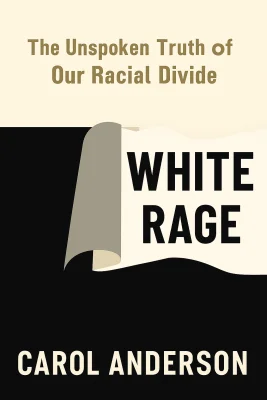
White Rage
The Unspoken Truth of Our Racial Divide
Categories
Nonfiction, History, Politics, Audiobook, Sociology, Social Justice, American History, Social Issues, Race, Anti Racist
Content Type
Book
Binding
Hardcover
Year
2016
Publisher
Bloomsbury USA
Language
English
ISBN13
9781632864123
File Download
PDF | EPUB
White Rage Plot Summary
Introduction
In the summer of 2014, as Ferguson, Missouri erupted in flames following the police killing of Michael Brown, the national conversation fixated on black rage. Commentators debated whether African Americans were justified in their anger, parsing the details of yet another confrontation between police and an unarmed black teenager. But this focus on black fury, while understandable, missed the deeper story unfolding across American history. The real force shaping America's racial landscape has been white rage—not the visible violence of burning crosses and white hoods, but the sophisticated, systematic dismantling of black progress through laws, policies, and institutions. This rage operates through courtrooms and legislatures, wielding bureaucracy as its weapon. It emerges not from the mere presence of black people, but from black advancement, black ambition, and black demands for full citizenship. Every major step forward by African Americans has triggered a calculated backlash, from the aftermath of the Civil War through the election of Barack Obama. Understanding this pattern reveals how America has repeatedly approached the threshold of true democracy, only to retreat into new forms of racial control.
Chapter 1: The Unfinished Revolution: Dismantling Reconstruction After Civil War
The Civil War's end in 1865 should have marked America's redemption from its "original sin" of slavery. With over 620,000 dead and the South devastated, the nation faced a choice between its slaveholding past and an inclusive democratic future. The Thirteenth, Fourteenth, and Fifteenth Amendments promised not just freedom but full citizenship for four million formerly enslaved people. The Freedmen's Bureau offered forty acres and education, the economic and intellectual foundation for genuine liberty. Yet even Abraham Lincoln, the Great Emancipator, harbored doubts about black citizenship. He advocated for colonization, telling black leaders in 1862 that "but for your race among us there could not be war." His successor Andrew Johnson proved far worse. Despite once calling Confederate leaders "traitors" who should be "hung," Johnson pardoned scores of rebels and restored plantation owners to their lands, throwing thousands of freedpeople off the forty acres they had begun to farm. The South's response was swift and devastating. States enacted Black Codes that made freedom meaningless—requiring blacks to sign annual labor contracts, forbidding them from owning firearms or hunting, and auctioning off those accused of vagrancy to the highest bidder. When federal courts tried to intervene, local violence exploded. In Memphis and New Orleans, white mobs slaughtered dozens of African Americans with impunity. Carl Schurz reported scenes of black women "scalped" and men "chained to a tree and burned to death." The Reconstruction amendments became dead letters as the Supreme Court systematically eviscerated their power. In case after case, the justices ruled that the federal government could not protect civil rights, that corporations deserved more constitutional protection than freed slaves, and that discrimination was constitutional as long as it appeared race-neutral. By 1903, Justice Oliver Wendell Holmes declared that federal courts had "no power" to remedy statewide wrongs against black citizens. As one Louisiana black man observed, "The whole South had got into the hands of the very men that had held us as slaves."
Chapter 2: Northern Migration Meets Southern Resistance: Black Mobility Under Attack
World War I created unprecedented opportunities for African Americans as European immigration slowed and Northern factories desperately needed workers. The Pennsylvania Railroad hired agents to recruit black Southerners, offering wages that seemed fantastical to those earning nine cents a day as sharecroppers. The Chicago Defender, the nation's premier black newspaper, became a clarion call for exodus, declaring "Get out of the South" and promising that Chicago's streets would provide "some real freedom." But black mobility triggered white rage across the South. States passed anti-enticement laws with crushing fines—Georgia demanded $25,000 for a labor recruiting license, equivalent to nearly three million dollars today. Police arrested suspected labor agents and threw blacks in jail simply for attempting to board trains north. In Jacksonville, Mayor J.E.T. Bowden had nearly five hundred black men arrested for vagrancy merely for seeking better jobs. Mississippi and other states stopped trains, arrested passengers, and banned the Chicago Defender, turning the First Amendment into a casualty of their war on black advancement. When legal methods failed, violence followed. Mary Turner, eight months pregnant, was lynched and her unborn child murdered for threatening to seek justice for her husband's killing. Yet even as terror stalked the South, over a million African Americans found the courage to leave between 1910 and 1930, seeking not just economic opportunity but the chance for their children to attend decent schools. The North offered hope but not sanctuary. Race riots exploded in Chicago, Detroit, and other cities as whites attacked black neighborhoods with systematic brutality. In Detroit, as the black population quadrupled, whites confined African Americans to a small area called Black Bottom through restrictive covenants and violence. When Dr. Ossian Sweet dared to move into a white neighborhood in 1925, a mob surrounded his home with rocks and racial epithets. Sweet's successful self-defense led to his prosecution for murder, revealing how the law itself had become a weapon of white rage. The promised land remained largely a mirage, but the Great Migration had begun the long struggle to make America's democratic promises real.
Chapter 3: Burning Brown: The Systematic Sabotage of School Desegregation
By 1954, the NAACP's legal strategy had exposed the fundamental lie of "separate but equal." In state after state, black children attended schools valued at a fraction of white institutions—in South Carolina, thirty buses served white students while not one transported black children. When the Supreme Court declared in Brown v. Board of Education that segregated schools were inherently unequal, African Americans celebrated what Roy Wilkins called "one of life's sweetest days." At last, it seemed, citizenship might finally be at hand. White resistance was swift, sophisticated, and devastating. The Southern Manifesto, signed by 101 congressmen, provided respectable cover for defiance by framing resistance as constitutional principle rather than racial hatred. States dusted off the discredited doctrine of interposition, claiming they could nullify federal law within their borders. Georgia redesigned its flag to feature the Confederate battle emblem, while Mississippi and other states passed laws to abolish public education entirely rather than integrate. The strategy was brilliantly cynical: stall and defy. Southern leaders knew their laws were unconstitutional but calculated that years of legal challenges would exhaust black patience and federal resolve while keeping another generation of black children in educational purgatory. Prince Edward County, Virginia, closed its public schools for five years rather than integrate, ensuring that 2,700 black children received no formal education while white children attended a state-funded private academy with public school teachers. Even the Sputnik crisis couldn't break white resistance to black education. When the Soviet satellite revealed America's technological inferiority, leaders like Congressman Carl Elliott demanded emergency federal aid to prevent the nation from falling "irretrievably behind." Yet Elliott and other Southern legislators ensured the National Defense Education Act excluded any requirement for integration, allowing segregated universities to receive federal funds while barring black students. They chose racial purity over national security, a decision whose consequences echo today: fifty years later, not a single African American earned a doctorate in astronomy or astrophysics, and America's share of the world's scientists and engineers had shrunk from 40 percent to 15 percent.
Chapter 4: Civil Rights Rollback: From Legal Victories to Mass Incarceration
The Civil Rights Movement's moral victories created a paradox: visible success triggered invisible backlash. As black protesters faced fire hoses and police dogs with dignity, they won hearts, minds, and legislation. The Civil Rights Act of 1964 and Voting Rights Act of 1965 seemed to complete the promise of Reconstruction, finally guaranteeing African Americans their full citizenship rights. Yet Richard Nixon understood that the movement's strength was also its vulnerability. In his Southern Strategy, he transformed civil rights from a moral crusade into a political liability, using coded language about "law and order" and "welfare queens" to appeal to white resentment without explicitly mentioning race. As aide H.R. Haldeman explained, "the whole problem is really the blacks. The key is to devise a system that recognizes this while not appearing to." Nixon's campaign ads showed burning cities and chaos, letting viewers draw their own conclusions about who threatened their world. The Supreme Court's conservative appointees systematically undermined civil rights gains. In Rodriguez, they ruled that massive funding disparities between white and minority schools were constitutional because education wasn't a fundamental right. In Milliken, they ensured suburban whites would never have to attend school with black children by blocking metropolitan desegregation plans. The Bakke decision began dismantling affirmative action by requiring "diversity" rather than remedying historical discrimination. Ronald Reagan perfected this strategy, using his Hollywood charm to sell devastating cuts to programs that African Americans disproportionately used while protecting benefits like Social Security that primarily served whites. Black college enrollment plummeted as student aid was restructured to exclude the neediest students. Urban aid collapsed from 22 percent of city budgets to 6 percent, forcing communities to close libraries, hospitals, and fire departments. Meanwhile, Reagan's administration facilitated drug trafficking to fund illegal wars, then declared war on the communities devastated by crack cocaine. The result was mass incarceration on a scale that exceeded apartheid South Africa—the new Jim Crow had arrived with a vengeance.
Chapter 5: Unelecting a Black President: Modern Voter Suppression and Resistance
Barack Obama's 2008 victory seemed to herald a post-racial America. For one shining moment, the world marveled at a nation that had elected a black president. Yet Obama's triumph carried within it the seeds of fierce reaction. His coalition of young people, minorities, and first-time voters represented a demographic earthquake that threatened traditional power structures. As Republican Senator Lindsey Graham admitted, "We're not generating enough angry white guys to stay in business for the long term." The response was systematic voter suppression disguised as election integrity. The American Legislative Exchange Council drafted model voter ID legislation that popped up in state after state, each creating hurdles that disproportionately affected African Americans and Latinos. In Texas, concealed weapons permits qualified for voting but student IDs did not. Alabama passed voter ID laws, then closed motor vehicle offices in Black Belt counties that had voted for Obama. Wisconsin extended DMV hours in Republican areas while reducing them in Democratic strongholds. The 2013 Shelby County decision gutted the Voting Rights Act, with Chief Justice Roberts arguing that racial discrimination was now a relic of the past. Within hours, states began implementing voting restrictions that had been blocked for decades. Texas immediately enforced a voter ID law that a federal judge called an "unconstitutional poll tax," designed to prevent hundreds of thousands of citizens from voting. Obama faced unprecedented disrespect and obstruction, from Congressman Joe Wilson's "You lie!" outburst to Speaker Boehner's secret invitation to Israeli Prime Minister Netanyahu. The president endured death threats at four times the rate of his predecessor while commentators questioned his patriotism and very citizenship. The election of America's first black president had triggered the most sophisticated campaign of voter suppression since the Jim Crow era, proving once again that black advancement would face fierce white resistance. The pattern held: progress provoked backlash, and the promise of democracy remained deferred.
Chapter 6: Beyond Visible Violence: The Institutional Nature of White Rage
White rage operates most effectively when it appears respectable and rational. Unlike the Ku Klux Klan's visible terrorism, institutional white rage works through legislatures, courtrooms, and bureaucracies, achieving its goals through laws and policies rather than lynchings. It succeeds precisely because it doesn't look like hatred—it presents itself as fiscal responsibility, law and order, and constitutional principle. The Supreme Court's systematic dismantling of civil rights protections exemplifies this sophisticated approach. Justices didn't declare blacks inferior; they ruled that corporations deserved more constitutional protection than freed slaves, that schools could remain separate as long as they appeared equal, and that voting rights belonged to states rather than citizens. Each decision used neutral legal language to achieve racially devastating results. Modern voter suppression follows the same playbook. Politicians don't advocate racial exclusion; they champion "election integrity" and "preventing fraud." They require documentation that minorities disproportionately lack, reduce voting hours in black precincts while extending them in white suburbs, and purge voter rolls using flawed databases. When challenged, they claim colorblindness while creating what federal judges repeatedly call discriminatory effects. The war on drugs represents white rage's most devastating recent triumph. The Reagan administration facilitated cocaine trafficking to fund illegal wars, then criminalized the communities devastated by crack while treating powder cocaine—used primarily by whites—far more leniently. The resulting mass incarceration destroyed black families and communities while appearing to address legitimate concerns about crime and public safety. By making "criminal" synonymous with "black," the system recreated many features of Jim Crow through seemingly race-neutral means.
Summary
America's racial history reveals a recurring pattern: every major advance by African Americans triggers a sophisticated campaign to roll back their gains. From Reconstruction's promise of forty acres and citizenship to Obama's election as president, black progress has consistently provoked white rage expressed through laws, policies, and institutions rather than visible violence. This rage operates most effectively when it appears reasonable and race-neutral, using bureaucracy and legal process to achieve what terrorism once accomplished through fear. The costs of this cycle extend far beyond black communities. The South's resistance to educational integration helped create the achievement gaps that plague American schools today, while the war on drugs destabilized entire cities and communities. Voter suppression undermines the democratic participation essential to responsive governance, and mass incarceration wastes human potential on an unprecedented scale. By repeatedly choosing racial control over democratic progress, America has squandered opportunities to fulfill its founding promises for all citizens. Understanding this pattern is essential to breaking it and finally moving forward toward the inclusive democracy that has remained just beyond our grasp for over 150 years.
Best Quote
“The truth is that the hard-fought victories of the Civil Rights Movement caused a reaction that stripped Brown of its power, severed the jugular of the Voting Rights Act, closed off access to higher education, poured crack cocaine into the inner cities, and locked up more black men proportionally than even apartheid-era South Africa.” ― Carol Anderson, White Rage: The Unspoken Truth of Our Racial Divide
Review Summary
Strengths: The review highlights the extensive research conducted by Anderson, noting the significant use of historical data and endnotes, which lends academic rigor to the book. It praises the book's ability to provide context to systemic oppression and its historical patterns, offering insights that challenge the reader's prior understanding of American history. Overall: The reader expresses a strong positive sentiment towards the book, deeming it essential reading for understanding racial issues in America. The book is recommended for its enlightening perspective on historical and systemic racism, suggesting it fills gaps left by traditional education.
About Author

Carol Anderson
Anderson investigates the intricate connections between race, public policy, and justice in the United States through her scholarly work. Her research emphasizes the interplay of domestic and international policies and their effects on African American struggles for human rights. By analyzing systemic racism, she sheds light on how political and legal frameworks have historically suppressed Black advancement. Her writing, characterized by accessible prose and rigorous research, often bridges historical narratives with contemporary racial and democratic issues, thus resonating with ongoing societal debates.\n\nAnderson's approach extends beyond mere historical recounting; it aims to engage readers in critical conversations about race and democracy. Her notable book, "White Rage: The Unspoken Truth of Our Racial Divide," articulates the backlash against Black progress and won the National Book Critics Circle Award for Criticism. Meanwhile, "One Person, No Vote: How Voter Suppression is Destroying our Democracy" analyzes the mechanisms undermining democratic participation, earning a longlist nomination for the National Book Award. Her scholarly contributions are not only influential in academic circles but also accessible to a broad audience, fostering public engagement and understanding of racial issues.\n\nAs an influential voice in contemporary discussions on race and democracy, Anderson has garnered significant recognition. She has been elected to the American Academy of Arts and Sciences, further establishing her impact on the field. Her work serves as a critical resource for anyone seeking to understand the complex dynamics of race, policy, and justice in America, making her books essential for readers interested in these pivotal issues. Through her efforts, Anderson empowers readers to critically engage with historical and current societal challenges, enhancing their comprehension of the enduring struggle for racial equality.
Read moreDownload PDF & EPUB
To save this Black List summary for later, download the free PDF and EPUB. You can print it out, or read offline at your convenience.
White Rage
by Carol Anderson
