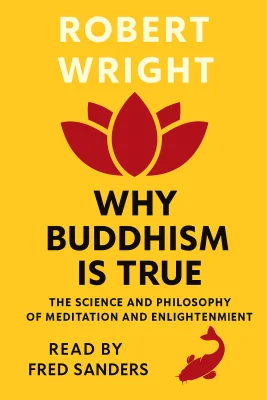
Why Buddhism Is True
The Science and Philosophy of Meditation and Enlightenment
Categories
Nonfiction, Self Help, Psychology, Philosophy, Science, Buddhism, Religion, Spirituality, Audiobook, Meditation
Content Type
Book
Binding
Audiobook
Year
2017
Publisher
Simon & Schuster Audio
Language
English
ISBN13
9781508235408
File Download
PDF | EPUB
Why Buddhism Is True Plot Summary
Introduction
# Buddhism Through the Lens of Modern Psychology Why do we suffer, even when our basic needs are met? This fundamental question has puzzled humanity for millennia, driving both ancient spiritual traditions and modern psychological research toward remarkably similar conclusions. In our age of unprecedented material prosperity and technological advancement, rates of anxiety, depression, and existential dissatisfaction continue to climb, suggesting that our external progress has not translated into inner peace or genuine contentment. This exploration reveals a profound convergence between Buddhist wisdom and evolutionary psychology, demonstrating how ancient contemplative insights align with cutting-edge neuroscience and cognitive research. The theoretical framework presented here suggests that human suffering stems not from external circumstances, but from systematic delusions built into our evolved minds. By understanding how natural selection shaped our mental processes for survival rather than happiness, we can begin to see why Buddhist practices of mindfulness and meditation offer scientifically validated pathways to liberation from unnecessary psychological suffering and moral blindness.
Chapter 1: Evolutionary Origins of Mental Delusion
Natural selection designed our minds not to perceive reality accurately, but to enhance our ancestors' survival and reproductive success in environments vastly different from our current world. This evolutionary legacy creates systematic distortions in how we perceive and respond to modern circumstances, generating much of the psychological suffering we experience today. Our brains operate as sophisticated prediction machines, constantly generating models of reality based on incomplete sensory data and evolutionary biases. These mental models prioritize speed and survival relevance over accuracy, leading to predictable errors in judgment and perception. The same neural circuits that helped our ancestors detect genuine threats now fire in response to emails, social media notifications, and other modern stimuli that pose no actual danger to our survival. Consider how our reward systems respond to contemporary environments. The dopamine pathways that once motivated careful foraging for scarce calories now drive compulsive consumption of readily available processed foods. The social comparison mechanisms that helped establish beneficial tribal hierarchies now fuel endless status competition through material accumulation and digital validation seeking. Our emotional systems exemplify this evolutionary mismatch. Feelings like anxiety, anger, and craving were calibrated for small-group living where threats were immediate and resources genuinely scarce. These same emotional responses, when triggered by modern circumstances, often create suffering disproportionate to actual challenges we face. The Buddhist diagnosis of ordinary consciousness as characterized by dissatisfaction and delusion finds compelling support in this evolutionary analysis. When we understand that our minds were shaped by natural selection rather than truth-seeking, we can begin to question the authority of thoughts and emotions that once served survival but now often mislead us. This scientific perspective validates the Buddhist insight that liberation begins with recognizing these built-in biases and learning to see beyond them. Understanding our evolutionary heritage doesn't excuse our limitations but empowers us to transcend them through conscious awareness and skillful practice.
Chapter 2: Mindfulness: Breaking Free from Thought Patterns
Mindfulness meditation represents a systematic method for observing the mind's habitual patterns without being automatically swept away by them. Rather than attempting to eliminate thoughts or suppress emotions, mindfulness involves developing a fundamentally different relationship to mental phenomena, characterized by clear awareness rather than unconscious reactivity. The practice begins with the deceptively simple task of paying sustained attention to immediate experience, often using the breath as an anchor point for awareness. This basic exercise quickly reveals how rarely we actually inhabit the present moment. Instead, our minds constantly wander into memories, fantasies, plans, and worries, creating what neuroscientists have identified as the default mode network's activity. Through sustained practice, meditators develop what researchers call metacognitive awareness, the capacity to observe their own thinking processes rather than being lost within them. This shift from identification to observation creates crucial space between stimulus and response, allowing for more conscious and skillful reactions to challenging circumstances. The transformation occurs gradually as practitioners learn to observe difficult emotions and sensations without immediately trying to fix, escape, or indulge them. A feeling of anxiety, for instance, can be experienced as a collection of physical sensations, thoughts, and impulses rather than an overwhelming state that defines one's entire being. This process of mindful observation weakens the automatic chains of conditioning that typically govern our responses. Research demonstrates that regular mindfulness practice literally rewires the brain, strengthening areas associated with attention and emotional regulation while reducing activity in regions linked to rumination and emotional reactivity. These neuroplastic changes support practitioners' subjective reports of feeling less controlled by their thoughts and emotions. The ultimate goal extends beyond stress reduction to fundamental insight into the nature of consciousness itself. As the capacity for clear observation deepens, practitioners begin to recognize that what they had taken to be a solid, controlling self is actually a fluid process of awareness interacting with constantly changing mental and physical phenomena.
Chapter 3: The Illusion of Self and Modular Mind
Modern neuroscience reveals that our sense of having a unified, controlling self is largely an illusion created by the brain's narrative-generating systems. Rather than being governed by a central executive, our minds operate more like a collection of specialized modules competing for control of consciousness and behavior, each designed by evolution to solve specific adaptive challenges. The modular model suggests that different mental systems handle distinct functions such as threat detection, mate selection, social status monitoring, and resource acquisition. These modules evolved to address particular survival challenges and can operate largely independently of conscious awareness, sometimes even in conflict with each other. This explains why people can seem like entirely different versions of themselves in different contexts. The individual who is patient and generous at home might become aggressive and competitive in professional settings, not due to hypocrisy but because different evolutionary modules have assumed control. The mate-seeking module creates different priorities and behaviors than the parenting module or the self-protection module. Brain imaging studies support this modular view by demonstrating that different networks of brain regions activate depending on the type of thinking or feeling occurring. There is no single brain region that could plausibly serve as the seat of a unified self, and split-brain studies provide dramatic evidence for the constructed nature of selfhood. What we experience as a coherent self is actually the temporary dominance of whichever module happens to be most active at any given moment, combined with our brain's tendency to create coherent narratives about our experiences after the fact. The left hemisphere acts as an interpreter, constantly generating explanations for actions and decisions that were actually initiated by unconscious processes. The Buddhist teaching of not-self aligns remarkably with these scientific findings. Both traditions suggest that careful observation reveals the absence of any fixed, controlling entity that could legitimately be called a permanent self. Instead, there is simply a flow of experiences arising and passing away within awareness. Recognizing the illusory nature of the controlling self paradoxically enables greater freedom and self-control. When we stop identifying so strongly with every thought and emotion that arises, we gain the space to choose which mental phenomena deserve our attention and energy.
Chapter 4: Emptiness: Seeing Beyond Constructed Reality
The Buddhist concept of emptiness reveals that objects, people, and experiences do not exist in the solid, independent way they appear to our ordinary perception. Rather than possessing inherent essences, things exist as constructions of our meaning-making minds, which actively project significance and emotional resonance onto raw sensory data. Neuroscience demonstrates that perception is fundamentally an active, constructive process rather than passive reception of objective information. The brain takes incomplete sensory input and builds sophisticated models of reality based on expectations, memories, and evolutionary biases. What we experience as the solid, objective world is actually a form of virtual reality created by neural processing. This constructive nature becomes apparent when we examine how emotional associations shape our perception of objects and situations. A childhood home feels warm and welcoming not because of its inherent properties, but because of the feelings and memories we project onto it. The same physical structure might feel cold and unwelcoming to someone with different associations. The essences we perceive in things reflect the emotional and motivational significance our evolutionary history has assigned to them. A potential romantic partner appears inherently attractive, a competitor inherently threatening, a desired object inherently valuable. But these qualities exist in the relationship between perceiver and perceived, not as intrinsic features of the objects themselves. During deep meditation, practitioners often report that familiar objects and experiences seem strangely empty of their usual significance while remaining visually and functionally recognizable. A tree is still clearly a tree, but it no longer carries the full weight of meaning and association that normally defines its essence in our experience. The recognition of emptiness extends to our perception of other people. The fixed essences we attribute to individuals, seeing them as inherently good or bad, friend or enemy, are largely projections based on limited interactions and our own psychological needs and conditioning. Seeing emptiness is not a nihilistic realization but a profoundly liberating one. When we recognize that the rigid categories and intense emotional reactions that normally govern our lives are constructions rather than ultimate truths, we gain the freedom to respond more skillfully to circumstances. The world becomes more fluid and workable when we stop taking our interpretations of it quite so seriously.
Chapter 5: Suffering, Attachment and the Path to Liberation
Buddhist psychology identifies attachment as the fundamental cause of suffering, not attachment to things themselves but attachment to our fixed ideas about how things should be. This clinging to rigid expectations and interpretations creates constant tension between our mental models and the fluid reality of actual experience, generating much of our psychological distress. The mechanism of attachment operates through our tendency to grasp at pleasant experiences, trying desperately to make them permanent, and to push away unpleasant experiences, trying to make them disappear entirely. Both strategies fail because they ignore the fundamental impermanence that characterizes all phenomena, and our attempts to control the uncontrollable generate the very suffering we seek to avoid. Modern psychology confirms this analysis through extensive research on hedonic adaptation and what researchers call the hedonic treadmill. Studies consistently show that people quickly return to baseline happiness levels even after major positive or negative life events. The pursuit of lasting satisfaction through external achievements or acquisitions is fundamentally futile because our brains are wired to constantly seek new sources of stimulation and improvement. The path to liberation involves developing a radically different relationship to experience, one characterized by acceptance rather than control. This doesn't mean passive resignation or indifference, but rather a clear-eyed recognition of what can and cannot be changed, combined with the wisdom to respond appropriately to actual circumstances rather than fighting against the basic conditions of existence. Mindfulness practice cultivates this accepting awareness by teaching us to observe our experiences without immediately trying to modify them. A painful emotion can be felt fully without the additional suffering that comes from resisting or judging it. A pleasant experience can be enjoyed without the anxiety that comes from trying to make it last forever. The liberation that results is not an escape from life's inevitable challenges but a fundamental transformation in how we meet them. Difficulties continue to arise, but they no longer trigger the same cascade of mental elaboration and emotional reactivity that typically multiplies suffering. Problems become workable when we stop adding layers of psychological drama to unavoidable circumstances. This shift from attachment to acceptance paradoxically increases our effectiveness in the world. When we're not constantly defending our ego or pursuing impossible fantasies of permanent satisfaction, we can see situations more clearly and respond more appropriately to what's actually needed in each moment.
Chapter 6: From Meditation to Moral Transformation
The insights gained through contemplative practice naturally extend beyond personal well-being to encompass ethical behavior and social responsibility. As practitioners develop clearer perception and reduced self-centeredness, they typically become more sensitive to the suffering of others and more motivated to help alleviate it through compassionate action. The connection between meditation and morality operates through several interconnected mechanisms. First, the development of mindfulness increases emotional regulation, reducing the likelihood of harmful actions driven by anger, greed, or delusion. When we're less reactive to challenging circumstances, we're less likely to say or do things we later regret. Second, the recognition of not-self gradually dissolves the rigid boundaries between self and other that often justify selfish behavior. If the self is revealed to be a construction rather than an ultimate reality, then the sharp distinction between my welfare and your welfare becomes less absolute and compelling. Third, seeing the emptiness of fixed categories reduces our tendency to dehumanize others based on group membership or past actions. When we understand that essences are projections rather than inherent qualities, it becomes much harder to write people off as irredeemably evil or fundamentally different from ourselves. The cultivation of loving-kindness meditation specifically develops positive emotions toward all beings, starting with oneself and gradually extending to loved ones, neutral people, difficult people, and eventually all sentient life. This practice systematically counters the brain's natural tendency toward in-group favoritism and out-group hostility. Research demonstrates that even brief loving-kindness meditation can increase positive emotions, reduce implicit bias, and enhance prosocial behavior toward strangers. Longer-term practitioners often report a profound shift in their basic orientation toward others, from suspicion and competition to openness and genuine care for others' wellbeing. However, the relationship between meditation and morality is not automatic or guaranteed. Contemplative skills can potentially be used for harmful purposes if not grounded in ethical principles and wisdom. The traditional Buddhist path therefore emphasizes moral conduct as both a prerequisite for and natural result of authentic spiritual development.
Chapter 7: Transcending Tribal Psychology
Human beings evolved in small groups where survival depended on intense cooperation within the tribe and often violent competition with outsiders. This evolutionary legacy manifests in modern life as an automatic tendency to categorize people as either allies or enemies, leading to prejudice, conflict, and violence on scales ranging from personal relationships to international warfare. Tribal psychology operates through several cognitive mechanisms that systematically distort our perception of others. We tend to see members of our own groups as diverse individuals with complex motivations while viewing outsiders as homogeneous stereotypes. We attribute positive behaviors by our allies to their good character while explaining away their negative behaviors as situational exceptions. These biases are maintained and reinforced by selective attention and memory. We naturally notice and remember information that confirms our existing group loyalties while filtering out contradictory evidence that might challenge our tribal identities. Social media algorithms amplify these tendencies by creating echo chambers that reinforce group identities and demonize opposing factions. The Buddhist analysis suggests that tribal psychology is rooted in the same fundamental delusions that cause individual suffering: the belief in solid, separate selves and attachment to fixed identities. When we identify strongly with particular groups, we create artificial boundaries that justify treating others as less deserving of moral consideration and compassionate treatment. Contemplative practice offers practical tools for transcending these evolutionary limitations. Mindfulness meditation develops the capacity to observe our tribal reactions without being automatically controlled by them. We can notice the arising of in-group loyalty or out-group hostility and choose whether to act on these primitive impulses. The recognition of emptiness reveals that group identities, like individual identities, are constructions rather than ultimate realities. The boundaries between us and them are not as solid as they appear to our conditioned perception. Understanding this can reduce the emotional charge around group differences and increase our capacity for empathy across traditional tribal lines. Loving-kindness meditation specifically counters tribal psychology by cultivating positive emotions toward all beings regardless of group membership, ethnicity, nationality, or ideology. Advanced practitioners report that the distinction between friend and enemy becomes increasingly meaningless as they recognize the fundamental similarity of all conscious beings in their basic desire for happiness and freedom from suffering. The transformation of tribal psychology represents not just a personal matter but a species-level imperative. In an interconnected world with weapons of mass destruction and global challenges requiring unprecedented cooperation, our survival may depend on developing more inclusive forms of identity that encompass all of humanity and perhaps all sentient life.
Summary
The convergence of ancient Buddhist wisdom and modern psychological science reveals that human suffering stems largely from systematic delusions built into our evolved minds, delusions that can be understood scientifically and overcome through contemplative practice and clear insight into the nature of mind and reality. This synthesis offers profound hope for both individual liberation and collective transformation. As more people learn to see through the illusions of separate selfhood and solid reality, we may witness the emergence of a more compassionate and wise form of human civilization, one capable of addressing our greatest challenges with clarity and wisdom rather than the confusion and reactivity that characterize so much of contemporary life.
Best Quote
“Ultimately, happiness comes down to choosing between the discomfort of becoming aware of your mental afflictions and the discomfort of being ruled by them.” ― Robert Wright, Why Buddhism is True: The Science and Philosophy of Meditation and Enlightenment
Review Summary
Strengths: The review highlights the book's unique approach of interpreting Buddhist doctrines through the lens of evolutionary psychology. It effectively explains how mindfulness meditation can address the mismatch between our evolutionary programming and modern life challenges, such as stress and tribalism. Weaknesses: The review points out that the book does not adhere to traditional or orthodox Buddhist teachings, presenting a selective interpretation instead. It also suggests that the title might be misleading, as the book focuses more on the benefits of mindfulness meditation rather than Buddhism itself. Overall: The review suggests a positive sentiment towards the book's insights on mindfulness meditation, though it notes the deviation from traditional Buddhist teachings. The recommendation level is moderate, appealing to those interested in evolutionary psychology and mindfulness.
About Author

Robert Wright
Wright synthesizes scientific insights with philosophical inquiry to explore the evolution of human nature and morality. His work delves into the intersection of evolutionary psychology, religion, and societal development, often challenging conventional perceptions of human behavior and its underpinnings. For instance, in his notable book "The Moral Animal," Wright probes how evolutionary processes shape psychological traits, prompting readers to reconsider their understanding of morality and self-interest. Meanwhile, his exploration of religious evolution in "The Evolution of God" offers a fresh perspective on how religious beliefs and institutions evolve over time, highlighting the dynamic interplay between culture and spirituality.\n\nReaders benefit from Wright's ability to make complex ideas accessible, drawing on a narrative style that reflects his interdisciplinary approach. His work appeals to those interested in the confluence of science, philosophy, and religion, encouraging a deeper understanding of how evolutionary principles influence human actions and societal progression. By integrating rigorous scholarship with engaging prose, Wright offers valuable insights into the development of human society, making his books essential reading for anyone interested in the origins and future trajectory of human thought and behavior. As a renowned author, his contributions continue to enrich discussions on these fundamental topics, with accolades like the National Magazine Award for Essay and Criticism further underscoring the impact of his work.
Read moreDownload PDF & EPUB
To save this Black List summary for later, download the free PDF and EPUB. You can print it out, or read offline at your convenience.

Why Buddhism Is True
by Robert Wright
