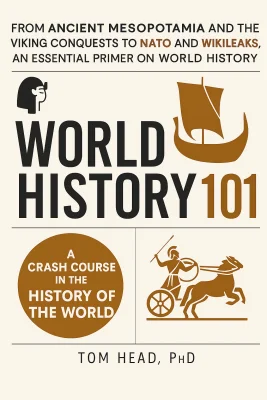
World History 101
From Ancient Mesopotamia and the Viking Conquests to NATO and WikiLeaks, an Essential Primer on World History
Categories
Nonfiction, History, Reference, Audiobook, Historical, World History
Content Type
Book
Binding
Kindle Edition
Year
2017
Publisher
Adams Media
Language
English
ASIN
B071Y37CZK
File Download
PDF | EPUB
World History 101 Plot Summary
Introduction
Picture this: two hundred thousand years ago, in the highlands of Ethiopia, our earliest ancestors took their first tentative steps into a world that would challenge them in ways they could never imagine. They had no way of knowing that their descendants would build pyramids that would last millennia, create empires spanning continents, and eventually split atoms. Yet within their struggles for survival lay the seeds of everything we recognize as human civilization today. The story of humanity is not a neat progression from darkness to light, but rather a complex tapestry woven from threads of triumph and tragedy, wisdom and folly, creation and destruction. As we trace this epic journey from the first cities of ancient Mesopotamia to the digital age of global connectivity, we discover that the same forces that drove our ancestors—the hunger for power, the quest for meaning, the desire for security—continue to shape our world today. The pharaohs who built monuments to their immortality, the emperors who conquered vast territories, and the revolutionaries who toppled ancient systems all grappled with questions that remain painfully relevant: How do we balance individual ambition with collective good? What price are we willing to pay for progress? And perhaps most importantly, what can the patterns of history teach us about navigating an uncertain future?
Chapter 1: Ancient Civilizations: The Cradles of Human Society
The transformation from wandering bands of hunter-gatherers to settled agricultural communities marks one of humanity's most profound turning points. Around 10,000 BCE, as the last ice age retreated, humans began to master the art of cultivation in the fertile valleys of the Middle East, China, and the Americas. This agricultural revolution was not merely about food production; it was about fundamentally reimagining what human society could become. In the river valleys of Mesopotamia, between the Tigris and Euphrates, the world's first cities emerged around 3500 BCE. The Sumerians, who called themselves the "black-headed people," created something unprecedented: urban civilization complete with writing systems, complex governments, and monumental architecture. Their city-states operated as independent entities united by common culture and mutual necessity, establishing patterns of cooperation and competition that would echo throughout history. When King Sargon of Akkad conquered these city-states around 2334 BCE, he demonstrated how loose confederations, no matter how stable, remained vulnerable to unified military force. Simultaneously, along the predictable floods of the Nile, ancient Egypt was developing its own model of civilization. The unification of Upper and Lower Egypt around 3100 BCE created the world's first unified nation-state, governed by pharaohs who claimed divine authority. The massive pyramids and elaborate burial practices that followed were not merely displays of wealth, but profound statements about the relationship between earthly power and eternal significance. As one inscription from the time declared, "The king is a god whose deeds live forever." These early civilizations established fundamental questions that would persist throughout history: How should societies organize themselves? What legitimizes political authority? How do we balance individual desires with collective needs? The answers they provided—through law codes like Hammurabi's, through religious systems that tied earthly order to cosmic purpose, through trade networks that connected distant peoples—became templates that later civilizations would adapt, modify, and sometimes reject entirely. Yet their core insight remained constant: human beings could transcend their animal origins only by learning to live together in complex, interdependent communities.
Chapter 2: The Rise and Fall of Classical Empires
The period from 800 BCE to 500 CE witnessed the emergence of empires that would define the classical world and establish patterns of conquest, governance, and cultural exchange that resonate to this day. These were not merely larger versions of earlier kingdoms, but fundamentally new forms of political organization that grappled with the challenges of ruling diverse populations across vast distances. The Persian Empire under Cyrus the Great revolutionized the concept of imperial rule by embracing tolerance rather than forced assimilation. Unlike previous conquerors who imposed their religion and customs on subject peoples, the Persians allowed local traditions to flourish while integrating diverse populations into a unified administrative system. This approach proved remarkably effective, enabling the empire to stretch from India to Greece and endure for over two centuries. When Alexander the Great finally conquered Persia, he adopted many of its administrative practices, recognizing their practical wisdom. Greece's contribution lay not in territorial expansion but in intellectual innovation. The Greek city-states, particularly Athens, experimented with new forms of governance, philosophy, and artistic expression that would influence Western civilization for millennia. Yet even democratic Athens relied on slavery and excluded women from political participation, revealing the persistent tension between high ideals and practical limitations. The Peloponnesian War demonstrated how even the most sophisticated political systems could destroy themselves through internal conflict and imperial overreach. Rome synthesized and expanded upon these earlier experiments, creating the most enduring empire of the ancient world. The Roman approach combined Persian administrative flexibility with Greek intellectual curiosity, adding their own genius for law and engineering. The transition from Republic to Empire under Augustus reflected a hard-earned understanding that complex societies sometimes required strong central authority to maintain stability and prosperity. Yet even Rome's success carried the seeds of its eventual decline, as the very size and complexity that made it great also made it increasingly difficult to govern effectively. These classical empires taught crucial lessons about the nature of power and governance. They demonstrated that successful empires must balance unity with diversity, central authority with local autonomy, military strength with cultural appeal. Their eventual fall reminded future generations that no political system, however sophisticated, can survive indefinitely without adaptation and renewal. Perhaps most importantly, they established the ideal of universal law and shared human dignity that would later inspire both the Christian concept of universal brotherhood and the Enlightenment vision of human rights.
Chapter 3: Medieval World: Faith, Feudalism and Cultural Exchange
The collapse of classical empires ushered in an era often mischaracterized as the "Dark Ages," but which actually witnessed extraordinary creativity in religion, philosophy, and cross-cultural exchange. From roughly 500 to 1500 CE, three great monotheistic traditions—Christianity, Islam, and Judaism—provided new frameworks for understanding human purpose and organizing society, while new forms of political organization emerged to fill the vacuum left by fallen empires. The rise of Islam in the 7th century exemplified how religious movements could become powerful political forces. The Prophet Muhammad's message of monotheism and social justice resonated far beyond Arabia, creating an empire that stretched from Spain to India within a century of his death. Islamic civilization became a conduit for preserving and transmitting classical knowledge, while innovations in mathematics, medicine, and philosophy flourished in centers like Baghdad and Córdoba. The Islamic world's relative tolerance for religious minorities created spaces where Jewish, Christian, and Muslim scholars could engage in intellectual exchange that enriched all traditions. Medieval Europe, meanwhile, developed feudalism as a response to political fragmentation and constant warfare. This system, based on personal loyalty and mutual obligation between lords and vassals, provided stability at the local level while making unified action difficult. The Catholic Church emerged as the one institution capable of transcending local boundaries, wielding both spiritual and temporal authority. The Crusades, launched in 1095, revealed both the mobilizing power of religious conviction and the devastating consequences of holy war. As one chronicler noted, "God wills it" became a justification for violence that would echo through centuries. The medieval world also witnessed remarkable cultural exchange along trade routes that connected Europe, Asia, and Africa. The Mongol Empire, though built through conquest, created unprecedented opportunities for the movement of goods, ideas, and technologies across Eurasia. Marco Polo's travels and the spread of the Black Death along these same routes demonstrated how interconnected the medieval world had become. Even catastrophes like the plague, which killed one-third of Europe's population, ultimately stimulated social and economic changes that would contribute to the Renaissance and the age of exploration. Medieval civilization's greatest achievement may have been its synthesis of faith and reason, creating intellectual frameworks that could accommodate both religious truth and empirical observation. This synthesis, whether in Islamic philosophy, Christian scholasticism, or Jewish commentary, established principles of inquiry and debate that would eventually challenge traditional authorities and pave the way for the scientific revolution. The medieval world proved that periods of apparent decline could actually be eras of profound transformation, preparing the ground for future breakthroughs.
Chapter 4: Revolutions and Enlightenment: Reshaping Society
The period from roughly 1500 to 1800 witnessed a series of interconnected revolutions—scientific, religious, political, and intellectual—that fundamentally transformed how humans understood themselves and their world. These changes did not occur in isolation but reinforced each other in ways that accelerated the pace of historical change and set the stage for the modern era. The Scientific Revolution began with figures like Copernicus and Galileo challenging received wisdom about the physical universe, but its implications extended far beyond astronomy and physics. By demonstrating that careful observation and mathematical reasoning could reveal truths about nature, scientists established new methods for understanding reality that would eventually be applied to society and politics. Francis Bacon's emphasis on empirical evidence and the scientific method represented a radical departure from reliance on ancient authorities and religious revelation alone. The Protestant Reformation, sparked by Martin Luther's challenge to Catholic authority, shattered the religious unity of Western Europe and inadvertently promoted intellectual freedom. Once the principle was established that individuals could interpret scripture for themselves, it became harder to maintain that any human authority was beyond question. The religious wars that followed were devastating, but they ultimately led to new concepts of religious tolerance and the separation of church and state. As Voltaire would later observe, "Those who can make you believe absurdities can make you commit atrocities." The Enlightenment synthesized these scientific and religious developments into a comprehensive worldview based on reason, natural law, and human progress. Thinkers like John Locke argued that governments derived their authority from the consent of the governed, while Adam Smith demonstrated how individual self-interest could serve the common good through market mechanisms. These ideas provided intellectual ammunition for political revolutions that would reshape the Atlantic world. The American and French Revolutions put Enlightenment principles into practice with mixed but profound results. The American Declaration of Independence proclaimed that "all men are created equal" and possess "unalienable rights," establishing principles that would inspire liberation movements worldwide. The French Revolution's Declaration of the Rights of Man and Citizen went even further, asserting popular sovereignty and universal human rights. Yet both revolutions revealed the gap between ideals and practice, as American revolutionaries continued to practice slavery while French revolutionaries descended into the Terror. These contradictions would haunt democratic movements for generations to come, but the revolutionary principles themselves had been unleashed and could not be recalled.
Chapter 5: World Wars and Globalization: The Modern Era
The period from 1914 to 1991 witnessed humanity's most devastating conflicts alongside unprecedented technological advancement and global integration. Two world wars and a Cold War that threatened human extinction paradoxically accelerated innovations in communication, transportation, and international cooperation that laid the foundation for today's interconnected world. World War I shattered the optimistic belief in inevitable progress that had characterized the late 19th century. The industrial technologies that had promised to improve human life proved equally capable of unprecedented destruction. Machine guns, poison gas, and artillery turned European battlefields into mechanized slaughterhouses, while the war's aftermath created conditions that would lead to even greater catastrophe. The collapse of empires and the harsh peace imposed on Germany created resentments and instabilities that ambitious demagogues would later exploit. The rise of totalitarian ideologies in the interwar period represented a fundamental challenge to liberal democratic values. Fascism and communism both promised to resolve the contradictions of modern life through total transformation of society, but at the cost of individual freedom and human dignity. The Holocaust revealed how quickly civilized societies could descend into barbarism when driven by racist ideology and unchecked state power. As Holocaust survivor Primo Levi observed, "It happened, therefore it can happen again." World War II became a genuine struggle between democracy and dictatorship, though the alliance between democratic and communist powers revealed the complexity of the moral landscape. The war's outcome preserved the possibility of human freedom, but at enormous cost—an estimated 70 million deaths worldwide. The development and use of atomic weapons introduced the possibility of human extinction, fundamentally changing the nature of international relations and military strategy. The Cold War that followed represented a new form of global conflict, fought through proxy wars, espionage, and competing visions of human progress. The division of the world into capitalist and communist camps created a bipolar system that provided stability of a sort, but at the cost of freedom for millions trapped behind the Iron Curtain. The eventual collapse of the Soviet Union without nuclear war demonstrated both the ultimate failure of totalitarian systems and the human capacity for peaceful transformation. Throughout this turbulent period, the foundations of modern globalization were being laid. International institutions like the United Nations, NATO, and the World Bank created frameworks for cooperation that transcended national boundaries. Technological advances in transportation and communication made truly global interaction possible for the first time in human history. The result was a world more interconnected than ever before, but also more vulnerable to global shocks and systemic failures.
Chapter 6: Technology and Human Rights: Challenging Traditional Power
The contemporary era, roughly from 1991 to the present, has been characterized by accelerating technological change and expanding concepts of human rights, creating both unprecedented opportunities and new forms of vulnerability. The end of the Cold War initially seemed to herald an era of democratic triumph and peaceful progress, but subsequent developments have revealed the persistent power of nationalism, religious extremism, and authoritarian governance. The digital revolution has transformed virtually every aspect of human life, creating new possibilities for communication, commerce, and creativity while also enabling new forms of surveillance and control. The internet has democratized access to information and provided platforms for grassroots organizing, as seen in movements from the Arab Spring to #MeToo. Yet the same technologies that enable democratic participation also facilitate the spread of disinformation and the manipulation of public opinion by both state and corporate actors. The expansion of human rights discourse has challenged traditional hierarchies based on race, gender, sexual orientation, and national origin. The women's liberation movement, civil rights struggles, and LGBTQ+ rights campaigns have gradually extended the promise of equality to previously marginalized groups. International human rights law has created new standards for state behavior and mechanisms for holding governments accountable for abuses. Yet the gap between ideals and reality remains vast, and backlash movements have emerged to defend traditional privileges and hierarchies. Globalization has created unprecedented prosperity for some while leaving others behind, fueling populist movements that challenge the liberal international order. The 2008 financial crisis, Brexit, and the rise of authoritarian populism worldwide have demonstrated the fragility of democratic institutions and international cooperation. Climate change represents perhaps the ultimate test of humanity's ability to act collectively in the face of long-term threats that transcend national boundaries. The COVID-19 pandemic has served as both a stress test and a preview of future challenges, revealing both the extraordinary capabilities of modern science and the persistent weaknesses of global governance. The rapid development of effective vaccines demonstrated human ingenuity at its best, while the unequal distribution of those vaccines and the politicization of public health measures revealed the limitations of international solidarity. The pandemic has accelerated existing trends toward digital transformation and social fragmentation while highlighting the continued importance of effective government and social cohesion.
Summary
The epic journey of human history reveals a fundamental tension between our capacity for both creation and destruction, cooperation and conflict, wisdom and folly. From the first agricultural settlements to the digital age, human societies have repeatedly faced the challenge of organizing complex communities, managing scarce resources, and maintaining social cohesion across differences of culture, belief, and interest. The rise and fall of civilizations, the cycles of progress and reaction, the persistent struggles for freedom and dignity—these patterns suggest that while the specific challenges change, the underlying human condition remains remarkably consistent. What emerges most clearly from this historical survey is that human progress is neither automatic nor irreversible. The achievements of one era can be lost in the next, while the failures of the past can provide wisdom for future generations if we are willing to learn from them. The same technologies that enable unprecedented prosperity and connection also create new vulnerabilities and opportunities for oppression. The expansion of human rights and democratic governance represents genuine progress, but it requires constant vigilance and renewal to survive the inevitable challenges from those who would roll back these gains. Perhaps most importantly, history teaches us that ordinary people have extraordinary power to shape the future when they act collectively with purpose and persistence. The great transformations of the past—from the agricultural revolution to the abolition of slavery to the fall of the Berlin Wall—were driven not by abstract historical forces but by countless individuals who chose to work for change despite the risks and obstacles they faced. As we confront the challenges of climate change, technological disruption, and democratic backsliding, history reminds us that the future is not predetermined but depends on the choices we make today. The question is not whether change will come, but whether we will have the wisdom and courage to guide it toward human flourishing rather than destruction.
Best Quote
“As the great German playwright Bertolt Brecht (1898–1956) put it, kisses leave no traces but wounds leave scars. History is mostly about the scars.” ― Tom Head, World History 101: From Ancient Mesopotamia and the Viking Conquests to NATO and WikiLeaks, an Essential Primer on World History
Review Summary
Strengths: The book is described as a "gateway" to further historical reading, suggesting it effectively piques interest in history. It is praised for its well-researched content, covering a broad timeline from Roman times to World War II, and for being simple and engaging. The book is also seen as a useful resource for building foundational knowledge in world history. Weaknesses: Criticisms include a perceived bias in discussing racism, a lack of structured chapters leading to a disjointed narrative, and a poor Turkish translation. Some readers found the book too brief, likening it to a collection of student notes, which made it difficult to enjoy. Overall: The book is generally well-received as an informative and engaging overview of world history, though some structural and content biases are noted. It is recommended for those new to historical studies, despite some translation and narrative issues.
About Author

Tom Head
Head reflects on the intersection of history and religion, crafting narratives that delve into the evolution of civil liberties and social justice. His interdisciplinary approach combines elements of U.S. and world history, ethics, and educational methodologies to foster a comprehensive understanding of complex societal themes. Through his books, such as "World History 101" and "Civil Liberties: A Beginner’s Guide," Head aims to make history accessible and engaging for a wide audience, encouraging readers to draw connections between past and present challenges.\n\nIn his pursuit of education through storytelling, Head connects historical events with contemporary issues, underscoring the importance of informed citizenship. This approach is particularly evident in works like "It’s Your World, So Change It," where he empowers readers to actively engage in social change. His books serve not only as informational resources but also as catalysts for discussion and critical thinking in classrooms and beyond.\n\nThe impact of Head’s work is evident in its broad appeal, reaching students and educators alike who seek to understand the dynamics of historical events and their relevance today. By exploring themes of justice and ethics, his narratives provide valuable insights that resonate with those interested in the intersection of history and modern societal issues. Through this body of work, Head has carved a niche as a writer dedicated to illuminating the pathways from past to present, enabling readers to navigate the complexities of the world with a more informed perspective.
Read moreDownload PDF & EPUB
To save this Black List summary for later, download the free PDF and EPUB. You can print it out, or read offline at your convenience.
World History 101
by Tom Head
