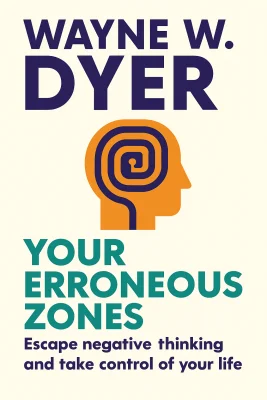
Your Erroneous Zones
Categories
Nonfiction, Self Help, Psychology, Philosophy, Health, Spirituality, Mental Health, Audiobook, Personal Development, How To
Content Type
Book
Binding
Mass Market Paperback
Year
1993
Publisher
Avon Books
Language
English
ASIN
0061091480
ISBN
0061091480
ISBN13
9780061091483
File Download
PDF | EPUB
Your Erroneous Zones Plot Summary
Introduction
Life is filled with invisible barriers that keep us from experiencing true happiness and fulfillment. These barriers aren't physical walls but psychological zones we've allowed to take control of our lives. Every day, millions of people walk around feeling guilty about their past, worried about their future, seeking approval from others, or avoiding the unknown. They're trapped in emotional prisons of their own making, believing these feelings are simply part of being human. But what if these limitations are actually choices? What if the anxiety, guilt, approval-seeking, and fear that dominate your life are patterns you've learned that can be unlearned? The journey to personal freedom begins with a simple but powerful realization: you have the ability to choose your emotional reactions in every moment. Your happiness doesn't depend on changing external circumstances but on changing how you respond to them. By recognizing these erroneous zones in your life and actively choosing different responses, you can free yourself from psychological imprisonment and begin living fully in the present moment.
Chapter 1: Taking Control of Your Emotional Responses
Taking charge of your emotional life begins with understanding that you—not others, not circumstances—control how you feel. This fundamental truth challenges the common belief that emotions simply happen to us. In reality, feelings are reactions you choose to have, even when that choosing happens unconsciously. Recognizing this power gives you the first key to emotional freedom. Consider this logical exercise: You can control your thoughts (if you don't, who does?). Your feelings come from your thoughts. Therefore, you can control your feelings. This simple syllogism reveals the pathway to emotional mastery. When someone says, "You hurt my feelings," the more accurate statement would be, "I hurt my feelings because of the thoughts I told myself about your reaction to me." The distinction is crucial because it places responsibility—and therefore power—back in your hands. A client named Harold provides a perfect example of this principle. For months, he worried obsessively about losing his job, making himself physically ill with anxiety. He lost weight, couldn't sleep, and became increasingly unhealthy. Despite our discussions about the futility of worry, Harold continued to choose anxiety, believing it was his responsibility to worry. When he finally did receive his pink slip, something unexpected happened. Within three days, he secured a better position with higher pay and greater satisfaction. His compulsiveness, redirected toward job hunting rather than worry, served him well. Harold learned firsthand that all his anticipatory anxiety had been wasted energy. The pathway to emotional control requires practice—much like learning to drive a stick shift. At first, it seems impossibly complex, requiring constant awareness and adjustment. But with practice, the process becomes automatic. Similarly, becoming aware of your thought patterns when you're upset and deliberately choosing different thoughts takes consistent effort. Start by catching yourself when you say things like "He made me angry" and remind yourself that you chose to be angry based on your interpretations. With time, choosing more productive emotional responses will become your new normal. The most liberating aspect of emotional control is living fully in the present moment. Guilt keeps you focused on the past, while worry projects you into the future. Both rob you of your only real time—now. By practicing present-moment awareness, you free yourself to experience life as it happens rather than dwelling on what can't be changed or what might never occur. As Henry James advised, "Live all you can; it's a mistake not to."
Chapter 2: Building Genuine Self-Love Without Seeking Approval
Self-love forms the foundation of all healthy relationships, yet many of us have learned to view loving ourselves as selfish or conceited. From childhood, we're taught to put others first, to share our toys, to be seen and not heard. These messages, while well-intentioned, often create adults who feel unworthy of their own affection and dependent on others' approval for validation. Tracy, a 23-year-old client, struggled deeply with self-worth. During a therapy session, she enacted a role-play confronting her mother about wanting to leave home. When the person playing her mother said, "If you leave, I'll have a heart attack; you know how my heart is," Tracy initially fell into her pattern of guilt and self-blame. After learning new response patterns, she replied, "You're concerned about your health and think you can't make it without me." When her "mother" escalated with emotional manipulation, Tracy maintained her boundaries without hostility, simply acknowledging her mother's feelings while not taking responsibility for them. This represented a profound shift from dependency to self-trust. Genuine self-love isn't about narcissism or conceit. Those who constantly boast about their achievements are actually revealing their insecurity and need for external validation. True self-love manifests as quiet confidence and acceptance of your whole self—flaws included. It's recognizing that your worth isn't determined by your achievements, appearance, or others' opinions but is inherent in your existence. To begin cultivating self-love, start by observing your self-talk. Notice when you say things like "I'm not good enough" or "I could never do that." These are learned responses, not truths. Challenge them by asking, "Who taught me to believe this about myself? Is it actually true?" Next, practice accepting compliments with a simple "thank you" rather than deflecting praise. Express your feelings honestly, even when they might not please others. Take time for activities you enjoy without guilt. Perhaps most importantly, separate your worth from your behavior. You can dislike something you've done without disliking yourself. When you make a mistake, learn from it without self-condemnation. Remember, at no time is self-hate healthier than self-love. As you practice these new patterns of self-acceptance, you'll discover something remarkable—your capacity to love others expands in direct proportion to your love for yourself.
Chapter 3: Breaking Free from the Tyranny of Guilt and Worry
Guilt and worry represent two of the most useless yet pervasive emotional patterns in human experience. They're opposite sides of the same coin—guilt immobilizes you in the present over something from the past, while worry immobilizes you now about something that may happen in the future. Both rob you of your only real time: the present moment. Robert Jones Burdette captured this perfectly when he wrote: "It isn't the experience of today that drives men mad. It is the remorse for something that happened yesterday, and the dread of what tomorrow may disclose." Consider this wisdom: "There are two days in the week about which I never worry... Yesterday and tomorrow." This perspective reveals the fundamental futility of both emotions. Helen, a client who discovered her husband's affair, became obsessed with questions like "Where did I go wrong?" and "What's wrong with me?" She alternated between fury and sadness, even contemplating having her own affair as retaliation. Her pain came not just from the infidelity but from her demand for justice—her belief that relationships should operate by certain rules of fairness. During therapy, Helen realized her husband's choice had countless possible motivations that had nothing to do with her worth. His behavior reflected his own needs and choices, not her value as a person. By shifting from external blame to internal responsibility for her reactions, Helen began healing. To break free from guilt, recognize that no amount of present-moment remorse can change history. When you catch yourself feeling guilty, ask: "What am I avoiding in the present by focusing on the past?" Often, guilt serves as an escape from taking responsibility for current challenges. Similarly, with worry, ask yourself: "Will my anxiety about this actually change anything?" The answer is invariably no. A practical approach to diminishing worry is giving yourself designated "worry periods"—ten minutes morning and afternoon to fret about everything on your mind. When worries arise outside these times, postpone them until your next scheduled worry session. This practice helps break the habit of continuous anxiety while revealing how unnecessary most worry truly is. Keep a "worry sheet" tracking your concerns and notice how few actually materialize as feared. For both guilt and worry, awareness is the first step toward freedom. When you catch yourself saying, "I should have..." or "What if...," pause and redirect your attention to this moment. Replace "I hope things will work out" with "I will make it happen." Replace "I wish things were better" with "I'm going to do the following to ensure I feel better." These simple shifts return power to where it belongs—with you, in the present moment, where all real living happens.
Chapter 4: Conquering Fear of the Unknown Through Deliberate Action
The fear of the unknown may be the most limiting of all psychological barriers. From early childhood, we're taught to be cautious, to stay in familiar territory, to avoid risk. While these lessons may have protected us physically, they often imprison us emotionally, preventing growth and new experiences that could bring fulfillment. Albert Einstein understood this when he said, "The most beautiful thing we can experience is the mysterious. It is the true source of all art and science." He might have added that it's also the source of all personal growth and excitement. Yet many equate the unknown with danger, preferring predictable unhappiness to unfamiliar possibilities. Horace, a 46-year-old client, desperately wanted to attend college after missing his opportunity due to World War II. Despite his desire, he was paralyzed by fear of competing academically with younger students fresh from high school. Though he'd taken entrance exams and arranged an interview at a community college, he kept inventing excuses: "I'm too old," "I'm not smart enough," "I'm not really interested." These were self-protective lies masking his deeper fear of failure. Horace was using what psychologists call "avoidance behavior"—creating rational-sounding justifications to avoid facing the unknown. To overcome fear of the unknown, begin by recognizing it as a choice rather than an inevitable reaction. Start with small, deliberate steps into unfamiliar territory. Order a dish you've never tried at a restaurant. Invite people with different viewpoints to your home. Take a new route to work. These seemingly minor actions build your confidence for larger leaps. Challenge perfectionism, which often underlies fear of the unknown. The belief that you must do everything well prevents you from trying anything new where you might initially perform poorly. Remember that failure is instructive—without it, we learn nothing. As Kenneth Boulding noted, "Nothing fails like success because you don't learn anything from it. The only thing we ever learn from is failure." A powerful exercise is to imagine the worst possible outcome of taking a risk—then assess its actual likelihood and impact. Most feared outcomes are far less probable and devastating than we imagine. Ask yourself, "If I were stripped of everything right now and dropped in a completely foreign environment with only my internal resources, could I survive?" This thought experiment reveals that true security comes not from external stability but from trusting your ability to handle whatever comes. Remember that all human progress—personal and societal—depends on those willing to venture into the unknown. As Robert Frost wrote in "The Road Not Taken": "Two roads diverged in a wood, and I—I took the one less traveled by, And that has made all the difference." Your freedom from fear begins with one step into unfamiliar territory, trusting not in certainty but in your capacity to grow.
Chapter 5: Eliminating Harmful Dependencies in Relationships
Dependency is the silent destroyer of relationships. It creates patterns of dominance and submission that ultimately breed resentment and destroy authentic connection. Psychological independence means freedom from obligatory relationships—from having to do something you wouldn't otherwise choose if the relationship didn't exist. Walt Disney's film "Bear Country" beautifully illustrates healthy versus unhealthy dependence. In it, a mother bear teaches her cubs survival skills—how to hunt, fish, and protect themselves. When they've mastered these abilities, she forces them up a tree and walks away forever. In her bear mind, she's completed her parental responsibilities. She doesn't manipulate them into visiting on alternate Sundays or threaten a nervous breakdown if they disappoint her. Throughout the animal kingdom, parenting means teaching offspring the skills for independence—then letting go. With humans, however, the natural drive for independence often conflicts with neurotic needs to control and possess others. This dependency trap manifests dramatically in marriage. Louis Anspacher described marriage in America as "that relation between man and woman in which the independence is equal, the dependence mutual, and the obligation reciprocal." Yet the two ugly words—"dependence" and "obligation"—explain the high rate of marital dissatisfaction and divorce. Most marriages follow a predictable pattern: initially, one partner (traditionally the woman) assumes a submissive role while the other dominates. After several years, the submissive partner begins feeling trapped and unfulfilled. If she asserts independence, the dominant partner feels threatened, often responding with increased control attempts. The marriage either ends or transforms—sometimes with roles reversed but the dependency pattern intact. A client named Mark illustrated this perfectly. In his fifties, he had endured an unhappy marriage for nearly thirty years. "It's never been any good, even from the beginning," he admitted. When asked why he stayed, Mark confessed, "I kept hoping things would get better." For three decades, he had avoided confronting problems—including a decade of sexual impotence—believing that passive waiting would somehow improve his situation. But as Mark learned, circumstances never spontaneously improve; they only change when someone takes action to change them. To eliminate harmful dependencies, begin by recognizing that you teach people how to treat you. If you're manipulated by anger, tears, or guilt, you've trained others that these tactics work. Create your own "Declaration of Independence" stating how you want to function in all relationships. Have direct conversations with those you feel dependent upon, explaining your need for autonomy. Start with small assertions—a simple "No, I don't want to" can test waters and build confidence. Remember that independence doesn't mean isolation. The healthiest relationships involve two self-reliant individuals who choose to share their lives rather than needing each other for completion or validation. As Dorothy Canfield Fisher wrote, "A mother is not a person to lean on, but a person to make leaning unnecessary." This wisdom applies to all relationships. True love allows others to be what they choose for themselves, without insistence that they satisfy your needs or expectations.
Chapter 6: Overcoming Procrastination Through Present-Moment Living
Procrastination may be the most universal of all self-defeating behaviors. While putting things off isn't inherently unhealthy, the anxiety, guilt, and immobilization that typically accompany it can significantly diminish your quality of life. At its core, procrastination is an escape from fully experiencing your present moments. Donald Marquis called procrastination "the art of keeping up with yesterday." To this we might add, "and avoiding today." The process works like this: You know there are certain things you want to do—not because others dictate them, but because they reflect your deliberate choices. However, many never get done despite your promises to yourself. Resolving to do something in the future that you could do now becomes an acceptable substitute for action, allowing you to avoid admitting you're compromising your goals. A colleague of mine exemplified this pattern perfectly. He was always talking about his numerous projects and how busy he was. When he spoke, others would feel exhausted just imagining his supposedly hectic life. But careful observation revealed he actually accomplished very little. He had "a zillion projects" in his mind but never got down to work on any of them. Each night, he likely deluded himself with promises about tomorrow, allowing himself to sleep despite knowing, on some level, that tomorrow would bring more of the same avoidance. This behavior often connects to fear of failure. By allowing yourself minimal time to complete a task, you create a built-in excuse: "I just didn't have enough time." But this self-deception prevents growth and satisfaction. As Ralph Waldo Emerson wrote, "Do not say things. What you are stands over you the while, and thunders so that I cannot hear what you say to the contrary." Your actions, not your words, reveal who you truly are. Procrastination frequently manifests as criticism of others. The critic sits back and comments on how doers are doing, finding this easier than becoming a doer themselves. Observe real champions in any field—the Henry Aarons, Johnny Carsons, or Katharine Hepburns of the world. These sustained high achievers don't waste time criticizing others; they're too busy doing. They work, create, and help those less talented rather than judge them. To overcome procrastination, start living five minutes at a time. Instead of viewing tasks in overwhelming totality, focus on using the next five minutes productively. Simply beginning often reveals that the anxiety was unnecessary—most tasks prove enjoyable once started. Ask yourself, "What's the worst that could happen if I did this now?" The answer is usually insignificant compared to the relief and satisfaction of action. Try giving yourself designated time slots—perhaps Wednesday from 10:00 to 10:15 PM—devoted exclusively to tasks you've been avoiding. These brief periods of focused effort often provide enough momentum to break through resistance. For immediate action, put this book down right now and do one push-up as your beginning exercise project. Just do it! The only thing holding you back is your belief that you're not as strong as you truly are. Remember, wishing and hoping are wastes of time. Eliminate words like "hope," "wish," and "maybe" from your vocabulary. Replace "I hope things will work out" with "I will make it happen." Replace "Maybe it will be okay" with "I will make it okay." These linguistic shifts reflect a fundamental change in mindset—from passive waiting to active creation of your life.
Chapter 7: Transforming Anger into Creative Energy
Anger may be the most destructive emotional pattern in our psychological repertoire. Though often justified as "only human" or necessary for emotional health, anger serves no constructive purpose. It's a temporary form of insanity—whenever you're not in control of your behavior, you are, by definition, insane. And when you're angry and out of control, you're temporarily insane. The irony of anger is that it never accomplishes what it supposedly aims for—changing others' behavior. Instead, it typically reinforces the very behaviors you're angry about. Consider the classic case of a mother constantly upset about her children's misbehavior. The more upset she gets, the more they misbehave. Her anger doesn't improve their conduct; it gives them power over her emotional state. Children quickly learn they can control adults through misbehavior that triggers anger. From their perspective: "See what it takes to set Mommy off? All you have to do is this, and you can get complete emotional domination over her for such a low price." At its core, anger stems from a single belief: "If only you were more like me." Whenever you select anger as a response to someone's behavior, you're denying their right to be different from what you prefer. But others will never be exactly as you want them to be. Much of the time, people and circumstances will not align with your preferences. That's reality—and it's not changing. So choosing anger means deciding to hurt yourself because reality doesn't match your expectations. That's truly absurd. Harold, a client with chronic anger issues, demonstrated how this pattern could change. During therapy, we discussed his frequent road rage and its impact on his health and relationships. We started with awareness—helping him recognize his angry thoughts the moment they arose. Then we practiced "anger postponement"—delaying his angry response by fifteen seconds, then thirty, gradually increasing the intervals. This simple technique taught Harold that anger wasn't inevitable but controllable. He also learned to distinguish between expressing legitimate frustration (therapeutic) and experiencing immobilizing rage (destructive). With practice, Harold developed the ability to "fake" anger when needed—using a stern voice with his children for emphasis without experiencing the physical and psychological pain of genuine anger. He learned to label his feelings in those crucial first ten seconds before anger escalated, often diffusing situations completely. Most importantly, he replaced his expectation that others should behave according to his standards with acceptance of differences. A powerful antidote to anger is humor. It's physiologically impossible to be angry and laugh simultaneously—they're mutually exclusive states, and you have the power to choose either. As Winston Churchill observed, "It is my belief, you cannot deal with the most serious things in the world unless you understand the most amusing." Learning to stand back and observe the absurdity in most situations provides perspective that dissolves anger. Remember that anger, like all emotions, begins with thought. When faced with frustrating circumstances, you can choose different thoughts. Instead of "He shouldn't do that," try "If he wants to be a fool, I'm not going to choose to be upset. He, not me, owns his behavior." Instead of "This traffic jam is intolerable," think "I can use this time creatively to compose a letter in my head or relive a pleasant memory." By recognizing anger as a choice rather than an inevitable reaction, you free yourself from one of life's most debilitating emotional patterns. You discover that maintaining inner peace matters more than being right or changing others. This doesn't mean becoming passive—you can still work effectively to change unsatisfactory conditions—but you do so from a place of clarity rather than emotional turbulence.
Summary
The journey to freedom from psychological barriers is essentially a journey back to your natural state—one of presence, joy, and self-acceptance. Throughout this exploration, we've seen that happiness isn't something to be pursued or achieved but rather experienced when we remove the self-imposed limitations that block it. As Will Durant discovered after searching for happiness in knowledge, travel, wealth, and achievement: "Every normal function of life holds some delight." Your path forward begins with a single powerful choice—to take responsibility for your emotional responses rather than blaming circumstances or others. This doesn't mean life will be without challenges, but it transforms how you experience them. Instead of being a victim of events, you become their interpreter and navigator. As the book reminds us, "You are what you choose today, not what you've chosen before." Each moment offers a fresh opportunity to choose differently, to respond from inner freedom rather than conditioned patterns. Begin right now by identifying one erroneous zone in your life—perhaps approval-seeking, guilt, or fear of the unknown—and make a deliberate choice to respond differently the next time it arises. Your freedom isn't somewhere in the distant future; it's available in this moment, if you choose it.
Best Quote
“Acceptance means no complaining, and happiness means no complaining about the things over which you can do nothing.” ― Wayne W. Dyer, Your Erroneous Zones
About Author

Wayne W. Dyer
Dyer reframes the landscape of personal growth by delving into the interplay between intention and reality, which forms the backbone of his transformative philosophy. Through his seminal works like "The Power of Intention," Dyer explores how an individual's focused thoughts can shape their life experiences. By integrating Eastern philosophy with Western psychological insights, he offers methods that empower readers to harness their internal energies, thereby co-creating a desired reality. His emphasis on spiritual awakening and mindful living provides a unique pathway to personal transformation, as evidenced in "The Power Of Awakening," which continues to inspire readers to achieve a heightened state of awareness.\n\nWhile many books in the self-help genre focus on overcoming obstacles through external strategies, Dyer's approach uniquely emphasizes internal shifts. His philosophy is articulated through a blend of anecdotal evidence and psychological principles, as seen in "You'll See It When You Believe It." This approach not only demystifies the concept of personal empowerment but also provides practical steps for readers to manifest their goals. Therefore, Dyer's works serve as a catalyst for change, offering a roadmap for individuals seeking to live with purpose and fulfillment. By encouraging a shift in perspective, he transforms readers’ understanding of their potential, making his teachings widely applicable across various facets of life.\n\nReaders who engage with Dyer’s writings can expect a profound shift in how they perceive personal and spiritual development. His accessible yet authoritative tone ensures that complex concepts are digestible, allowing individuals to apply these insights practically. Dyer’s influence as an author extends beyond his books, impacting millions through lectures and media appearances, which have raised substantial funds for public television. Therefore, his legacy endures as a guiding light for those aspiring to achieve inner peace and outward success. His bio and works remain a testament to the power of intentional living and self-empowerment.
Read moreDownload PDF & EPUB
To save this Black List summary for later, download the free PDF and EPUB. You can print it out, or read offline at your convenience.
Your Erroneous Zones
by Wayne W. Dyer
