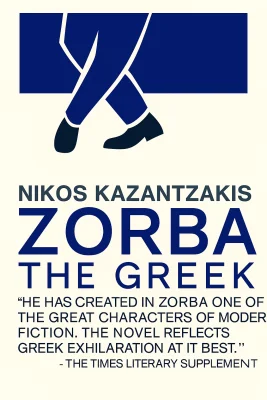
Zorba the Greek
Categories
Philosophy, Fiction, Classics, Audiobook, Historical Fiction, Literature, Greece, 20th Century, Novels, Literary Fiction
Content Type
Book
Binding
Paperback
Year
2000
Publisher
Faber & Faber Ltd
Language
English
ASIN
0571203132
ISBN
0571203132
ISBN13
9780571203130
File Download
PDF | EPUB
Zorba the Greek Plot Summary
Introduction
# Zorba's Dance: A Journey from Books to Life Rain hammered the grimy windows of a Piraeus café as a young intellectual clutched his manuscript about Buddha, preparing to escape to Crete. Through the storm-streaked glass, wild eyes bored into his soul. The door burst open. A weathered stranger of sixty strode in, shaking gray curls free of rainwater. Without invitation, he planted himself at the scholar's table. "Traveling? Where to? Take me with you." This was Zorba—Alexis Zorba—a man who had lived a dozen lives as miner, potter, musician, lover, and wanderer. Something in his directness, his complete absence of hesitation, struck the bookish young man like lightning. Here was life itself, unfiltered and unafraid. Within hours, they had struck a deal. The intellectual would work his inherited lignite mine on a remote Cretan beach. Zorba would manage it. Together, they would venture into the wild heart of an island where ancient passions still ruled, where philosophy met raw existence, and where a man could learn to dance on the edge of the abyss.
Chapter 1: The Fateful Encounter: When Philosophy Meets Raw Life
The Cretan coastline stretched before them like a promise written in sand and stone. Ancient mountains tumbled into an indigo sea, while the nearest village clung to tradition like barnacles to rock. The narrator had come seeking solitude for his writing, but Zorba transformed their crude hut into a university of living. Each morning, Zorba leaped from his bed with the energy of a man half his age, attacking the day with fierce joy. He taught the narrator to see the world through different eyes—not as a collection of philosophical problems to be solved, but as a feast to be devoured. "You think too much," Zorba would growl, watching his employer struggle with abstract concepts. "The head is good for keeping the rain off, nothing more." The lignite mine became Zorba's obsession. He threw himself into the work with passionate intensity, his weathered hands reading the earth's moods like ancient scripture. Thirty lean, sun-darkened workers gathered around him as he barked orders, his authority absolute and unquestioned. The intellectual found himself relegated to observer, watching this vital stranger transform from wandering philosopher to master craftsman. In the evenings, Zorba would unwrap his santuri with the tenderness of a lover undressing his beloved. The music that poured forth was raw, primal—the sound of a soul refusing to be tamed. "Listen, boss," he would say, his fingers dancing across the strings, "this is how a man talks to God—not with words, but with his whole body, his whole soul." Sometimes he would leap up and dance, his aging body defying gravity and time, lost in rhythms older than civilization itself. The contrast between them could not have been starker. While Zorba descended into the earth's bowels each morning, his boss retreated into the world of words, wrestling with a manuscript about Buddha that had haunted him for years. One man embraced the physical world with every fiber of his being, the other sought escape from it through spiritual abstraction. Yet in those firelit evenings, watching Zorba's impossible dances, the intellectual began to question his own bloodless pursuit of enlightenment.
Chapter 2: Building Dreams in Cretan Soil: The Mine and Its People
Their lodging came courtesy of Dame Hortense, a faded French cabaret singer who had washed up on this remote shore like driftwood from a more glamorous age. She was past sixty, with painted wrinkles and desperate optimism, living in a crumbling hotel filled with the ghosts of her former lovers—admirals and pashas who had once showered her with gifts and promises. Her small establishment reeked of cheap perfume and faded dreams, but she welcomed them with the desperate hospitality of the truly lonely. Zorba's eyes gleamed when he saw her—not with desire, but with recognition. Here was another soul who had lived fully, who bore the beautiful scars of experience. "My little Canavaro," she would coo, using the name of a long-dead Italian admiral, her hands fluttering over Zorba's weathered features. Zorba, moved by her pathetic dignity, played along with gentle cruelty, promising marriage while knowing it was a lie that would comfort them both. The mine was producing decent lignite, but transportation remained a nightmare. Mules could only carry so much down the treacherous mountain paths, and profits were being eaten alive by logistics. Zorba's solution was characteristically bold—a cable railway stretching from the monastery's pine forest to the sea, suspended on steel cables and powered by gravity alone. He spent nights hunched over miniature models, calculating angles and tensions with the intensity of a general planning a campaign. His drawings showed tree trunks floating down the mountainside on angel wings, while monks blessed the enterprise from each corner of the page. The plan required renting forest land from the local monastery, a negotiation that would test all of Zorba's considerable charm. As he prepared for departure to Candia to acquire proper equipment, Zorba's eyes held the gleam of a man who had found his calling. This wasn't just about profit—it was about imposing human will upon the indifferent landscape, about making the impossible seem inevitable through sheer audacity and engineering cunning. The cable railway would be his masterpiece, his declaration that dreams could be made manifest through will and steel.
Chapter 3: Love's Dangerous Fire: The Widow's Tragedy and Village Justice
The village harbored its own tensions, centered around a widow whose very presence seemed to charge the air with electricity. She was a woman in her thirties, dark-haired and full-bodied, whose husband had died leaving her vulnerable to village gossip and male desire. She moved through the streets like a black panther, her hips swaying with unconscious provocation, leaving a trail of masculine frustration in her wake. Young Pavli, nephew to the fierce patriarch Mavrandoni, had fallen completely under her spell. His pale face grew paler with each passing day of unrequited longing, his passion consuming him like a fever. He haunted her garden walls and composed clumsy love songs that the whole village could hear, his very existence becoming a reproach to the woman who would not accept him. The widow's reputation was poison. The village women, led by the shrieking Deli-Katerina, declared her a sorceress who lured men to their doom. Her garden of orange trees became a focal point of tension, men finding excuses to pass by her gate, hoping for a glimpse of her tending her fruit. The scent seemed to carry promises of forbidden sweetness, while her very existence challenged the village's careful moral balance. Zorba recognized the danger immediately. "That woman is dynamite," he warned his boss. "She'll set this whole village on fire if someone doesn't handle her properly." The intellectual, despite feeling his own blood quicken whenever she passed, remained paralyzed by analysis and propriety. He could write eloquently about passion, but when confronted with its raw reality, he retreated into the safety of observation. On Easter Sunday, as the village celebrated Christ's resurrection with dancing and wine, the tragedy reached its climax. Pavli, driven beyond endurance by unrequited love, threw himself into the sea rather than live without the widow's acceptance. His body washed ashore like a broken doll, swollen and lifeless, and the village's rage found its target in the woman they blamed for his destruction.
Chapter 4: The Great Catastrophe: When Ambition Meets Reality
Zorba's grand engineering project became a monument to magnificent failure. For months, he had labored with obsessive dedication, installing pylons with the precision of a master craftsman. The narrator watched his friend transform into a man possessed, driven by visions of success that would vindicate all his wild theories about life and luck. The inauguration ceremony drew the entire village, including a delegation of monks from the nearby monastery who had come to bless the enterprise. Zorba had arranged everything with theatrical flair—Greek flags snapping in the breeze, a roasted sheep turning on a spit, and barrels of wine waiting to toast their triumph. The village worthies gathered in their finest clothes, while workmen stood ready at the mountain summit to release the first load of timber. "In the name of the Holy Trinity!" cried the abbot, sprinkling holy water on the machinery. Zorba pulled the signal cord with the pride of a naval commander launching a battleship. The first log hurtled down the mountainside like a meteor, gathering speed until it disintegrated in a shower of sparks and splinters. The crowd scattered as debris rained from the sky. But Zorba was undaunted. "It's nothing!" he shouted, his face flushed with desperate optimism. "The machine needs running in!" He signaled for the second log, then the third, each one ending in spectacular destruction. The final timber shot past the pylons entirely, arcing through the air like a javelin before plunging into the sea with a tremendous splash. One by one, the pylons collapsed like dominoes, the cable snapping with sounds like gunshots. The monks fled, clutching their icons and muttering prayers, while the villagers ran for cover. In minutes, months of work lay in ruins. The narrator sat among the wreckage, watching Zorba calmly carve meat from the abandoned feast. "See how good it is, boss?" Zorba said, his voice steady as stone. "It melts in your mouth." Even in catastrophic failure, he found reasons to celebrate the simple pleasure of being alive.
Chapter 5: The Final Dance: Separation and the Legacy of Living Fully
The catastrophe of the cable railway marked the end of their Cretan adventure, but not before one final tragedy struck. Madame Hortense, the pathetic old courtesan who had pinned her fading hopes on Zorba's promises of marriage, fell ill with pneumonia. She lay dying in her squalid hotel room while the village vultures circled, waiting to strip her possessions like carrion birds. Zorba sat by her bedside as she slipped in and out of delirium, reliving her glory days with phantom lovers. "My little Canavaro," she whispered, pressing a crucifix to her withered breast, mistaking Zorba for the Italian admiral who had been her greatest love. Her parrot watched from its cage, unable to understand why his mistress no longer responded to his calls. When death finally claimed her, the villagers swarmed through her rooms like locusts, fighting over her meager treasures. They stripped the place bare within hours, leaving only a single worn slipper as evidence that she had ever existed. Zorba watched the pillaging with disgust, then gently closed the old woman's eyes and carried her parrot to safety. The narrator knew their time together was ending. The mine was worthless, their money gone, and the village held too many ghosts for them to remain. On their final night, they sat by the sea sharing wine and memories, both knowing they would never meet again but unable to speak the words aloud. "Teach me to dance," the narrator said suddenly, seized by a desperate need to learn Zorba's language before it was too late. Zorba leaped up with joy, his weathered face transformed by delight. "The zeimbekiko!" he cried. "A wild, military dance!" They threw themselves into the ancient steps, their feet pounding the sand like drums, their bodies writing stories in the air that no book could ever capture. In that moment, the intellectual finally understood what Zorba had been trying to teach him all along.
Chapter 6: Beyond Death: Zorba's Eternal Laughter
Years passed like pages torn from a calendar and scattered by the wind. The narrator traveled to distant countries, always carrying Zorba's memory like a talisman against the gray respectability of academic life. Postcards arrived sporadically—from Mount Athos, where Zorba had tried and failed to find peace among the monks; from Romania, where he worked in oil fields and married a buxom local woman; from Serbia, where he discovered another copper mine and another chance at fortune. The final message came from a village schoolmaster near Skoplije, written in careful German script. Zorba had died as he lived—standing upright, gripping a window frame, laughing at death like an old friend who had finally come to collect a long-overdue debt. His last words were characteristically defiant: "Men like me ought to live a thousand years!" The schoolmaster's letter included an invitation from Zorba's widow, Lyuba, to visit and claim the santuri that Zorba had left as his final gift. But the narrator knew he would never make that journey. Some treasures are too precious to be touched by reality. The instrument belonged in memory, where its music could play forever without the risk of silence. Instead, he sat by another sea in another country, remembering the wild Macedonian who had taught him that life was not a problem to be solved but a dance to be danced. Somewhere in the distance, he could almost hear the sound of a santuri playing, its strings vibrating with all the joy and sorrow and magnificent absurdity of human existence. Zorba was gone, but his laughter echoed on, a reminder that the only sin is to live without passion.
Summary
Zorba's story transcends the simple tale of friendship between two men on a remote Greek island. It becomes a meditation on the eternal struggle between thought and action, between the safety of books and the dangerous vitality of lived experience. The narrator's journey from intellectual paralysis to physical expression—culminating in that final dance on the beach—represents nothing less than a spiritual awakening, a recognition that wisdom comes not from renunciation but from complete engagement with life's chaos. The tragedies that punctuate their adventure—the widow's brutal death, Hortense's pathetic end, the spectacular failure of the cable railway—serve not as cautionary tales but as affirmations of Zorba's central philosophy. Better to risk everything and fail magnificently than to succeed at nothing worth attempting. In the end, Zorba's greatest gift was not his wisdom but his example: the sight of a man refusing to surrender to time, dancing on the edge of the abyss with undiminished joy, proving that the human spirit can triumph over mortality through the simple act of living fully, passionately, and without apology.
Best Quote
“I felt once more how simple and frugal a thing is happiness: a glass of wine, a roast chestnut, a wretched little brazier, the sound of the sea. Nothing else.” ― Nikos Kazantzakis, Zorba the Greek
Review Summary
Strengths: The review highlights the book's profound impact on the reader during a challenging time, emphasizing its philosophical depth and life-affirming message. The narrative is praised for its simplicity, humor, and truthfulness, capturing the essence of living fully and embracing life's uncertainties. The book is described as a timeless work that transcends cultural boundaries, offering a genuine portrayal of human nature versus societal constructs. The film adaptation is also commended for its faithful representation of the novel. Overall: The reader expresses a deeply personal connection to the book, recommending it highly for its philosophical insights and life lessons. The book is portrayed as a powerful, transformative read that encourages embracing life with vigor and authenticity.
About Author

Nikos Kazantzakis
Kazantzakis explores the intersection of existentialism and spirituality through his profound literary works, reflecting a relentless quest for meaning and transcendence in modern life. His themes often delve into the complexities of freedom, death, and faith, navigating the tension between reason and belief. This thematic inquiry is evident in his novel "Zorba the Greek," which embodies the essence of living life with unbridled freedom, and "The Last Temptation of Christ," a controversial psychological exploration of Jesus. By weaving modernist elements with deep philosophical questions, Kazantzakis offers readers a unique blend of narrative and intellectual challenge.\n\nHis method of integrating philosophy into literature serves not only to entertain but also to provoke thought, encouraging readers to engage with existential and spiritual dilemmas. Works like "The Odyssey: A Modern Sequel," an epic poem that continues Homer’s narrative, and "Askitiki," which investigates spiritual asceticism, showcase his capacity to extend traditional forms and ideas into new territories. Meanwhile, his politically infused narratives, such as "Freedom or Death," resonate with themes of resistance and identity, reflecting the socio-political struggles of Cretan Greeks.\n\nReaders of Kazantzakis's books gain insight into the human condition, fostering a deeper understanding of both personal and collective challenges. His legacy as a widely translated Greek author ensures that his works continue to reach diverse audiences, offering them opportunities to reflect on universal themes through a culturally rich lens. As a figure honored with the International Peace Award and multiple Nobel Prize nominations, Kazantzakis’s impact extends beyond literature into cultural and philosophical discourse, solidifying his place in the literary canon.
Read moreDownload PDF & EPUB
To save this Black List summary for later, download the free PDF and EPUB. You can print it out, or read offline at your convenience.
Zorba the Greek
by Nikos Kazantzakis
