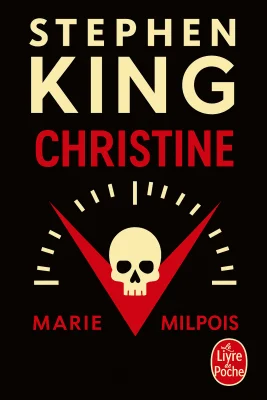
Christine
Categories
Fiction, Audiobook, Horror, Mystery, Thriller, Fantasy, Suspense, Paranormal, Supernatural, Horror Thriller
Content Type
Book
Binding
Paperback
Year
2001
Publisher
LGF
Language
English
ISBN13
9782253147695
File Download
PDF | EPUB
Christine Plot Summary
Introduction
# Christine: The Devil's Bargain on Four Wheels The summer heat shimmered off Roland LeBay's cracked driveway when seventeen-year-old Arnie Cunningham first laid eyes on her. Christine—a rusted, dying 1958 Plymouth Fury with a FOR SALE sign propped against her spider-webbed windshield. Something electric passed between boy and machine in that moment, a connection that would prove more dangerous than first love and more consuming than obsession. Dennis Guilder watched his best friend fall under Christine's spell with growing unease. What began as a teenager's innocent desire for wheels quickly transformed into something darker. The car seemed to change Arnie from the inside out, clearing his acne, strengthening his frame, and hardening his once-gentle nature. But Christine demanded more than restoration—she demanded devotion. And in the shadows of Will Darnell's garage, where the Plymouth slowly returned to her former glory, Dennis began to suspect that some machines carry more than rust and oil in their bones. They carry memories, grudges, and an appetite for revenge that twenty years of decay had only sharpened.
Chapter 1: The Fateful Encounter: A Boy Meets His Destiny
The August afternoon blazed mercilessly as Dennis drove his best friend home from their construction job. Arnie Cunningham sat beside him, the same scrawny, acne-scarred kid he'd known since childhood—until they rounded the corner onto LeBay's street. That's when Arnie's eyes bulged behind his steel-rimmed glasses, and he grabbed Dennis's arm with desperate fingers. "Stop the car! Go back!" Arnie's voice cracked with an urgency Dennis had never heard before. There on the dying lawn sat a 1958 Plymouth Fury, her red and white paint job faded to the color of dried blood and old bones. The left windshield was a spider's web of cracks, the rear deck bashed in, upholstery bleeding through torn seat covers like exposed wounds. Roland LeBay emerged from his house—a skeletal man in his seventies, his scalp mottled with psoriasis, wearing a yellowed back brace like armor. His pale eyes gleamed with predatory recognition as he sized up his mark. This was a man who had spent decades in the Army, fighting what he called "the shitters"—everyone who had ever crossed him or stood in his way. "She's been with me since 1957," LeBay wheezed, his voice carrying the weight of old grudges. "Brand new off the lot. Had the smell of a new car then—finest smell in the world." His crude laugh revealed teeth like broken tombstones. The hot air that billowed from Christine's open door reeked of age and decay, but Arnie breathed it in like perfume. Arnie circled the wreck like a man possessed, his hands trembling as he traced her rusted flanks. "Look at her lines, Dennis," he whispered, his voice thick with something approaching reverence. Dennis watched in horror as Arnie's checkbook materialized, the boy's hands steady now with terrible purpose. Two hundred and fifty dollars changed hands, along with something less tangible but far more valuable—the first piece of Arnie Cunningham's soul. As they drove away, Dennis caught sight of LeBay in his rearview mirror, standing on his diseased lawn with tears streaming down his weathered cheeks, as if he'd just buried his only child. The old man's smile held the satisfaction of someone who had just passed along a curse to the next generation.
Chapter 2: Twin Resurrections: Metal and Flesh Transformed
Will Darnell's garage squatted on the outskirts of Libertyville like a mechanical graveyard. Darnell himself was a mountain of a man, wheezing and corrupt, his establishment serving as both auto shop and front for various criminal enterprises. But he recognized something in Arnie's dedication that amused him—or perhaps served his purposes. The change began immediately, subtle as poison seeping through skin. Within days of buying Christine, Arnie's complexion started clearing—not gradually, as teenage acne usually fades, but with startling rapidity. The angry red pustules that had marked him as an outcast simply vanished, leaving behind a face that was not just clean but somehow older, harder, more defined. Dennis found his best friend increasingly absent, spending every free moment at the garage. When Arnie did surface, he spoke only of Christine—her needs, her progress, her beauty waiting to emerge from beneath the rust. The obsession consumed him like a fever, burning away everything that had made him recognizably himself. The restoration progressed in strange, haphazard ways that defied logic. Arnie would replace a radio antenna while the exhaust system dragged on the ground, install new seat covers while the engine block leaked oil like a hemorrhaging wound. Yet somehow, impossibly, Christine began to improve. New parts appeared as if by magic—a pristine grille here, fresh chrome there, each addition bringing her closer to her former glory. "That boy's got it bad," Darnell told his poker buddies, watching Arnie crawl beneath Christine's chassis for the third time that evening. "Seen plenty of kids fall for cars, but this one's different. This one's got the sickness." When Dennis suggested that the restoration was consuming too much of Arnie's life, his friend's response was swift and cutting, delivered in a voice that carried an echo of something ancient and implacable. "You don't understand," Arnie said, his gray eyes developing a flat, dangerous quality. "She needs me. And I need her." The gentle boy who had once been afraid of his own shadow now carried himself with the swagger of someone who owned the world—or was owned by it.
Chapter 3: Love Triangle: Flesh, Blood, and Steel
Leigh Cabot arrived at Libertyville High like a vision from another world—honey-blonde hair, dark blue eyes, and a natural beauty that made other girls seem like rough sketches. She was everything Arnie had never dared to dream of: popular, intelligent, and impossibly out of his league. Yet somehow, impossibly, she noticed him. The transformation Christine had wrought in Arnie was subtle but undeniable. His cleared complexion revealed strong bone structure that had been hidden beneath years of acne. His newfound confidence, born of mastering the mechanical mysteries of his car, translated into an unexpected magnetism. When Leigh asked him about a homework assignment, their eyes met with the electric recognition of mutual attraction. Their first real date nearly became their last. Driving back from the movies in Christine, Leigh began choking on a piece of hamburger. But instead of pulling over to help her, Arnie seemed paralyzed, his hands frozen on the steering wheel while she clawed at her throat. The car's radio began playing music from the 1950s, and the dashboard lights seemed to pulse with malevolent life. The thick, cloying odor of death and decay seemed to pour from Christine's upholstery. In those terrifying moments when Leigh thought she was dying, she could have sworn the car was enjoying it. Only the quick thinking of a hitchhiker they'd picked up saved her life, applying the Heimlich maneuver while Arnie stood frozen. "There's something wrong with that car," she told Dennis later, her voice shaking with remembered terror. "It tried to kill me. I know how that sounds, but it's true. And Arnie... it was like he wasn't even there. Like something else was driving." When she finally broke up with Arnie, giving him an ultimatum to choose between her and the car, his response revealed how completely he had changed. "You're just jealous," he snarled, his face twisting with ancient spite. "You can't stand that I love something more than you." The boy who had once worshipped her was gone, replaced by something that looked at her with cold contempt. That night, Christine sat in the Cunningham driveway, her chrome gleaming in the moonlight, her headlights flickering once like a predator's eyes opening in the dark.
Chapter 4: Wheels of Vengeance: Death Rides at Midnight
Buddy Repperton and his gang made their fatal mistake on a November night when they thought Arnie Cunningham needed to be taught a lesson. The hulking sociopath who had been expelled for pulling a knife on Arnie led his crew—Don Vandenberg, Moochie Welch, and Sandy Galton—in breaking into Darnell's garage. They spent hours systematically destroying Christine, smashing her windows, slashing her tires, and spray-painting obscenities across her perfect paint job. But Christine had been through worse before, and she had learned to hate with a patience that spanned decades. While Arnie was safely away at a chess tournament in Philadelphia, establishing the perfect alibi, something else took the wheel. The car that had witnessed such anguish, such deliberate death, carried those dark emotions in her very steel and chrome, waiting for the right moment to express them again. Moochie Welch was the first to die, caught on a deserted stretch of JFK Drive in the early morning hours after Thanksgiving. The police found what remained of him scattered across fifty yards of asphalt, his body pulverized by repeated impacts. The hit-and-run driver had backed up and run him down again and again, as if killing him once wasn't enough to satisfy whatever rage had motivated the attack. Detective Rudolph Junkins stood in the cold dawn light, studying the scene with the methodical patience of a man who'd seen too much human cruelty to be easily shocked. But this felt different—more personal, more vicious than the usual drunk-driving fatalities. The killer had taken time with Moochie, savoring each impact like a connoisseur sampling fine wine. Three weeks later, Buddy Repperton and his remaining crew met their end in the snow-covered hills outside town. Their Camaro was found wrapped around a concrete barrier, burned to a skeletal frame that barely resembled a car. The official report blamed alcohol and reckless driving, but Junkins noticed details that didn't fit—skid marks that suggested another vehicle had been involved, traces of red paint embedded in the victims' flesh. The paint matched Christine's color scheme perfectly.
Chapter 5: The Possession Complete: When Evil Takes the Wheel
By winter, the boy who had been Arnie Cunningham existed only as a shell, a puppet dancing to the will of Roland D. LeBay's malevolent spirit. The research Dennis had conducted revealed the full scope of the horror—LeBay hadn't been just any owner. He had been Christine's first and only love, a man whose bitterness had poisoned everything he touched for over two decades. LeBay's brother George painted a portrait of a man consumed by rage from childhood, someone who would throw a three-year-old brother onto a picket fence for getting in his way, hold a knife to his wife's throat when she wouldn't give him drinking money. The Army had been his natural home, a place where his capacity for cruelty could flourish under the guise of discipline. But it was Christine who had finally given Roland's life meaning. He had ordered her custom-painted in red and white—colors Plymouth never offered—and had lavished upon her all the love he had never shown another human being. When his six-year-old daughter Rita choked to death during one of their Sunday drives, any normal parent would have traded the car immediately. But LeBay kept Christine, polished and perfect. Six months later, his wife Veronica drove Christine into the garage, fitted a hose to the exhaust pipe, and fed the other end through the rear window. She died breathing the same poisoned air that had carried her daughter's last breath, choosing Christine as both the instrument and witness of her final act. Now LeBay's spirit, bound to Christine by decades of obsession and hate, had found the perfect host in lonely, desperate Arnie Cunningham. The boy's need for love and acceptance had made him vulnerable, and LeBay had poured himself into that emptiness like poison into a wound. When Dennis tried desperately to reach whatever remained of his friend, it was like shouting into a hurricane. "You stole my girl," Arnie said during their final conversation, his voice carrying the weight of ancient grievances. But it wasn't really Arnie speaking—it was LeBay, using his young body like a ventriloquist's dummy. The possession was complete, total, and seemingly irreversible.
Chapter 6: Final Confrontation: Crushing the Devil's Machine
Dennis knew that conventional weapons would be useless against something that could heal itself, so he chose the most unconventional weapon he could find—a massive septic tank truck he and Leigh had commandeered. If Christine was going to be destroyed, it would take something with the weight and power to crush her beyond any possibility of regeneration. The trap was set at Darnell's garage on a snowy January night. Dennis and Leigh waited in the darkness, knowing that Christine would come for them eventually. LeBay's hatred was too pure, too focused, to let them live with the knowledge of what they had discovered. The car's impossible self-repair, her backward-running odometer counting down to some unknown zero point, the way she seemed to anticipate needs before they were voiced—she was more than a machine now. She came like a red and white nightmare, her headlights blazing through the falling snow. The battle that followed was less a fight than an execution. Dennis used the truck's massive bulk to batter Christine again and again, crushing her steel body into twisted metal. But even as she died, Christine fought back with supernatural fury, her engine screaming defiance until the very end. The garage became a battlefield of sparks and screaming metal as Christine tried desperately to escape the relentless pounding. Her perfect paint job cracked and peeled, her chrome twisted into grotesque shapes, her engine block finally cracking with a sound like a dying scream. Yet still she fought, driven by twenty years of accumulated hatred and the malevolent will of her long-dead master. In those final moments, Dennis caught a glimpse of something that would haunt him forever—a face in Christine's rear window that might have been Arnie's, no longer possessed but finally free, as his prison of steel and chrome collapsed around him. The boy Dennis had tried so hard to save had found his own way to break LeBay's hold, choosing destruction over eternal servitude. When the Pennsylvania State Police found the wreckage, they saw only the remains of a car that had been crushed beyond recognition. But Dennis knew better. He had seen the way the metal seemed to quiver even in death, as if some part of LeBay's malevolent spirit still clung to the twisted steel.
Chapter 7: Echoes of Darkness: The Price of Obsession
The official story was neat and tragic—a family destroyed by a series of unfortunate accidents. Michael Cunningham found dead in his garage from carbon monoxide poisoning, while his wife Regina and son Arnie died in a car crash on the Pennsylvania Turnpike. The newspapers called it a terrible coincidence, but Dennis knew the truth was far more horrible. Christine's remains were compressed into a cube of scrap metal and supposedly disposed of, but Detective Junkins's silence when Dennis asked about it suggested that even in death, the car inspired unease. Some hungers, Dennis had learned, were too strong for mere destruction to satisfy. The boundary between the mechanical and the supernatural had been crossed, and the crossing had left scars that would never fully heal. Years passed, and Dennis tried to build a normal life. He graduated from college, became a teacher, even found love again—though never with the desperate intensity that had marked his relationship with Leigh Cabot. She had moved away, married, and started a family, but their occasional correspondence carried an unspoken understanding of the darkness they had survived together. But the nightmares never completely stopped. Dennis would dream of Christine restored to her malevolent glory, hunting through the streets with her headlights blazing like the eyes of something that had never learned to forgive or forget. He would wake in cold sweats, his hand instinctively reaching for his injured leg, where the old wounds still ached on snowy nights. The final horror came in a newspaper clipping years later—a brief item about a man killed when a car crashed through the wall of a drive-in theater in California. The victim's name was Sandy Galton, the one member of Repperton's gang who had escaped Christine's initial rampage by leaving town. Even in death, it seemed, the Plymouth's appetite for vengeance remained unsatisfied. Dennis kept the clipping in his wallet for years, a reminder that some hungers transcend the boundaries between life and death, between the mechanical and the supernatural. In the end, Christine had proven that love and hate were merely different faces of the same terrible obsession, and that some bonds, once forged in blood and steel, could never truly be broken.
Summary
Christine's story ultimately revealed itself as a meditation on the seductive nature of power and the terrible cost of absolute devotion. Arnie Cunningham's transformation from awkward teenager to something cold and merciless was complete, his humanity sacrificed on the altar of his obsession with a machine that had become the vessel for Roland LeBay's festering hatred. The car had given him confidence, respect, and the ability to strike back at those who had wronged him—but the price was his soul, traded away one small compromise at a time until nothing remained but an empty shell animated by ancient rage. The true horror lay not in the supernatural elements, but in the recognition that such obsessions exist in the real world—the need to possess and control, the inability to let go, the way love can curdle into something monstrous when it becomes an end in itself. Christine was LeBay's monument to his own inability to accept loss, a steel and chrome sarcophagus that preserved his hatred long past the point where it should have turned to dust. In the frozen streets of Libertyville, love and death had merged into a single, unstoppable force that would not rest until every slight was avenged and every enemy destroyed. The machine may have been crushed, but the lesson remained eternal: some hungers are too strong for death to satisfy, and some loves are too twisted to ever truly die.
Best Quote
“I think part of being a parent is trying to kill your kids.” ― Stephen King, Christine
Review Summary
Strengths: The review highlights the intriguing and creepy storyline of "Christine," featuring a possessed 1958 Plymouth Fury with a menacing presence. The novel includes a diverse cast of characters, including teens, bullies, and an evil supernatural element, which adds depth to the narrative. The nostalgic references to the 50s and 60s music and culture are appreciated. Weaknesses: The book's length is criticized as excessive, with the narrative being too wordy and lacking sufficient substance. The reviewer expected more intense and graphic events, similar to other Stephen King works, which were not delivered. Overall: The reader expresses mixed feelings about "Christine," acknowledging its engaging elements but finding it less compelling than other Stephen King novels. The recommendation is lukewarm, suggesting it may not be a top choice for all fans.
About Author

Stephen King
King interrogates the boundaries between the supernatural and the ordinary, using his writing to delve into the dark recesses of human nature. His early life experiences in Maine, marked by familial challenges and economic instability, deeply influenced his narrative style and thematic focus. These experiences led him to explore themes of isolation and fear in works like "Carrie" and "The Shining". His storytelling often revolves around small-town settings infused with supernatural elements, where the horror of the unknown mirrors the inner turmoil of his characters.\n\nStephen King's career, notably marked by his ability to blend horror with elements of suspense and psychological depth, has made a profound impact on literature and popular culture. While his breakthrough book, "Carrie", allowed him to transition from teaching to full-time writing, his subsequent works, such as "Salem's Lot" and "The Dead Zone", further cemented his status as a master of modern horror. Beyond his books, King’s contribution to literature has been recognized through numerous awards, highlighting his influence in transforming horror into a respected literary genre. \n\nFor readers and aspiring writers, King's bio serves as a testament to the power of perseverance and the importance of grounding fantastical narratives in relatable human experiences. His work not only entertains but also offers a lens through which to examine societal fears and personal anxieties. The author’s profound impact on horror and beyond demonstrates the enduring relevance of his storytelling methods, which continue to inspire and captivate audiences worldwide.
Read moreDownload PDF & EPUB
To save this Black List summary for later, download the free PDF and EPUB. You can print it out, or read offline at your convenience.

Christine
by Stephen King
