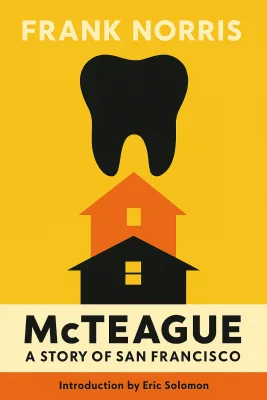
McTeague
A Story of San Francisco
Categories
Fiction, Classics, Historical Fiction, Literature, American, School, 19th Century, Novels, Literary Fiction, College
Content Type
Book
Binding
Mass Market Paperback
Year
2003
Publisher
Signet Classics
Language
English
ASIN
0451528913
ISBN
0451528913
ISBN13
9780451528919
File Download
PDF | EPUB
McTeague Plot Summary
Introduction
# The Golden Tooth: A Tale of Greed and Ruin The massive golden tooth swings in the San Francisco fog like a gilded pendulum marking time toward disaster. Below it, in rooms reeking of ether and carbolic acid, McTeague practices his brutal dentistry with the delicate precision of a blacksmith. His hands, enormous and hairy as a gorilla's, can crack walnuts between thumb and forefinger, yet somehow manage the intricate work of drilling and filling human teeth. The big man knows nothing of proper training or licenses—only the crude techniques learned from a traveling charlatan in the gold fields. When Marcus Schouler brings his cousin Trina for treatment, something stirs in McTeague's primitive soul that will destroy them all. The delicate girl with masses of blue-black hair becomes an obsession that transforms the simple dentist into something dangerous. But it's the lottery ticket in Trina's pocketbook—five thousand dollars in sudden wealth—that plants the seeds of their mutual destruction. What begins as love and friendship will spiral into betrayal, violence, and murder, as three lives become entangled in the golden web of avarice that glitters as falsely as the tooth hanging outside McTeague's window.
Chapter 1: The Simple Life: McTeague's World Before Love and Money
McTeague's Sundays follow the same ritual as the cable cars that screech past his window. Heavy soup at the car conductors' coffee joint, then back to his dental parlors with a pitcher of steam beer. He strips to his vest, feeds coke to his stove, and settles into his operating chair to read the paper. The rooms smell of ether and cheap tobacco, while his canary trills from its gilt cage. This is contentment for a man whose needs are simple as an animal's. The dentist is a giant among men—six feet three inches of slow-moving flesh and bone, with a shock of yellow hair and hands that dwarf ordinary mortals. His mind works like his body, ponderous and deliberate, shaped by years in the Big Dipper Mine where his father died coughing blood into a tin cup. A traveling dental charlatan taught him the trade, and McTeague learned it with the same methodical patience he once applied to swinging a pickaxe. From his bay window perch, he watches Polk Street's daily theater unfold. Dawn brings laborers trudging past with lunch pails, followed by clerks hurrying toward the cable cars. The fashionable ladies from the avenue above appear for their marketing, commanding their grocers with quiet authority. But McTeague remains apart from it all, content in his isolation above the street's commerce and conversation. His only friend is Marcus Schouler, a volatile young man who works at the dog hospital and fills the air with passionate speeches about labor rights. Marcus is everything the dentist is not—quick, excitable, full of grand gestures and empty phrases about the downtrodden masses. Yet somehow they have become companions, bound together by shared meals and mutual loneliness in the great indifferent city. Neither man suspects that friendship will soon become the instrument of their mutual destruction.
Chapter 2: Fortune's Kiss: The Lottery Win and Marriage
The wedding celebration erupts in McTeague's dental parlors like champagne from a shaken bottle. Trina, radiant in white silk and orange blossoms, sits beside her massive husband while their guests feast on oyster soup and roast goose. The photographer's rooms, hastily converted for the ceremony, overflow with laughter and the clink of borrowed glasses. Old Grannis, the timid bookbinder, trembles with the honor of serving as best man. But the evening's true drama unfolds when Maria Macapa, the half-mad Mexican cleaning woman, bursts through the door with news that stops every conversation cold. Trina's lottery ticket has won the grand prize. Five thousand dollars. The sum hangs in the air like incense, transforming every face in the room. Marcus forces a smile that doesn't reach his eyes—he had courted Trina first, stepping aside for friendship's sake, never imagining such fortune would follow. The lottery agent arrives with the evening paper to verify the impossible. Number 400,012. The winning ticket that Trina bought almost by accident, more to be rid of Maria's persistent sales pitch than from any hope of winning. Now the simple dental assistant and his bride have been lifted from their modest world into something larger and more dangerous. The golden tooth outside McTeague's window catches the gaslight as the celebration continues, but something has shifted in the room's atmosphere. As the guests finally depart, McTeague finds himself alone with his wife and a fortune that seems too vast to comprehend. Trina clutches his massive arm, her eyes bright with possibility, while somewhere in the shadows of memory, Marcus retreats with his jaw working in suppressed rage. The lottery ticket, innocent as paper, has planted seeds that will grow into something monstrous. Neither bride nor groom can imagine how this windfall will poison everything it touches, transforming their simple love into an obsession that will consume them both.
Chapter 3: Betrayal's Sting: Marcus's Revenge and Professional Ruin
The friendship between McTeague and Marcus dies slowly, like a wound that festers in silence. What begins as sullen glances across their usual lunch table escalates into bitter accusations. Marcus cannot forget that he gave up Trina—and unknowingly, her fortune—for the sake of loyalty. The knowledge eats at him like acid, transforming his generous nature into something twisted and vengeful. At Frenna's saloon, he drinks and rages about being "played for a sucker," how his sacrifice has been repaid with betrayal. The confrontation comes on a night thick with cigarette smoke and whiskey fumes. Marcus, his face flushed with drink and rage, hurls accusations at the bewildered dentist. The money should have been his, he claims. McTeague owes him everything. When the dentist's pipe smoke drifts into Marcus's face, the smaller man explodes with fury, knocking the porcelain pipe from McTeague's lips. It shatters against the far wall like their friendship, and then Marcus's hand moves to his jacket. Steel flashes in the gaslight. The knife spins through the air, missing McTeague's head by inches before embedding itself in the wooden wall with a solid thunk. The saloon falls silent. Death has passed between them, leaving only hatred in its wake. Marcus flees into the night, but his revenge is just beginning. He knows exactly where to strike—not at the man's body, but at his livelihood. Months later, the official notice arrives at McTeague's door like a death sentence. The State of California has discovered that the dentist never attended dental college, never earned the right to practice. Someone has informed the authorities—someone who knew exactly how to destroy everything McTeague has built. The massive man stares at the legal document, his thick fingers tracing words that spell his doom. Marcus's knife may have missed its mark, but his true weapon has found its target with surgical precision.
Chapter 4: The Descent: Poverty, Obsession, and Violence
The golden tooth comes down from its perch outside the window, wrapped in newspapers like a corpse. McTeague's dental parlors, once filled with the whir of his engine and the sharp scent of carbolic acid, stand empty and silent. The instruments that had been extensions of his hands are sold to other dentists who possess the magical paper that grants them legitimacy. The big man wanders through his former domain like a ghost, touching familiar surfaces that no longer belong to him. Trina watches her husband's transformation with growing alarm, but her own nature is changing too. The five thousand dollars, safely invested with Uncle Oelbermann, becomes more than security—it becomes an obsession that consumes her waking thoughts. She hoards every penny with the fervor of a miser, counting and recounting her growing pile of coins hidden in a chamois bag. The neat, cheerful housewife who once took pride in their comfortable rooms becomes a penny-pinching harridan who grudges every expenditure. Their descent accelerates with each failed attempt at employment. McTeague's clumsy efforts at factory work end in disaster, his massive frame unsuited to delicate tasks. The police force rejects him despite his physical prowess—his stupidity is too obvious, his manner too brutish. They abandon their comfortable suite for progressively cheaper quarters, finally settling in a single whitewashed room that reeks of cooking grease and desperation. The first blow falls on a rain-soaked evening when McTeague returns from another fruitless day of job hunting. Whiskey burns in his veins, transforming his usual stolid nature into something quick and cruel. When Trina refuses him money for drinks, his massive hand shoots out, pinching her arm with fingers like steel clamps. Her scream of pain only fuels his savage pleasure, and he discovers a new way to extract what he wants from his miserly wife. The violence escalates with each passing week, McTeague's enormous strength becoming a weapon of intimidation as Trina's obsession with gold deepens into madness.
Chapter 5: Blood and Gold: Murder and the Final Theft
The breaking point arrives on a rain-soaked evening when desperation finally overwhelms whatever restraint McTeague still possesses. Unemployed for months, reduced to odd jobs that barely provide drinking money, he discovers that Trina has withdrawn her entire five thousand dollars from Uncle Oelbermann's keeping. The knowledge that she sits on this fortune while denying him even carfare ignites a rage that alcohol has been building for months. He finds her in the kindergarten where she works as a scrub woman, her hands raw from washing floors, her once-beautiful hair hanging in greasy tangles. The building is empty except for Trina, working late to prepare for a children's Christmas party. When McTeague appears in the doorway, drunk and swaying, she knows immediately that this night will be different. His small eyes hold a terrible finality that makes her blood turn to ice water. "I want that money," he says, his voice deadly calm. "All of it. Every nickel." Trina backs away, her cleaning rags forgotten, water dripping from her reddened hands. She tries to reason with him, to bargain, but McTeague is beyond negotiation. The animal in him has finally broken free of its chains. When she refuses for the final time, his massive fist crashes into her face with the force of a sledgehammer. The violence that follows is swift and terrible. In the small cloakroom where children hang their coats, McTeague beats his wife to death with his bare hands. Her small body offers no resistance to his enormous strength. The deed done, he stands panting over her broken form, then methodically searches her room above the school. He finds the canvas sack crammed with gold pieces, the chamois bag, the brass matchbox—all the hoarded wealth that has poisoned their marriage. By morning, Trina lies cold in a pool of her own blood while McTeague flees the city with her fortune, the massive dentist having finally claimed his wife's treasure at the ultimate price.
Chapter 6: Into the Wasteland: Flight and Pursuit
McTeague runs like a wounded animal, his instincts driving him toward the mountains of his youth. He takes a freight train south through Nevada, his stolen fortune weighing heavy in a canvas sack, his canary cage wrapped in flour sacks—the last remnant of his former life. The other passengers assume he's a horse doctor fleeing some violent crime, and they're not entirely wrong. The man who once pulled teeth in a San Francisco dental parlor has become something primitive and dangerous. In the mining country near Death Valley, he finds temporary refuge working at the Big Dipper mine under the name Burlington. The familiar rhythm of pick and shovel, the camaraderie of the night shift, the honest exhaustion of physical labor—all of it feels like coming home. For weeks he loses himself in the underground darkness, his massive frame perfectly suited to the brutal work. But some animal instinct warns him of approaching danger, a sixth sense that prickles along his spine during the long desert nights. Marcus Schouler has been tracking him across hundreds of miles of wasteland, transformed into something lean and predatory during his months as a cowboy. The former dental student burns with the fever of pursuit, driven by rage and the promise of reward money. When the sheriff and his deputies finally arrive at the mine, McTeague has already vanished into the wilderness, following trails only a former miner would know. His flight takes him deeper into the wasteland, where even experienced prospectors fear to venture. The desert becomes both sanctuary and trap as McTeague flees eastward toward Death Valley, carrying his stolen gold and his caged canary. He leaves behind the last traces of civilization, the man who began as a simple dentist now stripped down to his essential nature—a creature of appetite and violence, running toward a confrontation that has been inevitable since the first lottery ticket was drawn. Behind him, Marcus follows with the patience of a hunting wolf, closing the distance with each passing day.
Chapter 7: Death Valley Reckoning: The Final Confrontation
The desert sun beats down like a hammer on an anvil when Marcus finally catches up with his quarry in the heart of Death Valley. The alkali flats stretch endlessly in every direction, white as bone, shimmering with heat mirages that promise water where none exists. McTeague's mule lies dead between them, shot in Marcus's desperate attempt to stop the animal that carried their only hope of survival. The burst canteen has already surrendered its precious contents to the thirsty sand. "Hands up!" Marcus shouts, his revolver trained on the massive figure stumbling through the wasteland. McTeague turns slowly, his face burned black by the sun, his clothes hanging in tatters. His small eyes, nearly swollen shut from the glare, focus on his former friend with the dull recognition of a wounded beast. They are dead men now, both of them, trapped in a furnace that will kill them in hours. Yet even facing certain death, the old hatred flares between them like the heat shimmer rising from the desert floor. The canvas sack with its five thousand dollars in gold pieces hangs from the dead mule's saddle, and both men know that whoever claims it will die rich, if nothing else. The fight is brief but savage. McTeague's enormous strength overwhelms Marcus's speed and cunning, his fists pounding like sledgehammers until his enemy's struggles cease. But in his final moments, Marcus manages one last act of spite—he snaps a pair of handcuffs around their wrists, chaining the living to the dead with bonds that cannot be broken. McTeague stands alone in the vast emptiness, shackled to Marcus's corpse, the fortune in gold coins scattered uselessly around them. The sun climbs higher, promising death by degrees in the furnace of the desert. His canary, somehow still alive in its little gilt cage, chirps feebly in the silence. The man who began by pulling teeth has been reduced to his most basic elements—flesh, bone, and the terrible weight of choices that can never be undone. In the measureless desolation of Death Valley, McTeague faces the final reckoning of his appetites, alone except for the dead man's company and the mocking song of a caged bird that will soon join them both in the democracy of death.
Summary
Frank Norris crafts a tale of inexorable destruction, where human nature reveals itself as fundamentally bestial when stripped of civilization's restraints. McTeague's journey from simple dentist to murderer follows the logic of naturalistic determinism—each choice leading inevitably to the next, each character trapped by forces beyond their understanding or control. The golden tooth that promised prosperity becomes a monument to human folly, presiding over lives destroyed by the very fortune meant to save them. In Norris's brutal vision, the thin veneer of civilization cannot contain the primitive drives that govern human behavior. Love becomes possession, friendship transforms into betrayal, and survival becomes the only law that matters. The gold that promises freedom becomes the instrument of enslavement, while the desert that offers escape becomes the final judge. McTeague achieves a terrible kind of purity in the end—reduced to his essential nature, he faces eternity chained to the consequences of his choices, alone in a landscape as pitiless as the human heart itself.
Best Quote
“It belonged to the changeless order of things---the man desiring the woman only for what she withholds; the woman worshipping the man for that which she yields up to him. With each concession gained the man′s desire cools; with every surrender made the woman′s adoration increases...” ― Frank Norris, McTeague: A Story of San Francisco
Review Summary
Strengths: The review highlights the book's gripping narrative and emotional depth, noting its ability to evoke strong emotions such as passion, hate, greed, love, violence, and horror. The characters, despite being deeply flawed, are portrayed in a way that makes readers care about them and their deteriorating relationships. Weaknesses: The review points out the novel's coarseness, vulgarity, and unsettling content, which were condemned by contemporary reviewers. It suggests that the book's depiction of poverty and violence may be disturbing to some readers. Overall: The review conveys a mixed sentiment, acknowledging the novel as a minor American classic with a compelling story and a powerful finale. However, it warns potential readers about its unsettling themes and coarse content, suggesting it may not be a pleasant read for everyone.
About Author

Frank Norris
Norris investigates the interplay between human nature and societal forces through the lens of naturalism, engaging deeply with the notion of the civilized man grappling with his primal instincts. His work is characterized by a preoccupation with the inner "brute" within individuals, a theme prominently explored in his book "McTeague". This focus is influenced by philosophical ideas such as those of Thomas Henry Huxley on Darwinism and the criminological theories of Cesare Lombroso, as well as the literary techniques of Émile Zola. Norris synthesizes these influences to illustrate the struggle between man's base desires and societal expectations, offering a nuanced view of human behavior during the Progressive era.\n\nIn crafting narratives that explore societal conflicts and personal struggles, Norris extends beyond traditional storytelling to evoke a socialist mentality, even though he did not openly endorse socialism as a political stance. His books, like "The Octopus: A California Story" and "The Pit", reveal how economic and social structures impact individuals, therefore inspiring writers such as Upton Sinclair. By studying under Joseph LeConte at the University of California, Berkeley, Norris absorbed an optimistic strand of Darwinist philosophy, which permeates his bio in both theme and method, connecting broader scientific debates to individual fates.\n\nReaders interested in the intersections of naturalism, social critique, and philosophical thought will find Norris's work compelling. His novels serve as a platform to interrogate societal dynamics and human impulses, therefore offering valuable insights into the human condition. By weaving scientific and philosophical ideas into his narratives, Norris provides a rich, multifaceted exploration of American life, making his literature a significant study for those interested in the socio-political influences on personal identity and behavior.
Read moreDownload PDF & EPUB
To save this Black List summary for later, download the free PDF and EPUB. You can print it out, or read offline at your convenience.
McTeague
by Frank Norris
