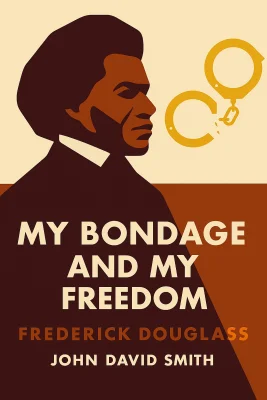
My Bondage and My Freedom
Categories
Nonfiction, Biography, History, Memoir, Politics, Classics, Autobiography, African American, American History, Race
Content Type
Book
Binding
Paperback
Year
2003
Publisher
Penguin Classics
Language
English
ASIN
0140439188
ISBN
0140439188
ISBN13
9780140439182
File Download
PDF | EPUB
My Bondage and My Freedom Plot Summary
Introduction
# Frederick Douglass: From Bondage to Voice In the annals of American history, few figures embody the transformative power of education and self-determination quite like Frederick Douglass. Born into the brutal reality of slavery in Maryland around 1818, Douglass would rise to become one of the most eloquent voices for human freedom the world has ever known. His journey from chattel property to internationally renowned orator and author represents not merely personal triumph, but a testament to the indomitable nature of the human spirit when confronted with systematic oppression. What makes Douglass's story particularly compelling is how he weaponized literacy against the very system designed to keep him ignorant. His master's angry declaration that learning would make him "unfit for slavery" became the roadmap to his liberation. Through Douglass's extraordinary life, readers will discover the profound connection between knowledge and freedom, witness the evolution of a master strategist who understood that true liberation required not just physical escape but intellectual and moral awakening, and explore the complex dynamics of resistance, identity, and leadership that shaped both his personal journey and the broader struggle for human rights in America.
Chapter 1: Early Years in Bondage: Childhood Under Slavery
Frederick Douglass's earliest memories were shaped by the peculiar cruelties and contradictions of plantation life on Maryland's Eastern Shore. Born Frederick Augustus Washington Bailey in the desolate district of Tuckahoe, he entered a world where human beings were reduced to property and family bonds were systematically destroyed. His grandmother, Betsey Bailey, became his primary caretaker, a woman whose strength and resourcefulness would leave an indelible mark on his character. She was renowned throughout the community for her skill in making fishing nets and cultivating sweet potatoes, earning a reputation that was really the result of careful planning and hard work. The young Frederick experienced his first devastating lesson about slavery when he was around six years old. His grandmother, following the heartbreaking custom of the time, led him on the twelve-mile journey to Colonel Edward Lloyd's plantation, where he would live under the authority of Captain Anthony, his probable father and legal master. The moment of realization that his beloved grandmother had left him among strangers marked his true initiation into the realities of bondage. The pain of this separation revealed to him the fundamental cruelty of a system that treated children as commodities to be moved at will. Life on Lloyd's plantation exposed Frederick to the full spectrum of slavery's horrors and contradictions. He witnessed the brutal whipping of his Aunt Esther, whose only crime was loving a man her master disapproved of, and observed the casual violence that governed daily life. Yet even in this environment, he found moments of kindness from unexpected sources, particularly from Lucretia Auld, who would bandage his wounds and occasionally slip him bread. These small acts of humanity became beacons of hope in an otherwise dark world. The plantation operated as a self-contained universe with its own brutal logic. Colonel Lloyd owned hundreds of slaves across multiple farms, creating a hierarchy of suffering where overseers wielded absolute power over human lives. Frederick learned early that slaves who told the truth about their conditions faced severe punishment, while those who praised their masters might find temporary favor. This lesson in the politics of survival would prove crucial to his later understanding of how oppression functions through both violence and psychological manipulation. The constant uncertainty and fear that defined plantation life taught young Frederick that under slavery, no relationship was sacred and no security permanent. Children could be sold away from their families at any moment, friendships could be severed by a master's whim, and even the most basic human needs for affection and stability were subject to the arbitrary decisions of those who owned them. These early experiences planted the seeds of rebellion in his mind, as he instinctively understood that such a system was fundamentally wrong and contrary to human nature.
Chapter 2: The Power of Literacy: Education as Liberation
Frederick's life took a dramatic turn when he was sent to Baltimore at age eight to serve the family of Hugh Auld. This move from rural plantation to urban environment would prove pivotal to his intellectual awakening. His new mistress, Sophia Auld, initially treated him with unprecedented kindness, even beginning to teach him to read. However, when her husband discovered this instruction, his furious reaction inadvertently provided Frederick with the key to his future freedom. Hugh Auld's declaration that literacy would make Frederick "unfit for slavery" served as an epiphany. If reading was so dangerous to the slave system, then it must be the pathway to liberation. From that moment, Frederick embarked on a clandestine educational campaign, using every resource at his disposal. He traded bread with poor white children in exchange for reading lessons, carefully studying their school books and practicing letters whenever possible. The irony was not lost on him that hunger, one of slavery's weapons of control, became his tool for acquiring the knowledge that would ultimately free him. The transformation of Sophia Auld from kind teacher to harsh overseer illustrated slavery's corrupting influence on all involved. As she grew more vigilant in preventing Frederick's education, he became more cunning in pursuing it. He would carry Webster's spelling book in his pocket, seizing every opportunity to practice with sympathetic children who saw nothing wrong in helping him learn. These young allies, untainted by adult prejudices, often expressed the natural human sentiment that Frederick deserved freedom as much as anyone. Frederick's acquisition of "The Columbian Orator" at age thirteen marked another crucial milestone. This collection of speeches and dialogues, particularly one featuring a debate between a master and slave, provided him with powerful arguments against slavery and models of eloquent resistance. The book's emphasis on natural rights and human dignity gave intellectual framework to his instinctive understanding that bondage was wrong. Through these texts, he encountered the speeches of great orators, expanding his vocabulary and sharpening his ability to articulate the case for freedom. As Frederick's literacy advanced, so did his awareness of the broader world beyond slavery. He learned about the abolitionist movement in the North, discovered that there were white people who opposed slavery, and began to comprehend the political and economic forces that sustained the institution. This knowledge was both liberating and torturous, as it made him acutely aware of his degraded condition while still being powerless to change it immediately. Yet this tension between awareness and bondage only intensified his determination to achieve the freedom that his education had taught him was his natural right.
Chapter 3: Breaking Point: Confronting the Slave Breaker
By 1834, sixteen-year-old Frederick had become too independent for his master's comfort. Thomas Auld, frustrated by his slave's growing assertiveness and literacy, sent him to Edward Covey, a local farmer notorious for his ability to "break" difficult slaves. Covey's reputation was built on systematic brutality designed to crush the spirit of any slave who showed signs of resistance or self-respect. For Frederick, this represented the ultimate test of his resolve to remain mentally free despite physical bondage. Covey's methods were calculated and relentless. He worked Frederick from dawn to dusk in all weather, providing minimal food and rest while maintaining constant surveillance. The physical exhaustion was intended to prevent any thoughts beyond mere survival. For months, Frederick endured this regimen, feeling his spirit gradually crushed under the weight of constant labor and abuse. The psychological warfare was as devastating as the physical punishment, designed to convince him that resistance was futile and submission his natural state. The breaking point came after six months of this treatment. When Covey attempted to tie Frederick up for another beating, something fundamental shifted within the young man. Instead of submitting, he fought back with desperate fury, grappling with Covey for nearly two hours until the exhausted overseer finally gave up. This physical confrontation represented far more than a simple fight; it was Frederick's declaration that he would no longer accept the role of victim, regardless of the consequences. The victory over Covey transformed Frederick's understanding of himself and his relationship to slavery. As he later wrote, "I was nothing before; I was a man now." The realization that he could resist, that his oppressors were not invincible, rekindled his determination to achieve actual freedom. Covey never attempted to whip him again, perhaps recognizing that something essential had changed in his captive. This moment of successful resistance became the psychological foundation for Frederick's eventual escape and his lifelong commitment to fighting oppression wherever he found it. The confrontation with Covey also taught Frederick valuable lessons about the nature of power and resistance. He learned that bullies often backed down when faced with determined opposition, that the appearance of absolute authority could mask fundamental weakness, and that the willingness to risk everything for principle could sometimes achieve what cautious compliance never could. These insights would serve him well in his future battles against slavery and racism, as he understood that moral authority combined with personal courage could challenge even the most entrenched systems of oppression.
Chapter 4: Journey to Freedom: The Great Escape
Frederick's path to physical freedom required careful planning and considerable courage. After his confrontation with Covey, he was hired out to William Freeland, a relatively mild master who allowed his slaves some autonomy. Frederick used this opportunity to establish a secret school for fellow slaves, teaching them to read and write despite the enormous risks involved. This experience of educating others reinforced his understanding that knowledge was indeed the pathway from slavery to freedom, not just for himself but for his entire community. An initial escape attempt in 1836 failed when the plan was betrayed, landing Frederick briefly in jail and demonstrating the constant dangers faced by those who dared to seek freedom. However, this setback only strengthened his resolve. Returned to Baltimore and apprenticed as a ship caulker, he learned a valuable trade while carefully planning his next escape attempt. The skills he acquired in the shipyard would later provide him with economic independence in the North, illustrating his strategic thinking about life beyond slavery. On September 3, 1838, Frederick successfully escaped by impersonating a free black sailor, using borrowed identification papers and his knowledge of maritime terminology to convince authorities of his free status. The journey from Baltimore to New York required nerves of steel and quick thinking, as any suspicious official could have ended his bid for freedom. His success depended not only on courage but on the literacy and general knowledge he had fought so hard to acquire during his years in bondage. Arriving in New York as a free man, Frederick experienced the intoxicating but terrifying reality of liberty. He quickly married Anna Murray, a free black woman who had assisted his escape, and the couple settled in New Bedford, Massachusetts. However, freedom brought new challenges, including the discovery that racial prejudice existed in the North as well, limiting his employment opportunities despite his skills as a caulker. These early experiences as a free man taught him that legal emancipation was only the first step in a longer struggle for true equality and human dignity. The transition from Frederick Bailey to Frederick Douglass symbolized his transformation from slave to free man. Taking a new name was both a practical necessity to avoid capture and a symbolic act of self-creation. No longer would he be defined by the name given to him by his master; he would define himself. This act of renaming represented the broader theme of his life: the continuous struggle to assert his own humanity and dignity in a world that sought to deny both.
Chapter 5: Finding His Voice: Rise as Abolitionist Leader
Frederick's emergence as a public speaker began almost accidentally when he attended an anti-slavery meeting in Nantucket in 1841. His impromptu speech about his experiences in slavery electrified the audience and caught the attention of William Lloyd Garrison, the leading white abolitionist of the era. Garrison immediately recognized Frederick's potential as a powerful weapon in the fight against slavery and recruited him as a lecturer for the Massachusetts Anti-Slavery Society. For several years, Frederick worked closely with Garrison and his followers, learning the techniques of public speaking and the strategies of the abolitionist movement. However, this relationship gradually became constraining as Frederick's intellectual growth outpaced his mentors' expectations. The white abolitionists wanted him to simply tell his story as a former slave, providing emotional testimony to slavery's cruelties, while they handled the philosophical and political arguments. This division of labor increasingly frustrated Frederick, who had developed sophisticated ideas about slavery and freedom that he was eager to share. The publication of his first autobiography in 1845 marked a crucial step toward intellectual independence. By providing detailed accounts of his experiences, including names and places, Frederick established his credibility while also making himself vulnerable to recapture. The book's success led to a speaking tour of Britain and Ireland, where he experienced for the first time what it meant to be treated as a complete equal regardless of race. This international exposure broadened his perspective and strengthened his confidence in his own abilities. Upon returning to America in 1847, Frederick made the decisive break with Garrison by establishing his own newspaper, "The North Star." This move represented his belief that African Americans must lead their own liberation struggle rather than relying on white allies, however well-intentioned. Garrison and his followers viewed this as ingratitude and betrayal, but Frederick understood that true freedom required not just the absence of chains but the presence of genuine self-determination and leadership within the black community. Frederick's speaking tours throughout the North revealed both his extraordinary oratorical gifts and the persistent racism that existed even among those opposed to slavery. Audiences were often surprised by his eloquence, with some doubting that he had ever been enslaved because they could not reconcile his sophistication with their preconceptions about black capabilities. This skepticism, while insulting, actually served his larger purpose by forcing people to confront their assumptions about race and human potential.
Chapter 6: Independent Path: Breaking from White Allies
The establishment of "The North Star" in 1847 marked Frederick's emergence as an independent leader rather than a protégé of white abolitionists. This transition was not without controversy, as many of his former allies questioned his decision to compete with existing anti-slavery publications and doubted his ability to sustain such an ambitious undertaking. However, Frederick understood that controlling his own platform was essential to his effectiveness and credibility as a leader. Through his newspaper, Frederick addressed not only slavery but the full spectrum of issues affecting African Americans and other marginalized groups. He advocated for women's rights, immigrant rights, and economic justice, demonstrating his understanding that the struggle for human dignity was interconnected across different forms of oppression. His support for women's suffrage, particularly his crucial intervention at the Seneca Falls Convention in 1848, showed his commitment to universal human rights rather than narrow sectarian interests. Frederick's evolving political philosophy led him to break with Garrison over fundamental questions of strategy and constitutional interpretation. While Garrison viewed the Constitution as irredeemably pro-slavery and advocated for dissolution of the Union, Frederick came to believe that the Constitution could be interpreted as an anti-slavery document and used as a tool for liberation. This shift reflected his growing pragmatism and his belief that political action, including voting and office-holding, was necessary to achieve meaningful change. The passage of the Fugitive Slave Act in 1850 presented both challenges and opportunities for Frederick's independent approach to activism. The law, which required Northern citizens to assist in capturing escaped slaves, brought slavery's horrors directly to free states in ways that many had never experienced. Frederick used this moment to educate Northern audiences about the true nature of slavery while building broader coalitions opposed to the institution's expansion. Frederick's independence also extended to his international relationships and reputation. His speaking tours in Britain and Europe established him as a global figure in his own right, not merely as a representative of American abolitionism. This international recognition enhanced his credibility at home while providing him with alternative sources of support and validation that reduced his dependence on American allies who might seek to constrain his message or activities. Throughout the 1850s, Frederick walked a careful line between moral suasion and more militant approaches to ending slavery. While he never abandoned his belief in the power of words and moral arguments, he increasingly supported more direct action, including assistance to the Underground Railroad and qualified support for armed resistance to slavery. This evolution demonstrated his ability to adapt his tactics while maintaining his core principles.
Chapter 7: Legacy of Leadership: Champion for Human Rights
Frederick Douglass's influence extended far beyond the abolition of slavery, establishing him as one of the most important American voices for universal human rights and dignity. His approach to social change, combining moral arguments with political action, personal testimony with broader analysis, and American ideals with universal principles, provided a template for future civil rights leaders and social justice advocates. During the Civil War, Frederick played a crucial role in pushing President Lincoln toward emancipation and in advocating for the recruitment of black soldiers. His famous declaration that the war could not be won while fighting "with one hand tied behind our back" referred to his belief that African Americans must be allowed to fight for their own freedom. When the government finally authorized black military units, Frederick actively recruited soldiers, including two of his own sons, demonstrating his willingness to put his family at risk for his principles. The end of slavery marked not the conclusion but the expansion of Frederick's mission. During Reconstruction, he fought tirelessly for voting rights, educational opportunities, and economic justice for former slaves. He understood that legal freedom without political power and economic opportunity would prove hollow, and he used his influence to advocate for comprehensive approaches to achieving true equality. His prescient warnings about the dangers of abandoning Reconstruction proved tragically accurate as the gains of the post-war period were systematically rolled back. Frederick's later career included service in various government positions, including United States Marshal for the District of Columbia and Minister to Haiti. These appointments represented significant symbolic victories, demonstrating that a former slave could rise to positions of national prominence and international responsibility. However, he never lost sight of the broader struggle, using his platform to continue advocating for civil rights and human dignity until his death in 1895. His personal life also reflected his commitment to equality and integration. His second marriage to Helen Pitts, a white woman, sparked controversy in both black and white communities but demonstrated his belief that love and respect should transcend racial boundaries. Frederick's response to critics was characteristically direct and principled, noting that he was simply honoring both sides of his heritage while refusing to be constrained by others' prejudices. Frederick's literary legacy, including three autobiographies and countless speeches and essays, established him as one of the most important American writers of the nineteenth century. His mastery of language and his ability to combine personal narrative with political analysis created new forms of American literature while providing enduring testimony to the human capacity for growth, resistance, and transformation in the face of systematic oppression.
Summary
Frederick Douglass's remarkable journey from slavery to international prominence demonstrates that human dignity and intellectual capacity cannot be destroyed by even the most brutal oppression. His life proves that education and self-determination are not privileges to be granted by others but fundamental rights that must sometimes be seized through courage and persistence, and that true liberation requires both personal transformation and systemic change. From Douglass's experience, we learn that individual excellence must be coupled with commitment to lifting others and challenging unjust institutions, and that the most powerful response to oppression is often the cultivation and expression of one's full humanity. Modern readers facing their own struggles for dignity and recognition can draw inspiration from his strategic thinking, his refusal to accept limitations imposed by others, and his understanding that the fight for justice requires continuous renewal by each generation willing to speak truth to power and work for a more equitable world.
Best Quote
“The marriage institution cannot exist among slaves, and one sixth of the population of democratic America is denied it's privileges by the law of the land. What is to be thought of a nation boasting of its liberty, boasting of it's humanity, boasting of its Christianity, boasting of its love of justice and purity, and yet having within its own borders three millions of persons denied by law the right of marriage?” ― Frederick Douglass, My Bondage and My Freedom
Review Summary
Strengths: The review highlights the autobiography's detailed and insightful portrayal of slavery, particularly its psychological impact. Douglass's intelligence and observational skills are praised, as is his ability to convey the deep injustices of slavery through personal experiences and reflections on family dynamics. Overall: The reader expresses a strong appreciation for Douglass's work, emphasizing its educational value and emotional depth. The autobiography is recommended for its profound exploration of the evils of slavery and the resilience of the human spirit. The reader finds it both enlightening and moving, suggesting it offers fresh insights into the historical context of slavery.
About Author

Frederick Douglass
Douglass interrogates the pervasive injustices of slavery and advocates for societal transformation through education and civil rights. His work embodies the belief that knowledge is a fundamental tool for liberation; therefore, he pursued self-education even while enslaved, which later fueled his prolific writing and speaking career. Central to Douglass's philosophy is the idea that self-determination is critical for both individual and collective freedom. His compelling narratives, such as "Narrative of the Life of Frederick Douglass, an American Slave," illustrate the brutal realities of slavery while advocating for equality and human dignity. \n\nAs a prominent abolitionist, Douglass extended his influence by engaging with key social issues beyond slavery, such as women's suffrage. Notably, he was the only man to publicly support Elizabeth Cady Stanton's call for women's voting rights at the Seneca Falls Convention in 1848. This advocacy was paralleled in his editorial work with "The North Star," where he emphasized intersectional social justice. Douglass's contributions were not limited to writing; he held significant public roles, including U.S. Marshal for the District of Columbia and Minister Resident to Haiti, underscoring his impact on both domestic and international stages. His life and work remain integral to understanding the fight for equality, offering rich insights for readers interested in the historical interplay of race, education, and justice.
Read moreDownload PDF & EPUB
To save this Black List summary for later, download the free PDF and EPUB. You can print it out, or read offline at your convenience.
My Bondage and My Freedom
by Frederick Douglass
