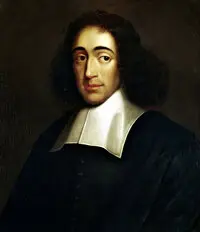
Baruch Spinoza
Spinoza interrogates the essence of existence and the divine through his rigorous rationalist philosophy. Embracing a monistic framework where God and Nature are viewed as synonymous, he dismantles the traditional dualistic separation of mind and body. In his seminal work, "Ethics," Spinoza meticulously builds this vision using a geometric method that challenges the prevailing Cartesian dualism and offers a pantheistic perspective. His writings question established religious doctrines, therefore laying the groundwork for Enlightenment values such as secularism and rational inquiry. Spinoza's commitment to reason and his critique of religious orthodoxy underscore his radical approach, making him a pivotal figure whose ideas extend beyond the philosophical to influence modern Biblical criticism.\n\nThe impact of Spinoza's philosophy is profound, inviting readers to explore a deeper understanding of freedom, ethics, and democracy. Through works like the "Theologico-Political Treatise," he promotes religious tolerance and advocates for a secular government, thus influencing the Dutch political landscape of his time. By integrating rationalism with ethical and political thought, Spinoza provides valuable insights into reconciling human freedom with determinism. This method appeals particularly to those interested in philosophy and political theory, while his critique of religious and philosophical norms benefits scholars seeking to understand the intersection of reason and faith. Although unrecognized by awards during his lifetime due to the controversial nature of his work, Spinoza's legacy continues to resonate, celebrating the convergence of intellectual rigor and transformative thought.
Books by Baruch Spinoza

Ethics
Popular Authors

Robin Sharma
5 books

James Clear
2 books

Sarah Knight
4 books

Daniel Goleman
9 books

Stanley D. Rosenberg
1 books


Niall Kishtainy
1 books

Anthony Scaramucci
1 books
J. Richard Gott
1 books

Trevor Moawad
2 books

Mark McNeilly
1 books

Lara Love Hardin
4 books
