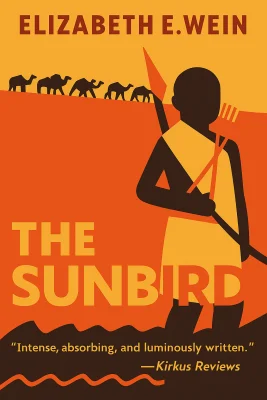
The Sunbird
Categories
Fiction, Historical Fiction, Young Adult, Africa, Fantasy, Historical, Childrens, Teen, Historical Fantasy, Arthurian
Content Type
Book
Binding
Paperback
Year
2006
Publisher
Firebird
Language
English
ASIN
0142401714
ISBN
0142401714
ISBN13
9780142401712
File Download
PDF | EPUB
The Sunbird Plot Summary
Introduction
In the sixth-century African kingdom of Aksum, twelve-year-old Telemakos Meder possessed a gift that would either save his people or destroy him. Half-British, half-Aksumite, with hair white as salt and eyes blue as winter sky, he could vanish into crowds like mist into stone. While plague ravaged trade routes and threatened to consume nations, Emperor Gebre Meskal needed an invisible spy—someone who could slip through shadows and return with secrets that armies could not obtain. The boy who had captured lions as cubs and walked fearlessly among emperors would soon discover that his greatest enemy wasn't the desert heat or the salt smugglers who bound him. It was the terrible loneliness that comes when you must remain silent to stay alive, when speaking your own name means death, and when the only witness to your suffering is the gold collar locked around your throat—a mark of ownership that might be the only thing standing between you and oblivion.
Chapter 1: The Art of Becoming Invisible
Telemakos crouched among the palm fronds at the fountain's edge, his breath barely stirring the warm air. The marble rim cleared the top of his head perfectly, and the imported soil beneath was soft and moist. He watched his aunt Goewin conduct her audience with three merchants, their voices carrying across the Golden Court as they negotiated salt shipments to Britain. The men spoke over Goewin as if she were invisible, their condescension thick as honey. They called him "Foreign One" when they noticed his pale hair framing his coffee-colored face, but they never truly saw him. Telemakos had learned to move through their world like water through stone. "Telemakos," Goewin said suddenly, her voice cutting through the humid air like a blade. "Come here." His blood turned to ice. No one had ever found him before. He crawled from the palms and knelt before her, head bowed, his mind racing with excuses. "Follow that party and discover what plot they were hiding from me," she commanded. So began his education in the art of shadows. Telemakos stalked the merchants through palace halls, reading their servants' movements like a hunter reads animal tracks. When stealth failed, audacity succeeded. He slung pebbles at monkeys to create chaos, slipped between animal handlers, and became part of their entourage simply by belonging nowhere and everywhere at once. The words he overheard chilled him to the bone. "Plague will raise the price of salt," the Afar chieftain murmured. Alexandria was considering quarantine. The Mediterranean ports were dying, but salt and wine commanded premium prices from the desperate. Standing in a granite alcove afterward, Telemakos whispered his revelation to the empty air: "I am invisible."
Chapter 2: An Emperor's Desperate Request
Three months passed like fever dreams. Telemakos practiced his gift while his mother worried and his silent father watched with eyes like winter storms. The news from the salt traders had proven true—plague crept along trade routes like fire along dry grass, consuming cities and leaving quarantine in its wake. Emperor Gebre Meskal arrived at Grandfather's house without ceremony, carrying an ivory chess set and wearing clothes as simple as any merchant's. Only the gold-shot linen at his throat and the emerald cross at his shoulder marked his rank. "I have not seen you in my court of late," the young emperor said, his voice carrying the weight of unspoken challenges. They played santaraj until Telemakos's strategies crumbled like poorly mortared walls. Then Gebre Meskal set up the same game again, moving just one pawn differently. The single piece carved its way through Telemakos's army like a blade through silk. "Many would say he is the lowliest player on the board," the emperor mused, returning the captured king to Telemakos's palm. "Yet he has brought down an army. Alone." The weight of those words settled in Telemakos's chest like stones. When Gebre Meskal spoke of Deire's destruction—the port city consumed by plague, surrounded by rings of fire and steel—his tears fell onto the chess pieces like rain on carved bone. "If Deire is destroyed, I fear for Adulis," the emperor continued. "Who subverted my rule in the south will sensibly move north. I shall watch Adulis with care and with secrecy, from without and from within." His dark eyes fixed on Telemakos with calculating intensity. "Perhaps one day soon you will want to see Adulis." The invitation hung in the air between them, heavy with promise and threat.
Chapter 3: Journey to the Salt Desert
The gold collar closed around Telemakos's throat with the finality of fate itself. His mother's hands shook as she guided him to the goldsmith's anvil, both of them playing their parts in this elaborate deception. The thick band would mark him as royal property—protection and prison in one. Goewin's fingers traced the metal as she explained its purpose. "No one will know what you are, but if you are seen, they will know you belong to someone who can afford to reclaim you." In the darkness before dawn, his mother shaved his head until his scalp gleamed like polished wood. The ritual felt like burial preparations. When she kissed his bare skull, her tears fell cold against his skin. His father led him south on the Salt Road, through landscapes that grew progressively more hostile. Medraut let Telemakos do everything—choose the path, find water, catch their food. Each night they camped further from civilization, until only the stone monuments to Afar dead dotted the increasingly barren horizon. At the last well before the true desert, Telemakos spotted the caravan he would shadow—fifty camels lurching against the skyline like black prayer beads against yellow silk. His father's goodbye was barely a whisper: "God go with you, Telemakos." The words hung in the air long after Medraut had turned away, walking north toward mountains and safety while his son walked south toward heat and unknown dangers.
Chapter 4: Captive in Darkness
The leather water bag leaked slowly at first, so gradually that Telemakos didn't notice until the precious liquid was nearly gone. By then he was seeing mirages—cities shimmering in the distance, phantom lakes that disappeared when approached. He buried his bow and knife in the rocks, scattered the pieces to hide his true purpose, and approached the caravan with the last of his strength. The camel driver who gave him water had patient hands and spoke gently to his animals. It seemed like providence. But providence wore a cruel mask. They stripped him naked under the stars, searching for stolen goods. Finding none, they bound his hands and wrapped cloth around his eyes, transforming him from person to property in the space of heartbeats. "He's worth a fortune," the camel driver said, fingering the gold at Telemakos's throat. "Whoever put that band on him will pay dearly to have him back." The blindfold became his world. Days blended into nightmare as he stumbled behind camels, his feet splitting on salt and stone. The men fed him sparingly and spoke of him as cargo—a deaf-mute royal bastard fleeing monastery walls. At the salt mines, they sold him to Hara the Scorpion, a warden whose paranoia matched his cruelty. The gold collar that should have protected him only made him more valuable, more suspicious. Hara kept him blindfolded and bound, afraid his face would be recognized, afraid his silence masked intelligence. Water became more precious than gold. Telemakos carried it to the salt cutters under the pitiless sun, stumbling across crystalline plains that burned his feet and scorched his lungs. Three measures a day—barely enough to keep him alive, never enough to ease the constant thirst that gnawed at him like a living thing.
Chapter 5: Breaking Free from Blindfolds
The man called Lazarus arrived like death personified, his voice oily with disdain, his scent rank as spoiled meat. Hara had waited for this visitor, saving Telemakos like a choice morsel for someone with particular appetites. "What is that?" the Lazarus asked, and Telemakos felt the weight of evaluation in those words—not curiosity about a person, but appraisal of an object. They debated his worth while he stood silent as stone. Hara suspected him of being the emperor's spy, the one they called Harrier. The Lazarus wanted proof of his muteness, demanding tests that made Telemakos's skin crawl with memory. The knife slid under his fingernail like liquid fire. Telemakos hissed through his teeth but did not scream. They tried again, the blade splitting the nail down to the quick, and still he held his silence. Someone in the tent wept—not for pain, but for pity. "I suppose it is mute," the Lazarus finally conceded, his voice thick with disappointment. But as the voice receded and plans were made to sell him elsewhere, Telemakos memorized every syllable. The accent was Noba—specific, regional, familiar. The cruelty was casual, practiced. The paranoia spoke of guilt unconfessed. When they sealed his eyes with grease and grit, the darkness became complete. But inside that darkness, memory worked like fire on metal, forging connections, building understanding. He had come to find the Lazarus, and the Lazarus had found him first.
Chapter 6: The Unmasking of Traitors
Princess Sofya rescued him from the mines with the efficiency of long planning and the ruthlessness of royal blood. Her Afar warriors cut his bonds with obsidian blades, and for the first time in months, Telemakos could lift his hands to his face. "Can you see?" Sofya demanded, her imperial voice cutting through his tears of relief. The world blazed white and painful, but it was still the world. "I think so," he whispered, the words strange on his unused tongue. The journey home became a lesson in healing. His feet grew strong again on camel-back. His eyes learned to focus despite the scarring. Most importantly, his mind sorted through months of overheard conversations, building a map of corruption that led from salt mines to palace corridors. Back in Adulis, Goewin held him like salvation itself. "Well done," she whispered against his shattered scalp. "My sunbird, my brave one." But their reunion was shadowed by confession. In the safety of her arms, Telemakos finally spoke his failure: "I never saw the Lazarus. I knew he was there, but I never saw his face or learned his name." Goewin's response surprised him. "Do you think I would have been better pleased had you returned with bloody stumps instead of whole hands?" Then memory sparked understanding. The Lazarus had mentioned his childhood friend on the emperor's council. Only one councilor spoke Noba with that particular accent, carried stories of his homeland like treasured possessions. "It's Karkara," Telemakos breathed. "The Authority is Karkara."
Chapter 7: A Voice Reclaimed
The final confrontation came not in some distant desert, but in Grandfather's own dining hall. Anako—revealed now as the Lazarus himself—sat at their table accepting hospitality while plotting murder. His stench of sour corruption filled the room like smoke from a funeral pyre. Telemakos played his part perfectly, the mute servant grinding salt between granite stones. But when Anako's rings caught the light, when that oily voice spoke of eating salt "like a millionaire," rage shattered his careful mask. The salt mill exploded in his shaking hands, scattering white powder like snow across the floor. Anako rose with predatory grace, stone weapons in his fists, and brought them crashing down on Telemakos's skull. Darkness. Then clarity sharper than any blade. Telemakos lay paralyzed but fully aware as Anako knelt with a fruit knife, preparing to carve out his eyes. "Lazarus!" Telemakos spat, the word erupting from months of enforced silence. "I know you!" The accusation rang like bronze bells, carrying all his accumulated fury and pain. He spoke of betrayal and corruption, of gold bought with plague-tainted blood, of the moral rot that would sacrifice children for profit. When rescue came in the form of Goewin's flying fists and Grandfather's outraged household, Telemakos had already won the only victory that mattered. He had spoken truth to evil and lived. Standing bloodied but unbroken before the emperor's court, he delivered his final judgment: "Send him to Afar. Let him carry water to the salt cutters, bound and blindfolded, given only the twentieth part of a single skin each day." The sentence carried the weight of lived experience, of suffering transformed into justice.
Summary
In the end, Telemakos's greatest victory was not the capture of traitors or the protection of his kingdom, but the recovery of his own voice. The boy who had learned to be invisible discovered that true power lay not in hiding from the world, but in choosing when to emerge from the shadows. His scars would fade with time—the torn fingernails would grow back, the rope burns would heal, the memories would lose their sharpest edges. But the lessons burned into his soul during those months of captivity would shape him forever. He had learned that silence could be a weapon as sharp as any blade, but that speech, when finally unleashed, could topple kingdoms. Most importantly, he had discovered that even in the deepest darkness, even when stripped of name and identity and hope, something essential remained unbroken—the core of self that no amount of suffering could touch. The sunbird, after all, was built for light.
Best Quote
“Here he comes, moving among the enemies all on his own. Do you see? He acts alone, but he is not alone. He has an army behind him, also, my army; and with our lives we will fight to defend him.” ― Elizabeth Wein, The Sunbird
Review Summary
Strengths: The review highlights "The Sunbird" as an exceptional adventure story with a compelling protagonist, Telemakos, whose invisibility within the royal household allows for unique espionage opportunities. The narrative is praised for its suspense, emotional depth, and satisfying subplot about family relations. The book is compared favorably to "Prisoner of Azkaban," suggesting it elevates the series with its intricate character studies and political intrigue. Weaknesses: The review questions the believability of Telemakos's prodigious abilities, such as his extraordinary senses and linguistic skills, which may stretch plausibility. Overall: The review conveys a highly positive sentiment, recommending "The Sunbird" as a standout entry in the Lion Hunter series, appreciated for its rich storytelling and emotional resonance.
About Author

Elizabeth Wein
Wein investigates the intertwining of courage and identity through historical fiction and aviation-themed narratives, particularly set against wartime backdrops. Her work, notably in the "Code Name Verity" series, delves into the complexities of friendship and resilience amidst the challenges of World War II. This series gained significant acclaim, with "Code Name Verity" being named one of TIME magazine's "100 Best YA Books of All Time." Beyond her focus on wartime settings, Wein extends her literary exploration to Arthurian legends reimagined within the Kingdom of Aksum in sixth-century Ethiopia, thus combining myth with historical depth.\n\nHer readers benefit from richly developed characters and intricate plots that encourage reflection on personal strength and moral choices. Wein's passion for aviation, sparked by obtaining her own pilot's license, is evident in her stories, providing an authentic backdrop for her themes. Her books, such as "Rose Under Fire" and "The Pearl Thief", highlight her skill in blending historical elements with fictional narratives, offering both entertainment and thought-provoking insights.\n\nA respected figure in young adult literature, Wein has received numerous accolades, including the Edgar Award and Michael L. Printz Honor. Her works, such as "Black Dove, White Raven" and "Stateless", further her exploration of international settings and historical intricacies. Through this body of work, Wein not only captivates but also educates, making her an influential author whose bio reflects a dedication to storytelling that bridges past and present.
Read moreDownload PDF & EPUB
To save this Black List summary for later, download the free PDF and EPUB. You can print it out, or read offline at your convenience.

The Sunbird
by Elizabeth Wein
