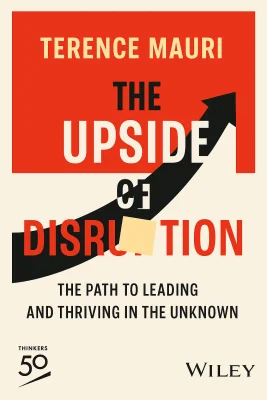
The Upside of Disruption
The Path to Leading and Thriving in the Unknown
Categories
Business, Nonfiction, Leadership, Management
Content Type
Book
Binding
Hardcover
Year
2024
Publisher
Wiley
Language
English
ISBN13
9781394192601
File Download
PDF | EPUB
The Upside of Disruption Plot Summary
Introduction
Disruption permeates every aspect of contemporary leadership and organizational life. Accelerating technological advancements, geopolitical tensions, and shifting customer expectations have created an environment where traditional leadership approaches no longer suffice. The ability to navigate disruption—not just as an inevitable challenge but as a potential catalyst for growth and transformation—separates future-ready leaders from those destined to become obsolete. This perspective represents a fundamental shift in how we understand disruption: not as something that merely happens to organizations, but as something that can be harnessed and directed. The DARE framework—Data, Agility, Risk, and Evolution—offers a comprehensive approach to finding opportunity amid turbulence. Through compelling examples ranging from multinational corporations to innovative startups, we discover how leaders can develop the cognitive flexibility and courage necessary to thrive in uncertainty. The framework demonstrates that by cultivating specific mindsets and capabilities, leaders can transform potential threats into strategic advantages. This path requires more than technological adaptation; it demands a willingness to unlearn established practices, embrace intelligent risk-taking, and build ecosystems of trust that can withstand the pressures of constant change.
Chapter 1: Data: The AI Revolution Reshaping Leadership Paradigms
The Age of AI has arrived, fundamentally altering the leadership landscape and creating what might be considered an Age of Wonder. Like most transformational technologies, artificial intelligence carries both tremendous promise and significant risk. Unlike previous technological revolutions, AI possesses two capabilities that make it uniquely disruptive: the ability to create new things independently and make decisions autonomously. This represents an unprecedented shift in how we understand productivity, intelligence, and the relationship between humans and machines. Leading with AI requires understanding that while technology changes rapidly, humans adapt more slowly. Many organizations suffer from what might be called the "AI-Intelligence Illusion"—placing blind faith in technology to increase productivity without understanding its impact on human behavior, culture, and trust. The paradox becomes evident when considering that despite massive investments in technology, many leaders report feeling more overwhelmed, not less. Leaders now face the challenge of distinguishing between "warm tech" that enhances human capabilities and "cold tech" that potentially diminishes them. The evolving relationship between AI and leadership follows three distinct phases: Excitement, Experimentation, and Embedded Everywhere. The initial Excitement phase, characterized by hyperbole and inflated expectations, gives way to the Experimentation phase, where organizations develop practical applications and use cases. The final Embedded Everywhere phase represents a future where AI becomes ubiquitous and invisible—interwoven into every aspect of organizational life. Forward-thinking leaders must navigate these phases while managing concerns around ethics, privacy, job displacement, and information integrity. The true challenge lies not in implementing AI but in reimagining leadership itself. When deploying AI, leaders must consider fundamental questions about human-machine collaboration: How do we align AI to serve humanity rather than diminish it? How do we ensure AI amplifies human potential instead of replacing it? The concept of the "Anything Workforce"—agile, cross-disciplinary, and focused on character skills like adaptability and creativity—provides a vision for what human work might look like in an AI-enabled world. Successful navigation of the AI revolution demands a balance between technological implementation and human-centered leadership. Organizations must cultivate cultures where curiosity drives exploration of AI's possibilities while ethical guardrails ensure responsible deployment. This requires leaders to adopt a beginner's mindset—what the Japanese call Shoshin—characterized by openness, eagerness, and lack of preconceptions. The path forward involves automating routine tasks while creating space for humans to engage in the complex, creative, and empathetic work that machines cannot replicate. As we enter the Age of Co-Intelligence, the challenge extends beyond technical integration to reimagining organizational mindsets, cultures, and capabilities. The leaders who succeed will be those who understand that attention, not data, has become the scarcest resource—and who design systems that respect this reality. They will create environments where AI serves as a co-thinker, enhancing human judgment rather than replacing it, and where technology augments rather than diminishes what makes us distinctly human.
Chapter 2: Agility: Unlearning as the Key to Organizational Evolution
Unlearning represents perhaps the most undervalued capability in contemporary leadership. While organizations consistently emphasize the importance of learning and adaptation, they frequently overlook the prerequisite step: dismantling established mental models, processes, and assumptions that no longer serve current realities. This challenge becomes evident when examining the experience of attempting to unlearn deeply ingrained habits—like a self-taught tennis player struggling to correct a faulty serve technique. Such unlearning requires humility to recognize inadequacies, vulnerability to seek guidance, and willingness to temporarily inhabit discomfort. The "Half-Life of Everything" concept vividly illustrates why unlearning has become essential. The time it takes for knowledge, skills, and competitive advantages to lose currency continues to accelerate—technical skills now have a half-life of just 2.5 years, while competitive advantage for S&P 500 companies lasts fewer than 18 months. This relentless compression creates an imperative: as organizational speed increases, so must the rate of unlearning. Without deliberate unlearning, leaders become prisoners of their past successes, trapped in mental models that once created value but now represent constraints. "Bureaucratic BS" constitutes perhaps the most pernicious barrier to organizational agility. This umbrella term encompasses the accumulated friction of unnecessary rules, duplicative processes, excessive meetings, and siloed behaviors that slow decision-making and ultimately kill innovation. Research reveals that approximately one-third of leaders spend 700 hours annually (about 33% of their total working time) dealing with bureaucratic activities that add little value. This represents not merely an inefficiency but a profound tax on organizational intelligence, diverting attention from high-impact initiatives to low-value compliance activities. Unlearning also applies to our relationship with failure. Most organizations suffer from a paradoxical condition: they cannot innovate without failing, yet culturally resist acknowledging failure. Learning to "fail well" means viewing setbacks as instruments of discovery and growth—what might be called "From Action I Learn" (FAIL). The distinction between productive failures (hypothesis-driven experiments that reduce uncertainty) and unproductive failures (avoidable errors stemming from carelessness) becomes crucial. When leaders normalize productive failure, they create psychological safety for exploration and experimentation. Toxic cultures represent another domain requiring deliberate unlearning. The case of Uber illustrates how "move fast and break things" mentality, coupled with unchecked growth, created a problematic environment requiring significant cultural reconstruction. Unlearning toxic patterns demands attention to three critical areas: empowering "silence breakers" who call out problems, recognizing that culture change requires collective action, and creating dedicated time and space for cultural reflection and reconstruction. The shift from "move fast and break things" to "move fast and do the right thing" exemplifies this unlearning journey. The essence of unlearning can be captured in the Japanese concept of Henka (変化), which embraces evolution and rethinking in cycles. Like turning lead into gold, unlearning transforms constraining elements into enabling ones. Without this capacity, organizations become trapped in Industrial Age thinking despite operating in an Intelligence Age reality. As NASA demonstrates by consistently asking, "Are we learning at the speed of science?" the habit of questioning established practices provides a foundation for continuous evolution and prevents the organizational equivalent of fossilization.
Chapter 3: Risk: Cultivating the Courage Advantage in Uncertain Times
The courage advantage represents a critical yet frequently overlooked leadership capability in times of accelerating disruption. While conventional wisdom suggests that boldness increases organizational risk, evidence increasingly indicates the opposite: in volatile environments, the failure to act boldly often poses the greatest danger. Research demonstrates that compared to peers in slow-moving companies, leaders in fast-moving organizations report 2.4 times higher operational resilience, 2.2 times higher growth, and 3.7 times higher innovation rates. This suggests that courage—properly channeled—creates rather than compromises organizational stability. Developing the courage advantage begins with understanding that boldness does not imply recklessness. Rather, it involves calculated risk-taking based on clear strategic priorities and an objective assessment of the competitive landscape. John Deere exemplifies this approach, having continuously reinvented itself over nearly two centuries by balancing respect for legacy with willingness to pioneer new technologies. Facing challenges like rising labor costs, supply chain disruptions, and sustainability imperatives, Deere made bold investments in autonomous tractors, carbon capture, robotics, and drones—transforming potential threats into strategic opportunities through what might be called "execution certainty." Willful contrarianism—deliberately adopting perspectives that challenge conventional wisdom—provides another dimension of the courage advantage. Patagonia's decision to make Earth its "only shareholder" by channeling all profits to environmental causes exemplifies this approach. By rejecting the shareholder primacy model that dominates corporate thinking, founder Yvon Chouinard demonstrated how contrarian thinking can align business practice with deeply held values. This approach requires identifying "billion-dollar beliefs"—fundamental convictions about what will shape the future—and building strategy around them rather than merely following industry trends. The concept of "beyonders"—organizations that consistently outperform expectations—offers additional insight into the courage advantage. Originally coined by psychologist Ellis Paul Torrance to describe going "beyond where you've never been before and beyond where others have been," the beyonder mindset combines execution certainty with trust certainty. Danish energy company Ørsted exemplifies this approach, transforming from a conventional fossil fuel company into the world's leading offshore wind operator through bold strategic choices aligned with the global transition to renewable energy. This transformation required not just technical adjustments but fundamental mindset shifts about the organization's identity and purpose. Cultivating the courage advantage depends on developing specific leadership capacities: the ability to balance offensive and defensive strategies, the willingness to question established assumptions, and the skill to implement high-velocity decision-making processes. These capacities stand in contrast to the "rubber band effect," where leaders may temporarily stretch their thinking during special events or retreats but snap back to conventional approaches when facing day-to-day pressures. Overcoming this effect requires systematic attention to decision rights, meeting structures, and incentive systems that reward rather than penalize appropriate risk-taking. The courage advantage ultimately represents more than a tactical approach to uncertainty; it constitutes a fundamental stance toward the future itself. As Maya Angelou observed, "Courage isn't something you're born with, but something you develop by doing small courageous things." For leaders navigating disruption, the courage to speak from the heart (derived from the Latin "cor"), to acknowledge uncertainty without becoming paralyzed by it, and to create environments where others can similarly act with conviction provides the foundation for sustainable advantage in turbulent times.
Chapter 4: Evolution: Building Trust as the Currency of Future Readiness
Trust functions as the ultimate currency for navigating organizational transformation, yet it faces unprecedented challenges in contemporary business environments. According to research, trust in institutions broadly continues to decline, with ten out of fifteen industry sectors reporting significant trust erosion over the past three years. This deterioration carries tangible costs—companies that suffer trust-related scandals typically forfeit approximately 30% of their market value compared to peer organizations. Without trust, cultures fracture, customers disengage, and talent leaves, creating a spiral of diminishing capabilities precisely when organizations need to maximize collective intelligence. The Trust Mindset framework offers a practical approach to strengthening organizational resilience through three interconnected dimensions: Who We Are (identity), How We Work (agility), and How We Grow (scalability). The Who We Are dimension establishes shared purpose and values that create what academic Fobazi Ettarh calls "vocational awe"—a collective sense of mission-driven community. This dimension manifests through four interconnected elements: Believing (connecting work to meaningful impact), Belonging (creating environments where people feel valued as integral team members), Braving (cultivating courage to speak truth and challenge assumptions), and Becoming (emphasizing continuous growth and development). The How We Work dimension addresses the persistent challenge of "fake empowerment"—situations where leaders claim to delegate authority while maintaining rigid control mechanisms. Research indicates that 63% of leaders identify lack of agility as a significant barrier to performance, while 57% of employees report that fake empowerment characterizes their organizational culture. Companies like Unilever have tackled this challenge through initiatives like the "Compass Organization," which simplifies business operations into five focused groups while increasing end-to-end accountability. Google's "Simplicity Sprint" represents another approach, systematically identifying and eliminating barriers to speed and execution. The How We Grow dimension focuses on creating an inclusive and actionable growth narrative that enables people to own their part in the organization's future. Research reveals a substantial gap between aspiration and reality in this area—66% of employees express confusion about their organization's future growth story, while 54% don't feel equipped with the right mindsets or skillsets to contribute effectively. Companies like Hermès demonstrate how this dimension can drive sustainable advantage by turning megatrends like sustainability into concrete initiatives, such as developing mycelium-based leather alternatives that could represent half of global revenues by 2035. Trust-building requires continuous attention to three accelerators: leading with trust (prioritizing trust as a core value rather than a byproduct), adopting a listening mindset (asking questions that stimulate reflection and growth), and encouraging divergent thinking through BYOD (Bring Your Own Divergence). This last element recognizes that diversity in all forms—cultural, cognitive, and experiential—correlates directly with improved decision-making, problem-solving, and financial performance. Companies with above-average diversity scores consistently report higher returns on innovation and what might be called "Return on Intelligence." The imperative to build trust extends beyond organizational performance to fundamental human needs. In an age of increasing automation anxiety and declining social connection, trust provides the foundation for meaning, energy, and pride in work. As Hack Future Lab research indicates, only 57% of leaders worldwide are actively trusted, while 33% of employees agree that they "trust a stranger more than my boss." Reversing these trends requires leadership that elevates what makes us distinctly human—our capacity for connection, creativity, and care—while harnessing technology to augment rather than diminish these qualities.
Chapter 5: Beyond Disruption: The DARE Framework for Future-Ready Leadership
The DARE framework—Data, Agility, Risk, and Evolution—provides a comprehensive approach to navigating the future's complex terrain. While disruption often arrives as an unwelcome intrusion, the framework reframes it as an invitation to reconsider fundamental assumptions about leadership, organizations, and human potential. Each component addresses a distinct dimension of the leadership challenge while collectively creating a synergistic approach to finding opportunity amid turbulence. The Data dimension focuses not merely on technological implementation but on reimagining leadership for an AI-enabled world. As organizations move through the phases of AI adoption—Excitement, Experimentation, and Embedded Everywhere—the challenge shifts from technical integration to human alignment. Leaders must distinguish between "warm tech" that enhances human capabilities and "cold tech" that potentially diminishes them. This requires cultivating what the Japanese call Shoshin (beginner's mind)—approaching AI with openness, eagerness, and lack of preconceptions while recognizing that attention, not data, has become our scarcest resource. The Agility dimension centers on unlearning as the prerequisite for organizational evolution. In a world where the half-life of knowledge and competitive advantage continues to compress, the ability to dismantle established mental models becomes crucial. This involves addressing "bureaucratic BS"—the accumulated friction of unnecessary rules and processes—while developing healthier relationships with failure. The Japanese concept of Henka (変化) captures this orientation, emphasizing evolution and rethinking in cycles as essential to preventing organizational fossilization. The Risk dimension develops the courage advantage necessary for thriving amid uncertainty. Research consistently demonstrates that in volatile environments, the failure to act boldly often poses greater dangers than calculated risk-taking. This requires cultivating "willful contrarianism"—deliberately challenging conventional wisdom—while identifying "billion-dollar beliefs" that shape strategic priorities. Organizations that adopt a "beyonder" mindset combine execution certainty with trust certainty, consistently outperforming expectations by balancing offensive and defensive strategies. The Evolution dimension establishes trust as the currency of future readiness. The Trust Mindset framework strengthens organizational resilience through three interconnected dimensions: Who We Are (identity), How We Work (agility), and How We Grow (scalability). In an age of increasing automation anxiety and declining social connection, trust provides the foundation for meaning, energy, and pride in work. This requires leadership that elevates distinctly human qualities—connection, creativity, care—while harnessing technology to augment rather than diminish these capacities. Together, these dimensions create a leadership approach capable of transforming disruption from threat to opportunity. The DARE framework represents not merely a set of tactical responses but a fundamental stance toward the future itself—one characterized by curiosity to explore, courage to rethink, clarity to focus, and conviction to act. As we navigate the complex terrain ahead, this orientation provides the foundation for sustainable advantage in turbulent times, turning what might be perceived as darkness into a path toward discovering our collective light.
Summary
Finding the upside in disruption requires a fundamental reorientation in how leaders perceive and respond to change. The DARE framework—Data, Agility, Risk, and Evolution—transcends conventional approaches by recognizing that disruption represents not merely a challenge to be managed but an opportunity to be seized. This perspective shifts leadership focus from preservation to transformation, creating space for reimagining organizational mindsets, cultures, and capabilities. The framework reveals that our greatest limitations often stem not from external constraints but from internal ones—our reluctance to question established assumptions, our tendency toward conformity over courage, and our preference for the comfort of certainty over the potential of the unknown. The journey toward future-ready leadership demands more than technological adaptation or strategic repositioning; it requires psychological transformation. Leaders must cultivate specific mindsets: the curiosity to explore emerging possibilities, the humility to unlearn outdated approaches, the courage to make bold choices amid uncertainty, and the compassion to build trust-based environments where others can similarly evolve. This path is neither easy nor straightforward, but it offers the most promising route through disruption's challenging terrain. For those willing to embrace both its rigors and rewards, it provides not just a survival strategy but a blueprint for discovering unprecedented possibilities in the spaces where old certainties dissolve and new realities emerge.
Best Quote
Review Summary
Strengths: The review highlights the book's proactive approach to dealing with disruption, emphasizing the "DARE" mindset. It praises the book's focus on leveraging AI to enhance human potential and the importance of adopting a human-centered approach to AI.\nOverall Sentiment: Enthusiastic\nKey Takeaway: "The Upside of Disruption" advocates for a proactive, anticipative mindset in navigating change, emphasizing the importance of data, agility, calculated risks, and continuous evolution. The book underscores the transformative role of AI and the necessity of a human-centered approach to its adoption, promoting adaptability and the dismantling of outdated practices.
About Author

Terence Mauri
Mauri investigates the intersection of leadership and innovation, providing frameworks that enable leaders to thrive amid disruption. Through his books, including the acclaimed "The Leader’s Mindset: How To Win In The Age of Disruption," he offers strategic insights that translate complex challenges into actionable plans. As a mentor at the London Business School, Mauri extends his expertise to help organizations anticipate and adapt to change. His work with publications like the London Business School’s Entrepreneurship Review showcases his commitment to thought leadership, ensuring that individuals can effectively navigate the unpredictable landscapes of modern business.\n\nFor readers seeking practical guidance, Mauri's focus on disruption and change is invaluable. His clear and engaging writing style demystifies the intricacies of leadership, making his ideas accessible to a wide audience. By dissecting the dynamics of innovation, he empowers aspiring leaders with the confidence to embrace uncertainty and turn it into opportunity. Therefore, those interested in organizational transformation will find his insights particularly beneficial, as Mauri equips them with the mindset needed to excel in an ever-evolving world. Through his authoritative voice, Mauri inspires a proactive approach to leadership, encouraging a shift from merely coping with change to actively shaping the future.
Read moreDownload PDF & EPUB
To save this Black List summary for later, download the free PDF and EPUB. You can print it out, or read offline at your convenience.
The Upside of Disruption
by Terence Mauri
