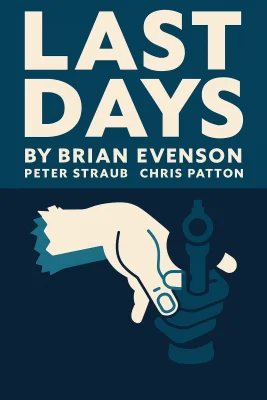
Last Days
Categories
Fiction, Horror, Mystery, Thriller, Crime, Cults, Cult Classics, Mystery Thriller, Noir, Horror Thriller
Content Type
Book
Binding
Paperback
Year
2009
Publisher
Underland Press
Language
English
ASIN
0980226007
ISBN
0980226007
ISBN13
9780980226003
File Download
PDF | EPUB
Last Days Plot Summary
Introduction
The cleaver came down with surgical precision, severing flesh from bone in a single, decisive blow. Kline watched his hand fall away—separate, alien, still twitching with phantom life. The pain was nothing compared to what came next: the deliberate press of his bleeding stump against the hotplate's glowing coil. The sizzle of cauterized flesh filled the air as he turned, left-handed now, to shoot the gentleman with the cleaver through the eye. This was how it began—with amputation, fire, and death. What Kline didn't know was that his mutilation had marked him, branded him as chosen by those who worship through subtraction. The Brotherhood of Mutilation had been watching, waiting for someone like him—someone who could sever part of himself and continue killing. They would come for him with promises of purpose and belonging, drawing him into a world where less truly is more, where each missing limb brings one closer to divine revelation. But in this landscape of voluntary dismemberment and religious fervor, Kline would discover that some forms of salvation require the complete destruction of everything human that remains.
Chapter 1: The Reluctant Prophet: Kline's Unwilling Induction
The phone calls started weeks after Kline had retreated to his bed, staring at the stump where his right hand used to be. Two voices—one deep, one lisping through a mangled lip—spoke of his heroism, his refusal to flinch when the cleaver fell. They had read about him in the papers, they claimed. They admired him. "Was it true that you cauterized your own wound?" the lisping voice asked with something approaching reverence. "A hotplate," Kline admitted, remembering the smell of his own burning flesh, the way his vision had tunneled as he fought to stay conscious long enough to kill his attacker. The voices belonged to Ramse and Gous, as he would learn. Ramse bore the scars of his devotion across his torn lip and missing ear. Gous was newer to the faith, sporting only a missing hand—a mere "one" in their hierarchy of amputation. They spoke of opportunity knocking, of plane tickets waiting at airports, of purposes greater than desk jobs and prosthetic limbs. Kline refused. He had money—the briefcase he'd taken after shooting the gentleman with the cleaver contained enough to last years. He could buy cigars, perfect one-handed golf, purchase a drawer full of prosthetics for all occasions. He didn't need their opportunity. But opportunity, it seemed, wouldn't take no for an answer. When Kline ignored the second call, unplugged his phone, and retreated deeper into his apartment's cocoon of unwashed sheets and sour milk, they came for him. He woke to find them sitting beside his bed like patient angels of mutilation, bundled in heavy coats despite the warm room. "We knocked and knocked," Ramse explained through his shredded lip. "But we knew you didn't mean the lock for us." They helped him dress—gray slacks, white shirt, red clip-on tie. The uniform of their faith, unremarkable as office workers, invisible as bureaucrats. When Kline protested, Ramse simply smiled and demonstrated how their artificial hands could be unscrewed, revealing the stumps beneath. "You see," he said, "just like you. Only more so." The drive took hours through countryside that grew increasingly barren. Ramse steered with a cup attached to the wheel, his prosthetic hands piled on the seat between them like discarded gloves. They spoke of hierarchies—ones and twos and eights, the careful accounting of missing flesh. They spoke of Aline, their prophet, a man so holy that almost nothing of him remained. And they spoke of Borchert, the twelve who would soon want to meet him. "They had to make a special dispensation," Gous explained as guard towers appeared through the windshield. "Normally a one wouldn't be allowed. But you're different. You self-cauterized." The compound spread before them like a small town devoted to subtraction. Guards with single eyes manned the gates, their missing limbs replaced with gun prosthetics. Houses lined roads where the residents moved with the careful gait of the multiply amputated. At the heart of it all stood a stone manor house, windows glowing like eyes in the gathering dusk. "Welcome home, Mr. Kline," Ramse said as they passed through the final checkpoint. But home, Kline was beginning to understand, was a place you could only reach by leaving pieces of yourself behind.
Chapter 2: The Brotherhood's Deception: Flesh as Currency
Borchert received him in a stark room furnished with monastic simplicity. The man himself was a masterwork of surgical reduction—left arm gone at the shoulder, right leg amputated at the hip, fingers whittled down to careful stumps. Both ears had been sliced away, leaving smooth patches of skin, and one eye socket gaped empty as a cave. Yet he moved with the controlled grace of someone who had found perfect balance in asymmetry. "Mr. Kline," Borchert said, his remaining eye studying the newcomer with predatory interest. "Show me your stump." Kline extended his arm. Borchert grasped it with his remaining digits, pulling the scarred flesh close to his face like a connoisseur examining fine wine. "Nicely done. Quite professional. But I understood you were a self-cauterizer?" "It was redone afterward." "What a shame." Borchert's smile was a thin blade across his ravaged features. "Still, a good start nonetheless." The investigation, Borchert explained, concerned their founder. Aline had been murdered—his heart carved from his torso with surgical precision. The spiritual leader of their community, a man who had achieved the highest level of amputation possible while remaining technically alive, had been reduced to mere meat by an unknown killer. "We need the heart back," Borchert said simply. "It means something to us." But when Kline asked to see the body, examine the crime scene, interview witnesses, Borchert's cooperation evaporated like morning mist. The body was too sacred. The witnesses were too highly ranked to speak with a mere "one." Kline could see a reconstruction of the crime scene, nothing more. The room they showed him reeked of deception. Blood spatter painted the walls in impossible patterns. A chalk outline marked where a limbless torso had supposedly fallen, but the positioning was wrong, the blood flow inconsistent. When Kline knelt and scraped at the dark stain with his keys, the blood beneath was still moist—impossible after weeks of drying. "Someone's been playing with evidence," he told Borchert. "So it's a reconstruction," Borchert admitted with maddening calm. "So what?" "How can I solve a crime by looking at a fake crime scene?" Borchert's smile widened, revealing the gaps where his bottom teeth had been methodically extracted. "Reality is a desperate and evasive creature, Mr. Kline. Perhaps that's the most real truth of all." The game was rigged, the mystery manufactured. But by then Kline was trapped within the compound's gates, marked by his missing hand as one of the chosen. Borchert made it clear: leave without solving the case, and the other believers would revolt. Try to leave at all, and they would kill him for the good of the faith. "Nothing personal," Borchert assured him, balanced perfectly on his single leg. "But too much is at stake."
Chapter 3: Escape Through Fire: Flight from False Prophecy
The truth revealed itself in layers, each more grotesque than the last. Aline was alive—limbless, eyeless, earless, a whittled stub of humanity breathing through tubes and babbling through the remnants of his tongue. The murder was a fiction, the investigation a sham designed to give Borchert time to arrange Kline's crucifixion. "You'll die as Barabbas," Borchert explained with casual cruelty. "The thief crucified beside our Lord. It's quite an honor, really." But first, there would be another amputation. Borchert wanted Kline to demonstrate his commitment by removing his arm at the elbow—the same arm that bore his missing hand. "Flesh for knowledge," he said, producing a gleaming cleaver from the counter behind him. "Otherwise I shoot you where you stand." Kline positioned the blade against his elbow joint, feeling the sharp edge rest against skin and tendon. The hotplate glowed red beside him, waiting to seal what the cleaver would sever. His whole life balanced on the edge of that blade—the choice between certain death and voluntary mutilation. The cleaver fell with brutal efficiency. Pain erupted through his nervous system like wildfire as he pressed the stump against the burning coil. The smell of cauterized flesh filled his nostrils as darkness closed around the edges of his vision. But even as he collapsed, his remaining hand found Borchert's throat. The struggle was brief but vicious. Borchert, for all his theological commitment to amputation, proved remarkably attached to breathing. By the time Kline finished strangling him with his single hand, the room reeked of smoke and burning flesh. Matches from a dead guard's pocket provided the spark. Soon flames were licking up the walls, consuming furniture, racing through ventilation ducts toward the rest of the building. Kline stumbled through smoke-filled corridors, shooting guards with their own guns, leaving a trail of bodies in his wake. The compound erupted in chaos as fire spread from building to building. Guards with gun prosthetics rattled off shots into the darkness, unable to distinguish between smoke, shadow, and the one-armed specter moving among them. He collapsed on a roadside miles from the burning compound, blood loss and shock finally claiming him. The flames on the horizon painted the night sky orange as emergency sirens wailed in the distance. When the good Samaritan found him, Kline was technically dead—heart stopped, breathing ceased, body temperature dropping toward ambient. Yet somehow, impossibly, he lived. The hospital brought him back, but the doctors couldn't explain his survival any more than they could explain why they'd had to amputate the rest of his arm. The shoulder wound was too damaged, they claimed, too infected to save. Kline woke to find himself truly one-armed now, balanced on the knife's edge between human and something else entirely. Outside his window, the world continued its mundane existence, unaware that somewhere in its midst, a man had been marked by forces that counted flesh as currency and measured holiness in missing limbs.
Chapter 4: False Salvation: Among the Pauls
The second time they came for him, Kline was ready. Three men lay dead in his hospital room—Davis the guard, two nurses, all with their throats opened like secondary mouths. The woman who'd tried to poison his IV hung lifeless from his bedside, the dentist's mirror he'd driven through her eye socket gleaming like a tiny sun. Frank, the detective who'd been hunting him, bled out on the sidewalk below while gunfire echoed between buildings. When the smoke cleared, only the blond man remained standing—the one who'd shot his own partner rather than let him kill Kline. "Mr. Kline," the man said, extending his remaining hand. "What a pleasure it is to finally meet you." Paul, he called himself, though Kline suspected that wasn't his original name. He belonged to a different sect—the Pauls, who'd broken away from Borchert's brotherhood over doctrinal differences. Where the Brotherhood measured holiness through progressive amputation, the Pauls had stopped at one missing limb each, focusing instead on ritual and purpose. They took him to a compound disguised as an urban apartment building. Pauls in doorman uniforms ushered him through marble lobbies into rooms hung with grotesque paintings—faceless figures, screaming amputees, studies in human reduction rendered in oils and gold frames. They fed him carefully prepared meals and spoke of him in hushed, reverent tones. "You are the one," the chief Paul explained, a cultured man who played one-handed piano pieces with disturbing beauty. "You came not with an olive branch but with a sword. You left them fire and ashes, Mr. Kline. You harrowed hell itself." The Pauls treated him like a messiah, but their devotion felt suffocating rather than liberating. They brought him relics—his own severed forearm bones, stolen from the hospital, displayed in a lacquered casket like the remains of a saint. They spoke of prophecies and signs, of his miraculous ability to survive what should have been fatal wounds. But Kline recognized the trap closing around him. The Pauls wanted a messiah, yes—but only a dead one. A living god was too unpredictable, too powerful to control. They needed him martyred, transformed from flesh and blood into symbol and story. The crucifixion they planned would complete his apotheosis, turning the man who couldn't be killed into the savior who chose to die. "We believe in you," Paul said, his fingers dancing across piano keys in complex harmonies. "But belief requires sacrifice. Your sacrifice." When Kline tried to leave, they explained gently that the Brotherhood's survivors were still hunting him. Borchert's men would never stop looking, never stop trying to finish what their leader had started. His only choice was to embrace his destiny or spend the rest of his life running from men with guns for hands and nothing left to lose. The chief Paul's smile was beatific as he laid out the choices. "How long do you keep running, Mr. Kline? Is that really how you want to live? Like an animal?" But Kline had learned something about himself in the burning corridors of the first compound. He might not be the messiah the Pauls wanted, but he was something else entirely—something that knew how to turn devotion into ash and zealots into corpses. When he finally agreed to return to the Brotherhood, it wasn't submission to destiny. It was a declaration of war.
Chapter 5: The Messiah's Choice: Between Two Crucifixions
The truth burned through Kline's consciousness like acid through flesh: both sides wanted him dead, just in different ways. The Pauls would crucify him as their messiah, the Brotherhood as their antichrist. Either way, he'd end up nailed to wood with a theology carved into his corpse. "Borchert survived your little fire," Gous admitted when Kline confronted him. The former mutilate had been playing double agent, reporting to the Pauls while maintaining his cover within the Brotherhood. "If he was dead, he came back to life again." Impossible. Kline had strangled Borchert himself, felt the man's pulse fade to nothing beneath his fingers. But impossibility had become the governing principle of his existence. If he could survive being technically dead, shot through the head, and losing most of his arm, then perhaps his victims could prove equally resilient. The Pauls equipped him like a soldier: four pistols with silencers, clips full of hollow-point ammunition, tactical vest that accommodated his missing limb. They spoke of holy war, of divine retribution, of God's wrath made manifest through human agency. Their rhetoric was as sophisticated as their weapons, transforming murder into sacrament. "Kill them all," the chief Paul commanded with liturgical solemnity. "Cast down the false prophets. God wants you to destroy them." But Kline understood the deeper game. The Pauls needed him to eliminate the Brotherhood not for theological reasons but for territorial ones. Two cults couldn't occupy the same spiritual space. One had to consume the other, and Kline was their chosen instrument of consumption. He agreed because he had no choice, but also because some part of him wanted to see Borchert's face when death finally claimed him permanently. The fire had only been an opening move in a game whose rules kept changing. Now it was time for the endgame. Gous drove him most of the way, maintaining his cover until the moment came to choose sides. That moment arrived on a dark road outside the compound when Ramse, his old handler, drew a gun and demanded explanations. "What about the plan?" Ramse wanted to know. "What about bringing him back alive?" Gous shot his partner without hesitation, then turned to Kline with apologetic eyes. "They were going to crucify you anyway," he explained. "At least this way you have a chance." But chances were luxuries Kline could no longer afford. The compound's lights beckoned through the darkness like fallen stars, each one representing another mutilate who would try to kill him, another believer whose faith demanded his death. He was walking into a fortress filled with men who had already proven their willingness to sacrifice flesh for belief. The only question was whether he would emerge human or something else entirely. The answer, Kline suspected, would be written in blood across the compound's walls before dawn.
Chapter 6: The Cleaver's Gospel: Blood and Revelation
The killing began at the gates and spread inward like infection through bone. Two guards with gun prosthetics instead of hands never saw Kline coming—one shot through the back of the head while patrolling the fence, the other dropped by silenced bullets that sparked off his mechanical limb before finding flesh. Inside the compound, Kline moved through familiar streets with the precision of surgical steel. Each kill was calculated, efficient, necessary for survival. But with each trigger pull, each muzzle flash in the darkness, he felt something essential leaching away like blood from a severed artery. The stone manor house waited at the compound's heart, windows glowing amber in the pre-dawn darkness. Borchert's building. The source from which all this madness had flowed. Kline climbed the stairs he'd descended weeks ago as a burning, half-dead refugee. Now he ascended as something else—angel of destruction, harbinger of final judgment, the answer to every prayer for annihilation. Borchert lay in a hospital bed, wrapped in gauze like an ancient mummy. The fire had taken his eyes, left him blind and scarred, breathing through a machine that hummed with mechanical steadiness. A nurse attended him—legless, moving through her duties with the efficiency of someone accustomed to working around missing parts. "So we haven't managed to kill you after all, Mr. Kline," Borchert wheezed through his breathing mask. "Not for lack of trying." Kline dispatched the nurse when she reached for a hidden gun, then stood over the man who had orchestrated his mutilation. Borchert looked pathetic now—a burned remnant of the charismatic leader who had commanded absolute obedience through amputation. Yet his voice still carried that same maddening calm. "What are you waiting for?" Borchert asked. "Get it over with." But first, there were questions. Twenty of them, to be precise—a game Borchert proposed with his characteristic precision. For each answer, Kline would move closer to understanding the forces that had shaped his destiny. And at the end, Borchert would choose the manner of his own death. The revelations came like body blows. The Pauls intended to crucify him not as punishment but as apotheosis—to transform their living messiah into a martyred god. Paul needed him dead to consolidate power, to become the sole object of his followers' devotion. The whole rescue had been another manipulation, another level in a game whose rules only became clear when the players were already committed. "Truth or flesh, Mr. Kline," Borchert had asked during their first encounter. "Which is more important?" Now Kline knew the answer. Neither mattered. Only the cleaver mattered—the tool that separated one from the other with surgical precision. When Borchert requested decapitation as his chosen death, Kline obliged with three brutal strokes that reduced the prophet to meat and memory. He carried the severed head through the building's corridors, using it like a calling card as he opened doors and delivered cleaver strikes to the faithful. Each kill felt simultaneously like murder and amputation—as if he were cutting away pieces of the world itself, reducing reality to its essential components. By dawn, dozens of bodies lay scattered through rooms soaked with blood and ideology. The Brotherhood of Mutilation had been reduced to its core element: flesh separated from purpose, belief divorced from breath. And Kline walked among the carnage, no longer entirely human but not yet knowing what he had become.
Chapter 7: Ashes to Ashes: Purification Through Flame
The gasoline sloshed in the bucket as Kline approached the Pauls' compound, Borchert's head dangling from his fist like a grotesque lantern. The building's facade suggested respectability—another urban fortress disguised as ordinary architecture. But Kline had learned to see through such deceptions. The doorman Paul greeted him with ritual formality: "Well met, Paul." The phrase that had once seemed mysterious now revealed its true purpose—a way to erase individual identity in favor of collective madness. Everyone was Paul, which meant no one was anyone at all. "Just have to report," Kline explained, setting down Borchert's head and retrieving the bucket of gasoline he'd siphoned from his car. The doorman's eyes followed his movements with dawning comprehension, but understanding came too late to save him. The cleaver opened his skull like a ripe fruit. Inside, the familiar parquet floors stretched toward the piano where the chief Paul had played his one-handed serenades to amputation. Kline doused the wood with gasoline, creating trails of volatile liquid that would carry fire through every room. The fumes made him dizzy, or perhaps that was just the proximity to so much accumulated death. More Pauls tried to stop him, but their resistance crumbled before the cleaver's arc. These weren't fighters—they were believers, philosophers of flesh reduction who had never imagined their theories would be tested by someone willing to reduce everything to ash. Their screams echoed through hallways slick with gasoline and blood. When Kline finally lit the match, the building erupted in blue flames that raced along his carefully prepared trails. The fire caught his clothes, his skin, transforming him into a burning scarecrow staggering through doorways while Pauls pounded against locked exits. He rolled in the doorman's blood to extinguish himself, then stood in the street watching his handiwork. The entire building became a pillar of fire reaching toward heaven. Inside, he could hear voices raised in what might have been prayer or simply the sound of men dying badly. The screams gradually faded, replaced by the roar of flames consuming ideology along with flesh. Fire trucks arrived too late to save anything but surrounding buildings. Police cars blocked the streets while their occupants stared at the inferno, trying to piece together what sort of catastrophe could generate such comprehensive destruction. None of them noticed the one-armed man walking away through the crowd, still trailing smoke from his charred clothes. Frank found him hours later, sitting in a hospital room with Gous unconscious on the floor and madness glittering in his remaining eye. The detective had lost his arm to the same forces that had claimed Kline's, creating a bitter kinship neither man wanted to acknowledge. "You want to turn yourself in?" Frank asked. "This isn't a police station." "I thought I owed it to you," Kline replied, and lifted Borchert's head like an offering. But Frank understood what the courts never could—that some transformations couldn't be undone, some fires couldn't be extinguished. He looked at the blood-soaked figure before him and saw not a criminal but a force of nature that had burned through human categories entirely. "You're never going to be human again," Frank said simply. Kline nodded and walked back into the world, carrying his burden of severed flesh and severed faith. Behind him, the compound continued burning, sending black smoke into a sky that seemed suddenly too small to contain what he had become.
Summary
In the end, Kline sits alone with his collection of horrors—severed heads, empty buildings, the ashes of two faiths that had tried to claim him as their own. The money from his safe deposit box will let him disappear, become someone else, start over in a place where missing limbs don't carry theological significance. But he knows now that geography can't solve what amputation couldn't cure. The Brotherhood and the Pauls are gone, reduced to smoke and scattered bone, but their essential insight remains: transformation requires subtraction, and holiness demands sacrifice. Kline has become something unprecedented—not the messiah either side wanted, but the force that answered their prayers for revelation with finality. He has learned that the distance between salvation and annihilation is exactly as wide as a cleaver's blade. What emerges from Evenson's charnel house isn't hope but a harder truth about the nature of belief itself. Faith requires flesh, and flesh requires sacrifice, and sacrifice transforms both believer and victim into something beyond human recognition. In a world where men count missing limbs like rosary beads and worship through surgical precision, perhaps the only honest response is to burn it all down and walk away, carrying nothing but the knowledge that some forms of grace can only be achieved through complete amputation of the soul. Kline's journey ends where it began—with steel meeting flesh—but now he understands that he has become both blade and wound, the instrument of severance and its ultimate consequence.
Best Quote
“Curiosity is a terrible thing, he was thinking. How is it possible to stop oneself from needing to know?” ― Brian Evenson, Last Days
Review Summary
Strengths: The review highlights the book's intense and gripping narrative, blending literary horror with noir elements and existential themes. The prose is described as sharp and engaging, with a mix of dark comedy and grotesque imagery. The structure of the book, with its two-part narrative, is praised for its fitting reflection of the story's themes of severance and duality. Overall: The review conveys a highly positive sentiment, recommending "Last Days" as a compelling and brutal read that captivates with its unique blend of horror and noir. The book is noted for its award-winning status and its ability to maintain reader engagement through its intense and surreal storytelling.
About Author

Peter Straub
Straub interrogates the darker facets of human experience through his masterful blending of horror and literary sophistication. His work often weaves themes of trauma, memory, and identity into intricate narratives, which explore the blurred lines between reality and illusion. The author’s early book, "Julia," marked his initial foray into supernatural fiction, setting the stage for his acclaimed career in the genre. This innovative approach resonates in his later works like "Ghost Story" and the collaborative efforts with Stephen King, such as "The Talisman" and "Black House." Straub’s writing stands out for its psychological depth and lyrical prose, appealing to readers who appreciate complex storytelling that defies conventional genre boundaries.\n\nStraub's literary journey is characterized by a shift from initial literary novels to pioneering horror fiction, a move that brought him widespread recognition and success. His books often employ unreliable narrators and complex narrative structures, creating a unique reading experience that challenges and engages audiences. Moreover, his capacity to blend genres—melding elements of mystery, crime, and metafiction—enriches his storytelling. As a result, his contributions have been acknowledged with numerous accolades, including multiple Bram Stoker Awards. Straub’s bio exemplifies a trajectory that not only redefined horror literature but also captivated readers worldwide with its sophisticated narratives and profound thematic exploration.
Read moreDownload PDF & EPUB
To save this Black List summary for later, download the free PDF and EPUB. You can print it out, or read offline at your convenience.
Last Days
by Peter Straub
