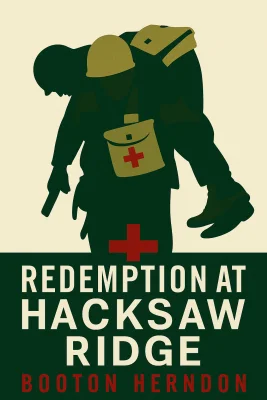
Redemption at Hacksaw Ridge
Categories
Nonfiction, Christian, Biography, History, Religion, Military Fiction, Biography Memoir, Historical, World War II, War
Content Type
Book
Binding
Kindle Edition
Year
2016
Publisher
Remnant Publications
Language
English
ASIN
B01MRE5F2P
File Download
PDF | EPUB
Redemption at Hacksaw Ridge Plot Summary
Introduction
On May 5, 1945, atop a blood-soaked cliff in Okinawa, a young American soldier stood alone against impossible odds. As his comrades retreated under withering Japanese fire, Desmond Thomas Doss remained behind, driven by an unwavering conviction that would earn him the Medal of Honor and forever change how America viewed conscientious objectors. This soft-spoken carpenter's son from Virginia had entered World War II without a weapon, guided only by his faith and an unshakeable belief in the sixth commandment: "Thou shalt not kill." Doss's story illuminates the remarkable journey of a man who transformed from a ridiculed outsider into one of America's most celebrated heroes. Through his extraordinary courage on the battlefields of Guam, Leyte, and Okinawa, readers will discover how unwavering principles can triumph over prejudice, how faith can provide strength in the darkest moments, and how one person's commitment to serving others can inspire generations. His legacy extends far beyond military valor, offering timeless lessons about moral courage, the power of conviction, and the true meaning of heroism in an age when such qualities seem increasingly rare.
Chapter 1: Early Years and Spiritual Foundations
Desmond Thomas Doss was born on February 7, 1919, in Lynchburg, Virginia, into a loving family that would shape his character through both gentle guidance and profound faith. His mother, Bertha Oliver Doss, was a devout Seventh-day Adventist who instilled in her son the fundamental principles that would define his entire life. His father, William Thomas Doss, worked as a carpenter, providing a modest but comfortable living during Desmond's formative years. The defining moment of young Desmond's moral development came through a simple household decoration. Hanging in the family living room was a framed illustration of the Ten Commandments, each accompanied by vivid drawings. As a curious child, Desmond would climb onto chairs to study these images more closely, particularly drawn to the sixth commandment's depiction of Cain slaying Abel. The horror of brother killing brother left an indelible mark on the boy's conscience, crystallizing his understanding that taking human life was fundamentally wrong. This early moral awakening was reinforced through countless acts of service and compassion within his community. When an injury to his hand prevented him from participating in sports, Desmond channeled his energy into helping others. He tended his mother's flower garden and distributed blooms to neighbors, particularly those who were ill. He volunteered at the local hospital, staying with dying patients so they wouldn't face their final moments alone. On one occasion, he donated his own blood to save a former church member, asking only that she and her husband return to regular worship in exchange for his sacrifice. The depth of Desmond's faith was matched only by his commitment to living according to its principles. He observed the Sabbath from sundown Friday to sundown Saturday, attended church regularly, and tithed faithfully despite his modest income. His education in a one-room Seventh-day Adventist school, under the inspiring guidance of teacher Nell Ketterman, reinforced these values while teaching him that "if a job is worth doing, it's worth doing right." This philosophy of conscientious excellence would prove crucial during his military service. Perhaps most importantly, Desmond's childhood was marked by witnessing the transformative power of faith within his own family. When his father finally joined the Seventh-day Adventist Church and committed to keeping the Sabbath despite potential job loss, young Desmond observed firsthand how divine providence rewarded faithful obedience. These early experiences created an unshakeable foundation of trust in God's protection and guidance that would sustain him through the most harrowing battles of World War II.
Chapter 2: Conscientious Objector in a World at War
When America entered World War II following Pearl Harbor, Desmond Doss faced a profound moral dilemma that would test his convictions to their limits. Unlike those who sought to avoid military service entirely, Desmond eagerly wanted to serve his country and support his fellow Americans in their hour of need. However, his deeply held religious beliefs prevented him from bearing arms or taking human life, making him what he preferred to call a "conscientious cooperator" rather than a conscientious objector. Enlisting in the Army on April 1, 1942, Desmond was initially assigned to the newly reactivated 77th Infantry Division at Fort Jackson, South Carolina. His early days in the service were marked by intense ridicule and hostility from fellow soldiers who viewed him as a coward or malingerer. The barracks echoed with profanity that deeply offended his religious sensibilities, and he faced physical harassment, including shoes thrown at him while he knelt in prayer. One particularly antagonistic soldier named Karger threatened to kill him in combat, declaring that religious objectors had no place in the Army. The military bureaucracy proved equally challenging to navigate. Despite official assurances from President Roosevelt and the Army Chief of Staff that conscientious objectors would be assigned to medical duties, Desmond initially found himself in an infantry company where officers repeatedly ordered him to carry weapons. His respectful but firm refusal to bear arms created friction with superiors who viewed his stance as insubordination. The situation became so tense that medical battalion officers attempted to discharge him under Section Eight, claiming mental instability based solely on his Sabbath observance. Desmond's commitment to keeping the Sabbath holy created additional complications throughout his training. While other soldiers observed Sunday as their day of rest and worship, Desmond required Saturday off, necessitating special passes to attend church in nearby towns. This arrangement drew resentment from fellow soldiers who perceived him as receiving preferential treatment, despite the fact that he worked extra duty on Sundays to compensate. His unwillingness to participate in Saturday training exercises led to confrontations with officers who threatened court-martial. The transformation in how others viewed Desmond began during a grueling twenty-five-mile march in the South Carolina heat. While his comrades collapsed from exhaustion and heat prostration, Desmond spent the day treating blistered feet and tending to the sick, often running to catch up with his unit after caring for wounded men. His compassionate service during this ordeal earned him the respect of Company B, marking the beginning of his acceptance as a valued member of the military community despite his unusual status as an unarmed soldier.
Chapter 3: The Crucible of Combat
Desmond's first taste of actual combat came during the assault on Guam in July 1944, where he faced the brutal realities of Pacific warfare. The landing itself was harrowing, with men wading through chest-deep water for 400 yards while Japanese artillery shells exploded around them. Once ashore, Desmond encountered his first casualties when a booby-trapped American fountain pen exploded among his comrades, severely burning several soldiers with white phosphorus. His calm, efficient treatment of these wounds under fire demonstrated his readiness for the challenges ahead. The Guam campaign taught Desmond valuable lessons about battlefield medicine and the unique moral complexities of treating wounded enemies. When he attempted to help wounded Japanese soldiers, American troops threatened to shoot him, citing previous incidents where Japanese had used grenades hidden beneath their bodies to kill approaching medics. This harsh reality forced Desmond to focus his life-saving efforts exclusively on American and Allied personnel, though the decision troubled his Christian conscience. Throughout the Pacific campaigns, Desmond developed innovative techniques for battlefield evacuation that would prove crucial in later actions. He learned to fashion litters from available materials, navigate treacherous terrain while carrying wounded soldiers, and provide emergency medical care under the most dangerous conditions. His willingness to accompany combat patrols, despite not being required to do so, earned him the grudging respect of line officers who initially viewed medical personnel as non-essential support staff. The Leyte campaign in the Philippines proved to be Desmond's bloodiest introduction to sustained combat operations. The tropical environment, constant rain, and fierce Japanese resistance created a nightmarish setting where death lurked around every corner. During one particularly harrowing rescue mission, Desmond saved his friend Clarence Glenn, carrying him through sniper-infested jungle only to watch him die just before reaching the aid station. This devastating loss taught Desmond to emotionally distance himself from the faces of the wounded, treating them as efficiently as possible without forming personal attachments that might compromise his effectiveness. Perhaps most significantly, these early combat experiences reinforced Desmond's growing belief that divine providence protected him during his missions of mercy. Time and again, he found himself exposed to enemy fire while treating wounded soldiers, yet emerged unscathed while others around him fell. One memorable incident occurred when a Japanese sniper had him clearly in his sights but inexplicably failed to pull the trigger, allowing Desmond to complete a dangerous rescue in an open rice paddy. These experiences strengthened his faith and gave him the confidence to take increasingly bold risks in service of his wounded comrades.
Chapter 4: Seventy-Five Lives: The Maeda Escarpment
The battle for Okinawa's Maeda Escarpment would prove to be Desmond's defining moment and one of the most extraordinary acts of individual heroism in American military history. On April 29, 1945, Company B was tasked with assaulting this imposing limestone cliff that commanded the entire width of the island and had already claimed two divisions' worth of casualties. The escarpment rose sharply from the valley floor, crowned by a sheer rock face thirty to fifty feet high, behind which Japanese forces had constructed an elaborate network of pillboxes and tunnels. Before the assault began, Lieutenant Gornto asked Desmond to lead the men in prayer, recognizing the spiritual strength that had sustained their medic through countless dangerous missions. Desmond's simple but heartfelt prayer asked for divine wisdom and protection, setting the tone for what would become an unprecedented military operation. The initial assault succeeded beyond all expectations, with the American forces destroying multiple enemy positions while suffering only one minor injury among the entire assault squad. However, the situation deteriorated rapidly when a massive Japanese counterattack threatened to overwhelm the American positions. As enemy artillery and mortar fire rained down on the escarpment and Japanese soldiers poured from hidden tunnels and caves, panic seized the American forces. Officers and non-commissioned officers struggled to maintain order as their men began a chaotic retreat down the cliff faces and cargo nets. In the confusion, wounded soldiers were left scattered across the bullet-swept hilltop with no hope of evacuation. While his comrades fled to safety, Desmond remained alone on the escarpment, methodically moving from one wounded soldier to another. Under intense enemy fire, he provided emergency medical treatment and then faced the seemingly impossible task of evacuating casualties down a fifty-foot cliff. Drawing upon his training in knot-tying from mountain warfare exercises, Desmond improvised a rope system using a double bowline that created two secure loops. This innovation allowed him to safely lower wounded men down the cliff face while maintaining control of their descent. For hours, Desmond continued this dangerous work, standing exposed to enemy fire as he secured each wounded soldier for evacuation. Each time he lowered a man to safety, he prayed for strength to save "just one more," then repeated the process with the next casualty. By the time he had evacuated every wounded American from the escarpment, military estimates placed the number of lives saved at seventy-five, though Desmond himself insisted the count was closer to fifty. Regardless of the exact figure, his single-handed rescue operation under impossible conditions earned him the Medal of Honor and established him as one of America's greatest military heroes.
Chapter 5: Wounds, Recognition, and the Medal of Honor
Desmond's heroic service on Okinawa came at a tremendous personal cost that would affect him for the rest of his life. During a night attack on May 21, 1945, he stepped on a Japanese hand grenade that severely wounded his legs and buttocks with seventeen pieces of shrapnel. Despite his injuries, he treated his own wounds and waited five hours for litter bearers, even giving up his place on the stretcher to a more seriously wounded soldier. As rescue teams carried him to safety, a sniper's bullet shattered his arm, but Desmond improvised a splint using a rifle stock and crawled 300 yards to the aid station. The physical trauma was compounded by the devastating diagnosis of tuberculosis, likely contracted during the harsh conditions on Leyte. Instead of returning home to his beloved wife Dorothy, Desmond spent the next five and a half years in various military and veterans' hospitals. The treatment for tuberculosis was brutal, requiring more than thirty painful bronchoscopy procedures and ultimately the removal of his left lung along with several ribs. These medical challenges transformed what should have been a triumphant homecoming into a prolonged struggle for basic health and mobility. Despite these setbacks, recognition for Desmond's extraordinary service came in the form of America's highest military honor. On October 12, 1945, President Harry S. Truman awarded him the Congressional Medal of Honor in a ceremony on the White House lawn. The citation detailed his remarkable actions on Okinawa, describing how he "refused to seek cover and remained in the fire-swept area with the many stricken, carrying them one by one to the edge of the escarpment and there lowering them on a rope-supported litter down the face of a cliff to friendly hands." The Medal of Honor ceremony was particularly meaningful because it represented official vindication of Desmond's approach to military service. President Truman, recognizing the unique nature of this award to a conscientious objector, personally stepped forward to congratulate Desmond and declared the medal "a greater honor than being President." This recognition helped pave the way for future Seventh-day Adventist servicemen and demonstrated that moral courage and religious conviction could coexist with patriotic service. The broader impact of Desmond's recognition extended far beyond individual accolades. His story became a powerful testimony to the possibility of serving one's country while maintaining deeply held religious principles. Fellow Medal of Honor recipients consistently chose him to represent them at special occasions, including the centennial celebration of the award where he met with President John F. Kennedy. His example inspired the establishment of Camp Desmond T. Doss, a training facility for young Seventh-day Adventist men preparing for military medical service, ensuring that his legacy would continue to influence future generations of conscientious cooperators.
Chapter 6: Life After War: Struggles and Service
The post-war years brought unexpected challenges that tested Desmond's faith and resilience in ways that combat never had. His extended hospitalization for tuberculosis treatment meant separation from his wife Dorothy and their newborn son, whom he couldn't even touch for fear of infection. The family's financial struggles were severe, living on Desmond's modest disability pension of $118 per month while Dorothy worked in a hosiery mill to make ends meet. Their attempts to establish a tropical fish breeding business failed catastrophically when a faulty thermometer caused the loss of their entire stock. The physical limitations imposed by Desmond's war injuries made traditional employment nearly impossible. With only one functioning lung, a weakened left arm, and persistent pain from shrapnel fragments, he couldn't return to his pre-war profession of carpentry. Various attempts at vocational rehabilitation through the GI Bill proved unsuccessful, as employers were reluctant to hire a disabled veteran regardless of his heroic status. The family lived in substandard housing, including a rundown farmhouse that was impossible to heat and a small cabin that Desmond built himself on four acres of rocky mountain land. The stress of these circumstances took a devastating toll on Dorothy's mental health, leading to her breakdown in 1952. Her treatment at a Seventh-day Adventist sanitarium provided some relief, but the family's struggles continued for years. The situation improved dramatically in 1957 when Desmond appeared on the television program "This Is Your Life," which provided them with tools, equipment, and land that enabled a more stable existence. Dorothy eventually returned to school to become a registered nurse, finding fulfillment in the Head Start educational program. Throughout these difficult years, Desmond never wavered in his commitment to sharing his story and inspiring others. He accepted every speaking engagement offered by churches and civic organizations, traveling across the country despite his physical limitations. His presentations, featuring demonstrations of the rope techniques he used on Okinawa and displays of his Medal of Honor and Bible, touched thousands of lives and helped spread the message that faith and courage could overcome seemingly impossible obstacles. Desmond's dedication to service extended beyond speaking engagements to practical community involvement. He led the Civilian Defense rescue service in Walker County, Georgia, personally funding and maintaining emergency equipment. In 1966, his team successfully rescued eight Boy Scouts and three adult leaders from a dangerous cave system, with Desmond spending more consecutive hours underground than any other rescuer. His greatest post-war project was the construction of the Lookout Mountain Seventh-day Adventist Church and school, which he saw as his most important contribution to helping disadvantaged children in the impoverished mountain region.
Chapter 7: Legacy of Courage and Faith
Desmond Doss's influence on American military service and religious freedom extends far beyond his individual Medal of Honor citation, creating lasting changes in how conscientious objectors are perceived and treated within the armed forces. His example directly paved the way for thousands of young Seventh-day Adventist men who followed him into military medical service, finding acceptance rather than hostility from their fellow soldiers. The Medical Cadet Corps, established to train future medical personnel, was renamed Camp Desmond T. Doss in his honor, providing specialized preparation for young men committed to serving their country while maintaining their religious principles. The transformation in military attitudes toward conscientious objectors became evident during the Vietnam War, where Seventh-day Adventist medics like Curtis Reed, Melvin Kohltfarber, Fred Villanueva, and George Vartenuk earned Bronze Stars for valor while serving as unarmed medical personnel. These men reported experiencing respect and admiration from their comrades rather than the suspicion and harassment that Desmond had endured. Their commanding officers recognized their courage and dedication, with one sergeant telling medic Mike Vartenuk that he had "more guts" than armed soldiers. Desmond's story also had profound international impact, particularly in Japan and the Pacific regions where he had served. Okinawan Seventh-day Adventists erected monuments commemorating his heroism at the Maeda Escarpment site, while local church members reported miraculous blessings in their agricultural endeavors. His testimony that a Japanese sniper had him in his sights but was mysteriously unable to fire became part of Adventist missionary lore, eventually reaching the former enemy soldier who confirmed the account. The broader cultural impact of Desmond's example resonates through American society's ongoing struggles with questions of religious freedom, moral courage, and the relationship between faith and patriotism. His life demonstrated that deeply held religious convictions need not conflict with loyal service to one's country, and that moral principles can actually enhance rather than diminish one's effectiveness as a citizen and soldier. The 2016 film "Hacksaw Ridge" introduced his story to a new generation, ensuring that his legacy of faith-based courage continues to inspire young people facing their own moral challenges. Perhaps most significantly, Desmond's unwavering commitment to his principles while serving others created a template for moral courage that transcends military service. His example shows that individuals can maintain their deepest convictions while working within systems that may not share those beliefs, finding ways to contribute meaningfully without compromising their integrity. This lesson proves particularly relevant in contemporary debates about religious freedom, conscientious objection, and the role of faith in public service, making Desmond Doss a timeless symbol of principled action in the face of adversity.
Summary
Desmond Thomas Doss proved that the greatest heroism often stems not from the weapons we carry, but from the convictions that carry us through our darkest moments. His extraordinary journey from a ridiculed conscientious objector to America's most decorated medic demonstrates the transformative power of unwavering faith combined with selfless service to others. In an age when moral courage seems increasingly rare, his example reminds us that standing firm in our deepest beliefs while actively serving our communities can create positive change that echoes through generations. The lessons from Desmond's life offer practical guidance for anyone facing pressure to compromise their principles or questioning whether individual conviction can make a meaningful difference. His story encourages us to view obstacles as opportunities to demonstrate our values through action, to find creative ways to serve others within any system or circumstance, and to trust that principled stands, even when unpopular, ultimately earn respect and create lasting positive change. For readers seeking inspiration about faith, courage, and service, or those interested in untold stories of American heroism, Desmond's legacy provides both hope and a compelling call to action in our own lives and communities.
Best Quote
“Ken Mittleider,” ― Booton Herndon, Redemption at Hacksaw Ridge
Review Summary
Strengths: The book is praised for its gripping and moving narrative, highlighting Desmond Doss's gallantry, courage, and faith. It is described as an inspiring story of a conscientious objector who served bravely in WWII without bearing arms. The story is considered a quick and engaging read, suitable for educational purposes, and is appreciated for its portrayal of an American hero. Weaknesses: Criticism is directed at the book's perceived propagandistic tone, with some readers feeling it serves as a promotional piece for the Seventh Day Adventist church and the US Army. The writing style is compared to a government press release, which detracts from its authenticity. Overall: The general sentiment is positive, with readers finding the story of Desmond Doss inspiring and compelling. However, some critique the book's promotional undertones. It is recommended for those interested in heroism and WWII narratives, though with caution regarding its potential biases.
About Author

Booton Herndon
Herndon explores the narratives of historical and biographical significance by meticulously researching and documenting the lives of American figures and institutions. His work is underpinned by a dedication to rigorous historical research and personal interviews, ensuring authenticity in storytelling. This approach is evident in his book "The Unlikeliest Hero", where he vividly chronicles the life of Desmond T. Doss, offering readers a profound understanding of individual heroism during wartime. Meanwhile, his outsider perspective in "The Seventh Day: The Story of the Seventh-day Adventists" showcases his ability to convey complex religious histories with clarity.\n\nHerndon’s writing style resonates with audiences who seek in-depth exploration of American history, focusing on both individual and institutional development. His thorough research methods and narrative skills make his works appealing to those interested in heroism and religious studies. The adaptation of his work on Desmond Doss into titles like "Redemption at Hacksaw Ridge" and "Hero of Hacksaw Ridge" illustrates the enduring impact of his narratives, reaching new generations and expanding his audience. This bio highlights how his books serve as both educational tools and engaging stories, offering insights into the resilience and dedication of their subjects.
Read moreDownload PDF & EPUB
To save this Black List summary for later, download the free PDF and EPUB. You can print it out, or read offline at your convenience.
Redemption at Hacksaw Ridge
by Booton Herndon
