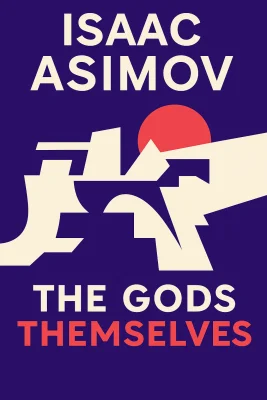
The Gods Themselves
Categories
Fiction, Classics, Science Fiction, Audiobook, Fantasy, Science Fiction Fantasy, Space, Novels, Aliens, Hugo Awards
Content Type
Book
Binding
Paperback
Year
2000
Publisher
Millenium
Language
English
ISBN13
9781857989342
File Download
PDF | EPUB
The Gods Themselves Plot Summary
Introduction
The tungsten pellets in the dusty reagent bottle had changed overnight. Frederick Hallam stared at the impossible transformation—gray oxide had become gleaming metal, heavier than it should be, radiating energy that defied every known law of physics. What he couldn't know was that this moment would birth humanity's greatest triumph and potentially its final catastrophe. The Electron Pump emerged from this mystery, drawing limitless clean energy from a parallel universe where different physical laws allowed impossible exchanges. Earth basked in abundance while the para-men, the invisible beings on the other side, seemed equally content with their cosmic partnership. But in the laboratories and corridors of Luna City, physicist Peter Lamont discovered equations that painted a terrifying picture. The Pump wasn't just trading energy—it was slowly rewriting the fundamental constants of reality itself. Soon the Sun would explode, consuming everything in a stellar detonation that would make Earth's nuclear weapons seem like firecrackers. Yet when Lamont tried to sound the alarm, he found himself crushed by the same scientific establishment that had elevated Hallam to godlike status.
Chapter 1: The Electron Pump: Hallam's Theft and Humanity's Blessing
Frederick Hallam's life changed the moment he noticed something wrong with a forgotten bottle on his laboratory desk. The tungsten pellets inside had transformed overnight from gray oxide to gleaming metal, impossibly dense and radiating mysterious energy. His colleague Benjamin Denison, brilliant but caustic, made the fatal mistake of questioning Hallam's competence with a sneering "How would you know?" This single insult would drive the mediocre radiochemist to heights he never could have reached alone. Driven by wounded pride and desperate to prove himself, Hallam pushed the mysterious material through every test the university could manage. The mass spectrometer revealed the impossible: plutonium-186, an isotope that couldn't exist under any known physics. The material was stable when it arrived but slowly became radioactive, as though the laws of this universe were gradually soaking into its alien structure. At a packed scientific seminar, Hallam announced his Great Insight to a stunned audience. The tungsten had come from a parallel universe where different physical laws made plutonium-186 stable. In exchange, tungsten-186 from Earth had crossed over, creating a bridge between realities. More audaciously, he proposed that intelligent beings on the other side had deliberately initiated this exchange, seeking energy just as humanity did. The implications were staggering. By carefully managing this inter-dimensional trade, both universes could tap into an inexhaustible energy source—the Electron Pump. While Hallam basked in his newfound fame as the Father of the Electron Pump, Denison's career withered. His early involvement was erased from official histories, and his attempts to claim credit only branded him as a bitter has-been. Within years, Hallam commanded Earth's entire scientific establishment while Denison sold cosmetics, his warnings about the Pump's dangers dismissed as the ravings of a failed scientist consumed by jealousy.
Chapter 2: Warnings Unheeded: Denison and Lamont's Desperate Fight
Twenty years later, physicist Peter Lamont discovered the truth that would haunt his dreams. Deep in the theoretical mathematics of para-physics, he found equations suggesting that the Electron Pump was slowly altering the fundamental forces of both universes. As energy flowed between realities, the strong nuclear interaction was intensifying in Earth's universe, making fusion reactions more efficient. The process was accelerating exponentially. Lamont calculated that within decades, the Sun would reach a critical threshold. The stellar furnace that had burned steadily for billions of years would suddenly ignite in a catastrophic explosion, consuming the inner solar system in minutes. His colleague Myron Bronowski helped him decode fragmentary communications from the para-universe—desperate messages spelling out "FEAR" and "PUMP BAD" in crude approximations of human language. The para-beings were trying to warn Earth, but no one was listening. When Lamont brought his findings to Frederick Hallam, now Earth's most revered scientist, he was met with explosive rage. Hallam refused to consider any threat to his legacy, dismissing the mathematics as the desperate fantasies of lesser minds. Government officials like Senator Burt demanded ironclad proof before they would risk the economic collapse that ending the Pump would cause. Even activist Joshua Chen, initially sympathetic, ultimately chose the promise of human immortality over uncertain doom. The scientific establishment closed ranks around Hallam, systematically destroying Lamont's career just as they had Denison's years before. Papers were rejected without review, funding disappeared, and colleagues avoided him like a plague carrier. The para-beings sent increasingly frantic messages, but their alien syntax made them easy to dismiss as meaningless noise. As Earth celebrated unlimited prosperity, Lamont found himself screaming into a void, watching humanity dance toward annihilation.
Chapter 3: The Para-Universe: Three Beings and Their Cosmic Sacrifice
In the parallel universe, reality operated under different rules. The strong nuclear force burned a hundred times brighter, making fusion so efficient that stars were tiny, dense jewels scattered across infinite darkness. In this realm lived the Soft Ones, creatures of living energy who could merge and separate at will, forming triads of specialized beings: the analytical Rational, the nurturing Parental, and the intuitive Emotional. Odeen was a Rational, brilliant and curious, devoted to learning from the ancient Hard Ones who guided their civilization. His triad-mate Tritt embodied the Parental instinct, obsessed with creating and protecting offspring. Between them flowed Dua, an Emotional unlike any other—questioning, rebellious, refusing to accept the simple role her species demanded. Their three-way meltings created ecstasy beyond description, but also something more: in those moments of union, they briefly became something greater than themselves. The Hard Ones had initiated the Electron Pump to save their dying civilization. As their small, efficient stars cooled toward extinction, the energy flowing from Earth's universe offered salvation. But Dua, with her strange gift for sensing truth, began to understand the terrible cost. The pump was strengthening nuclear forces in the para-universe, making their stars burn hotter and faster. Soon they would explode in chain reactions that would sterilize entire galactic regions. When Dua tried to sabotage the Pump by sending warning messages to Earth, the Hard Ones revealed their ultimate secret. The Soft Ones were not truly separate beings but larval stages of the Hard Ones themselves. Every mature triad eventually underwent a final melting, their three separate consciousnesses merging permanently into a single immortal entity. Odeen's growing understanding, Tritt's fierce protectiveness, and Dua's passionate rebellion were all necessary components of this transformation. As the three beings faced their final choice, they realized that even their resistance had been planned, their very defiance shaped to serve the ancient creatures who had orchestrated everything from the beginning.
Chapter 4: Lunar Refuge: Denison's Journey to the Moon
Benjamin Denison arrived at Luna City carrying nothing but bitter memories and a desperate hope for redemption. At sixty, his face bore the lines of twenty years selling cosmetics while watching lesser minds claim credit for his insights about the Electron Pump. The Moon's gentle gravity made his aging body feel almost young again, but it couldn't ease the weight of knowing that Earth was dancing toward destruction. The lunar colonists fascinated him with their casual adaptation to an alien world. Born in low gravity, they moved with an uncanny grace that made Earth-dwellers look clumsy by comparison. Selene Lindstrom, his tourist guide, embodied this new breed of humanity—tall, willowy, with the faintly Oriental features common among the Moon-born. Her casual nudity and matter-of-fact sexuality spoke of a culture freed from Earth's lingering puritanism, shaped entirely by the practical demands of survival in the void. But beneath Luna City's progressive surface, Denison sensed deeper currents. The physicist Barron Neville treated him with suspicious hospitality, clearly fishing for information while revealing little of his own work. The lunar scientists had been systematically excluded from Earth's major research projects, their requests for time on the great synchrotrons routinely denied. They were developing their own instruments, their own theories, nursing grievances that had been festering for decades. Commissioner Gottstein, Earth's representative on the Moon, confided his own fears about the growing estrangement between the worlds. The Lunarites were becoming something new, no longer quite human in the terrestrial sense. Their elongated bodies couldn't survive Earth's crushing gravity, making them permanent exiles from humanity's birthworld. Some, like Neville, seemed to embrace this isolation with an almost pathological intensity. The question was whether their separation would remain peaceful or explode into something darker.
Chapter 5: The Intuitionist: Selene's Gift and the Promise of a Solution
The truth about Selene emerged gradually, like a photograph developing in slow motion. She was no simple tourist guide but something far rarer—an Intuitionist, blessed with an almost supernatural ability to grasp complex physical principles without mathematical training. Her insights had sparked breakthrough after breakthrough in lunar physics, yet she remained hidden behind a facade of cheerful ignorance, her talents known only to a select few. Barron Neville was her lover and controller, using her gifts to advance his own research while keeping her existence secret from Earth's scientific establishment. But as Denison worked to develop his own theories about the Electron Pump's dangers, Selene found herself torn between loyalties. She sensed the truth in his equations, felt the approaching catastrophe in ways that mathematics couldn't quite capture. Together, they worked on the lunar surface under the blazing sun and star-filled darkness, developing a new kind of energy source that could counteract the Pump's effects. Where the Electron Pump drew power from the para-universe with its tiny, hot stars, Denison and Selene reached toward a different cosmos entirely—one where the weak nuclear force had created a single massive object containing all the matter in that universe. This "cosmeg" universe offered unlimited energy with a crucial difference: the flow was one-way, eliminating the gradual mixing of physical laws that made the Electron Pump so dangerous. But the technical challenges were staggering. The energy emerged at random points in space, impossible to control or contain with existing technology. Only Selene's intuitive understanding of multidimensional physics offered hope for taming this cosmic force.
Chapter 6: The Cosmeg Pump: Balancing Universal Constants
The breakthrough came during a moment of perfect synthesis between Denison's methodical analysis and Selene's intuitive leaps. Working in the shadow of a lunar crater, they achieved the first stable energy leak from the cosmeg universe—a brilliant star of pure power floating in the vacuum above their equipment. The implications were staggering: unlimited energy without the universe-destroying feedback loops that made the Electron Pump a ticking time bomb. But even as they celebrated this triumph, deeper conspiracies were emerging. Neville revealed his true agenda—not just energy independence for the Moon, but complete separation from Earth. Using the same principles that allowed energy transfer between universes, he planned to steal momentum from the cosmeg, turning the Moon into a vast spacecraft that would carry Luna City to the stars. The plan was breathtaking in its audacity and terrifying in its implications. The Moon's departure would doom Earth to solar explosion unless cosmeg pumps could be built quickly enough to replace the lost balancing force. But Neville didn't care. His pathological need to escape from any connection to humanity's birthworld had infected a significant portion of Luna City's population, turning their natural desire for independence into something approaching madness. Selene found herself caught between worlds—literally and figuratively. Her relationship with Neville was crumbling under the weight of his obsessions, while her work with Denison opened new possibilities she had never imagined. The choice was becoming clear: would the Moon's future be defined by Neville's desperate flight from humanity, or by a new partnership that could save both worlds while opening the entire universe to exploration?
Chapter 7: Freedom's Price: Earth, Moon, and the Stars Beyond
The final confrontation came not through violence but through democracy and the inexorable logic of physics. When Neville's faction called for a vote on independence, they discovered that most lunar citizens preferred the stars to remain within reach rather than flee into eternal isolation. The compromise was elegant: those who wished to explore the galaxy could build cosmeg-powered starships capable of crossing interstellar space in a human lifetime, while the Moon itself would remain as humanity's first stepping stone into the cosmos. Commissioner Gottstein proved more flexible than anyone had expected, recognizing that the old relationship between Earth and Moon was ending regardless of political decisions. The cosmeg pumps would be built as joint ventures, their output carefully calibrated to neutralize the Electron Pump's effects while providing energy for both worlds' expanding needs. Earth would handle the gradual shutdown of the para-universe connection, while the Moon became the center for humanity's next great leap outward. For Denison and Selene, the victory was deeply personal as well as cosmic. Their collaboration had evolved from necessity into something approaching love—not the simple physical attraction that had defined her relationship with Neville, but a partnership of minds that transcended the growing gap between Earth-born and lunar humanity. When Selene asked him to father her next child through artificial insemination, it represented something unprecedented: a conscious choice to blend the best of both worlds. As Earth's sun continued to shine safely in lunar skies, the first cosmeg-powered ships were already on drawing boards. Within a generation, human explorers would be visiting nearby stars, their journey measured in years rather than millennia. The universe that had once seemed so hostile and empty now beckoned with infinite possibilities, its vast energies finally harnessed not for destruction but for the greatest adventure in human history.
Summary
Isaac Asimov's cosmic trilogy reaches its resolution through the marriage of hard science and human ambition, showing how the greatest threats to survival often emerge from our greatest triumphs. The Electron Pump that promised unlimited prosperity became a weapon of cosmic destruction, while the very qualities that made humanity worth saving—curiosity, stubbornness, the refusal to accept limitations—nearly doomed the species to extinction. Yet in the end, it was these same human traits that provided salvation. Denison's bitter quest for vindication, Selene's intuitive gift for seeing beyond conventional wisdom, and even Neville's pathological need for independence all contributed to a solution that transformed threat into opportunity. The universe revealed itself not as a collection of separate realities to be exploited, but as an infinite source of energy and possibility waiting for minds bold enough to grasp its deeper patterns. Humanity's future lay not in fleeing from challenges but in embracing them, using the very forces that threatened destruction as stepping stones toward a destiny among the stars.
Best Quote
“There are no happy endings in history, only crisis points that pass.” ― Isaac Asimov, The Gods Themselves
Review Summary
Strengths: The review highlights the book's focus on a single, science-related "what-if" scenario, emphasizing its "pure" and "hard" science fiction nature. The science is described as accurate and grounded in reality. The book is praised for its excellent characters and engaging conversations. The structure of the narrative, divided into three distinct sections, is also noted as a strength. Overall: The reviewer expresses a highly positive sentiment towards the book, considering it one of the best examples of pure science fiction. Despite acknowledging that it may not be the best story overall, the reviewer recommends it highly, especially for its scientific depth and narrative structure. The reviewer's personal admiration for Asimov further enhances the recommendation.
About Author

Isaac Asimov
Asimov probes the intricate interplay between science and society, crafting narratives that question humanity's trajectory. His works often merge scientific inquiry with storytelling, as evidenced by the "Foundation" series, which introduces the concept of psychohistory to explore civilization's rise and fall. This fusion of mathematics and sociology demonstrates Asimov's commitment to blending intellectual rigor with creative vision. While his "Robot" series delves into the ethical dimensions of artificial intelligence, his nonfiction writings, like "The Intelligent Man's Guide to Science," demystify complex scientific principles, bridging the gap between expert knowledge and public understanding. This method ensures readers engage with both speculative ideas and tangible science.\n\nReaders benefit from Asimov's clear prose and rationalist approach, gaining insights into the potential futures of technology and society. His narrative style encourages readers to ponder ethical and philosophical questions, making his books not just entertaining, but thought-provoking. Asimov's influence extends beyond his fiction, as he served as a public intellectual and advocate for humanism, providing a moral framework for scientific advancement. The clarity of his communication helps a wide audience, from casual readers to academics, to grasp intricate scientific concepts, thereby expanding their understanding of both science fiction and factual science.\n\nAsimov's impact is further validated by his numerous accolades, including the Hugo Award for Best All-Time Series, affirming his legacy in the literary world. His storytelling not only captivates but also educates, fostering a deeper appreciation for the scientific method and its implications. By weaving together elements of mystery, science, and philosophy, Asimov's oeuvre challenges readers to explore the universe of ideas, making his contributions enduring and relevant. His work remains a valuable resource for those interested in the intersection of narrative and scientific thought, offering insights that are both timeless and pertinent.
Read moreDownload PDF & EPUB
To save this Black List summary for later, download the free PDF and EPUB. You can print it out, or read offline at your convenience.
The Gods Themselves
by Isaac Asimov
