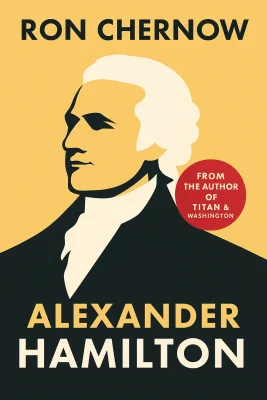
Alexander Hamilton
The bestselling inspiration for the hit Broadway musical
Categories
Nonfiction, Biography, History, Politics, Unfinished, Audiobook, Biography Memoir, Historical, American History, American Revolution
Content Type
Book
Binding
Paperback
Year
2005
Publisher
Penguin Books
Language
English
File Download
PDF | EPUB
Alexander Hamilton Plot Summary
Introduction
On a sweltering July morning in 1804, two men stood facing each other on a rocky ledge above the Hudson River. One was Aaron Burr, the sitting Vice President of the United States. The other was Alexander Hamilton, former Treasury Secretary and architect of America's financial system. The pistol shot that rang out moments later would end the life of one of America's most brilliant founding fathers, a man whose journey from Caribbean orphan to national leader embodied the promise and complexity of the new republic. Hamilton's death at forty-nine cut short a remarkable career, but not before he had fundamentally shaped the nation's economic and governmental foundations in ways that continue to influence American life today. Hamilton's extraordinary rise from illegitimate birth on a small Caribbean island to Washington's right-hand man and financial visionary represents one of history's most remarkable stories of talent overcoming circumstance. Through his creation of America's financial system, his pivotal role in ratifying the Constitution, and his visionary understanding of what the United States could become, Hamilton left an indelible mark on the nation. His life illuminates the transformative power of intellect and determination, the crucial importance of sound economic institutions to national success, and the complex interplay between personal ambition and public service that defines democratic leadership. Even as we continue to debate his legacy, Hamilton's vision of a dynamic, commercial republic with strong national institutions remains at the heart of American identity.
Chapter 1: Caribbean Origins: Orphan to Opportunity
Alexander Hamilton's life began in circumstances that gave little indication of his future greatness. Born on January 11, 1755 (or possibly 1757) on the small Caribbean island of Nevis, Hamilton entered a world defined by colonial trade, plantation slavery, and rigid social hierarchies. His mother, Rachel Faucette, had fled an unhappy first marriage before meeting James Hamilton, a Scottish merchant with whom she had two sons. Their relationship, never formalized in marriage due to her unresolved first union, meant that young Alexander carried the stigma of illegitimacy in a society that harshly judged such circumstances. Tragedy struck early and repeatedly in Hamilton's young life. His father abandoned the family when Alexander was around ten years old, leaving them in precarious financial circumstances. By the time he was thirteen, his mother had died from a fever, effectively orphaning him and his brother. This series of abandonments instilled in Hamilton a fierce independence and determination that would characterize his approach to life. Rather than crushing his spirit, these hardships seemed to fuel an extraordinary ambition and work ethic that would distinguish him throughout his career. Despite his disadvantages, Hamilton's intellectual gifts quickly became apparent. Working as a clerk for the international trading firm Beekman and Cruger in St. Croix, the teenage Hamilton displayed remarkable aptitude for business, mathematics, and writing. His employers were so impressed with his abilities that they occasionally left him in charge of operations during their absences – an extraordinary responsibility for someone so young. This early commercial experience gave Hamilton invaluable insights into international trade, finance, and the complexities of colonial economics that would later inform his vision for America's financial system. Hamilton's intellectual promise caught the attention of local community leaders, who recognized that this remarkable young man deserved opportunities beyond what the Caribbean could offer. When Hamilton wrote a vivid account of a devastating hurricane that struck St. Croix in 1772, his eloquence so impressed readers that they collected funds to send him to North America for education. Arriving in New York in 1773, just as revolutionary sentiments were building, Hamilton enrolled at King's College (now Columbia University) and quickly immersed himself in the political debates of the era. The circumstances of Hamilton's early life shaped his worldview in profound ways. Having experienced poverty firsthand, he understood the importance of economic opportunity and social mobility. His West Indian background gave him a global perspective that many American-born revolutionaries lacked. Perhaps most significantly, his status as an outsider – foreign-born, without family connections or inherited wealth – made him deeply appreciative of America as a land where talent could triumph over birth. This perspective would drive his passionate commitment to creating a strong national government capable of unleashing the new nation's economic and political potential.
Chapter 2: Revolutionary War: Washington's Indispensable Aide
When the American Revolution erupted, Hamilton seized the opportunity to prove himself. Initially joining a volunteer militia company, he quickly distinguished himself through his organizational skills and courage under fire. His military acumen brought him to the attention of General George Washington, who appointed the young man to his staff in March 1777. As Washington's aide-de-camp, Hamilton became the general's chief writer, drafting crucial correspondence and orders during the most challenging periods of the Revolutionary War. The relationship between Washington and Hamilton proved transformative for both men and for the nation they were helping to create. Washington, the reserved Virginia planter, found in Hamilton an intellectually nimble and articulate spokesman who could translate his thoughts into compelling language. Hamilton, in turn, gained a mentor whose judgment and character he deeply respected. Though their temperaments differed dramatically – Washington deliberate and cautious, Hamilton impulsive and brilliant – they formed an effective partnership that would shape the future republic. Hamilton's position on Washington's staff placed him at the center of the revolutionary effort, giving him unparalleled insights into the war's military, political, and economic dimensions. He witnessed firsthand the Continental Army's struggles with inadequate supplies, delayed pay, and inconsistent support from the states and Congress. These experiences profoundly influenced Hamilton's political thinking, convincing him of the need for a strong central government with robust powers of taxation and economic regulation. The chaos and inefficiency he observed during the war years would later fuel his federalist vision for America. Despite the prestige of his staff position, Hamilton longed for battlefield glory. In 1781, after more than four years of administrative service, he finally received his opportunity at the decisive Battle of Yorktown. Given command of a light infantry battalion, Hamilton led a nighttime assault on a British redoubt that contributed significantly to the American victory. This military triumph provided Hamilton with the heroic credentials he craved while cementing his place in the revolutionary narrative. When the British surrendered at Yorktown, effectively ending major combat operations, Hamilton had established himself as both a military hero and a political thinker. Throughout the war, Hamilton formed crucial relationships with other revolutionary leaders and expanded his understanding of governance. His marriage to Elizabeth Schuyler in December 1780 connected him to one of New York's most prominent families, providing social connections and financial stability that had eluded him in his early life. His close association with Washington gave him political capital that would prove invaluable in the nation-building process to come. By the time the Treaty of Paris formally ended the war in 1783, Hamilton had transformed himself from an ambitious immigrant into a respected national figure poised to help shape the new American republic.
Chapter 3: Constitutional Vision: Federalist Architect
The period following the Revolutionary War revealed the inadequacies of the Articles of Confederation, America's first attempt at national government. As a lawyer in New York, Hamilton witnessed how state interests undermined national cohesion, how foreign powers exploited American weakness, and how financial chaos threatened the young nation's stability. By 1786, with Shays' Rebellion in Massachusetts demonstrating the potential for civil disorder, Hamilton had become convinced that a complete overhaul of American governance was necessary for the republic's survival. When delegates gathered in Philadelphia for the Constitutional Convention in 1787, Hamilton arrived with perhaps the most ambitious vision for a new government. His plan, presented in a remarkable six-hour speech on June 18, called for a powerful national government with a president and senate serving during "good behavior" (essentially for life), and a house of representatives elected every three years. While many delegates found his proposal too reminiscent of the British monarchy they had just overthrown, Hamilton's arguments for a strong executive and an energetic national government influenced the final document. Though he found the Constitution imperfect, Hamilton recognized it as vastly superior to the Articles and committed himself wholeheartedly to its ratification. The ratification battle presented Hamilton with his greatest intellectual challenge and produced his most enduring contribution to American political thought. When anti-Federalist opposition to the Constitution emerged in New York, Hamilton conceived an ambitious writing project to defend the document. Collaborating with James Madison and John Jay under the pseudonym "Publius," he launched what became known as The Federalist Papers – a series of 85 essays explaining and defending the proposed Constitution. Hamilton personally wrote 51 of these essays, often producing several papers per week while maintaining his legal practice. His contributions covered topics ranging from taxation and military affairs to the judiciary and executive power, creating a comprehensive argument for the new system of government. Hamilton's vision of American governance, as articulated in The Federalist Papers, was remarkably forward-looking. Unlike many of his contemporaries who idealized classical republics or feared change, Hamilton embraced the idea that America would grow and transform, requiring a government capable of addressing unforeseen challenges. He understood that a commercial republic spanning a continent would need different institutions than a small agrarian state. His conception of "energetic government" – one with sufficient powers to advance national interests while remaining accountable to the people – challenged the prevailing view that governmental power was inherently threatening to liberty. The ratification of the Constitution in 1788 represented a personal triumph for Hamilton, particularly when New York – after intense debate – voted to approve the document. His intellectual contributions had helped secure the foundation for the new government, but Hamilton was not content merely to theorize about governance. With the establishment of the new federal government under President Washington, Hamilton would have the opportunity to translate his constitutional vision into practical reality, creating institutions and policies that would shape American life for generations to come.
Chapter 4: Treasury Secretary: Building America's Economy
When George Washington became the first president under the new Constitution in 1789, he appointed Hamilton as Secretary of the Treasury, a position that would allow him to implement his vision for America's economic future. The challenges facing the young nation were daunting: Revolutionary War debts remained unpaid, the country lacked a stable currency, foreign creditors doubted America's financial stability, and the new government had no reliable revenue sources. With characteristic energy and brilliance, Hamilton set about creating a comprehensive financial architecture that would transform the United States from a fragile confederation into a creditworthy nation. Hamilton's first major initiative was his Report on Public Credit, submitted to Congress in January 1790. He proposed that the federal government assume all state debts from the Revolution and pay them at full value, establishing America's reputation for financial integrity. This controversial plan faced fierce opposition, particularly from southern states that had already paid much of their debt. Through a famous compromise with James Madison and Thomas Jefferson – trading the assumption plan for locating the new national capital on the Potomac River – Hamilton secured passage of this cornerstone policy. By honoring all debts at face value, Hamilton established the principle that the United States would meet its financial obligations, creating confidence among investors both domestic and foreign. Building on this foundation, Hamilton established the First Bank of the United States in 1791, creating a central banking institution that could regulate currency, provide loans to businesses, and serve as the government's fiscal agent. The bank faced constitutional objections from Jefferson and Madison, who argued Congress lacked explicit authority to charter such an institution. Hamilton countered with his doctrine of implied powers, arguing that the Constitution's necessary and proper clause permitted actions needed to execute enumerated powers. Washington sided with Hamilton, setting a precedent for broad interpretation of federal authority that would have profound implications for American governance. Hamilton's financial system also included a plan for government-supported manufacturing. His Report on Manufactures, submitted to Congress in December 1791, laid out a visionary program for developing American industry through tariffs, subsidies, and infrastructure improvements. While his manufacturing proposals faced resistance from those favoring an agricultural economy, Hamilton's report articulated an economic nationalism that would influence American policy for generations. He understood that true independence required not just political sovereignty but economic self-sufficiency, particularly in industries crucial to national defense. Perhaps most importantly, Hamilton established reliable revenue sources through a system of tariffs and excise taxes, including the controversial whiskey tax that later sparked rebellion in western Pennsylvania. When that rebellion threatened federal authority in 1794, Hamilton accompanied Washington with militia forces to demonstrate that the new government could enforce its laws. This decisive response established the principle that democratic government required not just popular consent but the capacity to maintain order and execute national policy. By the time Hamilton left the Treasury in 1795, he had created a financial system that would endure in its essential elements for generations. His integrated program of debt management, banking, currency stabilization, and revenue collection established the economic foundation for American power and prosperity. Though many of his contemporaries failed to appreciate the significance of his achievements, Hamilton's financial architecture proved remarkably durable and adaptable as the nation expanded westward and industrialized in the nineteenth century.
Chapter 5: Political Battles: Jefferson, Adams and Party Strife
Hamilton's ambitious agenda inevitably generated powerful opposition. As Washington's first term progressed, two distinct political factions emerged – the Federalists led by Hamilton and the Democratic-Republicans guided by Jefferson and Madison. What began as disagreements over specific policies evolved into fundamental disputes about America's future direction, with Hamilton advocating for a commercial, industrial nation with strong central authority while Jefferson envisioned a republic of virtuous farmers with limited government. The conflict between Hamilton and Jefferson represented more than personal rivalry; it embodied competing visions for America's future. Hamilton, shaped by his Caribbean background and wartime experiences, believed that human ambition required constitutional restraints and that economic development required active government support. Jefferson, influenced by Enlightenment ideals and his plantation lifestyle, placed his faith in the wisdom of common farmers and feared the corrupting influence of financial speculation and manufacturing. Their disagreements extended beyond domestic policy to foreign affairs, with Hamilton favoring closer ties to Britain while Jefferson sympathized with revolutionary France. These philosophical differences soon manifested in practical political opposition. Jefferson and Madison organized resistance to Hamilton's financial system, particularly the national bank and assumption of state debts. They cultivated newspaper editors like Philip Freneau to attack Hamilton's policies and question his motives. Hamilton responded in kind, writing anonymous newspaper essays defending his programs and criticizing his opponents. These exchanges grew increasingly personal, with Jefferson privately describing Hamilton as a monarchist bent on subverting republican government, while Hamilton portrayed Jefferson as a dangerous radical whose policies would lead to anarchy. The French Revolution intensified these political divisions. When France declared war on Britain in 1793, Jefferson and his supporters saw it as an extension of the global struggle for liberty, while Hamilton viewed the increasingly radical revolution with alarm. Washington's Neutrality Proclamation, which Hamilton had advocated, angered those who believed America should support its revolutionary ally. The Jay Treaty of 1794, negotiated to resolve ongoing disputes with Britain, further polarized American politics, with Jeffersonians viewing it as a capitulation to former colonial masters while Hamiltonians saw it as a pragmatic necessity for American commerce. By Washington's second term, these political conflicts had hardened into America's first party system. Though neither man had intended to create permanent political parties, Hamilton and Jefferson found themselves leading opposing factions that would evolve into the Federalist and Democratic-Republican parties. Washington, in his Farewell Address (largely drafted by Hamilton), warned against the dangers of partisan divisions, but the political landscape had already been transformed by the bitter conflicts of his administration. When John Adams succeeded Washington as president in 1797, Hamilton's influence within Federalist circles created tensions with the new president. Adams resented Hamilton's presumption to direct policy from outside the administration, while Hamilton considered Adams temperamentally unsuited for leadership. Their mutual distrust weakened the Federalist Party at a critical moment, as the Quasi-War with France created new challenges for the young republic. Hamilton's appointment as second-in-command of the new army raised fears of militarism, while his public criticism of Adams before the 1800 election contributed to Federalist defeat and Jefferson's election as president.
Chapter 6: Legacy and Duel: Honor's Fatal Price
The election of 1800 marked a turning point in Hamilton's career and in American politics. Though he had helped deny Aaron Burr the presidency by supporting Jefferson in the electoral deadlock, Hamilton found himself increasingly marginalized as Jefferson dismantled key elements of his financial system. Returning to his law practice in New York, Hamilton maintained his political engagement through writings and correspondence, but his influence had diminished significantly. The Federalist Party he had helped create was in decline, and his vision for America seemed threatened by Jefferson's "revolution of 1800." These political disappointments were compounded by personal tragedy when Hamilton's eldest son Philip was killed in a duel in 1801, defending his father's honor against a political critic. This devastating loss gave Hamilton a firsthand understanding of dueling's terrible cost, yet he remained bound by the code of honor that governed gentlemen of his era. When his longtime political rival Aaron Burr challenged him to a duel in 1804 over alleged remarks questioning Burr's character, Hamilton faced an impossible choice between his moral opposition to dueling and his concern for his public reputation. On the morning of July 11, 1804, Hamilton and Burr met at Weehawken, New Jersey, for their fateful encounter. According to his second's account, Hamilton had resolved not to fire at Burr, considering dueling morally wrong yet feeling unable to decline the challenge without compromising his public standing. Burr's shot struck Hamilton in the abdomen, inflicting a wound that would prove fatal. Hamilton was transported back to Manhattan, where he lingered for 31 hours before dying on July 12, surrounded by his devastated family and friends. In his final hours, he reaffirmed his Christian faith, expressed forgiveness toward Burr, and voiced concern for his family's welfare. Hamilton's death at age 49 shocked the nation and transformed public perception of both men. Burr, though legally acquitted, found his political career destroyed by the duel. He would later face treason charges for a separate western conspiracy, spend years in European exile, and die in relative obscurity. Hamilton, meanwhile, achieved in death a level of public veneration that had often eluded him in life. His funeral in New York City drew thousands of mourners, and eulogies praised his brilliance, patriotism, and contributions to the nation. The most poignant legacy of Hamilton's death was its impact on his widow Elizabeth, who survived him by fifty years. She dedicated herself to preserving her husband's reputation, collecting his papers, interviewing his contemporaries, and working to secure his place in history. She also established the first private orphanage in New York City, honoring Hamilton's own experience as an orphan. Through her efforts and those of subsequent historians, Hamilton's contributions to American governance gradually gained the recognition they deserved. Hamilton's legacy proved remarkably durable and far-reaching. The financial system he created remained the foundation of American economic policy long after his death. His constitutional interpretations, particularly regarding implied powers and federal supremacy, were largely adopted by the Supreme Court under John Marshall. His vision of America as a commercial and industrial power gradually became reality in the nineteenth century. Perhaps most significantly, his conception of a strong federal government capable of energetic action in the national interest has remained a central feature of American governance, even as the country has evolved in ways he could never have imagined.
Summary
Alexander Hamilton's extraordinary journey from Caribbean orphan to founding father represents one of the most remarkable American stories of talent and determination overcoming circumstance. His vision of a dynamic, commercial republic with strong national institutions fundamentally shaped the United States in ways that continue to resonate today. As the architect of America's financial system, he created the structures that enabled the young nation to survive its precarious early years and eventually emerge as a global economic power. His expansive interpretation of the Constitution established precedents for federal authority that have defined American governance for over two centuries. Hamilton's legacy offers profound insights for contemporary society. His life demonstrates how intellectual brilliance and tireless work can overcome even the most disadvantaged beginnings. His economic vision reminds us that national prosperity requires both sound institutions and forward-thinking policies that embrace rather than resist change. Perhaps most importantly, his unwavering commitment to the American experiment, despite bitter political battles and personal setbacks, exemplifies the kind of passionate civic engagement that sustains democratic societies. For anyone interested in leadership, public policy, or economic development, Hamilton's career provides an invaluable case study in translating vision into lasting institutions that can transform not just individual lives but the destiny of nations.
Best Quote
“Perseverance in almost any plan is better than fickleness and fluctuation. (Alexander Hamilton, July 1792)” ― Ron Chernow, Alexander Hamilton
Review Summary
Strengths: The book is described as exhaustive in scope, providing a comprehensive view of Alexander Hamilton's life. The framing with Eliza in the prologue and epilogue is praised, as is the integration of historical lines into the musical's score. The audiobook narration by Scott Brick is highlighted as a standout feature, enhancing the listening experience.\nWeaknesses: The book is noted to be dry and dull in certain sections, particularly during the middle section discussing the establishment of the US banking system, which the reviewer found confusing. \nOverall Sentiment: Mixed. The reviewer appreciates the depth and detail of the biography but finds some parts less engaging.\nKey Takeaway: The book offers a thorough exploration of Alexander Hamilton's life and early US history, with some sections being more engaging than others. The audiobook narration by Scott Brick significantly enhances the experience.
About Author

Ron Chernow
Chernow interrogates the intricate narratives of American history, striving to uncover the complex dynamics of power and influence. Through his meticulously researched biographies, Chernow delves into themes of financial history and leadership, exploring how economic systems and personal ambitions shape societal change. His works, such as "The House of Morgan," not only offer a detailed examination of the financial sector but also provide a broader understanding of historical and economic forces. Meanwhile, by presenting multifaceted portraits of figures like John D. Rockefeller in "Titan," Chernow probes the dual nature of influential personalities who have left indelible marks on both industry and philanthropy.\n\nChernow employs a method of blending scholarly rigor with engaging narrative style, which allows readers to grasp complex historical contexts without sacrificing readability. This approach ensures that his biographies serve as both educational resources and captivating stories. Furthermore, Chernow’s exploration of American political and financial evolution is punctuated by his ability to connect personal stories with larger historical trends. By doing so, he offers readers a comprehensive view that illuminates the interconnectedness of individual lives and broader societal shifts.\n\nFor readers seeking a deeper understanding of American history and its key figures, Chernow's books provide valuable insights that bridge academic scholarship and public interest. His unique ability to humanize historical figures while maintaining intellectual rigor makes his work particularly beneficial for students, educators, and history enthusiasts. Recognition of his contributions is evident through awards such as the Pulitzer Prize for "Washington: A Life" and the National Book Award for "The House of Morgan." Consequently, Chernow's contributions continue to enrich the field of biographical literature, offering timeless lessons on the interplay between personal ambition and historical legacy.
Read moreDownload PDF & EPUB
To save this Black List summary for later, download the free PDF and EPUB. You can print it out, or read offline at your convenience.
Alexander Hamilton
by Ron Chernow
